 Skip to content

TL;DR:
- Indoor workout routines are effective for building strength and improving cardiovascular health without leaving home. Proper space, minimal equipment, and structured progression ensure consistent results, even with bodyweight exercises. Tracking progress and integrating personalized nutrition enhance overall fitness outcomes and sustainability.
Gym closures, packed schedules, and unpredictable weather don’t have to derail your fitness goals. Well-designed indoor workout routines give you everything you need to build strength, improve cardiovascular health, and stay consistent, all without leaving home. Meeting physical activity guidelines is entirely possible indoors when your routine is structured around proven principles. This guide covers the groundwork, setup, execution, and progression strategies you need to train effectively at home, whether you’re a beginner building a foundation or an experienced athlete maintaining peak condition.
Table of Contents
- Understanding indoor workout basics and health guidelines
- Preparing your space and tools for effective indoor workouts
- Executing structured indoor workout routines for strength and cardio
- Tracking progress and adapting indoor routines for continued gains
- The overlooked truths about indoor workout routines
- Enhance your indoor fitness with personalized nutrition plans
- Frequently asked questions
Key Takeaways
| Point | Details |
|---|---|
| Meet basic guidelines | Aim for 150 minutes of moderate aerobic activity and strength training twice weekly indoors for health benefits. |
| Use interval training | Structured intervals like 45 seconds work and 15 seconds rest maximize indoor workout effectiveness. |
| Progress workouts | Continuously increase exercise difficulty or volume to avoid plateaus and keep gaining strength and fitness. |
| Keep routines simple | Simple, consistent routines tailored to you outperform complex plans for long-term adherence. |
| Pair workouts with nutrition | Personalized diet plans complement indoor exercise to optimize results and overall health. |
Understanding indoor workout basics and health guidelines
Every effective home training routine starts with knowing what your body actually needs. Physical activity guidelines set a clear target for most adults: at least 150 minutes per week of moderate-intensity aerobic activity, plus muscle-strengthening exercises targeting all major muscle groups on two or more days each week. Both can be accomplished completely indoors.
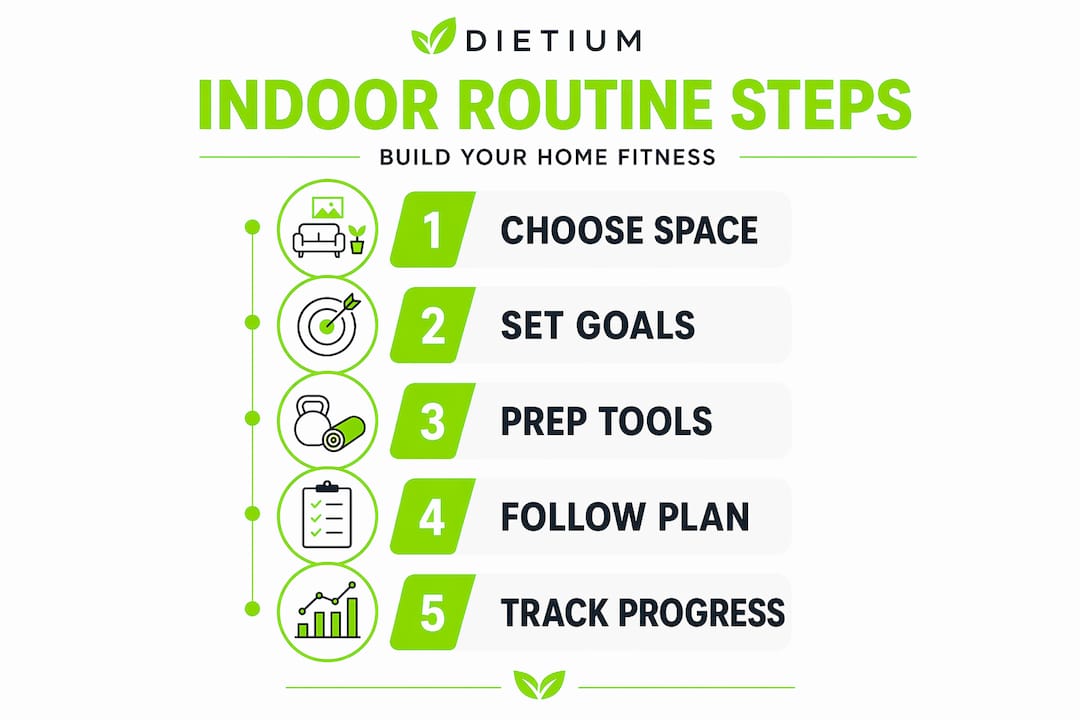
Aerobic activities don’t require a treadmill. Walking in place at a brisk pace, dancing to music, jogging through your hallway, or following an aerobic video all count toward your weekly minutes. The key metric is intensity: moderate means you can hold a conversation but feel your heart rate and breathing increase noticeably.
Muscle-strengthening is the other half of the equation. Bodyweight squats, push-ups, lunges, glute bridges, and rows using a towel and a door all engage the major muscle groups: legs, hips, back, core, chest, shoulders, and arms. You don’t need a barbell to hit every one of these. For beginner workout guidance, focus on mastering movement quality before chasing volume.
A few core principles make indoor workouts work:
- Consistency beats intensity. Three moderate sessions per week outperform one grueling session followed by five days of soreness.
- Gradual progression prevents plateaus. Increase reps, sets, or difficulty every one to two weeks.
- Rest is structured, not skipped. Short recovery intervals maintain intensity without overloading your joints.
- Variety supports full-body development. Rotate between push, pull, hinge, squat, and carry patterns across the week.
If you’re starting exercise motivation tips, focusing on a realistic, short routine in the first two weeks builds the habit before you scale up. Creating sustainable routines is what separates people who stay active for years from those who sprint for three weeks and quit.
Now that you understand health guidelines, let’s explore how to prepare your space and plan for effective indoor workouts.
Preparing your space and tools for effective indoor workouts
You don’t need a dedicated home gym. You need a clear, safe space roughly 6 feet by 6 feet, which is enough for a full-body mat workout, a standing circuit, and most high-intensity moves. Move furniture back, check for low ceilings on jumping exercises, and keep the floor surface in mind: bare hardwood works for most moves, but a yoga mat adds grip and joint protection.
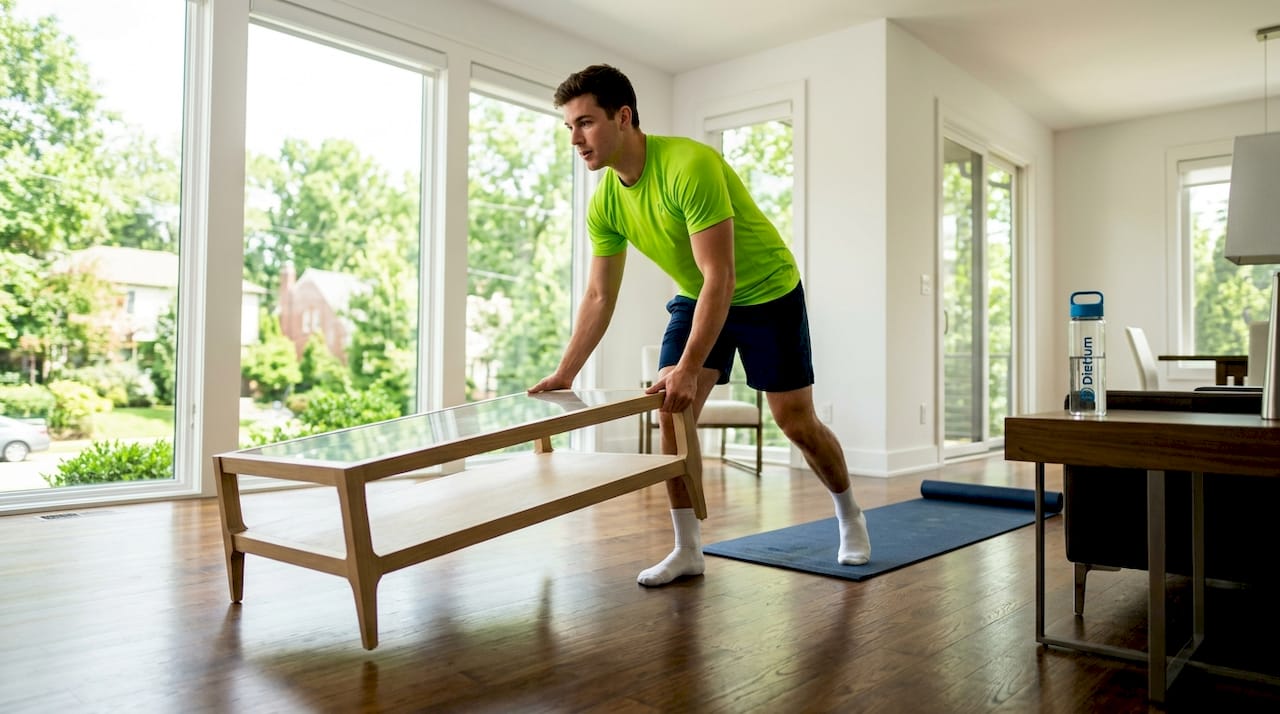
No-equipment routines can be highly effective when structured with intervals and rounds that maximize both space and time. The interval structure matters as much as the exercises themselves.
Minimal gear that genuinely helps:
- Exercise mat: Reduces impact on wrists, knees, and hips during floor work
- Resistance bands: Add load to squats, rows, and presses without weights
- A sturdy chair: Useful for step-ups, tricep dips, and seated core work
- Water bottle: Hydration affects performance more than most people realize; keep it within reach
Common home workout pitfalls and how to avoid them:
- Starting too hard too fast and burning out by week two
- Skipping warm-ups and increasing injury risk
- Treating “home workout” as optional on busy days
- Using inconsistent intervals that let intensity drift
Pro Tip: Set up your workout space the night before. Lay out your mat, fill your water bottle, and place your workout plan where you’ll see it. Reducing setup friction increases the chances you’ll actually start.
| Equipment item | Cost range | Primary benefit | Necessity |
|---|---|---|---|
| Exercise mat | $15 to $40 | Joint protection, floor work | Recommended |
| Resistance bands set | $10 to $30 | Load variation, upper body | Optional |
| Sturdy chair | Already owned | Step-ups, dips, support | Useful |
| Jump rope | $10 to $20 | Cardio intensity spike | Optional |
| Foam roller | $15 to $35 | Recovery, mobility | Recommended |
Follow workout habit templates to build your weekly schedule before you start filling it with exercises. The structure comes first, then the content. You’ll also find practical guides on staying active at home and effective home workout methods that complement your setup.
With your space ready, let’s dive into designing and executing indoor workout routines tailored to your goals.
Executing structured indoor workout routines for strength and cardio
A well-designed session follows a clear sequence: warm-up, working sets, and a brief cooldown. Each component serves a purpose, and skipping any one of them reduces results over time.
Follow this structure for a complete session:
- Warm-up (5 minutes): Arm circles, leg swings, hip rotations, and light marching in place. Raise your heart rate gradually and lubricate your joints before loading them.
- Circuit block 1 (aerobic focus): Jumping jacks, high knees, or shadow boxing. Use 45 seconds work and 15 seconds rest repeated across 4 sets to cover whole-body movements efficiently.
- Circuit block 2 (strength focus): Push-ups, bodyweight squats, reverse lunges, and glute bridges. Same interval structure applies. Major muscle groups should be targeted at least twice weekly with consistent progression.
- Core finisher (3 to 5 minutes): Plank holds, dead bugs, and bird-dogs to close each session.
- Cooldown (3 minutes): Static stretches for hip flexors, hamstrings, and chest. Lowers heart rate and maintains flexibility.
Pro Tip: If you can’t do a standard push-up yet, elevate your hands on a chair or wall. If the standard version feels too easy, slow the descent to 3 to 4 seconds. Both approaches change the difficulty without adding equipment. See beginner effective workouts for more modification options.
Use this table to match your routine to your primary goal:
| Routine type | Cardio ratio | Strength ratio | Example exercises | Session length |
|---|---|---|---|---|
| Cardio-focused | 70% | 30% | Jumping jacks, high knees, burpees, mountain climbers | 25 to 30 min |
| Strength-focused | 30% | 70% | Push-ups, squats, lunges, glute bridges, rows | 30 to 40 min |
| Hybrid (best for most) | 50% | 50% | Circuit alternating aerobic and strength moves | 30 to 45 min |
| High intensity home workout | 60% | 40% | Burpees, squat jumps, push-up variations, sprints | 20 to 25 min |
| Recovery session | 20% | 80% (low load) | Yoga flows, slow bodyweight work, mobility drills | 20 to 30 min |
The hybrid approach works well for most health-conscious individuals because it builds both cardiovascular fitness and muscular strength simultaneously. For strength training basics, understand that even bodyweight training produces measurable strength gains when load is applied progressively.
Once you’re familiar with routine execution, let’s explore how to track and progress your workouts for lasting results.
Tracking progress and adapting indoor routines for continued gains
Progress stalls when you stop challenging your body. Progressive overload means consistently increasing load, reps, sets, or exercise difficulty to avoid adaptation plateaus. Indoors, where you can’t simply add another plate to a barbell, this requires more creative thinking.
Practical strategies to apply progressive overload indoors:
- Increase reps: Move from 10 to 12 to 15 reps of squats before changing to a harder variation.
- Add sets: Go from 3 sets to 4 sets of each exercise in your circuit.
- Change tempo: Slow the lowering phase (eccentric) of any exercise from 1 second to 3 to 4 seconds.
- Shift leverage: Elevate feet for push-ups, progress to single-leg squats, or try archer push-ups.
- Reduce rest time: Cutting rest from 20 seconds to 10 seconds raises intensity without changing exercises.
Pro Tip: Keep a simple workout log, even a plain notes app on your phone. Record each exercise, reps completed, and a one-word effort rating (easy, moderate, hard). Review it every two weeks and adjust. Tracking fitness progress consistently is one of the highest-impact habits you can build.
Signs of a plateau to watch for:
- No increase in reps or sets over two to three weeks
- Workouts feel significantly easier without intentional changes
- Muscle soreness disappears entirely and never returns after sessions
- Motivation drops without an obvious lifestyle cause
When you spot these signs, change at least one variable in your routine. Swap a familiar exercise for a harder variation, add a new circuit block, or change your weekly schedule. Improving physical fitness naturally often requires these small but deliberate adjustments more than dramatic overhauls.
With progress tracking in place, let’s examine some deeper truths about indoor workouts that most people don’t discuss.
The overlooked truths about indoor workout routines
Most people don’t fail at indoor workouts because of poor exercises. They fail because they repeat the same routine for months without changing a single variable, and then wonder why results stopped. This is the most common pattern.
The fitness industry often promotes complexity: elaborate programs, multi-week periodization cycles, and equipment-heavy plans. For home-based training, this creates a paradox. The more complex the plan, the harder it is to follow consistently. The best resistance training program is the one you actually stick with. That statement sounds simple, but most people chase “optimal” at the expense of “done.”
There’s also a widespread belief that bodyweight training hits a ceiling quickly. It doesn’t. Single-leg squats, pike push-ups, push-up to side plank progressions, and similar leverage-based movements challenge advanced athletes. The ceiling is much higher than people assume. What limits most indoor exercisers is not a lack of equipment but a failure to progress the movements they already know. Revisiting strength training fundamentals often unlocks new progression paths people didn’t know existed.
Rest quality between sets also deserves attention. At home, distractions (a phone notification, a pet, a family member) eat into rest intervals. That shortens or extends your recovery inconsistently, which degrades workout quality over time. Treating rest as a deliberate, timed interval, not a passive pause, keeps your session structured and your intensity honest.
Simple, consistent routines built around your real schedule will always outperform complex plans that don’t survive contact with your actual life.
Enhance your indoor fitness with personalized nutrition plans
Indoor workout routines build your fitness base, but nutrition determines how fast you recover, build strength, and reach your body composition goals. What you eat before and after each session directly affects your energy, muscle repair, and long-term results.
At Dietium, personalized diet plans are built around your specific goals, activity level, and lifestyle. Whether you’re training for fat loss, muscle gain, or general health, personalized meal plans take the guesswork out of fueling your workouts correctly. Pair your home exercise plan with nutrition that matches your output, and you’ll see results that training alone can’t deliver. Use Dietium’s tools to track health and fitness progress holistically, combining workout metrics with nutrition data for a full picture of your progress.
Frequently asked questions
How much indoor exercise should I do weekly to maintain health?
Aim for 150 minutes per week of moderate aerobic activity, plus muscle-strengthening exercises on two or more days, to meet standard health guidelines. Both targets are fully achievable with structured indoor routines.
Do I need special equipment for effective indoor workout routines?
No. No-equipment indoor workouts using bodyweight exercises and timed intervals are effective for building total-body strength and cardiovascular fitness. A mat and a small clear space are all you genuinely need to start.
How can I progress my indoor workouts if I don’t have weights?
Increase reps, sets, tempo, or shift to harder leverage variations like single-leg squats and archer push-ups to apply progressive overload without any added equipment.
What’s the key to sticking with an indoor exercise routine?
Choose a simple plan that fits your schedule and preferences because, as ACSM guidelines confirm, consistency beats complexity for long-term results. A routine you complete three times a week beats a perfect program you abandon after two.
Can I combine indoor workouts with diet plans for better results?
Yes. Combining personalized nutrition with structured indoor workout routines accelerates both recovery and progress toward fitness goals. Aligning your calorie and macronutrient intake with your training demands produces measurably better outcomes than either approach alone.


