 Skip to content

TL;DR:
- Many health professionals find dietary assessment tools confusing, leading individuals to select inaccurate methods. These methods vary in precision, effort, and context, and no single approach perfectly measures individual intake. Building consistent awareness through appropriate tools allows for better personal nutrition management despite inherent limitations.
Even many trained health professionals struggle to select the right dietary assessment tool for their specific needs, which means everyday health-conscious individuals often feel completely lost when confronted with options like 24-hour recalls, food frequency questionnaires, or biomarker panels. The reality is that dietary assessment methods are foundational to personalized nutrition. Choose the wrong tool, and you end up with inaccurate data that leads to poor decisions about what to eat. This guide breaks down each method clearly, compares their strengths and weaknesses honestly, and shows you exactly how to apply them to your personal wellness goals.
Table of Contents
- Overview of key dietary assessment methods
- Strengths and weaknesses: comparing method types
- The rise of objective biomarkers in dietary assessment
- Applying dietary assessment in practice: surveys, documentation, and personal tracking
- Why no single method is perfect: a fresh perspective on personal nutrition
- Find your ideal dietary assessment toolkit with Dietium
- Frequently asked questions
Key Takeaways
| Point | Details |
|---|---|
| Multiple methods needed | No single dietary assessment tool covers all needs; combining approaches improves accuracy. |
| Validation matters | A method’s credibility depends on how it is validated and compared, so check reference techniques. |
| Biomarkers enhance objectivity | Biomarker panels can strengthen dietary validation but are not a complete replacement for self-report tools. |
| Documentation is essential | For reliable analysis and tracking, always review method documentation, especially in survey research. |
| Personalization drives success | Effective nutrition comes from tailoring assessment methods to your goals and lifestyle, not following trends. |
Overview of key dietary assessment methods
Now that you understand why dietary assessment can be confusing, let’s break down the main methods and their roles in nutrition.
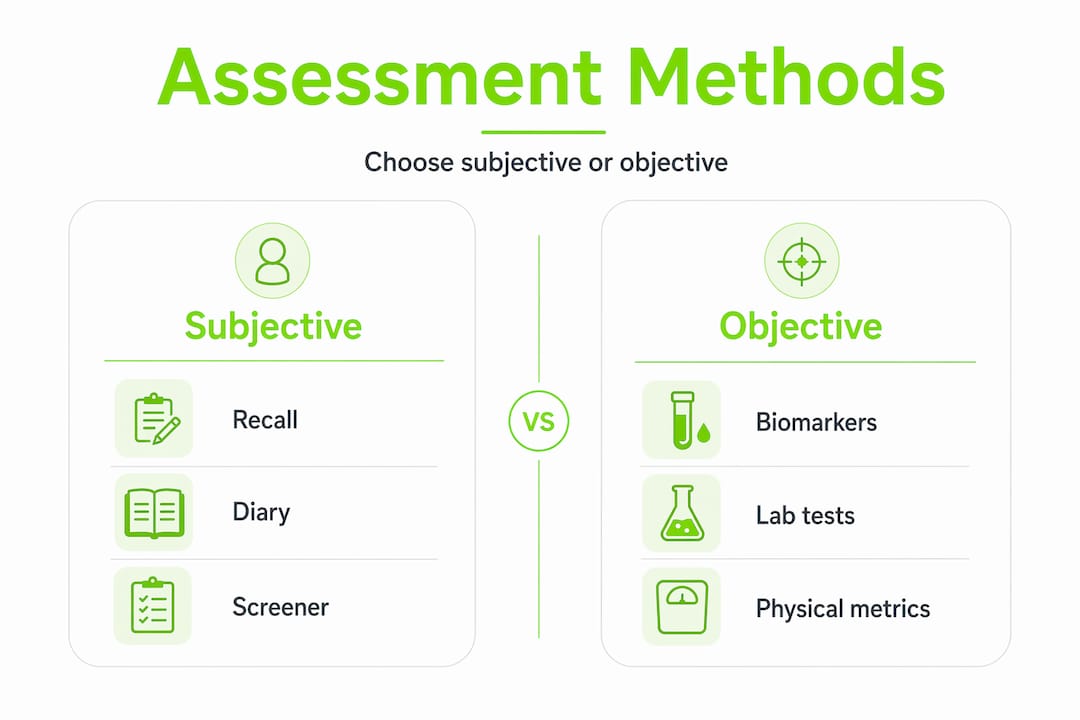
Common dietary assessment methods in nutrition research include 24-hour diet recalls, food records (also called food diaries), food frequency questionnaires (FFQ), and diet history. Each one captures dietary intake differently, making them suitable for different goals. Understanding their structure is the first step toward choosing the right fit for you.
You can explore a broader nutritional assessment overview to see how these tools fit into the wider picture of health and body composition monitoring.
Here is a quick breakdown of the four core methods:
- 24-hour recall: A trained interviewer (or digital tool) asks you to recall everything you ate and drank over the previous 24 hours. It captures detail but relies entirely on memory.
- Food diary (food record): You record everything you consume in real time over several days. It removes memory errors but can change eating behavior since you know you’re being watched.
- Food frequency questionnaire (FFQ): A structured survey asking how often you consume specific foods over a set period, usually weeks or months. Great for spotting patterns, less accurate for exact quantities.
- Diet history: An in-depth interview covering usual eating habits, meal patterns, and food preparation methods over a longer timeframe. Highly informative but time-intensive.
| Method | Type | Recall period | Best use case |
|---|---|---|---|
| 24-hour recall | Subjective | 1 day | Population studies, quick snapshots |
| Food diary | Subjective | 3 to 7 days | Detailed personal tracking |
| FFQ | Subjective | Weeks to months | Habit and frequency patterns |
| Diet history | Subjective | Long-term usual intake | Clinical assessment, in-depth review |
| Biomarkers | Objective | Varies by marker | Validation, research settings |
Each method sits on a spectrum from quick and accessible to detailed and demanding. The right choice depends on how much precision you need and how much time you’re willing to invest.
Strengths and weaknesses: comparing method types
Defining the methods is helpful, but understanding their strengths and weaknesses is key to choosing what works for you.
Short dietary assessment instruments (often called “screeners”) are useful when you don’t need to assess the total diet in detail. They sacrifice quantitative accuracy compared to more detailed methods, making them better suited for broad comparisons than for personalized nutrition planning. If you’re trying to understand whether you’re getting enough vitamin D or iron, a screener alone won’t cut it.
The more detailed tools (recalls and diaries) offer greater precision but come with their own problems. Recall bias is a major one. Most people underreport calorie-dense foods and overreport healthful ones. Food diaries reduce this bias somewhat, but they introduce a different issue: recording behavior often changes behavior, meaning the diary period may not reflect your true typical intake.

Here is a structured comparison of strengths and weaknesses:
| Method | Key strengths | Key weaknesses |
|---|---|---|
| 24-hour recall | Fast, detailed, low burden | Single-day snapshot, memory reliance |
| Food diary | Real-time accuracy, multi-day view | Behavior change, respondent burden |
| FFQ | Captures usual frequency, scalable | Lower quantitative accuracy |
| Diet history | Rich contextual data | Time-intensive, requires skilled interviewer |
| Screeners | Quick, low cost | Limited precision, not for individual use |
FFQs come with a particularly important caveat. Validation studies comparing FFQs to other self-reported methods can inflate apparent validity because both tools share the same types of measurement error. This is a critical concept: if you validate one flawed self-report tool against another flawed self-report tool, you’re not measuring truth, you’re measuring agreement between two imperfect systems.
Pro Tip: Always check what reference method a validation study used before trusting its conclusions. If an FFQ was validated only against another food diary and not against biomarkers, its accuracy claims may be overstated.
When monitoring specific nutrients, the choice of method matters even more. Detailed records work better for monitoring micronutrient intake than screeners, and food diary benefits extend beyond just calorie counting to identifying meal timing patterns and portion size trends.
If you’re managing specific health conditions or nutrient needs, consider looking at a multivitamin comparison guide alongside your dietary data for a fuller picture of where gaps might exist.
The rise of objective biomarkers in dietary assessment
Once you’ve weighed subjective methods, let’s look at the objective alternatives. Biomarkers can bring added confidence to your dietary assessment by providing data that doesn’t depend on memory or honest self-reporting.
Objective biomarker approaches are increasingly used to mitigate self-report misclassification. However, there is no single consensus set of best urinary metabolite markers across all diets and foods. This means biomarker panels are powerful but not plug-and-play solutions for everyday users.
The most commonly used biomarkers in dietary research include:
- Urinary sodium: Reflects actual sodium intake over 24 hours, making it one of the most reliable dietary biomarkers available.
- Urinary potassium: Tracks potassium consumption with reasonable accuracy, useful for cardiovascular and kidney health research.
- Doubly labeled water (DLW): Considered the gold standard for measuring total energy expenditure and calorie intake over 1 to 3 weeks. Expensive and not practical for everyday use.
- Urinary nitrogen (urea-derived): Estimates protein intake by measuring nitrogen excretion, since protein is the primary dietary nitrogen source.
In validation settings, urinary excretion biomarkers such as sodium, potassium, and nitrogen-derived protein are used as objective recovery references to compare the performance of self-reported methods. This process helps researchers understand how far off a food diary or FFQ is compared to biological reality.
Biomarkers are not a replacement for self-reported dietary tools. They are a calibration mechanism. Most people will never use doubly labeled water in their daily wellness routine, but understanding that these objective measures exist helps you appreciate why your tracking app data may carry a margin of error.
For most people outside of clinical or research settings, biomarkers are aspirational references rather than practical daily tools. That said, knowing they exist helps you understand why tracking food intake matters and how to interpret the data you collect. For deeper insight on interpreting what you track, review structured nutritional analysis methods that align subjective records with measurable health outcomes.
Applying dietary assessment in practice: surveys, documentation, and personal tracking
After uncovering both subjective and objective approaches, it’s time to bring assessment methods into everyday practice, both at the national level and in your personal wellness routine.
At the population level, large surveys like NHANES (National Health and Nutrition Examination Survey) and WWEIA (What We Eat in America) use validated 24-hour recalls to track national food consumption trends. These dietary assessment tools provide both documentation and guidance about how intake data were collected, and experts recommend careful review of that documentation when analyzing changes over time. This level of rigor is why national dietary guidelines can confidently recommend specific nutrient targets.
Population-level dietary surveillance across U.S. surveys differs in methods across data collection days and time periods. Analysts often restrict comparisons to comparable subsets to reduce bias, a lesson that applies equally to personal tracking. If you use a food diary for two weeks in January and then again in August, seasonal food availability may make those periods hard to compare directly.
For personal tracking, a structured approach dramatically improves data quality. Follow these steps to build a practical dietary assessment routine:
- Define your goal first. Are you tracking to lose weight, improve energy, identify food sensitivities, or meet micronutrient targets? Your goal determines which method fits best.
- Select your primary method. For habit patterns, try an FFQ style self-assessment. For detailed daily tracking, use a food diary or digital logging app.
- Record context alongside food. Note portion sizes, meal timing, preparation methods, and even your hunger level or emotional state. This context transforms raw data into actionable insight.
- Commit to a consistent tracking window. Three to seven non-consecutive days including at least one weekend day gives a more representative picture of usual intake than consecutive weekdays alone.
- Review and act on your data. Collecting data without reviewing it is wasted effort. Look for patterns weekly and adjust one variable at a time.
Pro Tip: When tracking, always record context, portion sizes, and timing for higher-quality data. A meal logged as “chicken salad” is far less useful than “grilled chicken breast, 4 oz, mixed greens, olive oil dressing, 2 tbsp, lunch, 12:30 PM.”
Pairing your dietary records with body composition metrics creates a richer wellness picture. Use health calculators for wellness to track BMI, body fat percentage, and calorie needs alongside your food data. Adding body composition tracking gives you a feedback loop that links what you eat to measurable physical outcomes over time.
Why no single method is perfect: a fresh perspective on personal nutrition
Bringing all these practical steps together reveals a truth most nutrition guides overlook: perfect dietary assessment does not exist, and chasing it can actually undermine your progress.
Here’s the uncomfortable reality. Even the most rigorously validated tools are population-level instruments first. A food frequency questionnaire validated on 5,000 adults may be reliable for identifying broad dietary patterns in that group. But you are not a group average. Your metabolism, food preferences, cultural eating patterns, and even gut microbiome create an individual context that no standardized tool fully captures.
This matters because many people, after learning about measurement error and recall bias, conclude that tracking is pointless. That’s the wrong takeaway. The value of dietary assessment isn’t achieving perfect accuracy. It’s building self-awareness and establishing a consistent feedback loop. A food diary that captures 85% of your actual intake accurately, used consistently for four weeks, will reveal more about your eating habits than a perfectly calibrated 24-hour recall done once.
Biomarker panels can add rigor to this process, but practical constraints limit their everyday use for most individuals. Doubly labeled water costs hundreds of dollars per measurement and requires laboratory analysis. Urinary nitrogen tests require 24-hour urine collection, which is not a casual wellness activity. For everyday users, these tools exist as benchmarks, not daily practices.
The real art of dietary assessment is matching the method to your specific goal and context. If you want to understand your general eating patterns, an FFQ or a structured weekly food log is sufficient. If you’re managing a specific health condition that requires precise macronutrient tracking, a detailed daily food diary with verified portion sizes is the right choice. If you’re in a clinical program, biomarker testing may be appropriate.
Pro Tip: Prioritize consistency and actionable interpretation over perfection. An imperfect record reviewed and acted on weekly outperforms a perfect record never analyzed.
Revisit your nutritional assessment overview periodically as your goals evolve. The method that served you well during a weight loss phase may not be the right fit when you shift focus to athletic performance or long-term disease prevention.
Find your ideal dietary assessment toolkit with Dietium
Now that you have clarity on dietary assessment options, Dietium offers a practical bridge between knowledge and action. Dietium’s platform combines AI-powered calculators, personalized meal planning, and nutrition tracking tools that align directly with the methods covered in this guide. You can personalize your diet based on your specific health goals, then track progress using structured tools built around evidence-based nutrition. Explore detailed nutritional assessment methods through Dietium’s educational content, and use the Recipians app for custom meal plans and macros that reflect your assessed dietary needs. Start with meal plan personalization to put your dietary assessment insights into practice immediately.
Frequently asked questions
How do I choose between a 24-hour recall and a food diary?
If you want detailed accuracy for a specific day, use a 24-hour recall; for tracking habits over time, a food diary is more effective because it captures patterns across multiple days.
Are dietary screeners reliable for detailed personalized nutrition?
Dietary screeners sacrifice quantitative accuracy compared to detailed methods, making them best for broad comparisons or population studies rather than precise personal nutrition planning.
Can dietary biomarkers fully replace self-reported methods?
Biomarker approaches lack consensus for best marker panels across all nutrients and foods, so they complement and validate self-reported methods rather than replacing them entirely.
How do large dietary surveys manage measurement differences?
National surveys provide documentation and guidance for intake data collection, and analysts recommend restricting comparisons to comparable subsets to reduce bias from methodological changes over time.
What is the main limitation of FFQ validation studies?
FFQ validation compared against other self-reported instruments can inflate apparent validity because both tools share the same error structures, making agreement look stronger than actual accuracy against objective measures.


