 Skip to content

TL;DR:
- Understanding the structure of Nutrition Facts panels enables consumers to make more informed and healthier food choices. By focusing on key elements such as serving size, calories, and nutrients to limit or seek, shoppers can quickly evaluate products against their dietary goals. Recognizing common label tricks and verifying information ensures accurate interpretation, empowering individuals to select foods aligned with their personal health priorities.
Picking up a packaged food and feeling genuinely confident about what you’re choosing is harder than it should be. Labels are dense, the terminology shifts product to product, and marketing claims on the front of the package rarely match the reality on the back. The good news: once you understand the structure of a Nutrition Facts panel, you can cut through the noise quickly. This guide walks you through every critical element, from serving sizes to added sugars, so your next grocery run is guided by real data rather than clever packaging.
Table of Contents
- What you need before you start: key label elements and tools
- Step-by-step: How to interpret the Nutrition Facts panel
- Common mistakes and label traps to avoid
- Double-checking and verifying label accuracy
- The uncomfortable truth: reading labels is useful—but only if you know your personal priorities
- Ready to make it easier? Tools and guides for personalized healthy eating
- Frequently asked questions
Key Takeaways
| Point | Details |
|---|---|
| Serving size is key | All nutrition label numbers depend on the serving size listed, so adjust based on your actual portion. |
| % Daily Value shortcuts | Use %DV to quickly judge if a food is high or low in nutrients you want to seek or avoid. |
| Watch out for label traps | Some foods use misleading small servings or ‘zero’ claims that don’t match what you really eat. |
| Personalize your focus | Decide which nutrients matter most for your goals and prioritize tracking those when reading labels. |
What you need before you start: key label elements and tools
Before you evaluate a single product, you need a baseline understanding of what a Nutrition Facts label is legally required to include. In the United States, the FDA mandates that all packaged foods display specific information in a standardized format. Knowing that structure saves you time and prevents confusion.
Every compliant label must display:
- Serving size and servings per container
- Calories per serving
- Total fat, saturated fat, and trans fat
- Cholesterol and sodium
- Total carbohydrates, dietary fiber, and total sugars (including added sugars)
- Protein
- Vitamin D, calcium, iron, and potassium
- % Daily Value (%DV) for applicable nutrients
Understanding reading nutrition labels starts with recognizing that all numbers on the label are calculated per serving, not per package. As the American Heart Association notes, nutrition values are based on the label’s serving size and servings-per-container; if you eat more than one serving, you must scale calories and nutrients upward. That bag of chips with “2.5 servings” is not one snack portion for most people.
A quick tool you already own makes this easier: your smartphone. Use the calculator app to multiply per-serving values by the number of servings you actually consume. Several label scanner apps also exist that pull up full nutrition data with a barcode scan. These are especially useful when comparing two similar products side by side in-store.
Prioritizing what to act on is equally important. University of Georgia Extension research confirms that calories work as a quick energy guide, but specific nutrients drive healthier choices. The priority nutrients to limit include saturated fat, trans fat, cholesterol, sodium, and added sugars. The nutrients to prioritize getting enough of include vitamin D, calcium, iron, and potassium. Building your quality ingredient selection insights around this framework keeps the decision simple.
| Label category | What it tells you | Why it matters |
|---|---|---|
| Serving size | The reference amount for all data | Prevents undercounting calories or nutrients |
| Calories | Energy per serving | Supports weight management goals |
| % Daily Value | Nutrient contribution to daily diet | Fast filter for high or low nutrient content |
| Nutrients to limit | Saturated fat, sodium, added sugars | Reduces chronic disease risk |
| Nutrients to prioritize | Fiber, vitamin D, calcium, iron, potassium | Supports long-term health |
Pro Tip: The very first thing to check on any label is the serving size. Every other number becomes meaningless if you don’t know how many servings you’re actually eating.
Step-by-step: How to interpret the Nutrition Facts panel
Once you’re familiar with the label structure, let’s walk through turning that knowledge into actionable steps when you shop.
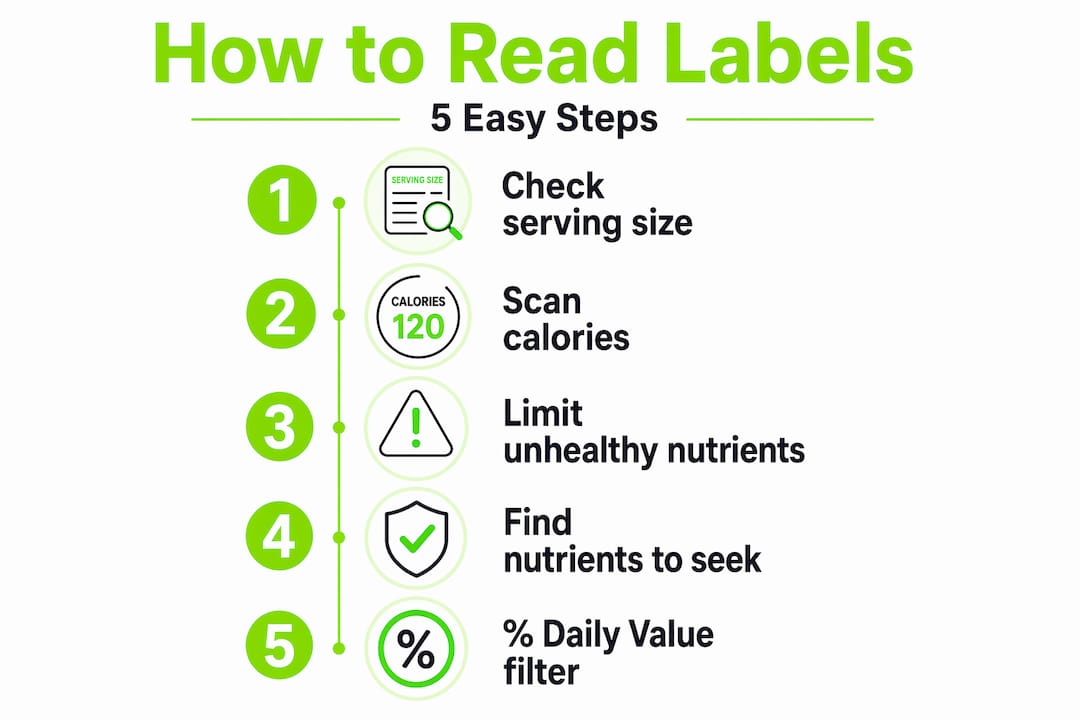
Step 1: Check the serving size first. Identify the stated serving size and the number of servings per container. Multiply accordingly if you eat more than one serving. A 200-calorie muffin listed as “2 servings” is actually a 400-calorie snack for most people.
Step 2: Assess calorie density relative to your goals. Calorie content gives you a fast screen. Foods under 100 calories per serving tend to be lighter options; over 400 per serving signals something more calorie-dense. Neither is inherently wrong, but the number sets context.
Step 3: Review nutrients to limit. Scan saturated fat, sodium, and added sugars. If any of these are high relative to their %DV, note it. These nutrients are directly linked to elevated risks for cardiovascular disease, high blood pressure, and blood sugar dysregulation.

Step 4: Check nutrients to seek. Fiber, potassium, calcium, iron, and vitamin D are commonly under-consumed in the American diet. A product with meaningful %DV contributions in these areas adds genuine nutritional value.
Step 5: Use the % Daily Value column as a fast filter. The %DV column helps interpret nutrient amounts in context of a daily diet; a serving with higher %DV contributes more to the daily reference intake than a serving with lower %DV. The general benchmark is clear: 5% or below is low, 20% or above is high.
Step 6: Read the added sugars line closely. The FDA requires a dedicated line for this. Per FDA guidance, “includes” indicates added sugars are within the total sugars count, and the label provides both grams and %DV for added sugars. Understanding the difference between naturally occurring sugars (from fruit or dairy) and added sugars (from processing) matters significantly for blood sugar management. Explore natural vs added sugars to build a clearer picture.
Below is a practical comparison of two granola bars that look similar on the front label:
| Attribute | Bar A | Bar B |
|---|---|---|
| Serving size | 1 bar (40g) | 1 bar (40g) |
| Calories | 180 | 160 |
| Saturated fat | 3g (15% DV) | 0.5g (3% DV) |
| Total sugars | 12g | 10g |
| Added sugars | 10g (20% DV) | 2g (4% DV) |
| Dietary fiber | 1g (4% DV) | 4g (14% DV) |
| Sodium | 180mg (8% DV) | 80mg (3% DV) |
Bar B is the clearer nutritional win. Lower added sugars, more fiber, significantly less saturated fat and sodium. Without reading the label, both bars might appear identical based on front-of-package claims like “Made with whole grains.”
For smart whole foods shopping, this kind of comparison is something you can repeat quickly once you’ve practiced the steps a few times. Start applying it to your most frequent purchases and your healthy grocery shopping routine will sharpen fast.
Pro Tip: Scan %DV for your personal goals first. If you’re managing blood pressure, zero in on sodium. If you’re focused on blood sugar, prioritize added sugars and fiber %DV.
Common mistakes and label traps to avoid
Even with the best intentions, it’s easy to fall for common label tricks. Here’s what to watch for to keep your choices genuinely healthy.
The “0g trans fat” trap. This is one of the most common misreadings. The FDA allows manufacturers to round down to zero if a product contains less than 0.5g of trans fat per serving. As the Heart Association clarifies, trans fat may not be obvious from the “0g trans fat” number alone because label values are per serving; if you eat more than one serving, even small per-serving amounts add up. Always check the ingredient list for “partially hydrogenated oils,” which signal trans fat presence.
Hidden added sugars under different names. Sugar appears on ingredient lists under more than 60 different names, including high-fructose corn syrup, cane juice, dextrose, maltose, and agave nectar. Ingredients are listed in descending order by weight. If sugar (under any name) appears in the top three ingredients, the product is high in added sugars regardless of how it’s marketed.
Small serving size illusion. Some products use unrealistically small serving sizes to make calorie and nutrient counts appear low. A “serving” of certain cooking sauces or condiments might be listed as one tablespoon, while a typical real-world use is three to four tablespoons. Always ask: how much of this do I actually eat in one sitting?
“Natural,” “organic,” and “light” claims on the front. These terms are loosely regulated and do not guarantee low calories, low sugar, or superior nutrition. “Organic” refers to farming practices, not nutrient quality. “Natural” has no strict legal definition under current FDA rules. “Light” can refer to color, texture, or flavor, not necessarily calorie content.
Trans fat may not be obvious from the “0g” line. Read the serving size and ingredient list for the full story.
When eating out smart, the same rules apply. Restaurant nutrition information, where available, uses similar per-serving frameworks that can mislead if you’re not calculating total intake.
Pro Tip: Multiply every per-serving number by the number of servings you actually eat before deciding if a product fits your goals. This single habit eliminates most label misreadings.
Double-checking and verifying label accuracy
After learning the basics and common pitfalls, you’ll want to feel confident that what you see on a label matches what you’re really eating. Here’s how to verify your choices.
An important reality: nutrition labels are estimates. NIST (National Institute of Standards and Technology) reports that measurement accuracy can vary by nutrient and context. You should treat the Nutrition Facts panel as accurate for what the label claims, but small variations are built into the system.
| Nutrient category | Typical accuracy range | Key consideration |
|---|---|---|
| Macronutrients (fat, protein, carbs) | Within 5-10% | Reasonable for general tracking |
| Calories | Within 5-10% | Rounding rules can affect totals |
| Vitamins (A, C, D) | Within 10-20% | Vary more due to stability and testing methods |
| Minerals (calcium, iron) | Within 5-15% | Generally reliable for label purposes |
| Sodium | Within 5% | Highly consistent, regulated closely |
For most people managing everyday diet choices, these variances are acceptable. For individuals managing medical conditions like kidney disease, severe allergies, or strict therapeutic diets, closer verification becomes important.
Here’s how to cross-check and verify:
- Use official government databases. The USDA FoodData Central database allows you to look up nutrient profiles for thousands of foods, including many branded products.
- Check manufacturer websites or contact them directly. For allergen-specific questions, manufacturers are required to respond to consumer inquiries about ingredients and potential cross-contamination.
- Use evidence-based health apps and tools. Platforms that integrate verified nutrition databases provide a second layer of confirmation for label data.
- Consult a registered dietitian for medically sensitive cases. When health conditions require strict nutrient management, professional guidance ensures data is applied correctly.
Access additional essential nutrient reference material when building a more complete picture of what your body requires. Especially for special diets, that context shapes how you interpret label data. For eating on the go, verification resources help when package labels are your only available data point.
The uncomfortable truth: reading labels is useful—but only if you know your personal priorities
Here is the perspective most nutrition guides skip: label reading is a skill, but it’s only powerful when you pair it with self-knowledge. Most people scan for calories and maybe sugar, then make a call. That’s a reasonable start. But it’s also where the process stays shallow.
The real issue is that a Nutrition Facts panel doesn’t know whether you’re managing hypertension, recovering from a workout, avoiding gluten, or trying to increase your dietary iron intake. The label is generic. Your body and your goals are not.
Someone focused on heart health should weight their label reading toward sodium and saturated fat above all else. Someone building muscle through resistance training should prioritize protein per serving and overall calorie density. A person managing type 2 diabetes should center their attention on total carbohydrates, fiber, and added sugars. Each of these individuals is looking at the same label and extracting different critical information.
Nutrition labels are not a test to pass. They’re a tool to personalize your eating decisions.
Consider a practical example: two people standing in the same grocery aisle, both picking up the same high-protein yogurt. One person is managing sodium intake due to blood pressure concerns and notices the yogurt has 190mg of sodium per serving, which is 8% DV. That detail changes their choice. The other person, focused purely on building muscle, sees 20g of protein per serving and buys it without a second thought. Both responses are rational given individual priorities. Neither person is wrong.
This is why blanket advice like “avoid high sodium foods” or “choose low-fat options” can mislead. Context matters more than any single nutrient rule.
Pro Tip: Pick one or two nutrients that align directly with your current health goal and track those consistently. Don’t try to optimize every number on every label. Focus wins over perfection.
For practical support in identifying healthy recipes that already align with your priorities, you reduce the label-reading burden significantly. When meals are built around your goals from the start, label literacy becomes a verification tool rather than a decision-making burden.
Ready to make it easier? Tools and guides for personalized healthy eating
If you want to go beyond DIY label reading into a truly personalized, easy-to-follow meal plan, here’s how Dietium can help.
Dietium.com offers a full suite of tools designed to turn nutrition knowledge into consistent daily habits. The platform’s AI-powered calculators help you assess your calorie needs, track macros, and evaluate foods against your specific health goals, whether that’s weight loss, muscle gain, or managing a chronic condition. When you’re ready to move from label literacy to a structured approach, you can personalize your diet using data-driven tools that align recommendations with your real numbers. The Recipians app takes it further by providing custom meal plans and recipe suggestions already filtered for your nutritional priorities. Explore meal plan personalization to see how structured planning simplifies every grocery trip and reduces the guesswork that makes label reading feel overwhelming.
Frequently asked questions
How accurate are nutrition labels on packaged foods?
Nutrition label values are generally accurate within 2 to 15%, depending on the nutrient, though macronutrients and sodium tend to fall within tighter ranges than vitamins and minerals.
What does % Daily Value mean on a nutrition label?
The %DV shows how much a nutrient in one serving contributes to a standard 2,000-calorie daily diet, with 5% or less considered low and 20% or more considered high.
Why do serving sizes on labels matter so much?
All nutrition data on a label is calculated per stated serving size, meaning your actual intake of calories and nutrients changes proportionally based on how much you eat compared to that serving.
How can you spot added sugars on a nutrition label?
Added sugars appear as a dedicated sub-line under total sugars, formatted as “Includes Xg Added Sugars,” accompanied by their %DV, making them distinct from naturally occurring sugars in the product.


