 Skip to content

Over half of American adults admit they struggle to maintain a regular fitness routine. Setting clear goals and understanding your current abilities is often the difference between falling off track and seeing real progress. This guide takes you through practical steps to evaluate your fitness, set achievable targets, and build a sustainable plan so you can see steady results and feel your best.
Table of Contents
- Step 1: Assess Current Fitness And Set Goals
- Step 2: Design A Personalized Exercise Plan
- Step 3: Integrate Nutrition And Hydration Strategies
- Step 4: Track Progress With Fitness Tools
- Step 5: Adjust Routine Based On Results
Quick Summary
| Key Insight | Explanation |
|---|---|
| 1. Assess Your Fitness Baseline | Measure key metrics like pulse rate and push-ups to understand your current fitness level before starting a workout plan. |
| 2. Create a Personalized Exercise Plan | Develop a balanced fitness strategy that includes cardiovascular activity and strength training tailored to your preferences and capabilities. |
| 3. Focus on Nutrition and Hydration | Maintain a balanced diet rich in nutrients and hydrate regularly to support your fitness goals and overall performance. |
| 4. Track Your Progress Effectively | Use various tools such as apps and journals to monitor your fitness journey and adjust strategies based on measurable results. |
| 5. Stay Flexible and Adjust Regularly | Continuously evaluate and adapt your workout plan every six weeks to ensure you are making progress and addressing changing needs. |
Step 1: Assess Current Fitness and Set Goals
Knowing your baseline fitness level is critical for developing an effective and personalized fitness strategy. Before diving into any workout routine, you need to understand where you currently stand physically and create realistic goals that match your current capabilities.
To get started, you will want to perform a comprehensive fitness assessment that tracks several key metrics. The American Heart Association recommends recording specific benchmarks including pulse rate before and after walking one mile, total walking time, number of push-ups completed without rest, flexibility measurements, waist circumference, and body mass index (BMI). These data points provide a clear snapshot of your current physical condition and help you design targeted fitness objectives.
Pro tip: Be honest with yourself during this assessment. Do not compare your results to others or feel discouraged by where you are right now. Every fitness journey starts with understanding your unique starting point. The goal is progress, not perfection. By documenting these baseline measurements, you create a concrete reference point to track your improvements over time.
In the next step, we will explore how to transform these initial measurements into actionable fitness goals that motivate and challenge you without overwhelming your current fitness level.
Step 2: Design a Personalized Exercise Plan
Creating an effective fitness plan transforms your baseline measurements into a strategic roadmap for achieving your health goals. Your personalized exercise strategy should be comprehensive, balanced, and tailored specifically to your current fitness level and desired outcomes.

The Mayo Clinic recommends designing a fitness program that includes a minimum of 150 minutes of moderate aerobic activity per week, complemented by strength training exercises targeting all major muscle groups at least twice weekly. This balanced approach ensures you are developing overall fitness rather than focusing on a single aspect of physical health. Start by selecting activities you genuinely enjoy such as swimming, cycling, walking, or group fitness classes to increase the likelihood of maintaining your routine.
When structuring your exercise plan, begin with lower intensity workouts and progressively increase difficulty. This gradual approach helps prevent injury and allows your body to adapt to new physical demands. Consider incorporating a mix of cardiovascular exercises, resistance training, flexibility work, and rest days. Your plan should be flexible enough to accommodate your schedule while challenging enough to promote continuous improvement.
Pro tip: Schedule your workouts like important appointments. By treating exercise as a non negotiable commitment to yourself, you are more likely to stay consistent and see meaningful results. Remember that progress is not linear and some weeks will be more successful than others.
In the next step, we will explore how to track your progress and make necessary adjustments to keep your fitness journey engaging and effective.
Step 3: Integrate Nutrition and Hydration Strategies
Successful fitness journeys are built on a foundation of strategic nutrition and smart hydration practices. Your body requires precise fuel and consistent fluid intake to support your workout goals and optimize overall performance.
The American Heart Association emphasizes the importance of a balanced diet that includes fruits, vegetables, whole grains, lean proteins, and healthy fats while limiting added sugars, sodium, and saturated fats. Think of your nutrition plan as the premium fuel that powers your fitness engine. Aim to consume complex carbohydrates for sustained energy, lean proteins for muscle recovery, and nutrient dense foods that provide essential vitamins and minerals.
Hydration is equally critical to your fitness success. Drink water consistently throughout the day, not just during workouts. A good rule of thumb is to consume approximately half your body weight in ounces of water daily, increasing intake during intense exercise or in hot environments. Monitor your hydration by checking urine color aim for a light pale yellow which indicates proper fluid balance.
Pro tip: Prepare your nutrition and hydration strategy in advance. Meal prep containers, water bottles, and strategic snacking can transform your fitness approach from reactive to proactive. Remember that nutrition is not about perfection but consistent, mindful choices that support your body’s needs.
In the next step, we will explore how to implement your nutrition plan and make sustainable dietary adjustments that complement your fitness goals.
Step 4: Track Progress with Fitness Tools
Tracking your fitness journey transforms abstract goals into measurable achievements. Understanding how to effectively monitor your progress will help you stay motivated and make strategic adjustments to your fitness plan.
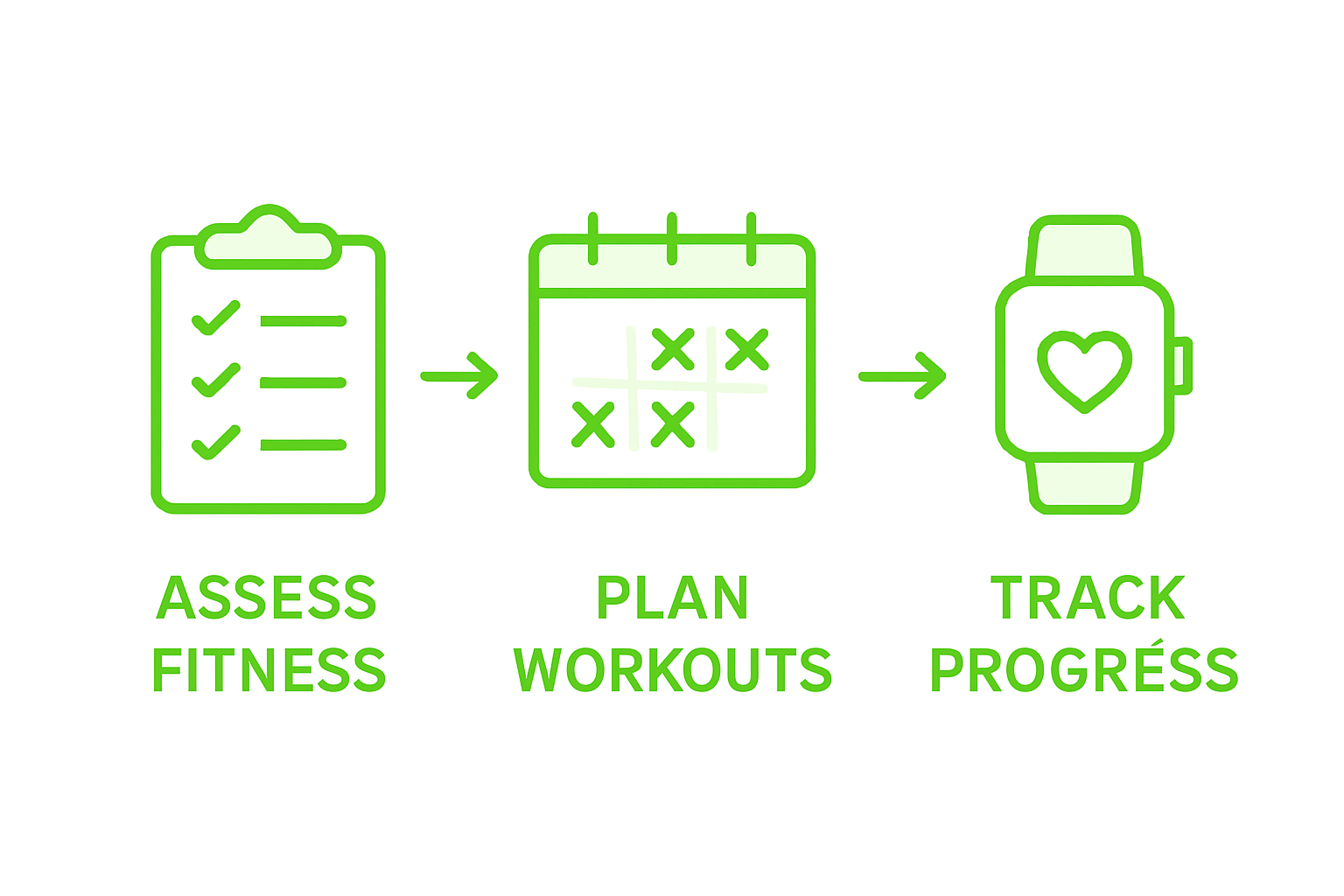
Action for Healthy Kids highlights the importance of fitness testing as a method to understand your physical strengths and identify areas for improvement. Choose multiple tracking methods that provide comprehensive insights into your fitness evolution. Consider using a combination of tools such as body measurement logs, performance journals, fitness apps, heart rate monitors, and progress photos to capture a holistic view of your transformation.
Digital tools can simplify progress tracking significantly. Smartphone apps and wearable fitness trackers allow you to record workout details, monitor calories burned, track running distances, and log strength training progressions. The key is consistency in recording your data and reviewing it regularly to understand your body’s responses to different exercise routines.
Pro tip: Create a weekly review ritual where you assess your progress. Look beyond just numbers and consider how you feel physically and mentally. Some of the most important progress indicators cannot be measured by technology but are experienced through increased energy, improved mood, and greater overall wellness.
In the next step, we will explore strategies for staying motivated and overcoming potential obstacles in your fitness journey.
Step 5: Adjust Routine Based on Results
Successful fitness journeys are dynamic and require continuous adaptation. Your initial workout plan is simply a starting point that will evolve as your body changes and your fitness capabilities improve.
The Mayo Clinic recommends assessing your fitness program every six weeks and making strategic adjustments to ensure ongoing progress. During these assessment periods, evaluate multiple dimensions of your fitness journey including workout performance, energy levels, physical measurements, and overall comfort with your current routine. Look for signs that indicate whether you need to increase intensity, modify exercise types, or potentially reduce workout complexity.
When analyzing your fitness results, pay attention to both quantitative and qualitative indicators. Quantitative metrics include weight changes, body measurements, strength improvements, and endurance benchmarks. Qualitative factors encompass how you feel during workouts, recovery time, motivation levels, and overall physical and mental well being. Some progression might be subtle yet significant such as improved workout recovery or increased daily energy.
Pro tip: Embrace flexibility in your fitness approach. Progress is rarely linear and what worked brilliantly last month might need refinement now. Your body is constantly adapting, so your workout routine should mirror that adaptability. Be willing to experiment and listen to your body’s signals.
In the final step, we will discuss strategies for maintaining long term motivation and creating a sustainable fitness lifestyle.
Take Control of Your Fitness Journey with Personalized Support
Improving physical fitness naturally requires a clear starting point, a well-designed exercise plan, smart nutrition, and continuous progress tracking—challenges highlighted throughout the step-by-step guide. If you find setting tailored goals, monitoring your metrics like BMI and body fat, or staying consistent with workouts difficult, you are not alone. These pain points can lead to frustration and stalled progress. That is why integrating technology and expert guidance is essential to maintaining motivation and seeing lasting results.
At Dietium.com, our advanced AI-powered Recipians app offers customized meal plans, workout routines, and precise tracking tools that transform these key concepts into actionable daily steps. Whether you need help aligning nutrition with your fitness objectives or want real-time insights into your body’s responses, our platform supports you at every stage. Don’t wait to make fitness manageable and sustainable—explore how you can start personalizing your health journey today by visiting Recipians. Empower yourself now to turn your baseline into breakthrough progress.
Frequently Asked Questions
How can I assess my current fitness level?
To assess your current fitness level, perform a comprehensive fitness assessment that includes measuring your pulse rate, recording your walking time for one mile, and tracking push-up counts, flexibility, waist circumference, and BMI. Start by documenting these metrics to understand where you currently stand in your fitness journey.
What should I include in my personalized exercise plan?
Your personalized exercise plan should include at least 150 minutes of moderate aerobic activity each week and strength training exercises for all major muscle groups at least twice weekly. Start with activities you enjoy and progressively increase the intensity to ensure continuous improvement.
How do I integrate nutrition into my fitness routine?
To integrate nutrition into your fitness routine, focus on consuming a balanced diet that includes fruits, vegetables, whole grains, lean proteins, and healthy fats. Prepare meals in advance to support your fitness goals and ensure you are fueling your body properly for workouts.
What tools can I use to track my fitness progress?
You can track your fitness progress using body measurement logs, performance journals, fitness apps, and wearable devices that monitor your workouts and physical changes. Choose at least three different tracking methods to obtain a comprehensive view of your fitness journey.
How often should I adjust my workout routine?
You should assess and adjust your workout routine every six weeks based on your performance and overall comfort. Evaluate both the quantitative metrics, like weight and strength, and qualitative indicators, such as your energy levels and motivation, to ensure your routine remains effective and engaging.
What steps can I take to stay motivated during my fitness journey?
To stay motivated during your fitness journey, schedule your workouts like important appointments and create a weekly review ritual to assess your progress. Celebrate small achievements to boost your motivation and remain open to making adjustments based on how you feel physically and mentally.


