 Skip to content

Just two 30-minute strength training sessions per week can slash your risk of premature death by up to 20%. Yet many beginners feel overwhelmed about where to start and why it matters beyond building muscle. This guide cuts through the confusion with clear science-backed basics, debunks common myths, and equips you with the knowledge to build a confident, effective strength training routine that transforms your health.
Table of Contents
- Introduction To Strength Training
- Basic Physiology And Mechanisms Of Strength Training
- Common Misconceptions About Strength Training
- Training Methods And Comparative Approaches
- Health Benefits And Impact On Longevity
- Practical Application And Getting Started
- Enhance Your Strength Training Journey With Dietium
- FAQ
Key Takeaways
| Point | Details |
|---|---|
| Mortality reduction | Regular strength training reduces premature death risk by up to 20% with just two weekly sessions. |
| Strength mechanisms | Muscle hypertrophy contributes over five times more to strength gains than neural adaptations alone. |
| Optimal frequency | Training 2 to 3 times weekly with rest days maximizes strength and recovery for beginners. |
| Training methods | Cluster training produces faster initial gains while traditional training sustains long term strength. |
| Metabolic boost | Each pound of muscle gained increases resting metabolic rate by 6 to 7 calories daily. |
Introduction to Strength Training
Strength training involves exercises that make your muscles work against external resistance like weights, bands, or your own body weight. Unlike general cardio that primarily targets your heart and lungs, strength training specifically challenges your muscles to grow stronger and larger. This makes it a cornerstone of health for every adult, regardless of age or fitness level.
Why does it matter so much? Beyond aesthetic changes, strength training fundamentally reshapes your body’s physiology. It builds muscle mass that burns calories even at rest, strengthens bones to prevent fractures, improves balance to reduce falls, and enhances metabolic health to fight diabetes and heart disease. The home workout essentials for beginners prove you don’t need a fancy gym to start reaping these benefits.
Research consistently shows that strength training delivers profound health improvements with minimal time investment. You’re targeting major muscle groups including legs (quadriceps, hamstrings, glutes), upper body (chest, back, shoulders), and core (abdominals, lower back). Beginner exercises like squats, push ups, rows, and planks effectively engage these areas. The beginner workout routine guide provides structured programs to help you start safely and progress systematically.
The beauty of strength training lies in its scalability. Whether you’re 25 or 75, completely new to exercise or returning after years away, you can adapt intensity and exercises to match your current abilities. Your muscles respond to progressive challenge at any age, making strength training the most democratic form of fitness enhancement available.
Basic Physiology and Mechanisms of Strength Training
Understanding how strength training actually works helps you train smarter and stay motivated when progress feels slow. Two biological mechanisms drive your strength improvements: muscle hypertrophy and neural adaptations. Research confirms that strength training produces significant muscle size increases through both processes, but they contribute differently.
Muscle hypertrophy means your individual muscle fibers literally grow larger. When you lift weights, you create microscopic damage to muscle proteins. Your body repairs this damage by synthesizing new proteins, making fibers thicker and stronger. This process relies heavily on the mTOR pathway, a cellular signaling system that ramps up protein production when you challenge your muscles. According to clinical guidelines, mechanical tension from lifting activates mTOR pathways, increasing muscle protein synthesis that leads directly to hypertrophy.

Neural adaptations improve how efficiently your brain recruits and coordinates muscle fibers. In your first weeks of training, you’ll gain strength primarily because your nervous system learns to activate more muscle fibers simultaneously and fire them in better coordinated patterns. These changes happen quickly, which explains beginner gains that seem to outpace visible muscle growth.
Here’s the critical insight: while neural factors matter, especially early on, muscle size ultimately determines your strength ceiling. Bigger muscles generate more force. The relationship isn’t perfectly linear because factors like fiber type, tendon stiffness, and leverage matter too, but hypertrophy remains the dominant driver for sustained strength development.
“Strength training results in a significant increase in muscle size due to hypertrophy and neural adaptations, with muscle size contributing over five times more to strength gains than neural factors alone.”
This understanding matters practically. If you want lasting strength, you need to build muscle through consistent progressive training and proper recovery nutrition for strength gains. Neural adaptations plateau relatively quickly, but muscle growth can continue for years if you keep challenging yourself appropriately. The comprehensive strength training benefits extend far beyond the weight room into every aspect of health and daily function.
Common Misconceptions About Strength Training
Beginners often stumble not from lack of effort but from believing widespread myths that derail their progress. Let’s correct the most damaging misconceptions so you can train with confidence and avoid wasted time.
-
Myth: You must train daily for results. Reality: Your muscles grow during rest, not during workouts. Training the same muscle groups daily prevents recovery and causes overtraining. Optimal frequency for beginners is 2 to 3 sessions weekly with at least one rest day between sessions for each muscle group. This schedule maximizes strength gains while preventing fatigue and injury.
-
Myth: Neural adaptations primarily drive strength gains. Truth: While neural factors produce quick initial improvements, muscle hypertrophy contributes over five times more to long term strength development. Don’t chase workout variety at the expense of progressive overload that builds muscle.
-
Myth: Strength training is only for bodybuilders and athletes. Reality: Every adult benefits profoundly from strength training for health, function, and longevity. It’s arguably more critical for older adults and those with metabolic conditions than for young athletes. The health returns on modest strength training investment exceed almost any other lifestyle intervention.
-
Myth: More training always produces better results. Recovery drives adaptation. Without adequate rest, you accumulate fatigue, increase injury risk, and blunt your body’s ability to build new muscle. Quality beats quantity consistently in strength training.
-
Myth: Building muscle makes you bulky and inflexible. Gaining significant muscle mass requires years of dedicated training and specific nutrition. Beginners, especially women, will build functional strength and improve body composition without unwanted bulk. Muscle actually enhances metabolic health and mobility when trained through full ranges of motion.
Pro Tip: Start with effective beginner strength routines that emphasize proper form and progressive challenge over training volume. Master fundamental movement patterns before adding complexity or frequency.
Training Methods and Comparative Approaches
Multiple training methods can build strength, but they produce different results over different timelines. Understanding these distinctions helps you choose approaches that match your goals and experience level.
Cluster training breaks traditional sets into smaller segments with brief rest periods between clusters. For example, instead of 10 continuous reps, you might perform 3 reps, rest 20 seconds, perform 3 more reps, rest 20 seconds, then finish with 4 reps. This approach allows you to maintain higher intensity throughout the set by preventing fatigue accumulation. Research demonstrates that cluster training improves maximal strength faster than traditional methods in programs shorter than 8 weeks.
Traditional resistance training uses standard set and rep schemes with longer rest periods between full sets, typically 2 to 5 minutes. While cluster training wins for rapid initial gains, traditional training produces superior strength improvements after 9 weeks. The same study found traditional methods more effective for sustained long term strength development, making them the better choice for ongoing programs.
High intensity functional training (HIFT) combines strength exercises with cardiovascular demands through varied functional movements performed at high intensity. Analysis shows HIFT effectively improves strength along with power, speed, and muscular endurance. However, it provides limited flexibility benefits and may compromise pure strength gains compared to dedicated strength protocols.
| Training Method | Best Timeline | Primary Benefits | Limitations |
|---|---|---|---|
| Cluster Training | Under 8 weeks | Rapid initial strength gains, maintains high intensity | Less effective long term than traditional |
| Traditional Training | 9+ weeks | Sustained strength development, proven long term | Slower initial progress than cluster |
| HIFT | Ongoing | Multiple fitness domains, time efficient | Limited flexibility gains, less pure strength |
For beginners, consider starting with a short cluster training phase to build confidence with rapid initial strength improvements. After 6 to 8 weeks, transition to traditional training methods for sustained progression. The strength training methods comparison explores these approaches in greater depth with program examples.
Pro Tip: Your training method matters less than consistency and progressive overload. Choose an approach you’ll stick with long term rather than constantly switching methods chasing marginal advantages.
Health Benefits and Impact on Longevity
The case for strength training extends far beyond muscle and performance into profound health and longevity benefits backed by robust evidence. These advantages make strength training essential healthcare, not optional fitness enhancement.
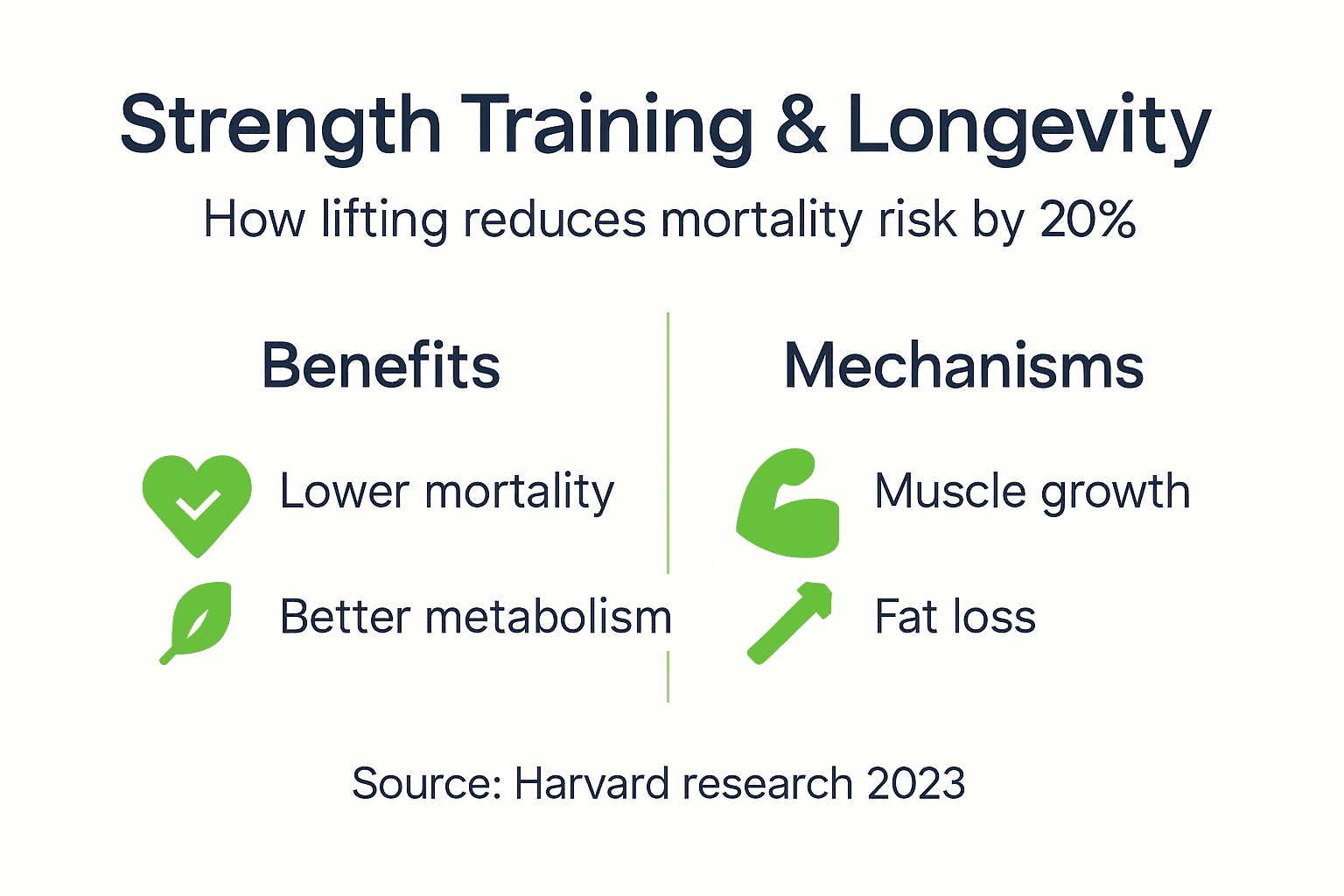
Harvard research confirms that just two 30 minute strength sessions weekly reduce all cause mortality risk by 10 to 20 percent. This includes significant reductions in cardiovascular disease, cancer, and metabolic disease deaths. The protective effect rivals or exceeds many pharmaceutical interventions, yet strength training costs nothing and produces zero negative side effects.
The metabolic advantages alone justify prioritizing strength training. Evidence shows each pound of muscle gained increases your resting metabolic rate by 6 to 7 calories daily. This might sound modest, but gaining 10 pounds of muscle creates a 60 to 70 calorie daily advantage that compounds to over 25,000 calories yearly. That metabolic boost aids fat loss, improves blood sugar control, and enhances insulin sensitivity.
| Health Outcome | Impact | Mechanism |
|---|---|---|
| All cause mortality | 10 to 20% reduction | Improved metabolic health, cardiovascular function, body composition |
| Cardiovascular disease | Significant risk reduction | Lower blood pressure, improved lipid profiles, enhanced endothelial function |
| Type 2 diabetes | Reduced risk and better control | Increased insulin sensitivity, improved glucose uptake, better glycemic control |
| Cancer | Lower mortality risk | Improved immune function, reduced inflammation, better body composition |
| Bone health | Increased density and strength | Mechanical loading stimulates bone formation, prevents osteoporosis |
| Mental health | Reduced depression and anxiety | Neurochemical changes, improved self efficacy, better sleep quality |
Strength training also preserves muscle mass and function as you age, preventing the sarcopenia that drives frailty, falls, and loss of independence in older adults. Maintaining strength directly correlates with quality of life and functional independence across your lifespan. The comprehensive strength training health benefits reveal how this single intervention positively impacts virtually every physiological system.
Practical Application and Getting Started
Knowing why and how strength training works means nothing without action. Here’s your practical roadmap to start training effectively and safely as a beginner.
-
Select compound exercises targeting major muscle groups. Squats, deadlifts, rows, presses, and pull exercises engage multiple joints and large muscle masses simultaneously. These movements deliver maximum return on training time while building functional strength that transfers to daily activities.
-
Train 2 to 3 times weekly with rest days between sessions. Clinical guidelines recommend this minimum effective dose covering all major muscle groups with adequate recovery. Monday, Wednesday, Friday works perfectly for most beginners, providing consistent stimulus without overtraining.
-
Start with manageable intensity and perfect your form. Use lighter weights initially to master movement patterns before adding load. Poor form under heavy weight causes injury and reinforces bad habits. Consider working with a qualified trainer for your first few sessions to establish proper technique.
-
Progress gradually using the principle of progressive overload. Once you can complete your target reps with good form, increase the challenge by adding weight, increasing reps, or shortening rest periods. Small consistent increases compound into dramatic long term gains.
-
Track your workouts to monitor progress objectively. Record exercises, weights, sets, and reps for every session. This data reveals trends, prevents stagnation, and motivates continued effort when you see measurable improvement over weeks and months.
-
Prioritize recovery through sleep, nutrition, and rest days. Your muscles grow during recovery, not during workouts. Aim for 7 to 9 hours of quality sleep nightly, consume adequate protein (0.7 to 1 gram per pound of body weight daily), and honor rest days completely rather than training through soreness.
Pro Tip: The beginner strength routines and guide to build your first workout routine provide structured templates that remove guesswork so you can focus on execution and consistency.
Enhance Your Strength Training Journey with Dietium
Strength training produces optimal results when paired with proper nutrition and systematic tracking. Dietium offers personalized resources that complement your training by tailoring meal plans to your specific goals, whether building muscle, losing fat, or improving overall health. The platform’s personalized meal plans align macronutrient intake with your training demands, ensuring you fuel recovery and growth effectively. Track your progress systematically using comprehensive tools to track fitness progress and leverage nutritional assessment methods to optimize your eating strategy. These integrated solutions transform isolated training efforts into a complete health optimization system.
FAQ
How often should beginners do strength training?
Beginners should aim for 2 to 3 strength training sessions per week with at least one rest day between sessions for each muscle group. This frequency provides sufficient stimulus for adaptation while allowing proper recovery time. Training more frequently without adequate rest prevents muscle growth and increases injury risk.
What is the difference between cluster training and traditional training?
Cluster training breaks sets into smaller segments with brief rest periods between clusters, maintaining higher intensity throughout. It produces faster strength gains in programs under 8 weeks. Traditional training uses standard sets with longer rest periods and proves more effective for sustained long term strength development after 9 weeks.
Can strength training help with weight loss and metabolism?
Yes, strength training significantly boosts metabolism by increasing muscle mass. Each pound of muscle gained burns an additional 6 to 7 calories daily at rest, compounding to substantial metabolic advantages over time. This elevated metabolic rate aids weight management, improves insulin sensitivity, and enhances overall metabolic health beyond what cardio alone provides.
Is strength training safe for older adults or beginners?
Strength training is safe and highly beneficial for all ages when approached with proper guidance and gradual progression. Older adults especially benefit from strength training’s ability to preserve muscle mass, maintain bone density, prevent falls, and sustain functional independence. Start with safe beginner routines that emphasize proper form and appropriate intensity for your current fitness level.
Recommended
- Why Strength Training Matters for Healthy Living – Dietium
- 1.Resistance Training Muscle Growth: Proven Strategies
- Effective Home Workouts: Science-Backed Results Anywhere – Dietium
- Weight Training Chain: Powerful 20 lb & Heavy Chains for Explosive Strength.
- 7 Ways Workplace Wellness Programs Support Smooth Moves – Onyx Removals


