 Skip to content

TL;DR:
- Healthy eating emphasizes consistent inclusion of nutrient-dense food groups rather than merely eliminating junk food.
- Understanding food groups helps build balanced, varied meals that support overall health without strict perfection.
Most people believe healthy eating is simply a matter of cutting out junk food. That belief misses the bigger picture. True nutrition is about what you consistently include in your diet, not just what you remove. Healthy diets rest on four core principles: adequacy, balance, moderation, and diversity. Understanding food groups is the most practical way to put those principles to work. This guide breaks down each group, explains what it contributes to your health, clears up common misconceptions, and shows you exactly how to apply this knowledge in everyday meal planning.
Table of Contents
- What are food groups and why do they matter?
- The five main food groups: similarities and differences
- How food groups support balanced nutrition
- Expert nuances and common edge cases
- How to use food groups for your own meal planning
- Why food group rules matter less than habits and patterns
- Personalize your healthy eating journey with expert support
- Frequently asked questions
Key Takeaways
| Point | Details |
|---|---|
| Food groups are frameworks | Understanding food groups helps you build more balanced and healthy meals, not track nutrients one by one. |
| Variety and patterns matter | Eating from all food groups regularly supports overall nutrition rather than aiming for perfection every meal. |
| Rules change with science | Guidance on food groups and their emphasis shifts as nutrition research evolves, so staying flexible is key. |
| Discretionary foods are extras | Foods high in sugar, fat, or salt are not a main food group and should be enjoyed only occasionally. |
| Meal planning made practical | Using food group knowledge can make planning, shopping, and eating better meals simpler and less stressful. |
What are food groups and why do they matter?
Food groups are categories that organize foods based on their shared nutrient profiles and the dietary roles they play. Grouping foods this way gives you a practical framework for building meals that cover your body’s needs without requiring a nutrition degree.
“Food group models are typically meant to guide balanced patterns, not require perfect matching at every meal; they emphasize proportioning, variety, and nutrient density and health.” — Dietary Guidelines for Americans
Here is why this framework matters on a daily level:
- Dietary adequacy: Eating across multiple groups reduces the risk of nutrient gaps, such as low iron, calcium, or fiber intake.
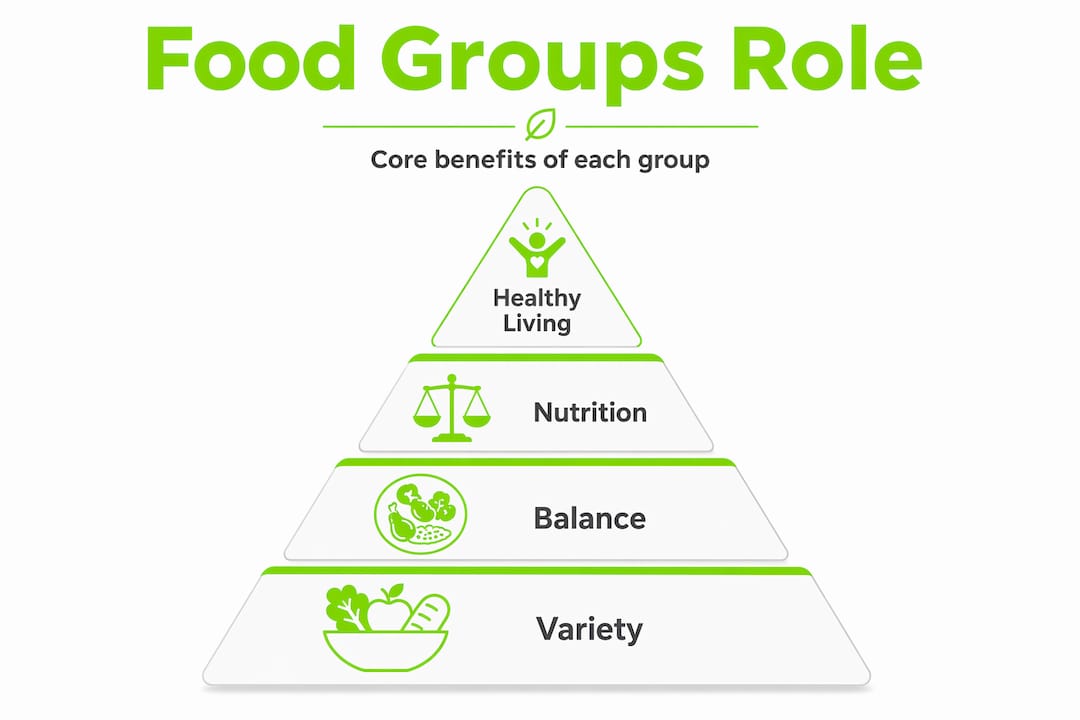
- Balance: Each group supplies different macronutrients and micronutrients, so variety across groups keeps your diet well-rounded.
- Guidance without obsession: Food groups point you toward proportions, not precise gram counts, making healthy eating approachable.
- Informed choices: When you understand which group a food belongs to, you can spot both nutrient-dense and lower-value options more quickly.
Most international nutrition authorities rely on five main food groups. The United States uses MyPlate, the United Kingdom uses the Eatwell Guide, and Australia uses its Five Food Groups model. Each framework organizes foods into overlapping categories, though exact boundaries can vary. Consistent across all of them is an emphasis on choosing nutrient-dense foods and building patterns over time, not chasing perfection at a single meal.
The five main food groups: similarities and differences
With a firm grasp on the overall purpose of food groups, let’s break down how major frameworks actually organize everyday foods and where they sometimes disagree.
The five groups that appear across most national guidelines are:
- Vegetables: Includes leafy greens, legumes (in some frameworks), root vegetables, and colorful produce.
- Fruits: Fresh, frozen, canned, or dried fruit; fruit juice counts in some frameworks but with limits.
- Grains and starches: Bread, rice, pasta, oats, and cereals; most frameworks prioritize whole grains.
- Protein foods: Meat, poultry, seafood, eggs, nuts, seeds, and legumes; plant-based alternatives are increasingly emphasized.
- Dairy and alternatives: Milk, yogurt, cheese, and fortified plant-based drinks like soy milk.
Here is how the three leading frameworks compare at a glance:
| Feature | US MyPlate | UK Eatwell Guide | Australia 5 Food Groups |
|---|---|---|---|
| Vegetables | Separate group | Combined with fruit | Separate group |
| Fruit | Separate group | Combined with veg | Separate group |
| Grains | Grains (half whole) | Starchy carbohydrates | Grain (cereal) foods |
| Protein | Protein foods | Beans, pulses, fish, meat | Lean meats and alternatives |
| Dairy | Dairy | Dairy and alternatives | Milk, yogurt, cheese |
| Oils | Not a group; note on label | Small oils section | Note only |
| Discretionary foods | Not a group; noted separately | Not a group | Explicitly excluded |
The NHS inform Eatwell Guide combines fruits and vegetables into a single category and labels grains as “starchy carbohydrates.” The NSW Government Five Food Groups model explicitly separates “sometimes foods” from the five core groups, making it clear that items like cakes, chips, and sugary drinks fall outside the structural framework of a healthy diet.
One detail worth noting: visual models such as a plate graphic or a wheel chart are not standardized globally. Small differences in how foods are categorized do not undermine the shared logic. Monitoring micronutrients across all five groups is what truly supports long-term health, regardless of which national model you follow.
How food groups support balanced nutrition
Understanding the differences between models is useful, but daily life is about what each group does for your health. Here is how each food group works in your body.

| Food group | Key nutrients | Main role | Example foods |
|---|---|---|---|
| Vegetables | Fiber, vitamins A/C/K, folate, potassium | Cellular protection, digestion, immune support | Spinach, carrots, broccoli, lentils |
| Fruits | Vitamin C, potassium, antioxidants, natural sugars | Energy, immune health, cardiovascular support | Berries, oranges, bananas, apples |
| Grains and starches | Carbohydrates, B vitamins, iron, fiber (whole grains) | Primary fuel source, energy metabolism | Brown rice, oats, whole-wheat bread |
| Protein foods | Protein, iron, zinc, omega-3s, B12 | Muscle repair, enzyme function, immune defense | Chicken, salmon, tofu, eggs, lentils |
| Dairy and alternatives | Calcium, vitamin D, protein, phosphorus | Bone strength, muscle contraction, nerve function | Milk, Greek yogurt, fortified soy milk |
Food group models emphasize proportioning, variety, and nutrient density for one reason: different nutrients work together. Calcium absorption, for example, depends partly on vitamin D. Iron from plant foods absorbs better alongside vitamin C. Eating across groups naturally creates these synergies.
Practical ways to add variety within each group:
- Swap white rice for quinoa or barley in grain-based dishes.
- Rotate protein sources weekly: fish one day, legumes the next, eggs the day after.
- Include one new vegetable each week to expand your micronutrient range.
- Try different dairy alternatives, such as fortified oat milk or almond milk, to vary calcium sources.
- Experiment with frozen or canned fruits and vegetables; they retain most of their nutrients and lower the cost barrier.
A heart-healthy, nutrient-dense diet is strongly linked to lower population risk for cardiovascular disease when it prioritizes minimally processed choices and limits items high in added sugar, sodium, and saturated fat.
Pro Tip: When choosing within any food group, ask yourself how close the item is to its original form. An apple is closer to its source than apple-flavored candy. Whole-wheat bread is closer than a white-flour pastry. The closer to the source, generally the higher the meal planning for balanced nutrition payoff.
Discretionary foods, such as chips, cakes, sugary drinks, and fast food, are not a food group. They exist in most people’s diets, and that is realistic. The key is treating them as occasional additions rather than structural parts of your eating pattern.
Expert nuances and common edge cases
Even with clear categories, food choices are not always one-size-fits-all. Here is what most people miss about food group nuances and authority disagreements.
Some foods genuinely fit more than one group. This creates confusion, but most frameworks have built-in solutions.
- Beans and peas: Beans and peas can fall into either the vegetable group or the protein group depending on the framework, so you cannot count them twice in the same meal. MyPlate, for instance, encourages people to use them primarily as a protein source if they already eat enough vegetables.
- Tofu and tempeh: These are plant proteins but also supply calcium, placing them close to dairy alternatives in some contexts.
- Fortified plant milks: Most frameworks now include these in the dairy and alternatives group, provided they are calcium-fortified.
- Nuts and seeds: Protein and fat sources simultaneously; frameworks typically place them in the protein group.
The science behind food group guidance also shifts over time. Dietary guidelines and public interpretation can change, especially around dairy’s role in the diet and the emphasis placed on different protein sources. Some researchers argue dairy receives disproportionate prominence in certain national guidelines relative to the evidence base. Others note that ultra-processed foods now make up a large share of diets in high-income countries, a reality that static food group charts were not originally designed to address.
Here is how to navigate these nuances without getting stuck:
- Follow the specific counting rules in whichever framework you use. Do not double-count a food in two groups.
- Treat food group models as starting frameworks, not rigid laws. The underlying goal is nutrient adequacy, not perfect categorization.
- When guidance updates, look for changes in the reasoning, not just the recommendation. Understanding why guidance shifts helps you evaluate meal planning tips for flexibility and apply new findings sensibly.
Pro Tip: Instead of memorizing every rule for every edge case, anchor yourself to three core principles: variety (eat a wide range of foods), nutrient density (favor minimally processed options within each group), and moderation (no single food or group should dominate your entire diet).
How to use food groups for your own meal planning
With those practical details in hand, you are ready to put food group knowledge to use in real life. Meal planning becomes noticeably easier once you treat food groups as a flexible checklist rather than a strict formula.
Follow these steps to build a food-group-based meal plan:
- Map your weekly meals loosely. List dinners for the week and note which groups each meal covers. A stir-fry with tofu, broccoli, and brown rice hits protein, vegetables, and grains in one dish.
- Check for missing groups across the day. If breakfast and lunch are heavy on grains and protein, prioritize fruits and vegetables at dinner and snacks.
- Plan snacks intentionally. Snacks are an easy opportunity to fill group gaps: a yogurt covers dairy, an apple covers fruit, a handful of nuts covers protein.
- Build a short shopping list by group. Organize your list under vegetable, fruit, grain, protein, and dairy headings. This makes gaps obvious before you shop.
- Rotate within groups, not just between them. Eating broccoli every day covers vegetables but misses the range of nutrients other vegetables provide.
According to Dietary Guidelines for Americans data, food group models are designed to guide balanced patterns, not mandate perfect matching at every meal. That is a critical distinction. A single meal does not need to check every box.
Pro Tip: Plan by the week, not the day. If Monday’s meals lean heavily on grains and protein, compensate with extra fruits and vegetables on Tuesday and Wednesday. This “pattern-based” approach reduces stress and reflects how real-life nutrition actually works. For households with varying needs, a meal planning for families approach helps account for different age groups and preferences simultaneously.
If you want support tailoring food group principles to your specific goals, personalized meal planning tools can match your intake targets to your health objectives far more precisely than a general chart.
Why food group rules matter less than habits and patterns
Here is where most nutrition advice stops short: it hands you the food group chart and assumes the work is done. The reality is more nuanced.
Strict food group tracking can quickly become counterproductive. When you obsess over whether a meal hits every category, eating becomes stressful rather than sustaining. That stress can erode the consistent habits that actually drive long-term health outcomes. People who maintain healthy diets over years rarely do so by auditing every plate against a chart. They do so by building flexible routines that default to variety and balance without requiring daily effort.
The WHO’s core dietary principles — adequacy, balance, moderation, and diversity — describe outcomes, not processes. Food groups are one tool to achieve those outcomes. They are not the only tool, and they are certainly not the finish line.
What actually works over time is building meals you enjoy, rotating foods you know, and gradually expanding variety as your taste and knowledge grow. A diet that is 80 percent well-structured and 100 percent sustainable beats a theoretically perfect diet that is abandoned after three weeks. This is where making smarter food choices becomes a daily practice rather than a one-time audit.
Our view: use food groups to orient yourself, especially when you are learning or restructuring your diet. Once the patterns feel natural, shift your attention from tracking categories to noticing how your energy, digestion, and satiety respond to different foods. That feedback loop is far more powerful than any chart.
Personalize your healthy eating journey with expert support
Knowing the food groups is the foundation. Applying them to your specific body, goals, and lifestyle is where real results happen. If you are ready to move beyond general guidance, personalized diet guidance at Dietium connects your food choices to measurable health objectives. Whether you need customized meal plans that reflect your macronutrient targets, dietary preferences, or fitness goals, or a practical guide to meal planning for families that works for everyone at the table, Dietium offers evidence-based tools and expert-backed support to make the process straightforward and effective. Start with what you have learned here and build from there.
Frequently asked questions
What is the healthiest way to use food groups in meal planning?
Use food groups as a flexible template to include a variety of nutritious foods at most meals, prioritizing balance and minimally processed options over rigid rules. The core dietary principles of adequacy, balance, moderation, and diversity give you a practical standard to measure against.
Are “sometimes” or discretionary foods a food group?
No, discretionary foods are not a food group; they are best treated as occasional choices outside the main groups due to their low nutrient value. Discretionary and sometimes foods are frequently excluded from food group accounting because the goal is nutrient adequacy.
Can one food belong to more than one food group?
Some foods, like beans and peas, can fit multiple groups, but most frameworks include specific counting rules so you only assign them to one group per meal. The USDA MyPlate guidance addresses this directly with practical counting advice.
Why do food group recommendations change?
Guidance shifts as new research emerges, particularly around protein sources and dairy’s role in the diet. Ongoing expert debate around saturated fat and animal products continues to influence how food group frameworks are updated and interpreted.
Do I need to eat from every food group at every meal?
No, focus on variety and overall balance across your meals and snacks throughout the day rather than checking every group at each sitting. Dietary guidelines data confirms that food group models are designed to guide patterns, not mandate perfection at every meal.


