 Skip to content

TL;DR:
- Nutrient density compares beneficial nutrients to calories, promoting smarter food choices.
- Foods high in nutrient density support overall health and reduce disease risk.
- Balancing nutrient density with enjoyment, cultural practices, and practicality is essential.
Most people trying to eat healthier focus on two things: calories and whether a food sounds healthy. But two foods with identical calorie counts can have wildly different effects on your body. A 200-calorie serving of kale and a 200-calorie serving of white crackers are not even close to nutritionally equivalent. This is where nutrient density becomes the most practical tool in your dietary toolkit. Understanding it shifts your focus from simply eating less to eating smarter, and it gives you a clear, evidence-based framework for building meals that actually support your health goals.
Table of Contents
- What is nutrient density and why does it matter?
- How nutrient density is measured: Metrics and methods
- Applying nutrient density: Making smarter meal choices
- Nuances and challenges: Limitations, processing, and real-world context
- A smarter approach: Balancing nutrient density with real-life choices
- Take the next step with smarter nutrition tools
- Frequently asked questions
Key Takeaways
| Point | Details |
|---|---|
| Nutrient density explained | Nutrient density measures the amount of beneficial nutrients per calorie in a food, helping you prioritize smarter choices. |
| Beyond calories | Focusing only on calories misses nutrition quality—look for foods high in vitamins, minerals, protein, and fiber. |
| Practical use | Understanding nutrient density makes grocery shopping, meal planning, and personalizing your diet easier and more effective. |
| No one-size-fits-all | No single scoring system is perfect—balance nutrient scores with taste, affordability, and your lifestyle. |
What is nutrient density and why does it matter?
Nutrient density is one of those concepts that sounds technical but is genuinely straightforward once you see it clearly. Nutrient density is defined as the ratio of beneficial nutrients, including vitamins, minerals, protein, and fiber, to energy (calories) in a food, often expressed per 100 kcal or 100g. In simple terms: how much nutritional value do you get for each calorie you consume?
This matters because not all calories are nutritionally equal. A food can be low in calories and low in nutrients (think plain iceberg lettuce), or high in calories and high in nutrients (think salmon or lentils). The goal is to identify foods that give you the most nutritional return per calorie spent.
Here is a quick comparison to make this concrete:
| Food (per 100 kcal) | Protein (g) | Fiber (g) | Calcium (mg) | Iron (mg) |
|---|---|---|---|---|
| Spinach | 12 | 8 | 290 | 7.2 |
| White bread | 3.3 | 1.1 | 48 | 1.0 |
| Whole milk | 5.4 | 0 | 188 | 0.1 |
| Potato chips | 1.8 | 0.9 | 10 | 0.4 |
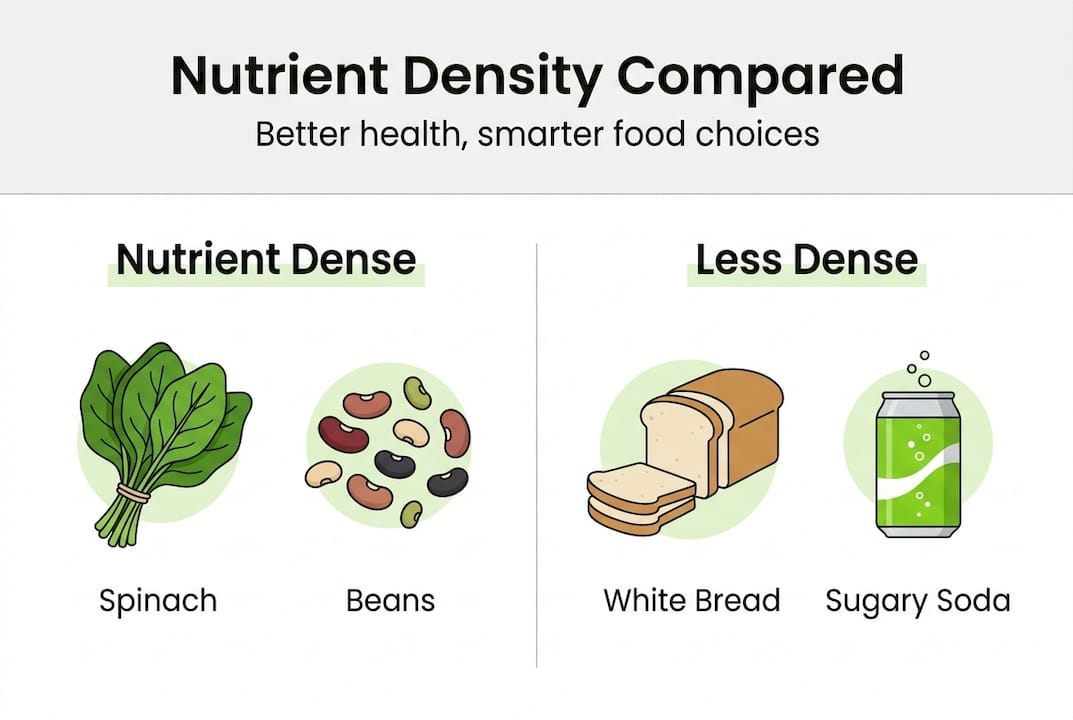
The difference is stark. Spinach delivers protein, fiber, calcium, and iron at a fraction of the calorie cost compared to chips.
Why does this matter beyond the gym or a weight-loss plan? Research consistently links higher dietary nutrient density to reduced risk of chronic diseases, including type 2 diabetes, cardiovascular disease, and certain cancers. Harvard’s healthy meals guide reinforces this, emphasizing that building meals from low-calorie, nutrient-dense foods supports long-term health outcomes.
Key benefits of prioritizing nutrient density:
- More vitamins and minerals per meal without excess calories
- Better satiety from fiber and protein-rich foods
- Reduced risk of micronutrient deficiencies
- Easier weight management without strict calorie restriction
- More sustainable dietary patterns over time
For a deeper look at how this concept connects to your overall food choices, nutrient density explained is worth reading alongside calorie density and healthy eating to understand how these two ideas work together.
How nutrient density is measured: Metrics and methods
Understanding the concept is just the first step. Let’s look at the tools and scores nutrition professionals actually use when analyzing foods.
The most widely used scientific tool is the Nutrient Rich Foods (NRF) Index, developed by researcher Adam Drewnowski. The formula works like this: NRFn.3 scores foods by summing the percentage of daily value (%DV) for 9 beneficial nutrients, then subtracting the %DV for 3 nutrients to limit, all calculated per 100 kcal.
The 9 beneficial nutrients tracked:
- Protein
- Fiber
- Vitamin A
- Vitamin C
- Vitamin D
- Calcium
- Iron
- Potassium
- Magnesium
The 3 nutrients to limit:
- Saturated fat
- Added sugars
- Sodium
This gives each food a single score that reflects both what it provides and what it contains in excess. A high NRF score means you are getting more of what you need and less of what you should limit.
Here is how different scoring systems compare:
| System | Focus | Basis | Best use |
|---|---|---|---|
| NRF Index | Nutrients vs. limiting factors | Per 100 kcal | Individual food comparison |
| NOVA Classification | Degree of processing | Food type | Identifying ultra-processed foods |
| Dietary Guidelines | Overall diet patterns | Daily intake | Population-level guidance |
These tools help you make direct comparisons between foods and personalize your diet based on your specific nutrient goals. For more detail on how these assessments are applied in practice, explore nutritional assessment methods and nutritional analysis methods.
You can also browse a practical nutrient dense foods list to see how common foods score. For foundational guidance on nutrient requirements, the nutrient requirements guide provides solid scientific grounding.
Pro Tip: No single scoring system is perfect for every situation. The NRF Index is excellent for comparing individual foods, but it does not account for how foods interact in a full meal. Use scores as a starting point, not the final word.
Applying nutrient density: Making smarter meal choices
Now that you understand how nutrient density is measured, here is how to use this knowledge when planning meals or shopping.

At the grocery store, you do not need to calculate NRF scores for every item. Instead, use a simple mental filter: does this food deliver meaningful protein, fiber, vitamins, or minerals relative to its calorie count? If yes, it earns a place in your cart. Nutrient density aids group planning and tools like the NRF enable scoring of individual foods, full meals, and entire diets, making it easier to assess your choices systematically.
High nutrient density meal examples:
- Breakfast: Eggs with sauteed spinach and whole grain toast
- Lunch: Lentil soup with a side of mixed greens and olive oil
- Dinner: Grilled salmon with roasted broccoli and quinoa
- Snack: Plain Greek yogurt with a handful of berries
Low nutrient density alternatives (common swaps to reconsider):
- White rice swapped for black beans or lentils
- Sugary cereal swapped for oatmeal with nuts
- Potato chips swapped for roasted chickpeas
- Flavored yogurt swapped for plain yogurt with fresh fruit
Nutrient needs also vary by individual. Active people need more protein and calories overall, but still benefit from prioritizing nutrient-dense sources. Children require more calcium and iron per pound of body weight. Older adults often need more vitamin D and B12. The framework adapts to all of these situations because it focuses on nutrients per calorie rather than a fixed list of approved foods.
For practical strategies on eating well despite a busy schedule, nutrition for busy professionals and meal planning for busy people offer actionable guidance. If you follow a plant-based diet, [nutrient dense vegan options](https://dietium.com/nutrient dense vegan foods) can help you meet your needs without animal products. Research also supports that certain brain-boosting foods align well with high nutrient density principles.
Pro Tip: Affordability matters. Beans, lentils, canned sardines, frozen spinach, and eggs consistently rank among the highest nutrient density foods at the lowest cost per serving. You do not need expensive superfoods to eat a nutrient-rich diet.
Nuances and challenges: Limitations, processing, and real-world context
While nutrient density is a powerful guide, real life adds layers of complexity that most articles skip over.
First, food processing significantly affects nutrient density. Cooking, refining, and fortifying foods all change their nutrient profiles. Boiling vegetables can reduce water-soluble vitamins like vitamin C. Refining whole grains strips fiber and B vitamins. On the other hand, cooking tomatoes increases lycopene availability. Processing is not always the enemy, but it does change the picture.
Edge cases to watch for include single-food diets, significant changes in nutrient content due to processing, and the risk of eating disorders when low-calorie nutrient density metrics are followed too rigidly. This is a real concern: someone obsessively chasing the highest NRF scores while minimizing calories could end up under-eating energy, which creates its own health problems.
Common pitfalls when applying nutrient density:
- Over-relying on scores without considering bioavailability (how well your body absorbs a nutrient)
- Ignoring satiety, which affects how much you actually eat throughout the day
- Dismissing cultural food traditions that may not score high but contribute to overall dietary satisfaction and adherence
- Treating all processing as equally harmful, when some processing preserves or enhances nutrients
There is also no universal standard. The NRF and NOVA models measure different things and can produce conflicting assessments of the same food. A minimally processed food might score well on NOVA but only moderately on NRF. Critics of nutrient density metrics also argue that overemphasizing low-calorie nutrition can inadvertently stigmatize calorie-dense whole foods like avocados, nuts, and olive oil, which are nutritionally valuable despite their calorie count.
“Nutrient density scores are tools, not rules. They help you make better comparisons, but they cannot replace the full context of your diet, lifestyle, and health status.”
For ideas on building balanced meals that respect both nutrient density and real-world variety, balanced vegan meal ideas offers practical examples that apply these principles without rigidity.
A smarter approach: Balancing nutrient density with real-life choices
Here is something worth saying directly: chasing perfect nutrient density scores can become its own problem. When you reduce food to a number, you risk losing sight of what makes eating sustainable, enjoyable, and culturally meaningful.
No single metric captures bioavailability, variety, satiety, or the role food plays in social and emotional wellbeing. A bowl of your grandmother’s bean stew may not have a calculated NRF score, but it delivers fiber, protein, iron, and a sense of connection that supports long-term health in ways a score cannot measure.
The practical approach is this: use nutrient density as your default filter for most food decisions, but stay flexible. Choose leafy greens, legumes, eggs, and whole grains most of the time. When budget, time, or preference calls for something different, make the best available choice without guilt. Explore nutrient dense vegan strategies if you want to build a plant-forward diet that hits your nutritional targets without obsessing over scores.
Pro Tip: Combine nutrient density awareness with taste, budget, and your lifestyle. Consistency over months matters far more than perfection on any single day.
Take the next step with smarter nutrition tools
Ready to put nutrient density into action? Dietium makes it straightforward. Rather than manually calculating scores or guessing which foods fit your goals, you can use personalized nutritional assessments to evaluate your current diet and identify specific gaps. From there, personalized meal plans built around your calorie needs, health goals, and food preferences take the guesswork out of daily eating. Whether you are managing your weight, building muscle, or simply trying to eat better, Dietium’s tools translate the science of nutrient density into practical, actionable steps you can start using today.
Frequently asked questions
What are examples of high nutrient density foods?
Leafy greens, beans, eggs, and milk are high in nutrient density because they deliver many essential nutrients per calorie. Higher NRF scores are consistently linked to affordable staples like milk for calcium and eggs and beans for protein.
How does nutrient density help with meal planning?
It helps you choose foods and meal combinations that provide more vitamins, minerals, and protein per calorie, optimizing health without excess calories. Nutrient density aids planning for both heterogeneous groups and individual diets.
Are processed foods always low in nutrient density?
Not all processed foods are low in nutrient density; it depends on the nutrients present, but ultra-processed options often score lower. Processing can alter NRF scores, and the NOVA model focuses on the degree of processing rather than nutrient content alone.
Can you overdo nutrient-dense, low-calorie foods?
Eating only very low-calorie, highly nutrient-dense foods can sometimes lead to imbalances or energy deficiency, so balance and variety are key. Low-energy focused diets may risk disorders, and single-food approaches require careful balancing to meet total energy needs.


