 Skip to content

TL;DR:
- Meal planning reduces decision fatigue and promotes healthier, more balanced eating habits.
- It improves health outcomes like weight management and better glycemic control through personalized strategies.
- Using digital tools and visual models simplifies meal planning, making it more sustainable and flexible.
Healthy eating doesn’t require iron willpower or hours in the kitchen every night. The real obstacle for most people isn’t motivation. It’s the daily friction of deciding what to eat, what to buy, and how to make it all work. Meal planning removes that friction. It shifts nutrition from a reactive scramble into a deliberate, manageable system. When you plan ahead, you eat better, spend less, and stress less. This article breaks down the core benefits of meal planning, the science behind its health outcomes, the best digital tools to support it, and practical frameworks you can apply starting this week.
Table of Contents
- The fundamental benefits of meal planning
- How meal planning drives long-term health results
- Meal planning in the digital age: Tech, tools, and flexibility
- Visualization and practical models: From plate diagrams to actionable steps
- Our perspective: Don’t let meal planning overwhelm you, start simple and build habits
- Take your nutrition further with Dietium’s meal planning tools
- Frequently asked questions
Key Takeaways
| Point | Details |
|---|---|
| Better nutrition choices | Meal planning helps you prioritize nutrient-rich foods, supporting long-term health. |
| Less stress and decision fatigue | Planning ahead frees you from daily last-minute food decisions and reduces willpower burnout. |
| Save money and reduce waste | Intentional meal plans lower grocery bills and cut unnecessary food waste. |
| Modern tools enhance results | Apps and frameworks make meal planning easier and more flexible for today’s lifestyles. |
The fundamental benefits of meal planning
Most people think of meal planning as a rigid, time-consuming ritual. The reality is the opposite. A solid plan actually gives you more freedom because you’ve already made the hard decisions. You walk into the grocery store knowing exactly what you need. You open the fridge at 6 p.m. and know exactly what’s for dinner. That clarity is the foundation of better nutrition.
The nutritional payoff is real. Meal planning encourages intentional selection of nutrient-dense foods and reduces unhealthy impulse purchases. When you’re not deciding on the fly, you’re far less likely to reach for processed convenience foods. You choose balanced meals in advance, which means more vegetables, more protein, and fewer empty calories by default.
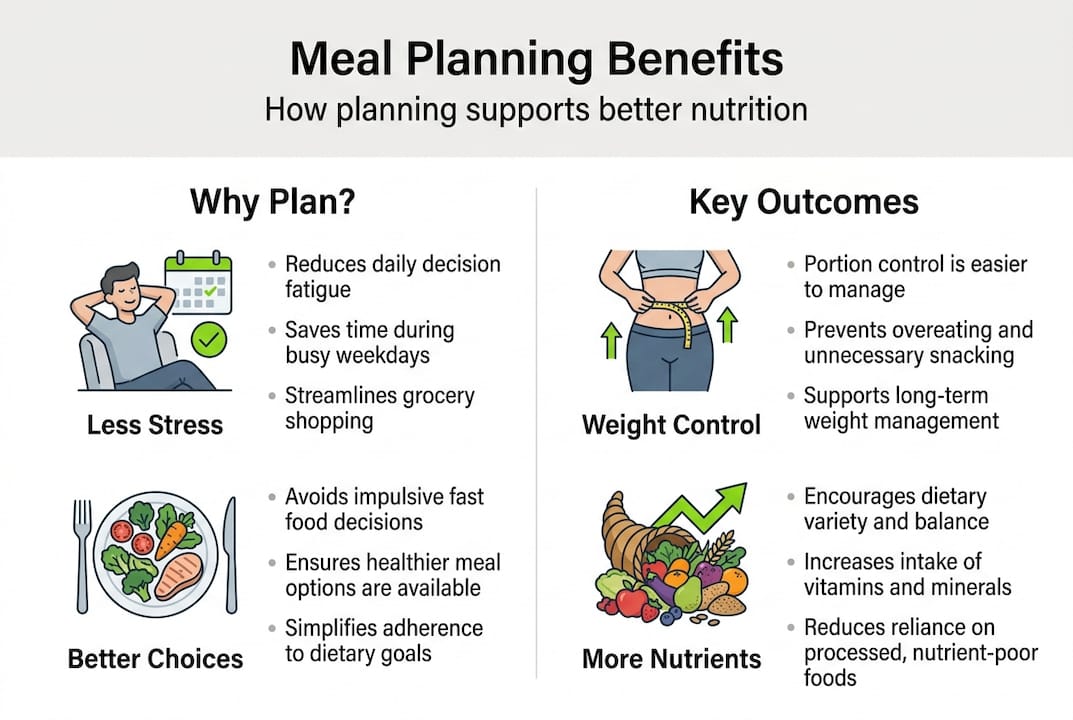
The financial benefits are equally significant. Planning meals ahead cuts time, costs, and food waste. The average American household wastes roughly 30 to 40 percent of the food it buys. A weekly meal plan directly attacks that number by aligning what you buy with what you actually cook.
Here’s a quick breakdown of what consistent meal planning delivers:
- Reduced grocery spending by eliminating redundant or unused purchases
- Less food waste through portion-aligned shopping lists
- Fewer impulse buys and late-night snack runs
- Better nutritional balance across the week, not just on good days
- Time savings by batching cooking and prep into focused sessions
- Family health support by making nutritious meals the default, not the exception
“Meal planning is not about eating perfectly every day. It’s about making the healthy choice the easy choice.”
For families especially, planning creates consistency. Kids eat more balanced meals. Adults avoid the 5 p.m. panic that usually ends in takeout. If you’re new to this, a simple meal planning guide can help you build the habit without overcomplicating it. And if budget is a concern, meal planning on a budget strategies make it accessible at any income level.
How meal planning drives long-term health results
Convenience is one thing. But meal planning also produces measurable health outcomes, and the research is clear on this.

Structured meal planning helps with weight loss, better glycemic control, and improvements in cardiometabolic markers. That means lower blood pressure, improved cholesterol, and more stable blood sugar. These aren’t minor quality-of-life upgrades. They’re the metrics your doctor tracks.
Personalized plans outperform generic dietary advice. When your meals are tailored to your calorie needs, macros, and health goals, you’re far more likely to stick with them and see results. Generic advice like “eat more vegetables” doesn’t translate into action the way a specific weekly plan does.
| Health outcome | Generic diet advice | Personalized meal planning |
|---|---|---|
| Weight management | Moderate impact | High impact |
| Glycemic control | Low to moderate | High |
| Cardiometabolic markers | Variable | Consistently improved |
| Long-term adherence | Low | Moderate to high |
| Decision fatigue reduction | Minimal | Significant |
Meal planning also reduces decision fatigue, which is the mental exhaustion that comes from making too many choices throughout the day. When food decisions are already made, you have more cognitive energy for everything else.
Key health benefits supported by research:
- Supports sustainable meal plan for weight maintenance without extreme restriction
- Helps you avoid overeating naturally by removing impulsive, hunger-driven choices
- Aligns directly with meal planning for fitness goals by timing nutrients around activity
Key stat: People who follow structured meal plans are significantly more likely to meet daily fiber, protein, and micronutrient targets compared to those eating without a plan.
Meal planning in the digital age: Tech, tools, and flexibility
The right tools make meal planning faster, smarter, and far easier to maintain. Today’s apps and platforms go well beyond simple recipe storage. They track macros, generate shopping lists, suggest meals based on dietary preferences, and even account for what’s already in your pantry.
Apps can help, but successful users prioritize flexible systems over rigid daily logging. The goal isn’t to track every gram of food forever. It’s to build a repeatable system that keeps you on track without burning you out.
Here’s what to look for when choosing a meal planning tool:
| Feature | Why it matters |
|---|---|
| Customizable meal templates | Adapts to your dietary needs and preferences |
| Auto-generated shopping lists | Saves time and reduces forgotten items |
| Macro and calorie tracking | Keeps nutrition goals visible and actionable |
| Recipe database | Reduces repetition and keeps meals interesting |
| Flexible scheduling | Allows swaps without derailing the whole plan |
Pro Tip: Don’t start with a 7-day plan. Begin with planning just 3 dinners per week. Once that feels automatic, add lunches. Gradual expansion leads to lasting habits.
Here’s a simple approach to integrating digital tools effectively:
- Choose one app and stick with it for at least 30 days before evaluating
- Set your goals first (weight, performance, budget) so the tool can serve them
- Use the shopping list feature every single week without exception
- Schedule a 15-minute weekly planning session rather than planning day by day
- Allow flexibility by keeping 1 to 2 “free choice” meals per week
For a detailed breakdown of what’s available, the meal planning apps comparison and top meal planning tools resources at Dietium cover the leading options. If you want plans built around your specific health goals, personalized meal plans take the guesswork out entirely.
Visualization and practical models: From plate diagrams to actionable steps
Knowing you should eat balanced meals is one thing. Seeing what that actually looks like on a plate is another. Visual models bridge that gap and make planning far more intuitive.
Plate models help visualize balanced, nutritious meals and improve diet quality. Harvard’s Healthy Eating Plate, for example, divides your plate into roughly half vegetables and fruits, one quarter whole grains, and one quarter lean protein, with healthy oils and water on the side. It’s a simple visual that removes the need to count calories at every meal.
When you plan meals using a plate model, you’re not calculating macros from scratch. You’re filling a template. That’s a fundamentally different cognitive task, and it’s much easier to sustain.
Planning ahead eases daily decision making, reducing nutrition-related willpower fatigue. Think of your meal plan as a set of defaults. When defaults are healthy, you don’t have to fight yourself to make good choices.
Here’s how to apply visualization practically:
- Use the plate model as your baseline for every planned meal
- Batch similar meals visually. If Monday’s dinner is a grain bowl, Tuesday’s can use the same base with different protein
- Color code your plan by food group to spot nutritional gaps at a glance
- Pre-portion snacks visually using small containers so decisions are already made
- Review your week visually on Sunday. A quick scan reveals if you’re heavy on carbs or light on vegetables
Pro Tip: Print or screenshot your weekly meal plan and put it on the fridge. Seeing it daily reinforces commitment and reduces the temptation to deviate.
For more strategies, smart meal planning tips and meal planning automation resources can help you build systems that practically run themselves.
Our perspective: Don’t let meal planning overwhelm you, start simple and build habits
Here’s what most meal planning content won’t tell you: the biggest reason people quit isn’t lack of motivation. It’s that they start with a system that’s too complex for their current lifestyle.
Seven days of fully mapped meals, precise macros, and coordinated grocery lists sounds ideal. In practice, it often collapses by Wednesday when life gets busy. The smarter move is to start with one anchor habit. Plan your lunches for the week. Just lunches. Do that consistently for two to three weeks until it feels effortless. Then add dinners.
Flexibility is not a compromise. It’s a feature. The best nutrition outcomes come from consistent, realistic systems, not perfect ones. A plan you follow 80 percent of the time beats a perfect plan you abandon after 10 days.
If you’re not sure where to start, step-by-step meal planning basics give you a practical foundation without the overwhelm. Build the habit first. Optimize later.
Take your nutrition further with Dietium’s meal planning tools
Dietium offers everything you need to make meal planning work for your specific goals, whether you’re managing weight, eating on a budget, or feeding a family. Explore personalized meal plans built around your calorie needs, dietary preferences, and health targets. Use the meal planning for families guide to simplify household nutrition without cooking multiple separate meals. And if cost is a priority, meal planning on a budget strategies help you eat well without overspending. Dietium’s tools are designed to reduce the friction between knowing what to eat and actually doing it, consistently.
Frequently asked questions
What is the main purpose of meal planning?
Meal planning helps you eat healthier, save money, and reduce daily stress by deciding what to eat before hunger or impulse drives the decision. Intentional food choices made in advance consistently lead to better nutritional outcomes.
How does meal planning help with weight loss?
Meal planning makes it easier to control portions and choose nutritious foods before cravings kick in. Structured meal planning supports weight loss and better glycemic control in clinical research.
What tools make meal planning easier today?
Meal planning apps, digital templates, and platforms like Dietium help you create, organize, and follow a healthy eating plan. Apps and digital tools are most effective when they support flexible, not rigid, planning systems.
Does meal planning take a lot of time?
A weekly planning session of 15 to 20 minutes saves hours of daily decision-making and unplanned grocery runs. Planning ahead saves time and reduces both food waste and unnecessary spending throughout the week.
Recommended
- What Is Meal Planning? Simple Guide for Every Lifestyle 2025 – Dietium
- Master meal planning for fitness goals: boost results – Dietium
- Meal Planning Tips 2025: Smart Ways to Eat Healthy – Dietium
- Master Meal Planning on a Budget: Save Money & Eat Well – Dietium
- Comment créer une routine alimentaire saine: un guide complet – Vitalcup


