 Skip to content

Most people count calories and assume that’s enough. But two foods with the exact same calorie count can have wildly different effects on your body, your energy, and your long-term health. A 100-calorie handful of almonds and a 100-calorie serving of gummy candy are not the same thing, not even close. Nutrient density is the concept that explains why, and once you understand it, you’ll never look at a food label the same way again. This guide breaks down the science, shows you real comparisons, and gives you practical tools to make smarter choices starting today.
Table of Contents
- What is nutrient density?
- How is nutrient density measured?
- Nutrient-dense foods vs. empty-calorie foods
- Practical tips to boost nutrient density in your diet
- Beyond the basics: advanced insights and common pitfalls
- Personalize your nutrition journey with Dietium
- Frequently asked questions
Key Takeaways
| Point | Details |
|---|---|
| Nutrient density matters | Choosing foods packed with nutrients per calorie leads to better health and more satisfying meals. |
| Not all calories are equal | Different foods with the same calories can offer vastly different levels of vitamins, minerals, and protein. |
| Simple swaps make a difference | Replacing empty-calorie foods with nutrient-dense options is an easy way to improve your diet. |
| Apply with easy habits | Focus on colorful produce, lean proteins, and whole grains to boost nutrient density at every meal. |
What is nutrient density?
Calories alone don’t tell you whether a food is actually feeding your body. Nutrient density is a measure of the nutrients provided per calorie of food. In other words, it asks: how much nutritional value are you getting for the energy you’re spending?
Think of your daily calorie budget like a spending limit. Every food you eat is a purchase. Some purchases give you a lot in return, vitamins, minerals, fiber, protein, antioxidants. Others give you almost nothing except energy. Those are called empty calories, and they’re the nutritional equivalent of buying a product that breaks the moment you open it.
Here’s what makes nutrient-dense foods stand out:
- High levels of vitamins and minerals relative to their calorie count
- Good sources of fiber, protein, or healthy fats
- Minimal added sugars, refined grains, or artificial additives
- Whole or minimally processed forms
“Not all calories are created equal. A calorie from spinach and a calorie from soda deliver completely different packages of nutrition to your body.”
This is where nutrient dense foods shine. They let you meet your nutritional needs without blowing your calorie budget. Compare that to calorie density, which measures how many calories are packed into a given weight of food. High calorie density foods (think butter or chips) deliver a lot of energy in a small volume. Nutrient density flips that question around and asks what you’re getting beyond the energy.
How is nutrient density measured?
Several scoring systems have been developed to rank foods by their nutritional value. The most widely used is the Nutrient Rich Foods (NRF) Index, created by researcher Adam Drewnowski. The NRF index calculates the sum of percent daily values (%DV) for beneficial nutrients minus the %DV for limiting nutrients like saturated fat, added sugar, and sodium, all measured per 100 calories.
Other systems include the ANDI score (Aggregate Nutrient Density Index), which focuses heavily on micronutrients and phytochemicals, and Nutri-Score, a European label system that grades foods from A to E. Each model weighs nutrients differently, which is why rankings can vary between systems.
Here’s a quick comparison of nutrient content per 100 calories for a few common foods:
| Food | Protein (g) | Fiber (g) | Vitamin C (%DV) | Iron (%DV) |
|---|---|---|---|---|
| Kale | 8.5 | 3.6 | 134% | 12% |
| Chicken breast | 18.7 | 0 | 0% | 5% |
| Apple | 0.5 | 4.8 | 11% | 1% |
| Cola (soda) | 0 | 0 | 0% | 0% |
The differences are striking. Kale delivers vitamins, minerals, and fiber for very few calories. Soda delivers nothing but sugar and energy. Chicken breast wins on protein. Apple scores well on fiber and some vitamin C.

Models also differ based on whether they measure per 100 grams, per 100 calories, or per serving size. This matters because water-rich foods like cucumber look less impressive per 100 grams but score well per 100 calories. Choosing a whole food diet naturally steers you toward high-scoring foods across most systems.
Pro Tip: When reading nutrition labels, divide the %DV of a key nutrient by the number of calories per serving. The higher that number, the more nutrient-dense the food is for that specific nutrient.
Nutrient-dense foods vs. empty-calorie foods
Now that you know how nutrient density is measured, let’s see it in action by comparing the best and worst choices on a typical grocery run.
Leafy greens like kale and collards consistently top nutrient density lists. Beef ranks high per calorie for protein and iron. Potatoes, while nutritious, score lower than most vegetables because of their higher starch content and lower micronutrient variety. And processed snacks? They’re almost always at the bottom.
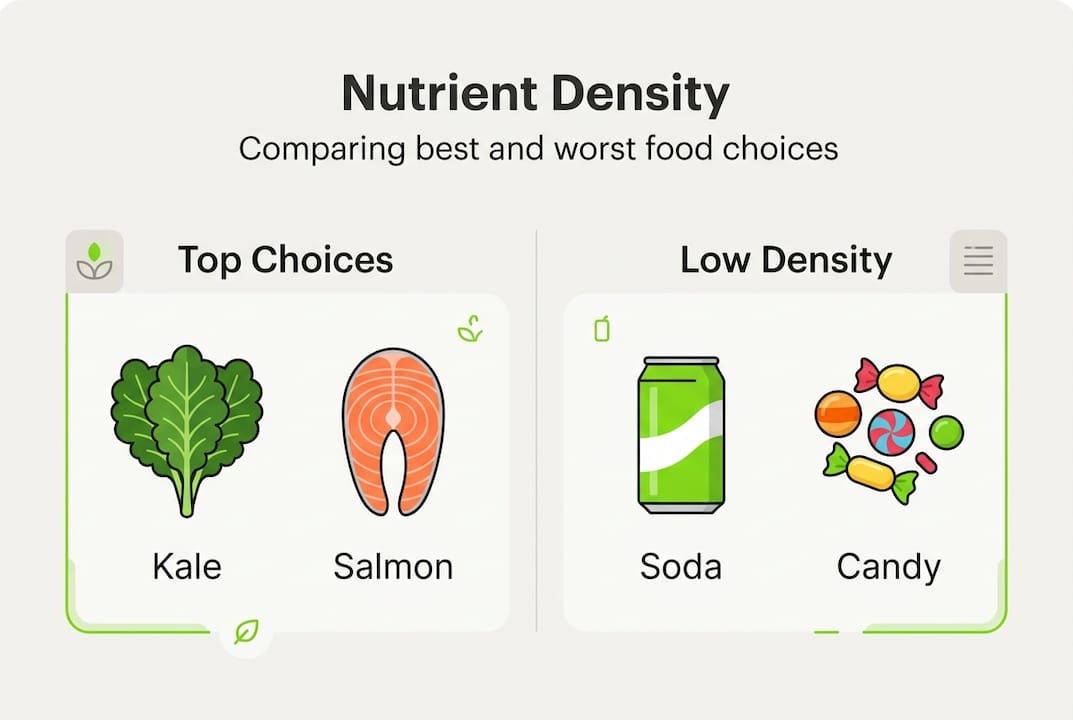
Let’s look at a direct comparison:
| Food (100 calories) | Key nutrients | Nutrient density rating |
|---|---|---|
| Kale | Vitamins A, C, K, calcium, iron | Very high |
| Grilled salmon | Protein, omega-3s, B12, selenium | Very high |
| White bread | Minimal vitamins, low fiber | Low |
| Regular soda | None | Very low |
Cabbage gives you a full cup for just 22 calories. Brussels sprouts clock in at 38 calories per cup, and both are loaded with vitamin C, fiber, and cancer-fighting compounds. That’s an extraordinary return on your calorie investment.
For nutrient dense vegan foods, options like lentils, chickpeas, spinach, and fortified plant milks deliver impressive nutrition without animal products. And for anyone building healthy dinner options, pairing a lean protein with a colorful vegetable is one of the simplest high-density strategies you can use.
Here are some easy swaps to raise the nutrient density of your meals:
- Swap white rice for quinoa or cauliflower rice
- Replace chips with raw veggies and hummus
- Choose water or sparkling water over soda
- Pick whole grain bread over white bread
- Add spinach or kale to smoothies, soups, and sauces
- Use beans or lentils to bulk up meals instead of extra pasta
The Harvard balanced meals guide recommends building your plate around low-calorie, nutrient-rich foods as the foundation of a healthy diet. It’s not about eating less. It’s about eating smarter.
Practical tips to boost nutrient density in your diet
With inspiring examples in mind, here’s how you can put nutrient density into practice for your own wellness.
-
Start with color. The more colorful your plate, the more diverse your nutrient intake. Different pigments in plants signal different vitamins and antioxidants. Red peppers, orange sweet potatoes, dark leafy greens, and purple cabbage each bring something unique.
-
Shop the perimeter. Grocery store layouts typically place whole foods (produce, meat, dairy) around the edges and processed foods in the middle aisles. Choosing brightly colored produce and lean proteins over empty calories maximizes nutrition without excess energy.
-
Read labels with density in mind. Instead of just checking calories, look at the %DV column. A food that gives you 20% of your daily iron for 80 calories is a much better deal than one that gives you 2% for the same calories.
-
Plan meals around a protein and a vegetable. This simple framework naturally pushes nutrient density up. Add a whole grain or legume, and you’ve covered most of your nutritional bases.
-
Make smart swaps when dining out. Restaurants don’t have to derail your goals. Check out tips for eating out healthy to find practical strategies for ordering high-density meals anywhere. Grilled over fried, salad over fries, water over soda.
-
Batch prep high-density staples. Cook a big batch of lentils, roast a tray of vegetables, and hard-boil some eggs at the start of the week. These become easy building blocks for nutrient-rich meals. For inspiration, explore plant-based lunch ideas that are quick, filling, and packed with nutrients.
Pro Tip: You don’t need to overhaul your entire diet overnight. Replacing just one low-density food per day with a high-density alternative adds up to significant nutritional gains over weeks and months.
Beyond the basics: advanced insights and common pitfalls
Once you’re applying nutrient density ideas, it’s smart to know where most people go wrong and how advanced users refine their eating habits.
One major limitation of nutrient density scores is bioavailability, which means how well your body actually absorbs a nutrient from a given food. Spinach is rich in iron, but plant-based iron (non-heme iron) absorbs less efficiently than the heme iron in red meat. Expert analysis confirms that models vary widely, and a truly smart approach considers bioavailability, cost, satiety, and the role of animal foods for certain nutrients.
Another edge case involves water content. A cucumber scores brilliantly per 100 calories but looks unremarkable per 100 grams because most of its weight is water. Single food planning uses a target nutrient density formula based on estimated average requirements (EAR) per energy percentile, which helps account for these distortions.
Cost and accessibility also matter. Kale and wild salmon are nutritious, but they’re not always affordable or available. Canned beans, frozen spinach, eggs, and oats are budget-friendly, highly accessible, and genuinely nutrient-dense. Don’t let perfect be the enemy of good.
Also, be cautious about the halo effect of so-called superfoods and their real benefits. Marketing labels can make ordinary foods seem extraordinary and vice versa. A “superfood” smoothie loaded with added sugar is not a health food, regardless of what’s on the label.
Common pitfalls to watch out for:
- Misreading scores: A high ANDI score doesn’t mean unlimited portions. Nuts score well but are calorie-dense.
- Food marketing traps: “Fortified” or “enriched” doesn’t equal naturally nutrient-dense.
- Ignoring variety: Eating only kale every day misses hundreds of other nutrients found in diverse foods.
- Overlooking personal needs: Pregnant women, athletes, and older adults have different nutrient priorities. One-size-fits-all scores don’t capture individual requirements.
- Neglecting satiety: A food can be nutrient-dense but not filling. Pair high-density foods with fiber and protein to stay satisfied.
“Diet quality is about the whole pattern, not a single score. Bioavailability, food synergy, and personal context all shape how nutrients actually work in your body.”
Personalize your nutrition journey with Dietium
Understanding nutrient density is a powerful first step. Applying it consistently to your unique lifestyle, goals, and food preferences is where real change happens. Dietium’s platform gives you the tools to do exactly that. Use the AI-powered calculators to track your calorie and nutrient needs, then build around them with personalized meal plans designed to maximize nutrient density for your specific health goals. Not sure where your current diet stands? Start with a nutritional assessment to identify gaps and opportunities. The Recipians app takes your preferences and goals and turns them into practical, delicious meal plans, so you’re never guessing about what to eat next.
Frequently asked questions
Which foods are considered most nutrient-dense?
Leafy greens like kale and collards top most nutrient density lists, alongside lean meats, eggs, beans, and colorful fruits and vegetables. These foods deliver the most vitamins, minerals, and fiber per calorie.
How can I measure nutrient density at home?
Check the %DV on nutrition labels and calculate via %DV per calorie to estimate density. Apps using NRF or ANDI scoring can also rank foods quickly and accurately.
Does nutrient density change when you cook food?
Yes. Cooking can reduce water-soluble vitamins like vitamin C, but it can also increase the bioavailability of other nutrients like lycopene in tomatoes. The method matters as much as the food itself.
Are all low-calorie foods nutrient-dense?
No. Some low-calorie foods offer very little nutritional value. Nutrient-dense foods include fruits, vegetables, lean meats, eggs, beans, and whole grains, not just anything with a low calorie count.


