 Skip to content

TL;DR:
- Portion size refers to the amount of food you serve yourself, which often exceeds the standardized serving size on labels. Understanding the difference helps prevent unintentional overeating, as real-world portions are typically two to three times larger than labeled servings. Using visual cues and small behavioral habits can improve portion estimation and support balanced, nutritious eating habits.
A portion size is the amount of food you choose to put on your plate, and it is almost always different from the standardized serving size printed on a nutrition label. Understanding portion sizes is the single most practical skill for managing calorie intake and building balanced eating habits. The Mayo Clinic defines a portion versus serving distinction that most people overlook: serving size is a fixed reference amount measured in cups, ounces, or pieces, while your portion is whatever you decide to eat. Confusing the two leads to unintentional overeating every day. Tools like measuring cups, Nutrition Facts labels, and simple household object comparisons make learning this skill straightforward and lasting.
What is the difference between portion size and serving size?
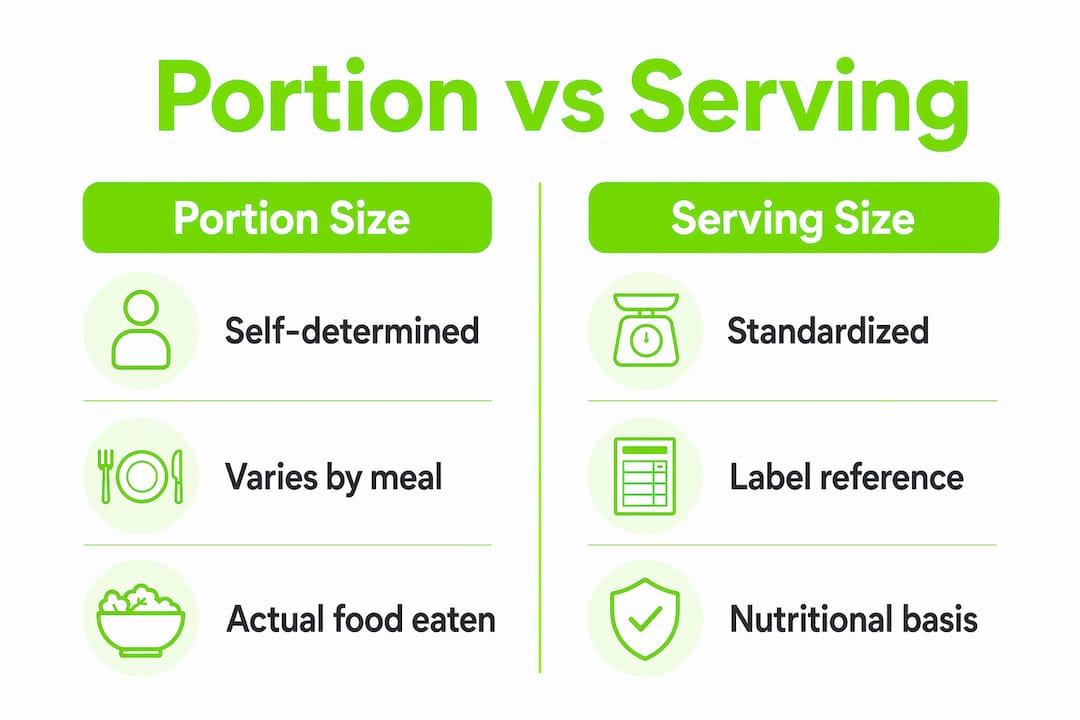
The gap between portion size and serving size is where most people’s calorie math breaks down. A serving size on labels is regulated by the FDA under Reference Amounts Customarily Consumed (RACC) rules. It represents a typical amount people eat, not a recommendation for how much you should eat.
Your portion, by contrast, is entirely self-determined. Pour a bowl of cereal without measuring and you have likely served yourself two or three times the labeled serving size. That means the calorie count you read on the box needs to be multiplied accordingly.
The table below shows how common foods compare between their labeled serving size and the typical portion most people actually eat.
| Food | FDA Serving Size | Typical Portion Eaten |
|---|---|---|
| Breakfast cereal | 3/4 cup (30g) | 1.5–2 cups |
| Pasta (cooked) | 1/2 cup (85g) | 2–3 cups |
| Peanut butter | 2 tablespoons | 3–4 tablespoons |
| Potato chips | 1 oz (about 15 chips) | 2–3 oz |
| Orange juice | 8 fl oz | 12–16 fl oz |
The pattern is consistent: real-world portions run two to three times larger than labeled servings. That gap directly explains why people who read labels still struggle to manage their intake.
Pro Tip: Before your next meal, check the servings-per-container line on the package, not just the calories per serving. A bag of chips labeled 150 calories per serving may contain three servings, putting the full bag at 450 calories.
How to estimate portions without a scale or measuring cup
Visual cues are the most practical tool for judging portion sizes in daily life. The Mayo Clinic recommends using familiar everyday objects to approximate correct servings without any measuring equipment. These comparisons are easy to memorize and apply anywhere, including restaurants and other people’s homes.
Here is a reliable reference list organized by food type:
- Fruit (1 serving): A tennis ball. One medium apple, orange, or peach fits this size.
- Vegetables (1 cup): A baseball. Use this for raw leafy greens or cooked vegetables.
- Protein (3 oz cooked): A deck of cards. Applies to chicken, fish, beef, or tofu.
- Carbohydrates (1/2 cup cooked): A computer mouse or a tightly packed fist. Covers rice, pasta, and oatmeal.
- Cheese (1.5 oz): Four stacked dice. A common portion error is cutting slices two to three times this size.
- Fats and oils (1 teaspoon): A single die. Butter, olive oil, and nut butters are easy to over-pour.
- Nuts (1 oz): A small handful or a golf ball. Calorie-dense foods like almonds and cashews require particular attention.
These visual anchors work because they tie abstract measurements to objects you already know. The learning curve is real but short. WebMD recommends starting with actual measuring cups and spoons for two to four weeks to calibrate your eye. After that initial period, your visual estimates become significantly more accurate because you have a concrete reference point built from real experience.
Pro Tip: Measure your most frequently eaten foods at least once using actual measuring tools. Seeing exactly what 1/2 cup of cooked rice looks like in your specific bowl makes future visual estimates far more reliable than any generic illustration.

Practical portion control tips for home, restaurants, and grocery shopping
Controlling portions does not require constant measuring. A set of consistent behavioral habits does most of the work. WebMD’s portion control guidance identifies several strategies that reduce intake without requiring calorie counting at every meal.
Follow these steps to build reliable portion habits across different eating situations:
- Switch to smaller plates and bowls. A standard dinner plate today is 12 inches across, compared to 9 inches in the 1960s. A smaller plate filled to the edge looks satisfying and naturally reduces the amount you serve yourself.
- Never eat directly from the package. Pour snacks into a bowl or onto a plate first. Eating from a bag removes all visual feedback about how much you have consumed.
- Portion leftovers before storing them. Divide cooked food into individual containers immediately after cooking. This removes the decision point at the next meal and prevents gradual portion creep.
- At restaurants, box half the meal before you start eating. Restaurant portions are typically two to three times a standard serving. Asking the server to box half immediately removes the temptation to finish the plate. For more strategies, Dietium’s guide on eating out healthy covers this in detail.
- Check servings-per-container before buying. At the grocery store, a product that looks like a single-serve item often contains two or more servings. Identifying this before purchase helps you plan intake accurately.
- Use your hand as a portable measuring tool. Your fist, palm, and thumb are always with you. A palm-sized portion of protein, a fist of carbohydrates, and a thumb of fat covers the basic structure of a balanced plate.
- Slow down and pause mid-meal. Satiety signals take about 20 minutes to reach the brain. Eating slowly and pausing halfway through gives your body time to register fullness before you have overeaten.
How to read nutrition labels to control your portions
Nutrition Facts labels are the most accurate tool for understanding nutritional portions, but only if you read them correctly. The FDA requires that serving sizes reflect typical consumption amounts, expressed in household measures plus metric units. The label is a reference, not a prescription.
The critical number most people skip is servings per container. Consuming an entire package often means eating multiple servings unintentionally, multiplying every nutrient value listed. The table below shows how to scale label data to your actual portion.
| Food | Serving Size (Label) | Calories per Serving | If You Eat This Much | Actual Calories |
|---|---|---|---|---|
| Granola | 1/4 cup | 120 | 1 cup | 480 |
| Salad dressing | 2 tablespoons | 80 | 6 tablespoons | 240 |
| Pasta sauce | 1/2 cup | 70 | 1.5 cups | 210 |
| Greek yogurt | 2/3 cup | 150 | Full 16 oz container | 450 |
The math is straightforward, but it only works if you know how much you are actually eating. Dietium’s resource on reading nutrition labels walks through this process step by step for common packaged foods.
WebMD emphasizes verifying label serving sizes early in your nutrition learning process. Smaller serving sizes on labels are typically much less than what people assume. Measuring your portions against label amounts at least once per food item builds lasting awareness of true serving amounts.
Why portion sizes matter for balanced nutrition
Portion sizing is not only about weight management. It is the mechanism through which you meet your daily nutrient requirements across all food groups. Average daily calorie needs are approximately 2,000 calories for women and 2,500 for men, though these figures shift based on age, activity level, and individual metabolism. Your calorie needs by age affect exactly how large or small your portions should be at each meal.
Balanced portions across food groups deliver the full spectrum of macronutrients and micronutrients your body needs. The British Heart Foundation recommends using the Eatwell Plate model as a proportional guide, with roughly half the plate as fruits and vegetables, one quarter as starchy carbohydrates, and one quarter as protein. Eating at least five portions of fruits and vegetables daily supports fiber intake, gut health, and micronutrient density.
Here is what balanced daily portioning looks like in practice:
- Fruits and vegetables: At least 5 portions daily. One portion equals roughly 80g or one medium piece of fruit.
- Starchy carbohydrates: 3–4 portions daily. One portion is about 1/3 cup of cooked rice or one medium potato.
- Protein: 2–3 portions daily. One portion is 3 oz of cooked meat, fish, or legumes.
- Dairy or alternatives: 2–3 portions daily. One portion is 1 cup of milk or 1.5 oz of cheese.
- Fats and oils: Small amounts. One portion is 1 teaspoon of oil or a thin spread of butter.
Portion sizing ties directly to fulfilling daily nutritional needs through balanced intake across food groups, not just calorie restriction. Getting this balance right consistently is what separates short-term dieting from long-term healthy eating.
Key takeaways
Accurate portion sizing is the foundation of balanced nutrition because it determines how much of every nutrient you actually consume relative to your body’s daily needs.
| Point | Details |
|---|---|
| Portion vs. serving size | A portion is what you eat; a serving size is a standardized FDA reference on the label. |
| Visual cues work | Use a deck of cards for protein, a fist for carbs, and a die for fats to estimate portions anywhere. |
| Labels require scaling | Always check servings per container and multiply nutrient values by how much you actually eat. |
| Smaller plates reduce intake | Switching to a smaller plate naturally decreases how much you serve yourself without counting calories. |
| Balance across food groups | Aim for at least 5 fruit and vegetable portions daily alongside measured carb, protein, and fat servings. |
What i’ve learned after years of watching people struggle with portions
The most common mistake I see is treating the serving size on a label as a suggestion for a reasonable meal. It is not. It is a regulatory reference point, and it is often shockingly small compared to what most people consider a normal amount to eat. A single serving of pasta is half a cup cooked. Almost no one eats half a cup of pasta.
The second mistake is skipping the measuring phase entirely and jumping straight to visual estimation. Visual estimation is the goal, but it requires calibration first. Measuring portions temporarily using actual cups and spoons for a few weeks is what makes the visual cues accurate later. Without that foundation, you are guessing, and most people’s guesses run 30–50% high on calorie-dense foods.
What actually works is combining methods. Use the plate model as your daily framework, hand cues as your portable backup, and occasional measuring for foods you eat frequently. Portion size estimation is most accurate when you combine multiple frameworks rather than memorizing fixed volumes for every food. That combination approach is also the most sustainable because it does not require perfection at every meal.
Patience matters here. Portion control is a learned skill, not an innate ability. Most people see meaningful improvement in their accuracy within four to six weeks of consistent practice. The goal is not to measure forever. The goal is to build a reliable internal sense of what a balanced plate looks like for your body and your goals.
— Srasti
How Dietium helps you put portion control into practice
Knowing the rules of portion sizing is one thing. Applying them consistently to your actual meals is another. Dietium’s personalized diet planning tool builds meal plans calibrated to your specific calorie needs, food preferences, and health goals, so portion sizes are built into every recipe from the start. The Recipians app goes further by suggesting meals, tracking your intake, and adjusting recommendations as your goals evolve. If you want a structured starting point that removes the guesswork from daily portioning, Dietium’s personalized meal plans are designed exactly for that.
FAQ
What is the difference between a portion and a serving size?
A portion is the amount of food you choose to eat at one meal. A serving size is a standardized reference amount set by the FDA for use on nutrition labels, and the two are rarely the same.
How do i measure portions without a scale?
Use everyday objects as visual guides: a deck of cards for 3 oz of protein, a fist for 1 cup of carbohydrates, and a single die for 1 teaspoon of fat. WebMD recommends starting with actual measuring tools to calibrate these visual estimates before relying on them daily.
Why do nutrition labels show such small serving sizes?
FDA regulations require serving sizes to reflect Reference Amounts Customarily Consumed (RACCs), which are based on typical eating amounts. These are reference points for comparing products, not recommendations for how much you should eat.
How many portions of fruit and vegetables should i eat daily?
The British Heart Foundation recommends at least 5 portions of fruits and vegetables per day. One portion equals roughly 80g, or one medium piece of fruit, or three heaped tablespoons of cooked vegetables.
Does eating from smaller plates actually reduce how much you eat?
Yes. Smaller plates reduce the visual cue that triggers larger self-served portions. WebMD identifies using smaller plates and bowls as one of the most effective behavioral strategies for reducing portion sizes without conscious calorie counting.


