 Skip to content

TL;DR:
- Setting health goals requires starting with a medical checkup, using the SMART framework, and building sustainable habits. Monitoring progress through regular reviews and adjusting goals prevents burnout and ensures lasting success. Focusing on adding healthy behaviors rather than restricting improves adherence and long-term health outcomes.
Setting health goals is the process of creating specific, measurable, and realistic objectives for fitness, nutrition, and overall wellness that direct your daily choices toward better health outcomes. Most people skip the foundational steps, which is exactly why so many goals collapse by week three. Knowing how to set health goals the right way means starting with your current health status, structuring targets with the SMART framework (Specific, Measurable, Attainable, Relevant, Time-bound), and building habits that hold up under real-life pressure. This article gives you the exact steps to do all three.
Why a medical checkup comes before any health goal
A medical checkup is the single most important step before you start any new fitness or nutrition routine. Starting with a health checkup helps set safe, personalized goals, especially if you have a chronic condition, are returning to exercise after a long break, or are making major dietary changes. Your primary care provider reviews your health history, runs basic screenings, and flags any risks that would make certain goals unsafe or counterproductive.
Here is what a standard pre-goal checkup typically covers:
- Blood pressure and resting heart rate to assess cardiovascular readiness for exercise
- Blood glucose and cholesterol panels to guide nutrition targets
- BMI and body composition to set realistic weight or fitness benchmarks
- Medication review to check for interactions with new exercise or diet plans
- Discussion of symptoms such as joint pain, fatigue, or shortness of breath that affect goal design
Many people can start exercise gradually without extensive testing, but awareness of your personal history and symptoms is non-negotiable. Gradual intensity scaling reduces injury risk and builds a sustainable fitness foundation. Skipping this step is the fastest way to set a goal your body cannot safely support.
Pro Tip: Ask your doctor to write down two or three specific numbers from your checkup, such as your resting blood pressure or fasting glucose. These become your baseline data points for measuring real progress.

How to set health goals using the SMART framework
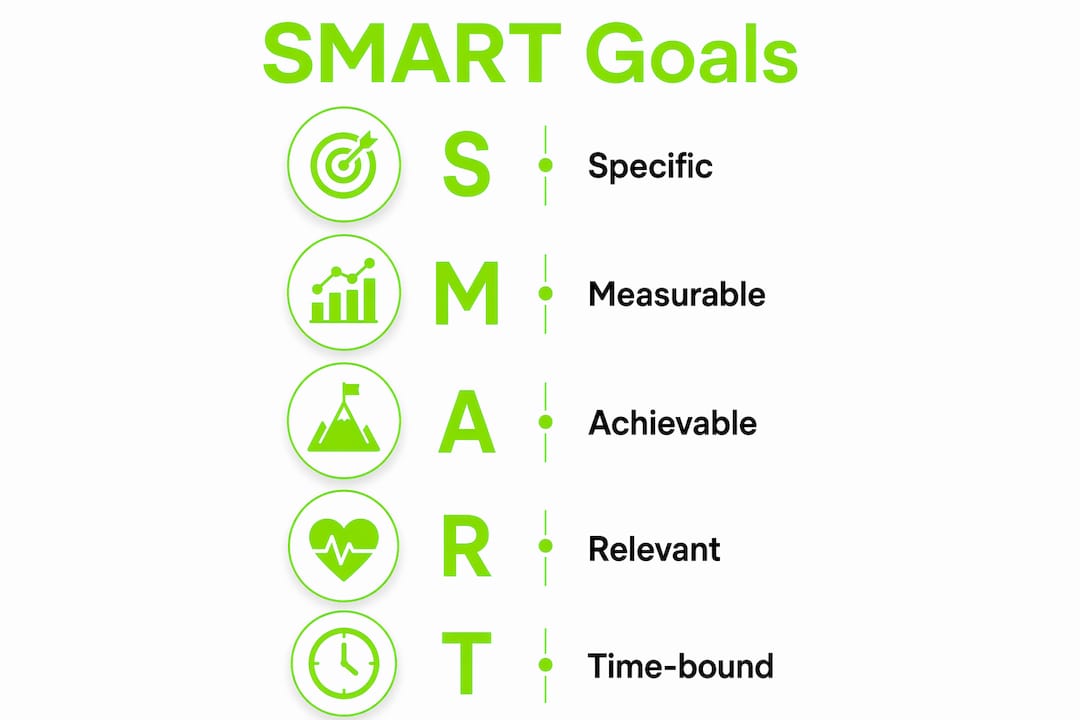
SMART goals are defined as objectives that are Specific, Measurable, Attainable, Relevant, and Time-bound. This structure transforms vague intentions into trackable plans. “Get healthier” is not a goal. “Walk 30 minutes five days a week for the next eight weeks” is a SMART goal.
Here is how each component applies to real health goal planning:
- Specific: Name the exact behavior. “Eat vegetables at lunch and dinner” beats “eat better.”
- Measurable: Attach a number. “Drink 64 ounces of water daily” is trackable. “Drink more water” is not.
- Attainable: Match the goal to your current capacity. If you currently walk zero days a week, starting with five days is a setup for failure. Two days is attainable.
- Relevant: Connect the goal to a health outcome you care about. If your checkup flagged high LDL cholesterol, a nutrition goal targeting saturated fat intake is directly relevant.
- Time-bound: Set a deadline. Time-bound smaller goals prevent stalls and make progress visible. A four-week target creates urgency without overwhelming you.
SMART vs. vague goal comparison
| Vague Goal | SMART Version |
|---|---|
| Lose weight | Lose 6 pounds in 10 weeks by reducing added sugar intake |
| Exercise more | Strength train 3 days per week for 45 minutes for 8 weeks |
| Eat healthier | Add one serving of leafy greens to lunch daily for 30 days |
| Reduce stress | Practice 10-minute guided meditation 5 nights per week |
| Drink more water | Drink 64 oz of water daily, tracked in a journal |
One important nuance: rigid application of SMART can oversimplify goal setting. Goals that are too aggressive create anxiety and dropout. The research is clear that goals should be optimally challenging, not maximally challenging. If a goal feels overwhelming after two weeks, that is data, not failure.
Pro Tip: Set no more than two or three SMART goals at a time. Prioritizing a few goals over multiple competing ones reduces stress and improves long-term commitment.
How do you build habits that support your health goals?
Practical goal setting relies more on strategic planning and environment design than on motivation or willpower alone. Motivation fluctuates. Your environment stays constant. Designing your surroundings to make healthy choices easier is the most reliable way to build healthy habits naturally over time.
The most effective habit-building strategies include:
- Habit stacking: Attach a new behavior to an existing one. “After I pour my morning coffee, I will take my vitamins.” This removes the need to remember or decide.
- Reducing friction: Put your gym bag by the door. Keep cut vegetables at eye level in the fridge. Make the healthy choice the path of least resistance.
- Breaking big goals into micro-habits: If your goal is to run a 5K, start with a 10-minute walk three times a week. Small wins build the identity of someone who exercises.
- Meal prepping on Sundays: Preparing lunches and snacks in advance removes the decision fatigue that leads to poor food choices on busy weekdays.
One counterintuitive strategy that consistently outperforms restriction-based approaches: focus on adding healthy behaviors instead of eliminating bad ones. “Drink a glass of water before each meal” crowds out soda more effectively than “stop drinking soda.” Addition is psychologically easier than subtraction.
Setbacks are not the end of a goal. They are a normal part of the process. The only real failure is not restarting. When you miss a day or a week, treat it as a data point and adjust, not a reason to quit.
For nutrition-specific targets, Dietium’s guide on setting nutrition goals covers how to structure eating behaviors with specific frequencies and deadlines that make monitoring straightforward.
How to monitor and adjust your health goals over time
Tracking progress is not optional. It is the mechanism that tells you whether your plan is working or needs to change. The most effective tracking methods combine objective data with behavioral records.
Tracking methods by goal type
| Goal Type | Tracking Method | Review Frequency |
|---|---|---|
| Fitness | Workout log or fitness app (steps, reps, duration) | Weekly |
| Nutrition | Food journal or calorie tracking app | Daily or weekly |
| Body composition | BMI, body fat percentage, measurements | Monthly |
| Sleep and recovery | Sleep tracker or written log | Weekly |
| Chronic condition markers | Lab results, blood pressure readings | Per doctor schedule |
Regular follow-up appointments with your healthcare provider reinforce accountability and enable goal revision based on real data. Screenings and lab tests are not just diagnostic tools. They are progress checkpoints. Dietium’s wellness tracking techniques resource outlines specific methods for monitoring body metrics like BMI, body fat percentage, and calorie needs across different goal types.
Knowing when to revise a goal is as important as setting it. If you have been consistent for four weeks and see no measurable change, the goal itself may need adjustment, not just your effort level. Tailoring goals to fit real life and perceived attainability prevents the anxiety and dropout that come from chasing targets that no longer fit your circumstances.
Pro Tip: Schedule a monthly “goal audit” in your calendar. Review what is working, what is not, and adjust one variable at a time. Changing everything at once makes it impossible to know what actually moved the needle.
Balancing challenge with attainability is the core skill in long-term health goal planning. Too easy and you lose motivation. Too hard and you burn out. The sweet spot is a goal that requires consistent effort but delivers visible progress within four to six weeks. For those focused on weight management specifically, Dietium’s resource on weight loss goal setting applies these same principles to a specific and common health objective.
You can also use wellness progress tracking strategies that focus on behavioral consistency rather than outcome numbers alone, which is especially useful when the scale or other metrics are slow to move.
Key takeaways
Effective health goal setting requires a medical baseline, a structured SMART framework, habit design, and consistent progress tracking to produce lasting results.
| Point | Details |
|---|---|
| Start with a checkup | Get baseline metrics from your doctor before setting any fitness or nutrition targets. |
| Use the SMART framework | Make every goal Specific, Measurable, Attainable, Relevant, and Time-bound. |
| Design your environment | Reduce friction and stack habits onto existing routines to replace willpower with structure. |
| Add, do not restrict | Focus on adding healthy behaviors first; they crowd out unhealthy ones more sustainably. |
| Track and revise regularly | Review progress monthly and adjust one variable at a time to stay on course. |
The part most goal-setting advice gets wrong
I have seen hundreds of people approach health goals with the same pattern: they set ambitious targets in january, go hard for two weeks, then disappear. The conventional advice says they lacked discipline. I disagree. They lacked a realistic starting point.
The most common mistake is not setting goals that are too easy. It is setting goals that are completely disconnected from current behavior. Someone who has not exercised in two years does not need a five-day-a-week gym plan. They need a two-day plan that builds the identity of someone who exercises. Identity comes before outcome.
The second mistake is treating every missed day as evidence of failure. Progress in health is not linear. Your body adapts in waves, not straight lines. The people who succeed long-term are not the ones who never slip. They are the ones who restart faster. A missed Wednesday does not erase a good Monday and Tuesday.
My honest recommendation: pick one goal in each of the three core areas, fitness, nutrition, and recovery, and make each one almost embarrassingly easy for the first month. You are not training your body in month one. You are training your consistency. Once consistency is established, increasing the challenge is straightforward. Skipping that foundation is why most people are back at square one by february.
— Srasti
How Dietium helps you build a personalized health plan
Dietium takes the guesswork out of health goal planning by combining AI-powered calculators with personalized meal and fitness tools. You can track body metrics like BMI, body fat percentage, and calorie needs directly on the platform, giving you the baseline data your goals require. The Recipians app delivers custom meal plans for every health goal, from weight management to chronic condition support, with recipe suggestions and fitness routines aligned to your specific targets. For a fully personalized diet plan built around your real numbers and objectives, Dietium provides the tools and expert content to get you started today.
FAQ
What is the first step in setting health goals?
The first step is a medical checkup to establish your baseline health metrics. Your doctor’s findings on blood pressure, glucose, and body composition give you the data your goals need to be safe and realistic.
How do SMART goals apply to fitness and nutrition?
SMART goals apply by turning vague intentions into specific, trackable behaviors with deadlines. For example, “strength train three days per week for eight weeks” is SMART; “exercise more” is not.
How often should you review and adjust your health goals?
Review your goals monthly. If consistent effort over four weeks produces no measurable change, adjust one variable, such as frequency, intensity, or nutrition target, before changing everything at once.
What is the best way to track nutrition goals?
A daily food journal or a calorie and macro tracking app provides the most accurate picture of nutritional intake. Weekly reviews of that data reveal patterns and help you adjust portion sizes or food choices.
Why do most health goals fail within the first month?
Most goals fail because they are too aggressive relative to current behavior. Goals that are optimally challenging rather than maximally challenging produce better adherence and reduce the anxiety that causes early dropout.


