 Skip to content

Most American millennials in cities are surprised to learn that over 60 percent regularly misinterpret nutrition labels, affecting their weight and overall health. With the constant flood of convenience foods and global food trends, decoding food packaging can quickly become confusing. This guide will help you master every nutrition label so you can confidently make healthier choices and manage your goals, giving you clarity instead of confusion on your next grocery trip.
Table of Contents
- Step 1: Set Up Your Nutrition Goals
- Step 2: Identify Key Label Sections
- Step 3: Compare Serving Sizes Accurately
- Step 4: Analyze Macronutrients and Calories
- Step 5: Verify Ingredients for Hidden Risks
Quick Summary
| Key Insight | Explanation |
|---|---|
| 1. Understand Serving Sizes | Recognizing true serving sizes prevents overconsumption and helps align with your dietary goals effectively. |
| 2. Navigate Nutrition Labels | Knowing how to read label sections aids in evaluating food options, ensuring they fit your nutritional objectives. |
| 3. Compare Portions Accurately | Accurately measuring servings protects against unintentional calorie surplus and facilitates balanced eating habits. |
| 4. Analyze Macronutrients | Understanding macronutrient qualities ensures proper energy intake and dietary balance tailored to your health goals. |
| 5. Verify Ingredients List | Scrutinizing ingredient lists reveals hidden sugars and unhealthy additives, helping you make better food choices. |
Step 1: Set Up Your Nutrition Goals
Establishing clear nutrition goals is your roadmap to healthier eating. By understanding how to read nutrition labels and align them with your personal health objectives, you can make informed dietary decisions that support your wellness journey.
Start by understanding serving sizes carefully. The first key element is recognizing how many servings are actually in a package and what constitutes a single serving. Many people mistakenly consume multiple servings without realizing it, which can significantly impact their nutritional intake. Check the serving size at the top of the nutrition label and compare it to how much you typically eat.
Next, evaluate your specific health goals. Are you aiming to lose weight, build muscle, manage a health condition, or simply maintain a balanced diet? Your goals will determine which nutritional aspects you should focus on most. For someone watching their weight, calorie count and serving size become crucial. If heart health is your priority, limiting saturated fats and added sugars will be a key strategy.
Pro tip: Create a personal nutrition tracking spreadsheet to log your daily intake and compare it against your specific health goals, making adjustments as you learn more about your dietary patterns.
Step 2: Identify Key Label Sections
Understanding the nutrition label is like decoding a blueprint for your health. This section will help you quickly navigate and comprehend the critical information packed into every food package.
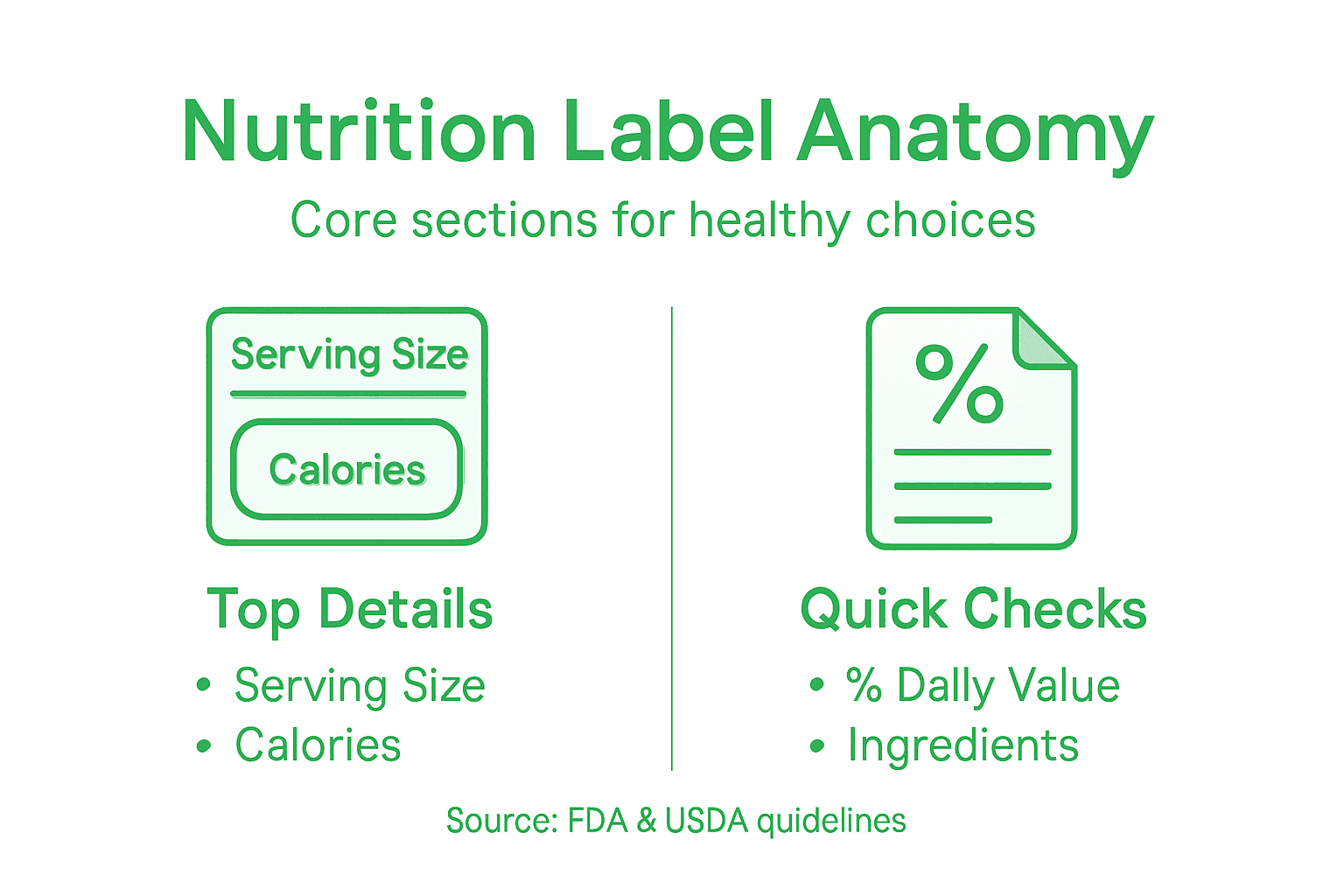
Start by focusing on key nutrition label sections. At the top, you will find the serving size and total calories per serving, which act as your foundational reference point. Serving sizes are standardized to help you compare different products accurately. Right below these numbers, look for the breakdown of nutrients youll want to limit or increase. These typically include total fat, saturated fat, cholesterol, sodium, total carbohydrates, and protein.
As you scan the label, pay close attention to the % Daily Values column. These percentages indicate how much of each nutrient is contained in a single serving relative to a standard daily diet. The FDA recommends using these values to quickly assess whether a food item fits into your nutritional goals. Foods with high percentages of beneficial nutrients like fiber, vitamins, and minerals can be great additions to your diet, while those with excessive sodium, added sugars, or saturated fats might require moderation.
Pro tip: Always keep a small magnifying glass or reading glasses nearby to help you read the fine print on nutrition labels more easily.
Step 3: Compare Serving Sizes Accurately
Mastering the art of comparing serving sizes is crucial for making informed nutritional choices. Understanding how to accurately assess portion sizes will help you manage your calorie intake and nutritional balance more effectively.
Comparing serving sizes accurately requires careful attention to detail. Start by looking at the serving size information at the top of the nutrition label, which tells you the standard portion for that specific food item. Most people make the mistake of assuming the entire package represents a single serving, when in reality, many packages contain multiple servings. Do a quick math check multiply the nutrition facts by the number of servings in the container to understand your total intake.

The FDA recommends paying close attention to how serving sizes relate to your actual consumption. For example, a small bag of chips might list 2.5 servings per container. If you eat the entire bag, youre consuming 2.5 times the calories and nutrients listed on the label. Use measuring cups or a food scale to ensure youre consuming the exact serving size, especially when tracking calories or managing specific dietary goals.
Pro tip: Keep a set of standard measuring cups in your kitchen to quickly and accurately portion out recommended serving sizes.
Here’s a quick overview of common nutrition label mistakes and how to avoid them:
| Mistake | Impact | Simple Solution |
|---|---|---|
| Ignoring true serving size | Overconsuming calories | Always check servings per container |
| Misinterpreting % Daily Value | Nutrient imbalance | Reference percentages for daily needs |
| Overlooking ingredients list | Hidden harmful additives | Scan first three ingredients closely |
| Focusing only on calories | Missing overall nutrition quality | Analyze protein, fat, and carb ratios |
| Not measuring portions | Inaccurate intake tracking | Use cups or scale for accuracy |
Step 4: Analyze Macronutrients and Calories
Breaking down the nutritional content of your food is key to understanding how what you eat impacts your health and fitness goals. This step will help you decode the macronutrient puzzle on nutrition labels.
Understanding macronutrient balance starts with recognizing the three primary macronutrients: carbohydrates, proteins, and fats. Each plays a unique role in your body and provides different amounts of energy. Look at the gram amounts next to each macronutrient on the label to assess their proportions. Carbohydrates and proteins provide 4 calories per gram, while fats deliver 9 calories per gram, making them more calorie dense.
The American Heart Association recommends focusing on the quality of macronutrients rather than just their quantity. Pay special attention to the types of fats specifically limiting saturated and trans fats while prioritizing foods with healthy unsaturated fats. For added sugars, aim to keep them as low as possible. Consider your personal health goals when analyzing these numbers some people might need more protein for muscle building, while others might focus on reducing overall calorie intake.
Pro tip: Create a simple spreadsheet to track your daily macronutrient intake and compare it against your personal health and fitness objectives.
Compare how each macronutrient supports different health goals:
| Macronutrient | Primary Function | Best For |
|---|---|---|
| Carbohydrates | Quick energy source | Endurance and active lifestyles |
| Protein | Muscle repair and growth | Building muscle, weight management |
| Fat | Long-term energy, absorption | Heart health, hormone balance |
Step 5: Verify Ingredients for Hidden Risks
Ingredient lists are your secret weapon in uncovering potential nutritional landmines hidden in seemingly healthy foods. Learning to decode these lists will help you make smarter, more informed dietary choices.
Understanding ingredient transparency requires a strategic approach. Ingredients are listed in descending order by weight, meaning the first few items represent the largest proportion of the product. Watch for red flags like partially hydrogenated oils, which signal trans fats, and added sugars masquerading under multiple names such as corn syrup, dextrose, maltose, or anything ending in syrup or sugar. Be especially cautious of products where sugar appears in the first few ingredients.
The global food labeling standards emphasize the importance of detecting potential health risks through careful ingredient examination. Pay special attention to allergen warnings and artificial additives. Look for short ingredient lists with recognizable whole food components. If you cannot pronounce or understand an ingredient, it might be a processed additive that offers little nutritional value. Consider products with fewer, more natural ingredients as healthier alternatives.
Pro tip: Download a free ingredient decoder app to quickly identify and understand unfamiliar or potentially harmful ingredients while shopping.
Take Control of Your Nutrition with Personalized Support from Dietium
Mastering nutrition labels can feel overwhelming when trying to balance serving sizes, macronutrients, and ingredient lists. This article reveals the critical challenges many face such as accurately comparing serving sizes, understanding % Daily Values, and uncovering hidden sugars or unhealthy fats. If you want to transform this knowledge into confident daily decisions that match your unique health goals, you need more than just information — you need a personalized system that adapts with you.
At Dietium, we understand these struggles and offer a comprehensive platform designed to simplify your journey. Our Recipians app creates custom meal plans and recipe suggestions based on your nutrition goals and dietary preferences. Combine this with advanced AI-powered tools like body metric calculators and real-time tracking to ensure you stay on target. Ready to turn the complexity of reading nutrition labels into powerful actions? Discover expert guidance, convenient meal planning, and fitness routines all in one place at Dietium.com. Start your transformation now and make every food choice count.
Frequently Asked Questions
How do I determine the correct serving size on nutrition labels?
Understanding the correct serving size is essential to manage your nutritional intake. Start by locating the serving size listed at the top of the nutrition label, and compare it to how much you typically consume. For accuracy, use a measuring cup or scale to portion out your food according to the recommended serving size.
What are the most important components to look for on a nutrition label?
The most important components to focus on are serving size, total calories, saturated fats, added sugars, and protein. Review the % Daily Values for each nutrient to assess how a food fits into your overall dietary goals. Use this information to make informed choices that align with your health objectives.
How can I analyze the macronutrient content of a food item?
To analyze macronutrient content, check the nutrition label for the grams of carbohydrates, proteins, and fats per serving. Remember that carbohydrates and proteins provide 4 calories per gram, while fats provide 9 calories. Track your daily intake and make adjustments based on your specific health goals, such as increased protein for muscle building.
What should I watch out for in ingredient lists on food labels?
When reviewing ingredient lists, watch for harmful additives like partially hydrogenated oils and excessive sugars, which can be listed under various names. Check that the first few ingredients are whole food items and avoid products with long, unrecognizable ingredient lists. This helps you choose healthier options and avoid processed foods.
How can I effectively track my daily nutritional intake?
To effectively track your daily nutritional intake, create a personal tracking spreadsheet that logs what you eat against your health goals. Include sections for calories, macronutrients, and any nutrients you are focusing on, such as fiber or added sugars. Update this daily to identify patterns and make necessary adjustments in your diet.
What common mistakes should I avoid when reading nutrition labels?
Common mistakes include overlooking the true serving size, misinterpreting % Daily Values, and neglecting the ingredients list. Always check the number of servings per container and compare nutrient percentages to your daily needs. This will help prevent overconsumption and promote balanced nutrition.
Recommended
- How to Read Nutrition Labels: A Beginner’s Guide – Dietium
- Eating Out Healthy: Smart Steps for Nutritious Dining Choices – Dietium
- Understanding Healthy Eating at Restaurants – Dietium
- 7 Essential Healthy Pantry Staples for Smarter Nutrition – Dietium
- Hair Nutrition Food: Boosting Growth and Vitality | MyHair


