 Skip to content

TL;DR:
- Most online nutrition advice is misinformation driven by commercial interests, with myths often based on emotional appeal. Evidence shows that whole foods, balanced macronutrients, and sustainable habits improve health, while restrictive diets and supplements pose risks. Critical evaluation of sources and focusing on long-term dietary patterns are essential to avoiding confusion and making effective health decisions.
Most nutrition advice circulating online is wrong, oversimplified, or driven by commercial interests rather than evidence. Nutrition myths debunked by current research reveal a consistent pattern: the foods and habits demonized for decades are often neutral or beneficial, while the “solutions” sold as fixes create new problems. Sources including BBC Food, Harvard-trained oncologist Dr. Ezekiel Emanuel, and the Mayo Clinic agree that carbs, fats, snacking, and exercise are all widely misunderstood. Getting these facts straight is not optional for anyone serious about long-term health. It is the foundation of every good dietary decision you will make.
Which common nutrition myths still persist and why?
Nutrition misinformation persists because it works emotionally. Myths simplify complex processes into appealing, fast-result promises, and social media amplifies those claims through echo chambers and commercial incentives. Understanding which specific myths are most damaging is the first step toward correcting them.
Myth 1: Carbs are fattening
Carbohydrates are the body’s primary fuel source, not a dietary villain. Carbs should form about 50% of daily energy intake, and the real problem is not carb quantity but carb quality. White bread and soda spike blood sugar; lentils, oats, and brown rice do not. The more alarming fact is that 90% of people do not consume enough dietary fiber, which is found almost exclusively in carbohydrate-rich whole foods. Cutting carbs does not fix fiber deficiency. It makes it worse.

Myth 2: All fats are bad
Fat phobia is one of the most damaging common nutrition misconceptions of the past 40 years. Healthy fats from olive oil, nuts, and fatty fish actively reduce disease risk. Half a tablespoon of olive oil per day is associated with a 19% lower mortality risk. The fats that cause harm are trans fats and excessive saturated fats from ultra-processed foods, not the unsaturated fats found in whole plant and animal sources.
Myth 3: You can exercise off a bad diet
Exercise is critical for cardiovascular health, mood, and longevity. It does not, however, give you a calorie-burning bonus that cancels out poor food choices. Humans burn roughly the same calories per day regardless of activity level, because the body compensates by reducing energy expenditure in other areas. Diet quality, not gym time, controls weight management. Exercise and nutrition are partners, not substitutes for each other.
Myth 4: Snacking is always harmful
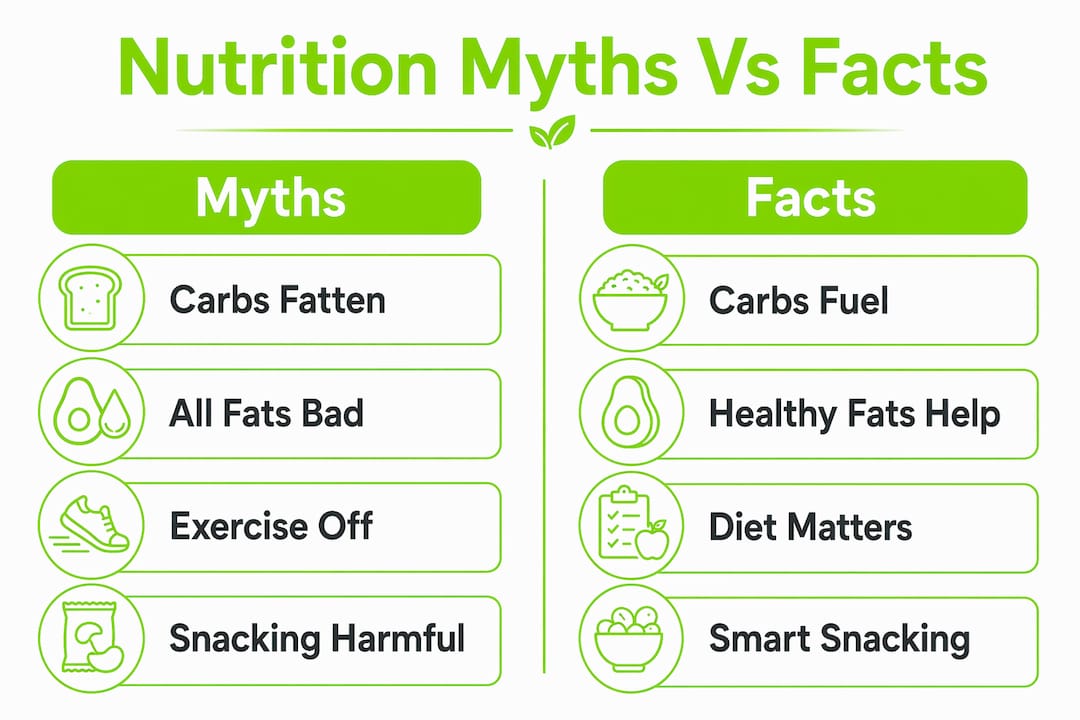
The problem with snacking is not the act itself. It is what most people snack on. The average adult consumes nearly 500 calories daily from snacks, and the majority of those calories come from ultra-processed foods. Nuts, plain yogurt, and fresh fruit are all evidence-backed snack choices that support satiety and nutrient intake. Explore nutrient-dense snack options to replace processed alternatives without sacrificing convenience.
Pro Tip: When evaluating a snack, check the ingredient list before the calorie count. Five ingredients or fewer, with no added sugars in the first three, is a reliable quality signal.
How do nutrition myths impact weight loss and health management?
Believing false nutrition claims does not just slow your progress. It can actively damage your health. Here are the four most consequential ways debunking diet myths matters for real-world outcomes.
-
Restrictive diets cause nutrient deficiencies. Cutting out entire food groups typically produces rapid initial weight loss, but that loss is mostly water, not fat. The body depletes glycogen stores, which hold water, before burning fat. Once glycogen is gone, the scale drops fast but the body begins losing muscle and micronutrients, not just fat. This is one of the most misunderstood weight loss myths debunked by basic metabolic science.
-
The “a calorie is a calorie” myth distorts food choices. 100 calories from candy and 100 calories from vegetables produce entirely different hormonal and metabolic responses. Vegetables trigger satiety hormones, stabilize blood sugar, and deliver fiber. Candy spikes insulin, increases hunger, and delivers nothing nutritionally useful. Treating all calories as equal leads people to choose low-calorie processed foods over whole foods, which is the opposite of what the evidence supports.
-
Protein powder overuse carries real risks. Most Americans already meet their recommended protein intake of 0.75 to 1.0 grams per kilogram of body weight through food alone. The supplement industry has convinced many people otherwise. The consequence is significant: two-thirds of tested protein powders contain unsafe lead levels. Supplementing a nutrient you already get enough of, using a product that may contain heavy metals, is a poor trade. For those seeking plant-based alternatives, reviewing plant protein sources is a safer starting point.
-
Detox diets are medically unnecessary and potentially harmful. The liver and kidneys detoxify the body continuously and effectively without any dietary intervention. Detox diets often omit entire food groups, creating deficiencies in protein, fat-soluble vitamins, and essential minerals. No clinical evidence supports the use of juice cleanses or detox protocols for improving health outcomes. A balanced diet supports the liver and kidneys far better than any cleanse.
What does current science recommend for balanced nutrition?
The evidence for what constitutes a healthy diet is more consistent than most people realize. The disagreement is mostly at the margins, not the center.
| Dietary Element | What the Evidence Says |
|---|---|
| Carbohydrates | Whole grains, legumes, and fruits should supply roughly 50% of daily energy |
| Fats | Olive oil, nuts, avocado, and fatty fish reduce disease risk and support brain function |
| Protein | Most adults meet needs through food; 0.75 to 1.0 g/kg body weight is the target |
| Fiber | Found in whole plant foods; 90% of people fall short of daily recommendations |
| Supplements | Useful only for confirmed deficiencies; not a substitute for whole food variety |
The foundation of evidence-based nutrition, which is the recognized standard term for this approach, is whole foods. Fruits, vegetables, legumes, whole grains, and nuts deliver fiber, micronutrients, and phytocompounds that no supplement replicates. The science of weight gain confirms that dietary pattern matters far more than any single food or nutrient. Moderate dairy inclusion is supported by current research for most adults, particularly for calcium and vitamin D. The question of whether superfoods are real is worth addressing directly: no single food has magical properties, but foods like blueberries, salmon, and leafy greens are genuinely nutrient-dense and worth prioritizing.
Pro Tip: Build meals around a vegetable base first, then add a protein source and a whole grain. This structure naturally produces the macronutrient balance the evidence supports, without tracking every gram.
Extreme restrictions and fad diets consistently underperform in long-term studies. The evidence-based nutrition approach prioritizes variety, adequacy, and sustainability over elimination. Eating patterns that people can maintain for years, not weeks, produce the best health outcomes.
How can you evaluate nutrition information and avoid myths?
Nutrition misinformation is not going away. The ability to assess a claim critically is now a core health skill.
- Check the source type. Peer-reviewed research published in journals like The American Journal of Clinical Nutrition or The Lancet carries more weight than a wellness blog, a supplement brand’s website, or a social media influencer’s testimonial. Registered dietitians and board-certified physicians are the appropriate professionals to consult for personalized advice.
- Watch for absolute language. Claims that a single food “causes cancer,” “burns fat,” or “detoxes your body” are almost always oversimplified. Nutrition science deals in patterns and probabilities, not absolutes. Any source using black-and-white language about complex biological processes is a red flag.
- Recognize confirmation bias. People tend to share and believe nutrition content that confirms what they already want to be true. If a claim tells you that your favorite food is actually healthy or that a food you dislike is toxic, apply extra scrutiny. Social media algorithms reinforce this by showing you more of what you already engage with.
- Assess commercial motive. Most nutrition myths are profitable for someone. The low-fat food industry, the supplement sector, and the detox product market all benefit from specific dietary fears. When a health claim is attached to a product for sale, treat it as marketing until proven otherwise.
- Prioritize sustainable changes. Avoid common dieting mistakes like chasing short-term results through elimination diets. The research consistently shows that gradual, whole-food-based changes outperform rapid interventions for both weight management and long-term health.
Key takeaways
Nutrition myths persist because they are simple, emotionally appealing, and commercially useful. The evidence points consistently toward whole foods, balanced macronutrients, and sustainable habits over any restrictive or supplement-driven approach.
| Point | Details |
|---|---|
| Carbs are not the enemy | Whole-food carbs supply fiber and energy; 90% of people already under-consume fiber. |
| Healthy fats reduce disease risk | Olive oil, nuts, and fish lower mortality risk and do not cause weight gain. |
| Exercise does not cancel diet | The body compensates for activity; food quality drives weight management outcomes. |
| Protein supplements carry risks | Most adults meet protein needs through food; two-thirds of powders contain unsafe lead. |
| Detox diets are unsupported | The liver and kidneys detoxify continuously; cleanses create deficiencies, not benefits. |
Why I think we’re solving the wrong nutrition problem
By Srasti
After years of working in the nutrition and wellness space, the pattern I see most often is not ignorance. It is exhaustion. People are not failing to find nutrition information. They are drowning in it, and most of it contradicts itself from one week to the next.
The real problem is not that people believe carbs are bad or that detoxes work. It is that the information environment makes it genuinely difficult to distinguish a well-designed clinical trial from a sponsored Instagram post. I have watched intelligent, motivated people cycle through elimination diets, protein supplements, and juice cleanses, not because they are gullible, but because the signals are deliberately confusing.
What I have found actually works is far less dramatic than the industry wants you to believe. Eating mostly whole plants, including adequate protein from food sources, and staying consistent over months rather than weeks produces results that no 30-day program matches. The joy of eating matters too. Restriction-based approaches that make food feel like a source of anxiety are not sustainable, regardless of what the macros look like on paper.
The most useful shift you can make is to stop asking “Is this food good or bad?” and start asking “Does this eating pattern support my health over time?” That question has a clear, evidence-based answer. The other one does not.
— Srasti
Take the guesswork out of your nutrition
Generic diet advice fails because it ignores your specific body, goals, and lifestyle. Dietium’s personalized diet planning tools replace one-size-fits-all rules with meal plans built around your actual calorie needs, macronutrient targets, and food preferences. The Recipians app integrates real-time tracking, custom recipe suggestions, and fitness routines so your nutrition plan adapts as your goals evolve. Instead of filtering through conflicting claims online, you get data-driven guidance grounded in the same evidence-based principles covered in this article. Start with a personalized assessment and build a plan that works for your body, not someone else’s.
FAQ
Are carbs actually bad for weight loss?
Carbohydrates are not inherently fattening. Whole-food carbs like oats, legumes, and vegetables support satiety and fiber intake, and cutting carbs often produces water loss rather than fat loss.
Are superfoods real or just marketing?
No single food has unique disease-curing properties, but nutrient-dense foods like blueberries, salmon, and leafy greens are genuinely beneficial as part of a varied diet. The term “superfood” is a marketing label, not a scientific classification.
Do I need protein supplements to build muscle?
Most adults already meet protein needs through food alone. Recommended intake is 0.75 to 1.0 grams per kilogram of body weight daily, and two-thirds of tested protein powders contain unsafe lead levels.
Are detox diets effective for cleansing the body?
Detox diets are not supported by clinical evidence. The liver and kidneys manage toxin removal continuously, and detox protocols often cause nutrient deficiencies by eliminating entire food groups.
How do I know if a nutrition claim is credible?
Check whether the claim is backed by peer-reviewed research and whether the source has a financial interest in your belief. Registered dietitians and board-certified physicians are the appropriate professionals for personalized nutrition guidance.


