 Skip to content

Calorie needs are not set in stone. From childhood to old age, your body’s daily energy requirements shift with every milestone. Dietary research shows that teenagers require up to 1,000 more calories a day than older adults due to faster growth and higher activity levels. Knowing your specific calorie needs can make a big difference in your health, helping you support growth, maintain muscle, and avoid common mistakes that lead to weight gain or fatigue.
Table of Contents
- Defining Calorie Needs By Age Groups
- Caloric Requirements Across Childhood And Adolescence
- Adult And Senior Calorie Needs Explained
- Influencing Factors: Activity, Health, And Lifestyle
- Common Mistakes When Estimating Calorie Needs
- Adjusting Caloric Intake For Optimal Health
Key Takeaways
| Point | Details |
|---|---|
| Calorie Needs Vary by Age | Understanding calorie requirements is essential as they change significantly across different life stages, influenced by metabolism and physical activity. |
| Personalized Nutrition is Key | Utilizing tools like TDEE calculators can help individuals determine their unique caloric needs based on specific characteristics and lifestyle. |
| Consider Lifestyle Factors | Factors such as muscle mass, activity level, and underlying health conditions play a crucial role in determining daily calorie needs. |
| Avoid Common Estimation Mistakes | Many individuals miscalculate their calorie needs by overlooking personal variations, leading to dietary imbalances and weight issues. |
Defining Calorie Needs by Age Groups
Understanding calorie requirements isn’t a one-size-fits-all proposition. Your body’s energy needs shift dramatically across different life stages, influenced by factors like metabolism, muscle mass, and activity level. According to dietary research from spscc, calorie needs vary substantially between age groups, making personalized nutrition crucial.
The 2020 Dietary Guidelines provide a comprehensive breakdown of estimated daily calorie requirements. These recommendations aren’t random numbers but carefully calculated estimates considering physiological changes. For instance, teenagers and young adults typically require more calories due to higher metabolic rates and growth processes, while older adults often need fewer calories as muscle mass naturally decreases.
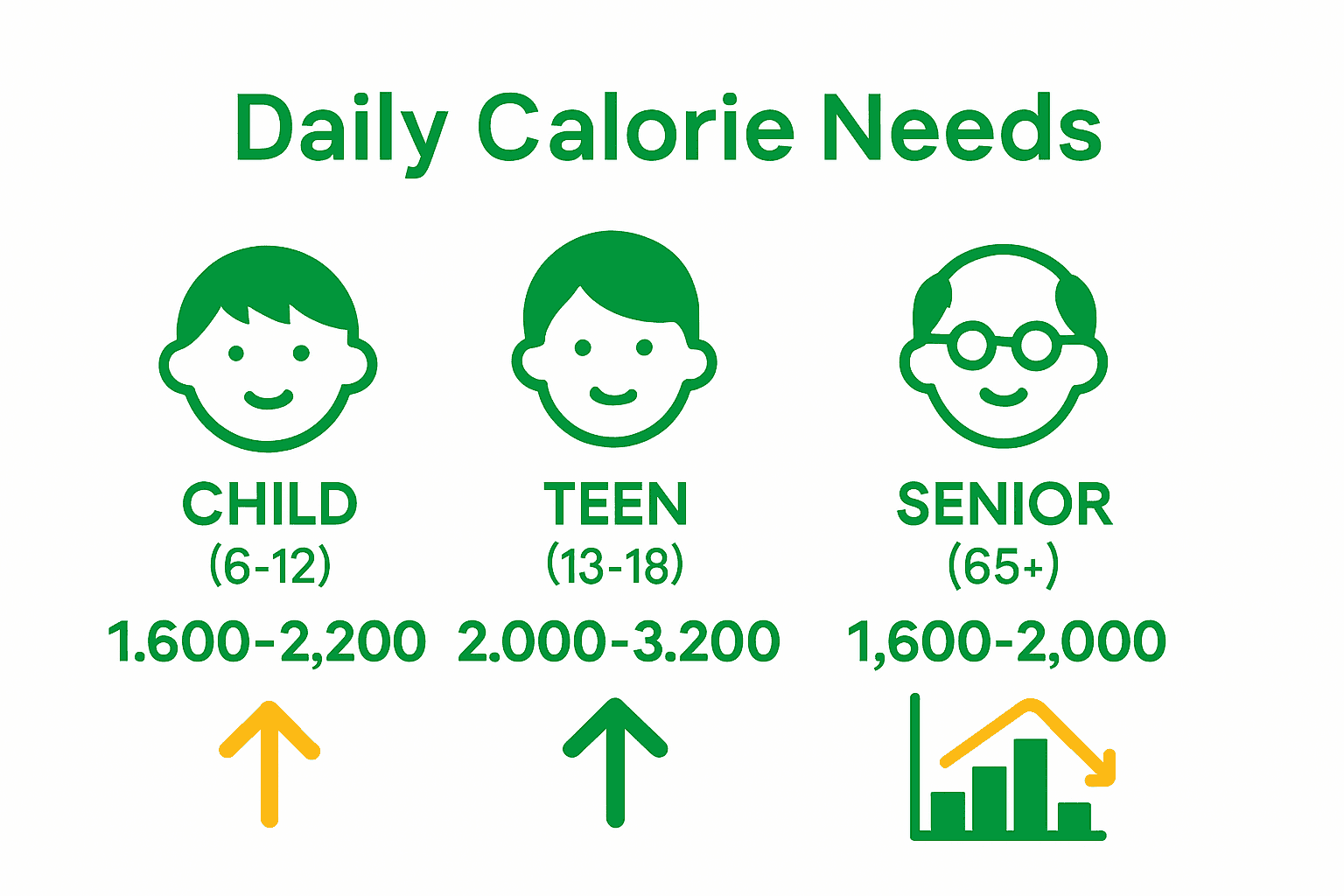
When examining calorie needs, several key factors come into play beyond just age:
- Basal Metabolic Rate (BMR): The calories your body burns at rest
- Physical Activity Level: More active individuals require more energy
- Muscle Mass: Muscles burn more calories even when you’re not exercising
- Hormonal Changes: Metabolic shifts during puberty, pregnancy, and menopause
To accurately determine your specific calorie needs, you’ll want to use a comprehensive TDEE calculator, which accounts for your individual characteristics. Remember, these are guidelines – your unique body composition and lifestyle will ultimately determine your precise nutritional requirements.
Caloric Requirements Across Childhood and Adolescence
Childhood and adolescence represent critical periods of nutritional development where calorie needs fluctuate dramatically. According to research from pmc, caloric requirements are not static but dynamically change based on age, gender, and physical activity levels, making personalized nutrition essential for healthy growth.
The Dietary Guidelines provide nuanced insights into calorie needs across different developmental stages. louis highlights that children and adolescents have uniquely complex nutritional demands. Younger children typically require fewer calories, while teenagers experience significant metabolic changes that dramatically increase their energy requirements – often coinciding with growth spurts, increased physical activity, and hormonal shifts.
Key factors influencing caloric needs during childhood and adolescence include:
- Growth Rate: Rapid physical development requires substantial energy
- Muscle Development: Increasing muscle mass raises metabolic requirements
- Physical Activity: Sports and exercise substantially impact calorie needs
- Puberty: Hormonal changes trigger metabolic transformations
Practical nutritional strategies involve understanding these dynamic needs. While generalized guidelines exist, individual variations mean that consulting healthcare professionals or using comprehensive TDEE calculator tools can provide more accurate, personalized calorie recommendations tailored to specific developmental stages.

Adult and Senior Calorie Needs Explained
Understanding calorie requirements for adults and seniors is more complex than simply counting numbers. According to lenmed, calorie consumption dramatically shifts as we age, influenced by factors like metabolism, muscle mass, and overall activity levels. What worked in your 20s won’t necessarily apply in your 40s or 60s.
Research from faolex reveals that calorie needs vary significantly across different adult life stages. Young adults typically require more energy due to higher metabolic rates and increased physical activity, while seniors experience a natural metabolic slowdown. This metabolic shift means older adults need fewer calories but must focus more on nutrient-dense foods to maintain optimal health.
Key considerations for adult and senior calorie needs include:
- Metabolic Changes: Gradual reduction in resting metabolic rate
- Muscle Mass: Natural decline in muscle tissue after age 30
- Hormonal Shifts: Impact of aging on metabolism and energy expenditure
- Activity Level: Continued importance of physical engagement
For precise nutritional guidance, consider exploring our healthy aging tips to complement your understanding of calorie needs. Remember, individual variation is key – what works for one person might not work exactly the same for another.
Influencing Factors: Activity, Health, and Lifestyle
Calorie needs are far more than simple mathematical equations. According to the en Institute of Medicine Equation, daily energy requirements are a complex interplay of multiple physiological and lifestyle factors. Your calorie consumption isn’t just about age or weight, but a nuanced calculation involving your unique metabolic profile, activity level, and overall health status.
The en Schofield Equation further illuminates how factors like gender, weight, and metabolic rate dramatically influence calorie needs. Essentially, two individuals of the same age and weight might have completely different caloric requirements based on their muscle mass, daily activities, and underlying health conditions. A sedentary office worker will need significantly fewer calories compared to an active athlete or manual laborer.
Key lifestyle factors impacting calorie needs include:
- Physical Activity: Intensity and duration of exercise
- Muscle Mass: More muscle increases metabolic rate
- Stress Levels: Chronic stress can alter metabolic processes
- Sleep Quality: Poor sleep impacts hormone regulation
- Underlying Health Conditions: Metabolic disorders affect energy expenditure
To optimize your nutritional approach, explore our comprehensive lifestyle changes guide that can help you understand how holistic health practices interconnect with your body’s energy requirements. Remember, your calorie needs are as unique as your fingerprint.
Common Mistakes When Estimating Calorie Needs
Calorie estimation isn’t an exact science, and most people fall into predictable traps that can derail their nutritional goals. According to hopewell, one of the most significant miscalculation errors involves drastically underestimating or overestimating physical activity levels. What you might consider a moderate workout could be interpreted differently by nutrition experts.
Many individuals make critical errors when attempting to calculate their daily calorie requirements. They often rely on generic online calculators without considering individual metabolic variations, muscle mass, or subtle differences in daily energy expenditure. A sedentary office worker might incorrectly assume they’re more active than they actually are, leading to potential weight gain or nutritional imbalances.
Common estimation mistakes include:
- Overlooking Muscle Mass: Muscle burns more calories than fat
- Ignoring Metabolic Variations: Individual differences matter significantly
- Misinterpreting Activity Levels: Overestimating daily movement
- Neglecting Hormonal Changes: Metabolism shifts with age and health conditions
- Using One-Size-Fits-All Calculations: Generic formulas rarely account for individual nuances
To get more precise insights, consider using our BMR calculator that helps you understand your unique metabolic profile. Remember, calorie needs are as individual as your fingerprint – what works for someone else might not work for you.
Adjusting Caloric Intake for Optimal Health
Optimal health isn’t about extreme dieting, but strategic nutritional management. According to spscc, achieving nutritional balance requires more than simply counting calories – it’s about understanding how different nutrients interact with your body’s unique metabolic processes.
louis emphasizes that caloric adjustment is a dynamic process, not a static calculation. Your body’s energy requirements constantly shift based on multiple factors like age, activity level, muscle mass, and overall health status. This means your nutritional strategy must be flexible and responsive, adapting to your changing physiological needs.
Key strategies for effective caloric intake adjustment include:
- Monitor Body Composition: Track muscle-to-fat ratio
- Assess Activity Levels: Adjust calories with changing exercise routines
- Consider Metabolic Health: Account for hormonal and metabolic variations
- Prioritize Nutrient Density: Focus on quality, not just quantity
- Regular Self-Assessment: Periodically evaluate your nutritional needs
To help you navigate these complex nutritional adjustments, explore our comprehensive guide on calculating calorie intake that provides practical, personalized insights. Remember, your body is constantly communicating its needs – learning to listen is the first step toward optimal health.
Take Control of Your Calorie Needs with Personalized Support
Navigating your daily calorie requirements can feel overwhelming as your body changes with age. This guide highlights how factors like metabolism, muscle mass, and activity levels impact your energy needs at every stage of life. If you struggle to accurately estimate calories or adjust your intake for growth, aging, or lifestyle shifts, you are not alone. Many face challenges understanding concepts like Basal Metabolic Rate (BMR), Total Daily Energy Expenditure (TDEE), and how hormonal changes influence nutrition.
Dietium offers a solution tailored to your unique physiology and goals so you never have to guess. With our advanced Recipians app, you get custom meal plans and recipe suggestions crafted to match your current calorie needs based on your age, activity level, and metabolic profile. Combine this with powerful tools like our BMR calculator and TDEE calculator to track your body’s demands accurately and make smarter nutritional decisions.
Don’t wait for confusion to slow your progress. Visit Dietium now and empower yourself with personalized guidance that adapts as your calorie needs evolve. Start managing your energy intake confidently today and embrace a healthier, balanced lifestyle.
Frequently Asked Questions
What are the daily calorie needs for children and adolescents?
Caloric requirements for children and adolescents vary significantly based on age, gender, and activity levels. Generally, younger children need fewer calories, while teenagers often have increased energy needs due to growth spurts and higher physical activity.
How do adult calorie needs change with age?
As adults age, their calorie requirements typically decrease due to a natural decline in metabolic rate and muscle mass. This means older adults need to focus on nutrient-dense foods rather than merely reducing calorie intake.
What factors influence individual calorie needs?
Individual calorie needs are influenced by several factors, including basal metabolic rate (BMR), physical activity level, muscle mass, hormonal changes, and overall health status.
How can I calculate my specific calorie needs?
To accurately determine your calorie needs, you can use a Total Daily Energy Expenditure (TDEE) calculator. This tool takes into account your individual characteristics, such as age, weight, height, gender, and activity level, to provide personalized calorie recommendations.


