 Skip to content

TL;DR:
- Personalized nutrition outperforms generic diets in weight loss, mood, and health outcomes.
- Effective meal planning should be tailored to individual biology, lifestyle, and preferences.
- Ongoing feedback and small wins are key to long-term adherence and sustainable progress.
Most people assume that eating healthy means following a standard meal plan. But that assumption quietly undermines their progress. Research shows that personalized nutrition outperforms generic diets on key outcomes including weight loss, mood, and triglyceride levels. The gap between knowing what to eat and actually getting results comes down to one thing: relevance. A meal plan built around your biology, your schedule, and your specific goals works because it fits your life. This article breaks down exactly how goal-oriented meal suggestions work, what mechanics drive them, and how to make them stick for the long run.
Table of Contents
- Why generic meal plans fail and personalization matters
- Core mechanics of goal-oriented meal planning
- Personalization in action: tailoring meal suggestions to your needs
- Making it sustainable: daily strategies for adherence and progress
- What most meal plans overlook: the power of real feedback and small wins
- Ready to personalize your meal plan and reach your goals?
- Frequently asked questions
Key Takeaways
| Point | Details |
|---|---|
| Personalization works best | Customized meal suggestions based on your biology, lifestyle, and preferences deliver improved adherence and better results. |
| Get your macros and calories right | Setting the right calorie deficit and macro distribution is key for weight loss, muscle preservation, and steady energy. |
| Sustainability is critical | Templates, batch prep, and celebrating small wins will help you stick with your plan for lasting results. |
| Track and adjust | Monitor your progress and adapt meals based on real feedback like energy, mood, and satiety for continued success. |
Why generic meal plans fail and personalization matters
Walk into any bookstore or scroll through any health website and you will find dozens of meal plans promising results. Most of them are designed for an imaginary average person. They set the same calorie targets, the same macro ratios, and the same food lists for everyone. That is their first and most fundamental problem.
Generic meal plans fail for several clear reasons:
- No biological context. They ignore how your body responds to specific foods, your metabolic rate, and your hormonal profile.
- No lifestyle fit. A plan that requires cooking three elaborate meals a day does not work for someone with a demanding job or young children.
- No sustainability mechanism. Rigid rules around food choices create fatigue, not habits.
- No feedback loop. Generic plans don’t adjust when your weight stalls, your energy drops, or your preferences shift.
The evidence against generic nutrition is building. Randomized controlled trials show that personalized nutrition produces meaningfully better results. The ZOE nutrition trial found participants on personalized plans reported greater improvements in mood and sleep compared to those on standard diets. A pilot study on personalized behavioral weight loss (PBWL) produced an average loss of 7 kg over 12 weeks, versus just 3.8 kg in the control group receiving general advice. These are not marginal differences. They represent a fundamentally different category of outcome.
“Personalized nutrition works because it treats the individual as the unit of analysis, not the population average.”
Personalization draws on inputs that generic plans simply ignore. According to the Mayo Clinic Diet, effective personalization accounts for your biology, genetic predispositions, lifestyle patterns, and food preferences. The Mayo Clinic model offers eight dietary styles with flexible food swaps, recognizing that no single template works for everyone. Empirical data from this approach shows consistent, modest weight loss, with longer program durations producing better results.
The real power of personalization is not just in the setup. It is in the ongoing process. Tracking your real-world responses, including weight changes, energy levels, mood patterns, and hunger signals, gives you the data to refine your plan over time. A custom meal plan that evolves with your feedback will always outperform a static plan that was designed for someone else. Sustained success is not about finding the perfect plan. It is about building a system that responds to your actual life.
Core mechanics of goal-oriented meal planning
Understanding why personalization matters, the next step is to master the mechanics that turn meal plans into actionable daily choices. Goal-oriented meal planning is built on a clear set of principles. When you understand each one, the process becomes far less overwhelming.
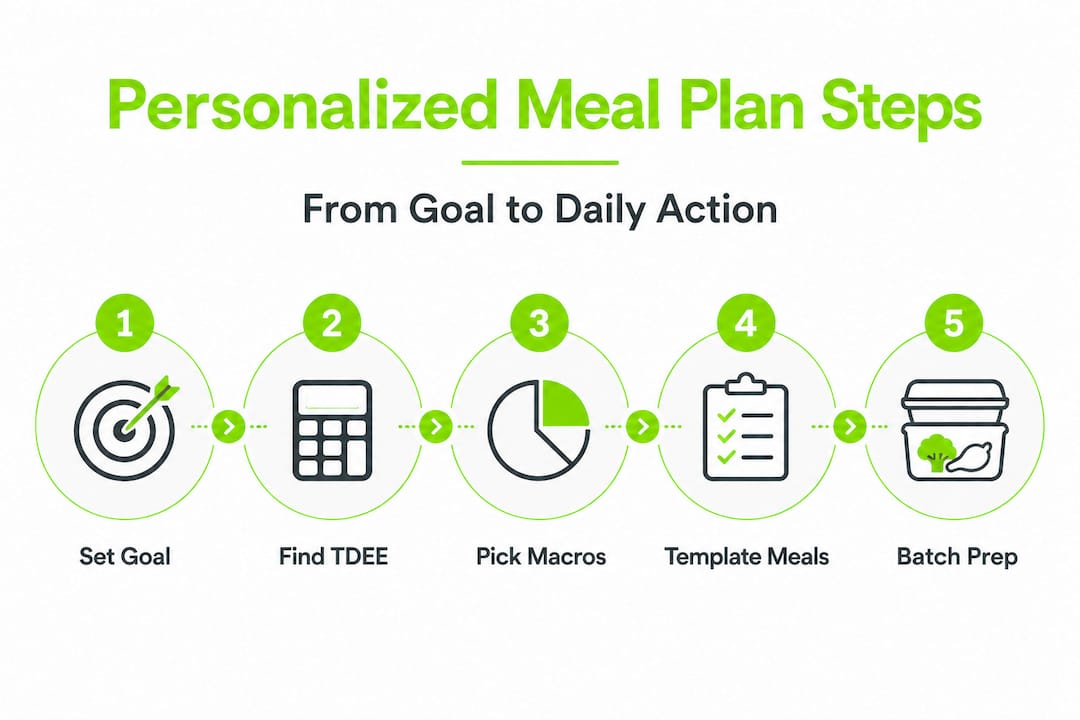
Step 1: Calculate your TDEE.
Your Total Daily Energy Expenditure (TDEE) is the number of calories your body burns in a full day, accounting for activity. This is your baseline. To lose weight, a moderate calorie deficit of 500 to 750 calories per day is the standard evidence-based target. This creates a weekly deficit of 3,500 to 5,250 calories, translating to roughly 1 to 1.5 pounds of fat loss per week.
Step 2: Set your macro targets.
Macros (macronutrients) are protein, carbohydrates, and fat. A practical starting ratio for most weight management goals is 30% protein, 40% carbohydrates, and 30% fat. Protein intake should reach 0.7 to 1 gram per pound of bodyweight daily to preserve muscle while in a deficit. Fiber targets of 25 to 35 grams per day support satiety and digestive health.
Step 3: Build meal templates.
Templates simplify execution. A practical meal planning structure uses a format of one protein source, one starchy carbohydrate, and two vegetables per meal. This framework covers your nutritional needs without requiring you to calculate every meal from scratch.
Here is a comparison of common approaches to meal planning:
| Approach | Flexibility | Adherence | Results focus |
|---|---|---|---|
| Generic diet plan | Low | Low | Population average |
| Template-based plan | Moderate | High | Individual goal |
| Full personalized plan | High | Very high | Individual biology + goal |
| Intuitive eating alone | Very high | Moderate | Varies widely |
Step 4: Use batch prep to reduce friction.
Batch cooking means preparing large quantities of staple foods, such as grilled chicken, cooked grains, and roasted vegetables, in one session. This directly reduces daily decision fatigue. When healthy food is already prepared, you are more likely to eat it.

Pro Tip: Cook your protein and complex carbs for three to four days at once. Store them in clear containers at eye level in the refrigerator so they are the first thing you reach for.
Timing also matters. Finishing your last meal at least two to three hours before sleep supports better metabolic outcomes and reduces unnecessary calorie intake. Pair this with fitness meal planning strategies to align your nutrition with your training schedule. For anyone new to this process, reviewing meal planning basics provides a solid foundation before moving into advanced customization. You can also explore personalized meal plans that match your specific health goal.
Personalization in action: tailoring meal suggestions to your needs
Having established the core meal planning skills, it is essential to bring them to life by adjusting them specifically to your personal context. Personalization is not just about food preferences. It involves a layered set of inputs that, when combined, create a truly effective strategy.
The key data points that drive personalization include:
- Biology. Your basal metabolic rate, hormonal patterns, and gut microbiome composition all affect how you process food.
- Lifestyle. Work schedule, sleep quality, stress levels, and physical activity all influence calorie needs and food timing.
- Preferences. Disliking a food guarantees you will stop eating it. Preference alignment is a non-negotiable input.
- Medical needs. Conditions like type 2 diabetes, hypertension, or use of GLP-1 medications require specific monitoring and adjustments within any nutrition plan.
The table below outlines how different personal factors affect meal planning decisions:
| Personal factor | How it shapes meal suggestions |
|---|---|
| High BMI | Larger calorie deficit may be appropriate; protein targets remain high |
| Older adult (65+) | Higher protein needs to counter muscle loss; softer food textures may help |
| Diabetes diagnosis | Low glycemic index focus; carbohydrate distribution across meals |
| Low self-efficacy | Simpler recipes; fewer decisions per day; incremental goal setting |
| Active lifestyle | Higher carbohydrate needs; pre and post-workout meal timing |
Continuous glucose monitors (CGMs) represent one of the most precise tools available today. They track your real-time blood sugar response to specific foods, revealing patterns that standard nutrition advice misses entirely. Some people spike sharply from white rice while others do not. This kind of data makes meal suggestions genuinely personal rather than just theoretically tailored.
Pro Tip: If you cannot access a CGM, track your energy levels two hours after each meal using a simple 1 to 5 scale for one week. Patterns will emerge quickly about which foods support steady energy and which cause crashes.
Genetics offer real insights but should not be overweighted. Research published in a gene-based nutrition review found that purely genetic personalization does not consistently outperform standard dietary guidance. The more effective approach integrates genetics as one input among many, not as a definitive answer. Broad dietary patterns, such as a high-protein, high-fiber diet with moderate fat, outperform hyper-specific genetic prescriptions in real-world outcomes.
Using nutritional assessment methods to evaluate your current eating patterns gives you a clear starting point. From there, evidence-based eating principles help you build a framework that accounts for your health priorities without overcomplicating the process.
Making it sustainable: daily strategies for adherence and progress
With a personalized strategy in place, let’s address the most important ingredient for your long-term success: how to sustain change daily. The most well-designed meal plan is worthless if you cannot follow it consistently. Sustainability is the metric that actually matters.
The simplest structural choice you can make is to use templates over recipes. A recipe requires you to follow steps every time. A template, such as protein plus carb plus two vegetables, allows you to vary the ingredients daily while keeping the nutritional structure consistent. Templates reduce decision fatigue and make healthy eating a default rather than a deliberate effort.
Practical daily strategies that actually work:
- Batch cook twice a week. Prepare proteins, grains, and chopped vegetables in advance. Batch prep eliminates decision fatigue at the most vulnerable times of day, like after work or late at night.
- Front-load water intake. Drinking eight to ten glasses of water daily, with the majority consumed before 2 p.m., reduces afternoon and evening hunger significantly.
- Anchor meals with fiber and protein. These two nutrients slow digestion and regulate hunger hormones. A breakfast with 30 grams of protein and 8 grams of fiber sets a controlled hunger pattern for the entire day.
- Set a dinner cutoff time. Finishing your last meal three hours before bed supports overnight fat metabolism and prevents casual snacking that rarely gets tracked.
- Track more than the scale. Monitor energy at midday, workout performance, sleep quality, and hunger levels between meals. These signals tell you far more about whether your plan is working.
“Self-efficacy, your belief in your ability to follow through, is the single strongest predictor of long-term adherence to any nutrition plan.”
Build that belief through small wins. Hitting your protein target every day for a week is a win. Preparing meals on Sunday without skipping it is a win. Each small success reinforces the identity of someone who follows through. Batch cooking tips for busy schedules make that process more manageable than most people expect.
Knowing when to adjust your plan is equally important. If your weight has not changed in two to three weeks and your adherence is solid, it is time to reassess your calorie target. If your energy is consistently low, your carbohydrate intake may need to increase. Review your meal planning tips regularly and treat your plan as a living document, not a fixed prescription.
What most meal plans overlook: the power of real feedback and small wins
Here is what rarely appears in mainstream nutrition advice: the plan is not the destination. It is the starting point of a learning process. Most people abandon their meal plans not because the plan was wrong, but because they expected it to be perfect. When it wasn’t, they concluded they had failed.
The more productive framing is this: every week gives you data. Weight up slightly? That is information about your calorie balance. Energy low on training days? That is information about your carb timing. Mood lower than usual? That often points to inadequate calorie intake or poor sleep, both of which your nutrition strategy can address.
Tracking mood, strength in the gym, hunger patterns, and sleep quality gives you a richer picture of progress than the scale alone ever could. Some of the most meaningful wins show up as better energy in the afternoon or fewer cravings after dinner, not as a number. Celebrating those wins builds the self-efficacy that keeps you going when results feel slow.
The custom plan benefits that matter most over time are not dramatic transformations. They are the accumulated effect of consistent, informed choices. Adjust the plan based on what the feedback tells you. That is not failure. That is how evidence-based nutrition actually works.
Ready to personalize your meal plan and reach your goals?
Now that you understand what sets real meal planning apart, here is how to get started with hands-on resources and expert support. Dietium.com offers the tools to move from general awareness to a personalized meal planning approach built around your specific goals. Start by using the platform’s calculators to establish your TDEE, macros, and body composition baseline. From there, explore nutritional assessment methods to identify where your current diet falls short. The Recipians app connects these inputs to custom meal suggestions, recipes, and fitness routines that adapt to your progress. For deeper guidance, evidence-based nutrition strategies across specific health goals are covered in detail within the Dietium content library.
Frequently asked questions
What is a goal-oriented meal suggestion?
A goal-oriented meal suggestion is a meal plan or idea designed to help you meet a specific health or fitness goal, such as weight loss, muscle gain, or better energy. These suggestions prioritize protein, fiber, and calorie targets calibrated to your individual objective rather than a population average.
How do I calculate my calorie and macro needs for my goal?
Calculate your Total Daily Energy Expenditure (TDEE), then apply a calorie deficit or surplus based on your goal, and distribute remaining calories across protein, carbs, and fat. TDEE-based calorie targets combined with a clear macro split are the foundation of effective goal-oriented meal planning.
Are personalized meal suggestions more effective than generic ones?
Yes. Personalized plans produce better adherence and measurably improved health outcomes, including greater weight loss and better mood and sleep, compared to standard one-size-fits-all approaches in multiple randomized controlled trials.
Can I personalize meal suggestions if I have medical conditions?
Yes, but medical conditions such as diabetes or use of GLP-1 medications require careful monitoring and medical supervision when following a personalized nutrition plan to ensure safety and effectiveness.
Do genetics make a big difference in personalized nutrition?
Genetics are one useful input but do not drive superior outcomes on their own. Gene-based personalized nutrition does not consistently outperform standard approaches, making multi-factor personalization that includes lifestyle and biology the more effective strategy.
Recommended
- Meal plan personalization: 9% LDL drop with tailored diets – Dietium
- Eating for specific goals: evidence-based nutrition strategies – Dietium
- Personalized Meal Plans for Every Health Goal – Dietium
- Master meal planning for fitness goals: boost results – Dietium
- Best grass-fed supplements for clean nutrition in 2026


