 Skip to content

TL;DR:
- Personalized meal plans consider individual factors like age, activity level, and medical conditions for better outcomes.
- AI-powered tools improve accuracy by using data and algorithms to tailor nutrition—especially for complex restrictions.
- Limitations include challenges with overlapping restrictions, rare conditions, and the need for human oversight.
Meal plan personalization: The key to effective diet customization
Generic meal plans fail most people, not because the nutrition science is wrong, but because your body, goals, and daily life are unlike anyone else’s. Almost no one follows basic guidelines, and even genetic data explains only a small fraction of why nutrient needs vary so dramatically between individuals. The variables that truly matter, things like your activity level, food intolerances, medical history, and personal preferences, rarely appear in a standard diet template. This article breaks down exactly what drives effective meal plan personalization, what the science actually proves, where the approach falls short, and how to set goals you can realistically achieve.
Table of Contents
- Understanding meal plan personalization: What really matters
- The science behind personalization: Data, algorithms, and real-world impact
- Edge cases and real-world challenges: Where personalization breaks down
- Debunking the hype: What personalized meal planning can and can’t do
- Personalized meal planning: What most guides miss
- Discover your ideal personalized meal plan with Dietium
- Frequently asked questions
Key Takeaways
| Point | Details |
|---|---|
| Personalization variables matter | Key factors like age, activity, and health shape truly effective meal plans. |
| AI-driven tools have impact | New technology makes it easier to match plans to individual needs, but privacy must be considered. |
| Watch for edge cases | Overlapping restrictions and health conditions require extra care—sometimes manual oversight. |
| Set realistic expectations | Personalized plans help, but lasting change relies on sustainable habits and behavior. |
Understanding meal plan personalization: What really matters
Once you realize generic plans often miss the mark, the next step is understanding which factors drive successful personalization. Meal plan personalization means building your diet around a specific set of variables that are unique to you, not a demographic average. It goes well beyond simply choosing “low carb” or “high protein.” A truly personalized plan accounts for how your body processes nutrients, what health conditions you manage, and even which foods you genuinely enjoy eating.
The most impactful personalization variables include:
- Age: Nutrient needs shift across life stages. Calcium and vitamin D matter more after 50. Protein needs increase for older adults trying to maintain muscle.
- Activity level: A sedentary office worker and a competitive runner cannot share the same calorie or macronutrient targets. Macronutrients refer to carbohydrates, proteins, and fats, the three main energy sources in food.
- Medical needs: Conditions like type 2 diabetes, hypertension, and kidney disease require specific dietary modifications that a generic plan simply won’t provide.
- Food allergies and intolerances: Gluten, tree nuts, dairy, shellfish, and soy are among the most common allergens, and missing even one can cause serious harm.
- Personal preferences and culture: A plan you won’t follow is useless. Cultural food preferences, taste preferences, and cooking habits all affect long-term adherence.
- Body composition goals: Fat loss, muscle gain, and maintenance all call for different calorie levels, meal timing strategies, and food choices.
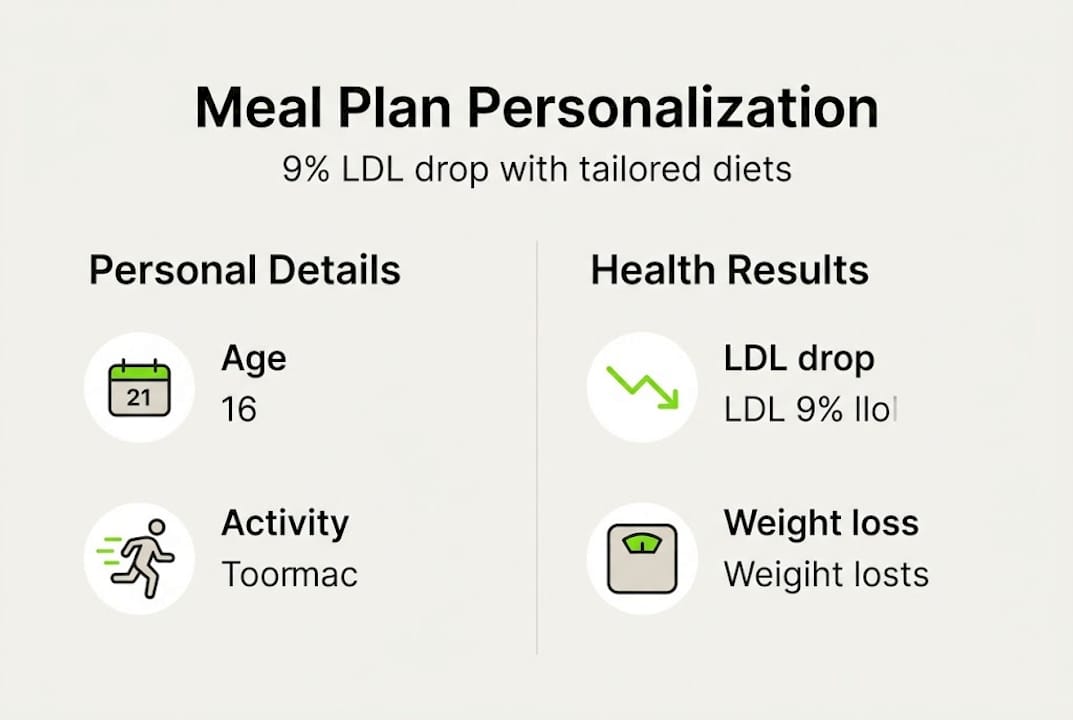
The contrast between generic and personalized plans is significant. Research tracking personalized nutrition outcomes shows that tailored approaches reduce LDL cholesterol (the “bad” kind) by 9%, lower HbA1c (a measure of long-term blood sugar) by 0.3%, and deliver weight loss results that are consistently superior to control groups. Personalized plans also hit nutrient targets with less than 5% deviation, meaning you’re getting the right amounts of vitamins and minerals, not just rough estimates.
| Feature | Generic plan | Personalized plan |
|---|---|---|
| Calorie targets | Population averages | Individual metabolic rate |
| Macronutrient split | Fixed ratios | Adjusted for goals and activity |
| Allergen management | Minimal or absent | Fully integrated |
| Medical condition support | Limited | Condition-specific modifications |
| Adherence over time | Often poor | Significantly better |
| Nutrient accuracy | Wide variance | Under 5% deviation from targets |
Exploring custom meal plan benefits further reveals how tailored nutrition consistently outperforms one-size-fits-all approaches across diverse populations. Understanding your starting point through proper nutritional assessment methods is the foundation before any personalization can happen effectively.

The bottom line here is straightforward. The more precisely a meal plan reflects your actual life and biology, the more likely you are to follow it and see real results. Generic plans set a baseline. Personalized plans build on your reality.
The science behind personalization: Data, algorithms, and real-world impact
Knowing which variables are important leads to the next question: how are these personal details transformed into effective, data-driven meal plans? The answer increasingly involves artificial intelligence and large language models (LLMs), which are AI systems trained on enormous amounts of text and data to understand and generate human-level responses.
Modern AI-powered nutrition platforms collect data points like your age, weight, dietary restrictions, health history, and fitness activity. They then use algorithms to cross-reference this information against nutritional databases, such as the USDA FoodData Central, to generate meal plans that fit your exact profile. AI/LLM integration with databases like USDA significantly enhances accuracy when handling individual preferences and dietary restrictions, and LLMs consistently outperform traditional methods in ingredient decomposition tasks. Ingredient decomposition means breaking a dish into its individual components to calculate exact nutrient content, which is critical for allergy safety and macro tracking.
The performance benchmarks are worth examining. Research shows that LLMs like Llama-3 (70B) achieve an F1-score of 0.894 for ingredient decomposition tasks. An F1-score is a measure of a model’s accuracy, where 1.0 is perfect. A score of 0.894 means the system correctly identifies and breaks down ingredients with very high reliability, reducing errors that could affect someone with a severe allergy.
Here is a summary of key clinical outcomes from recent personalized nutrition studies:
| Health metric | Outcome with personalized plan |
|---|---|
| LDL cholesterol | Reduced by 9% |
| HbA1c (blood sugar marker) | Lowered by 0.3% |
| Weight loss | Superior to control groups |
| Glycemic prediction accuracy | R² = 0.77 (strong predictive power) |
| Nutrient target deviation | Under 5% from individual targets |
Stat callout: A glycemic prediction R² of 0.77 means AI models can explain 77% of the variation in how your blood sugar responds to food. That’s a level of precision no generic plan can offer.
The practical implications for everyday users are significant. AI meal planning tools can now generate weekly menus, adjust for leftovers, and recalibrate based on real-time activity data. Comparing options through a meal planning tool comparison helps you identify which platforms offer the most relevant features for your specific goals.
That said, AI is not infallible. Systems still struggle with regional cuisines underrepresented in training data, and they can inherit biases from the datasets they were built on. The science is advancing fast, but human oversight remains essential, especially for high-stakes medical dietary needs.
Edge cases and real-world challenges: Where personalization breaks down
While the science is promising, meal plan personalization isn’t flawless, especially for those with complex needs. The situations where algorithms struggle most are precisely the cases where getting it right matters most.
Consider these common edge cases:
- Overlapping dietary restrictions: Someone who is vegan, gluten-free, and allergic to soy and tree nuts faces a narrow range of safe foods. Algorithms trained mostly on standard diets often fail to generate complete, nutritionally adequate plans for this group.
- Compound ingredient decomposition: A single restaurant dish or packaged product may contain dozens of hidden sub-ingredients. Edge cases involving multiple overlapping restrictions and complex ingredient decomposition remain a genuine weak spot for current AI tools.
- Eating disorders and mental health: Many personalization systems are not designed to screen for conditions like orthorexia (an unhealthy obsession with eating “correctly”) or binge eating disorder. Applying rigid macro targets or food rules to someone with these conditions can be actively harmful.
- Rare metabolic conditions: Conditions like phenylketonuria (PKU), where the body cannot process the amino acid phenylalanine, require such specific dietary control that algorithmic tools often cannot handle them safely without clinical oversight.
- Algorithmic bias: AI systems built primarily on data from certain populations can produce less accurate recommendations for users from different ethnic, cultural, or geographic backgrounds.
Data privacy is another serious issue. Personalized nutrition platforms often collect sensitive health and genetic data. Without strong privacy protections, this information can be misused or exposed in a breach.
Pro Tip: If your situation involves multiple overlapping restrictions, a rare medical condition, or a history of disordered eating, work with a registered dietitian alongside any digital tool. AI is a useful assistant, not a replacement for clinical expertise.
“Personalized nutrition algorithms are powerful, but they work best when the person using them is transparent about their full health picture and actively engaged in reviewing the recommendations.”
Strategies for meal planning for allergies go beyond simple substitutions and require systematic verification. If you’re managing a complex medical situation, exploring personalized plans for specific goals that are designed with clinical input will get you further than a generic AI-generated plan.
The key takeaway is that personalization tools are only as good as the data you feed them and the assumptions built into the algorithm. Knowing their limits helps you use them more effectively.
Debunking the hype: What personalized meal planning can and can’t do
Understanding the hurdles helps set realistic expectations about what personalized meal planning can truly provide. There is a lot of enthusiasm around personalized nutrition, and some of it is warranted. But a fair amount is overstated.
The honest picture, based on contrasting viewpoints on personalized nutrition, is this: personalized plans do outperform generic advice on adherence and health metrics, but their advantages are often smaller than claimed. Genetics explain very little of the variance in how people respond to food. Behavior, consistency, and lifestyle context drive the majority of outcomes.
Here are practical steps for setting achievable meal planning goals:
- Start with your current eating pattern: Before changing anything, track what you actually eat for one week. This baseline reveals habits and gaps more accurately than any questionnaire.
- Identify your top two or three priorities: Weight loss, blood sugar control, and energy improvement are all valid but require different approaches. Pick your most important goals first.
- Build in flexibility from the start: Rigid plans fail. Aim for 80% adherence as a sustainable target, not 100%.
- Review and adjust monthly: Your needs change as your weight, fitness level, and health status evolve. A plan that worked three months ago may need updating.
- Separate food quality from calorie math: Whole, minimally processed foods improve health outcomes even before calorie counting is involved. Start there.
RCT (randomized controlled trial) evidence on personalized nutrition outcomes confirms that gains are real but modest. The biggest predictor of success is not how sophisticated your plan is. It is whether you can actually follow it consistently over weeks and months.
Pro Tip: Focus on sustainable habits, not perfection. A simple plan you follow 85% of the time outperforms a perfect plan you abandon after two weeks.
Following meal planning best practices means treating your meal plan as a living document, not a fixed prescription. Adjust, iterate, and keep moving forward.
Personalized meal planning: What most guides miss
Most guides focus heavily on algorithms, macros, and genetic testing. What they underemphasize is the human side of actually changing how you eat, and that oversight is significant.
The truth is that the best meal plan in the world does nothing if it doesn’t fit into your Monday morning, your work schedule, your family dinner table, or your budget. Technology can optimize a meal plan down to the microgram. It cannot make you choose that meal plan when you are tired, stressed, or out of time.
Flexibility and self-awareness matter more than any algorithm. The people who see lasting results from personalized nutrition are those who treat their plan as a starting point and adapt it as life changes. They are not chasing perfection. They are building a repeatable system.
Tools are valuable, but real progress comes from using them honestly. Track your results. Notice what you actually eat versus what you planned to eat. That gap is where your real personalization work happens. Tying your nutrition approach directly to your fitness outcomes through meal planning for fitness results creates a feedback loop that keeps you accountable and adaptable. The algorithm sets the plan. You make it real.
Discover your ideal personalized meal plan with Dietium
If you’re ready to put these insights into action, Dietium provides the tools and guidance to help you build a meal plan that works for your specific variables. From detailed nutritional assessments that establish your baseline calorie and macro needs to structured support for fitness goals, allergies, and medical conditions, the platform is built around the personalization factors covered in this article. Explore Dietium personalized meal plans designed for every health goal, from weight loss to athletic performance to managing blood sugar. Data-driven guidance, practical tools, and evidence-based content are all in one place.
Frequently asked questions
What are the most important variables for meal plan personalization?
Age, activity level, health conditions, allergies, personal food preferences, and medical needs are the core factors that shape an effective personalized meal plan. Missing even one of these key personalization variables can undermine results and adherence.
Can personalized meal plans help with weight loss or diabetes?
Yes. Clinical data shows that personalized plans reduce LDL cholesterol by 9% and HbA1c by 0.3%, with weight loss outcomes that consistently outperform generic control-group diets, though the magnitude of improvement is modest.
How does AI improve meal plan personalization?
AI systems enhance accuracy by cross-referencing large nutritional databases with individual data, allowing them to handle complex preferences, dietary restrictions, and ingredient decomposition more reliably than traditional methods.
Are there any risks or privacy concerns with personalized meal plans?
Yes, particularly when platforms collect genomic or detailed health data. Privacy and ethical risks in AI-driven nutrition tools are real, so choosing reputable platforms with transparent data practices and strong security protocols is essential.


