 Skip to content

TL;DR:
- Improving appetite involves targeted eating habits, lifestyle strategies, and medical interventions when necessary.
- Persistent appetite loss lasting more than a few weeks requires professional evaluation to identify underlying causes before considering medications.
Improving appetite is defined as applying targeted eating habits, lifestyle adjustments, and, when necessary, medical interventions to restore healthy hunger signals and adequate nutritional intake. If you have been struggling with low appetite due to illness, stress, aging, or medication side effects, you are not alone. The clinical term for persistent appetite loss is anorexia (unrelated to the eating disorder anorexia nervosa), and it affects millions of people across all age groups. Behavioral modifications including smaller frequent meals, protein prioritization, and liquid calories are consistently the most effective first-line strategies. Harvard Health and the Merck Manual both confirm that addressing the root cause while applying practical eating strategies produces the best outcomes.
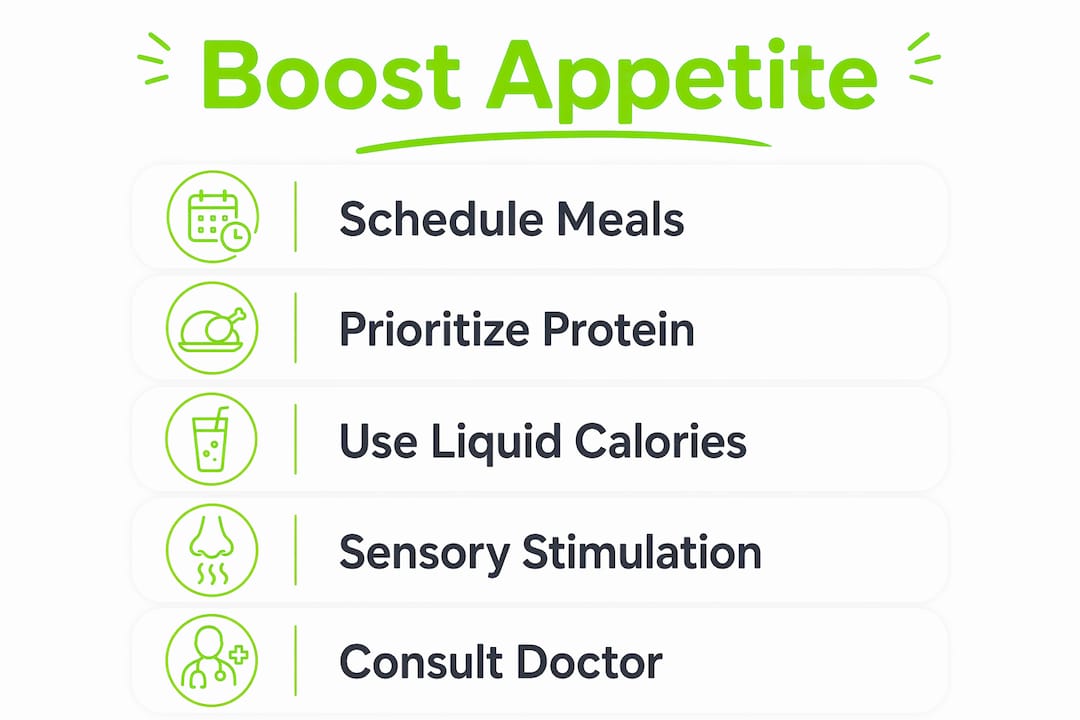
How to improve appetite: causes, signals, and when to see a doctor
Appetite decreases for many reasons, and identifying the cause determines the right response. Common triggers include aging, chronic illness, depression, anxiety, cancer treatment, and medications such as antibiotics, opioids, or chemotherapy drugs. Occasional low appetite after a stressful week or a stomach bug is normal. Persistent appetite loss lasting more than a few weeks is not.
Chronic unexplained anorexia signals the need for professional assessment, according to the Merck Manual. Waiting it out without evaluation risks missing serious underlying conditions such as thyroid disorders, gastrointestinal disease, or early-stage cancer.
Watch for these warning signs that require a doctor’s visit:
- Unintentional weight loss of more than 5% of body weight in one month
- Appetite loss lasting longer than two to three weeks without an obvious cause
- Nausea, vomiting, or abdominal pain accompanying reduced hunger
- Fatigue, weakness, or difficulty concentrating alongside poor intake
- Appetite loss in a child or older adult with no clear explanation
A healthcare provider will typically run blood panels, assess medication side effects, and screen for mood disorders before recommending any appetite-stimulating strategy. Getting that evaluation done first is not optional. It is the foundation of safe, effective care.
How does meal frequency and portion size influence appetite?
Meal timing and portion size are two of the most direct levers you can pull to stimulate hunger. The logic is straightforward: large meals overwhelm a weak appetite, while smaller, more frequent eating occasions keep your digestive system active and hunger cues firing regularly.
Follow these steps to restructure your eating schedule:
- Eat 6 to 7 small meals or snacks per day. Splitting meals into 5 to 6 smaller occasions re-establishes regular hunger cues and reduces the burden of eating when appetite is low, per Harvard Health. Think of each occasion as a light fuel stop, not a full tank.
- Space meals 2 to 3 hours apart. The NHS Royal Brompton and Harefield hospitals recommend this spacing to keep the stomach from becoming overfull while maintaining consistent energy delivery throughout the day.
- Use smaller plates and bowls. A full small plate signals completion and satisfaction without the visual overwhelm of a large plate with modest portions. This is a simple behavioral trick with real impact on how much you actually eat.
- Schedule meals around natural hunger windows. Most people feel slightly more hungry in the morning and early afternoon. Prioritize your highest-calorie meals during those windows rather than forcing a large dinner when hunger is at its lowest.
- Eat your favorite foods first. Starting with something you genuinely enjoy increases the likelihood you will keep eating. Saving the “healthy” item for last when appetite is already fading is a common mistake.
Pro Tip: Set a phone alarm for each meal and snack time for the first two weeks. Appetite often needs to be trained back into a rhythm before hunger cues return on their own.
For a deeper look at how meal spacing affects metabolism and hunger hormones, Dietium’s article on meal frequency and metabolism breaks down the science clearly.

What role do nutrients and liquid calories play in boosting appetite?
When appetite is poor, every bite and sip must work harder. Prioritizing protein and calorie-dense liquids ensures you meet nutritional targets even when total food volume is low.
| Strategy | Best for | Examples |
|---|---|---|
| High-protein solids | Muscle preservation, satiety balance | Hard-boiled eggs, canned tuna, Greek yogurt, cottage cheese |
| Liquid meal supplements | Meeting calorie needs with minimal effort | Protein smoothies, fortified soups, commercial supplements |
| Calorie-dense snacks | Adding energy without large volume | Nut butters, avocado, full-fat dairy, dried fruit |
| Soft or pureed foods | Ease of eating during illness or fatigue | Hummus, mashed sweet potato, blended lentil soup |
Protein-rich snacks like hard-boiled eggs and canned tuna are specifically recommended by Harvard Health because they preserve muscle mass while supporting appetite goals. This matters especially as protein needs increase with age and during recovery from illness.
Liquid calories are a practical tool when solid food feels like too much effort. Smoothies and liquid meal supplements are easier to consume when appetite is poor and help meet calorie needs without requiring a full plate of food. A smoothie made with whole milk, banana, peanut butter, and protein powder can deliver 400 to 600 calories in under 10 minutes of preparation and two minutes of drinking.
Pro Tip: Drink liquid calories between meals, not with them. Consuming fluids during meals fills the stomach faster and reduces how much solid food you eat.
For specific snack ideas that hit both protein and calorie targets, Dietium’s resource on high-protein snack ideas offers practical options for every lifestyle.
How can sensory and lifestyle strategies enhance appetite naturally?
The body’s hunger signals respond to more than just an empty stomach. Smell, sight, sound, movement, and social context all influence how hungry you feel and how much you eat.
These natural appetite enhancers work by engaging the brain’s reward and anticipation systems before food even reaches your mouth:
- Take a short walk before meals. Gentle movement before meals stimulates appetite and signals the body that it’s time to eat. Even a 10-minute walk around the block is enough to shift hunger hormones in a useful direction, particularly for older adults whose hunger cues have dulled.
- Cook or heat food with strong aromas. The smell of garlic sautéing, bread toasting, or soup simmering triggers anticipatory hunger. If you are not cooking from scratch, reheating food in a pan rather than a microwave releases more aroma and produces a stronger appetite response.
- Eat with other people when possible. Social eating reduces loneliness-related appetite suppression and improves both intake and enjoyment. If in-person meals are not an option, a video call during mealtime produces a similar effect.
- Relax dietary restrictions temporarily. If you are following a strict elimination diet or avoiding entire food groups, consider whether those restrictions are medically necessary right now. Allowing yourself more food variety increases the chance that something will appeal to you on a given day.
- Make the eating environment pleasant. Eating at a table with good lighting, music you enjoy, and no screens showing stressful content creates a calmer, more appetite-friendly setting than eating alone in front of the news.
When are appetite-stimulating medications appropriate?
Medications to stimulate appetite are adjuncts, not first-line treatments. They are used after underlying causes have been addressed and behavioral strategies have been tried. The Merck Manual outlines several options that clinicians use under medical supervision.
| Medication | Primary use | Key consideration |
|---|---|---|
| Cyproheptadine | Appetite stimulation in underweight patients | Antihistamine with appetite side effect; used off-label |
| Corticosteroids | Short-term appetite boost in cancer or chronic illness | Not suitable for long-term use due to side effects |
| Megestrol acetate | Cancer and AIDS-related anorexia | Effective but carries risk of blood clots |
| Dronabinol | AIDS-related anorexia, chemotherapy nausea | FDA-approved; precise dosing required |
Appetite-stimulating medications such as cyproheptadine, corticosteroids, megestrol, and dronabinol are used under medical supervision as adjuncts after treating underlying causes. Each carries its own risk profile, and none should be self-prescribed.
Dronabinol offers the most specific dosing example of how carefully these medications are managed. Dronabinol for AIDS-related anorexia starts at 2.1 mg orally twice daily, given one hour before lunch and dinner, and is adjusted based on individual tolerance. That level of precision reflects how seriously clinicians approach appetite medications. These are not supplements you add casually. They require a prescriber, monitoring, and a clear clinical indication.
The takeaway: if you have tried behavioral and nutritional strategies for several weeks without improvement, talk to your doctor about whether a medication evaluation makes sense for your situation.
Key takeaways
Improving appetite requires a structured combination of meal timing, nutrient prioritization, sensory stimulation, and medical evaluation when loss is persistent or unexplained.
| Point | Details |
|---|---|
| Eat smaller, more frequently | Six to seven small meals spaced 2 to 3 hours apart re-establishes hunger cues without overwhelming a weak appetite. |
| Prioritize protein and liquid calories | Hard-boiled eggs, smoothies, and fortified soups deliver high nutrition with low eating effort. |
| Use movement and social eating | A short walk before meals and eating with others both measurably increase hunger and food intake. |
| Separate fluids from meals | Drinking between meals, not during them, prevents early fullness and supports better food intake. |
| Seek medical evaluation for persistent loss | Appetite loss lasting more than two to three weeks without a clear cause requires professional assessment before any medication is considered. |
What I have learned about appetite loss that most articles skip
Most content on this topic jumps straight to food lists and misses the behavioral architecture underneath. After working with nutrition data and meal planning frameworks at Dietium, the pattern I keep seeing is this: people with low appetite do not need more food options. They need a structure that removes the decision fatigue around eating.
The most underrated strategy is scheduling. When you are not hungry, deciding what to eat three times a day feels like a burden. Removing that decision by pre-planning meals and setting alarms turns eating from a choice into a routine. Routines do not require motivation. That distinction matters enormously for anyone dealing with illness-related or stress-related appetite loss.
The second thing most articles skip is the fluid timing issue. Drinking water or juice with meals is so normalized that people do not question it. But separating fluids from meals is one of the highest-impact, zero-cost changes you can make. It does not require buying anything or changing what you eat. It just requires shifting when you drink.
Finally, I want to be direct about medications. They have a real place in clinical care, but they are not a shortcut. Reaching for megestrol or dronabinol before addressing sleep, stress, medication side effects, and meal structure is working backwards. The behavioral steps are not the consolation prize. They are the foundation. Medications build on top of that foundation when it is not enough on its own.
If your appetite has been low for more than a few weeks, use the meal planning tips at Dietium as a starting point, then talk to your doctor. Do not wait.
— Srasti
Build a meal plan that works for your appetite
Dietium’s personalized diet planning service takes the guesswork out of eating when appetite is unreliable. You get a meal plan built around your specific calorie and protein targets, your food preferences, and your schedule. The Recipians app generates meal suggestions and snack options that fit your goals without requiring you to make constant food decisions. For a data-driven starting point, Dietium’s nutritional assessment tools help you identify exactly where your intake is falling short so you can close the gap with precision. If you are ready to stop guessing and start tracking, Dietium gives you the structure to do it.
FAQ
What causes sudden loss of appetite in adults?
Sudden appetite loss in adults is most commonly caused by acute illness, stress, medication side effects, or emotional distress. If it persists beyond two to three weeks without a clear cause, the Merck Manual recommends medical evaluation to rule out underlying conditions.
What are the fastest natural ways to increase hunger?
Taking a short walk before meals, eating in a social setting, and using strong food aromas are among the fastest natural appetite enhancers. Harvard Health confirms that gentle movement and social eating both produce measurable increases in hunger and food intake.
Should I drink protein shakes to improve my appetite?
Protein shakes and liquid meal supplements are recommended specifically for people with poor appetite because they deliver high calories and protein with minimal eating effort. Harvard Health suggests using them between meals or as evening snacks rather than as meal replacements.
How many meals a day should I eat if I have low appetite?
Six to seven small meals spaced 2 to 3 hours apart is the schedule recommended by the NHS Royal Brompton and Harefield hospitals for people with poor appetite. This frequency keeps hunger cues active without the burden of large portions.
When do appetite-stimulating medications become necessary?
Appetite-stimulating medications such as megestrol or dronabinol become appropriate when underlying causes have been treated and behavioral strategies have not restored adequate intake. They require a prescription and medical supervision, as each carries specific risks and dosing requirements.


