 Skip to content

TL;DR:
- Food allergy management involves allergen avoidance, emergency preparedness, and proper dietary planning to prevent reactions. Accurate diagnosis, carrying epinephrine, and clear communication are essential safety tools. Ongoing medical follow-up helps to adapt management strategies and uphold quality of life.
Food allergy management is defined as the ongoing practice of allergen avoidance, emergency preparedness, and informed dietary planning to prevent reactions and maintain quality of life. The nine most common allergens in the United States, including peanuts, milk, tree nuts, shellfish, eggs, fish, wheat, soy, and sesame, trigger IgE-mediated reactions in millions of people. Knowing how to manage food allergies starts with an accurate diagnosis, a reliable emergency plan, and consistent daily habits. This guide covers the tools, meal strategies, and treatment options that make living with food allergies both safe and sustainable.
What tools and preparations are essential for daily food allergy management?
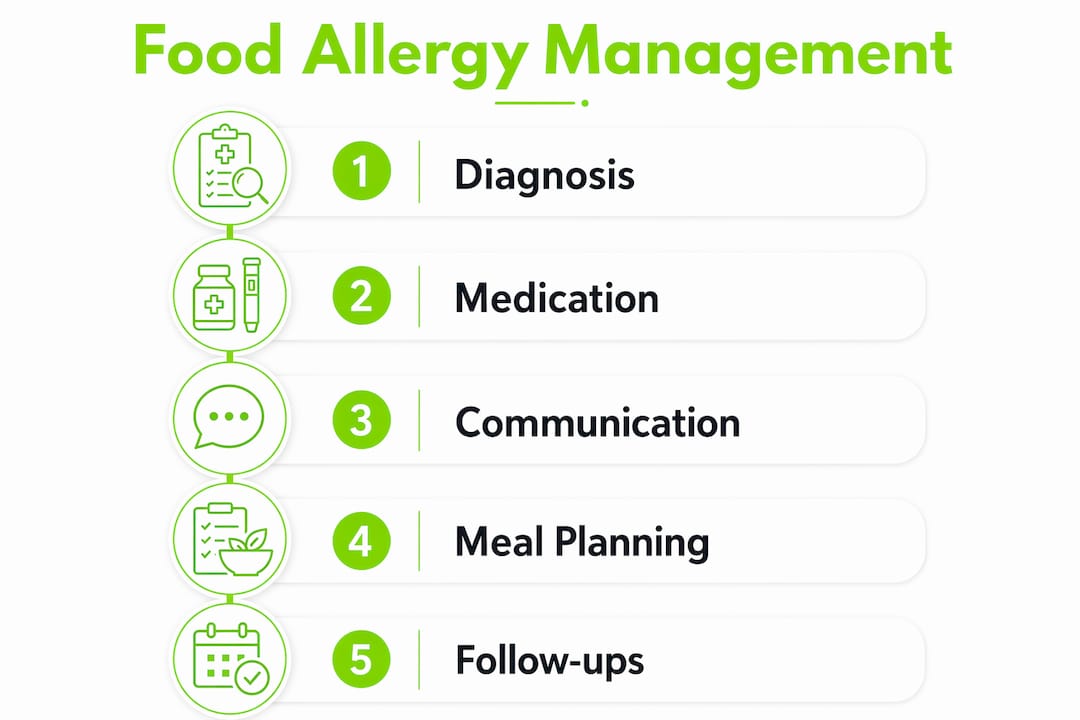
Effective food allergy management depends on three pillars: accurate diagnosis, emergency medication, and clear communication. Without all three in place, even careful people face unnecessary risk.
Getting the right diagnosis first
Accurate allergy diagnosis depends more on a thorough clinical history than on lab tests alone. Skin prick tests and blood panels can suggest sensitivities, but the oral food challenge remains the gold standard for confirming a true allergy. This distinction matters because an incorrect diagnosis often leads to unnecessary food restrictions, which reduces nutritional variety without improving safety.

Epinephrine: the non-negotiable tool
Epinephrine auto-injectors, such as EpiPen, are the first-line treatment for severe allergic reactions. Antihistamines relieve minor symptoms but cannot stop anaphylaxis. Every person with a confirmed food allergy should carry two epinephrine doses at all times, since a second dose may be needed before emergency services arrive.
Communication as a safety tool
Informing schools, workplaces, and restaurants about your specific allergies is not optional. It is a core safety measure. Written allergy action plans shared with teachers, coaches, and caregivers reduce the chance of accidental exposure in supervised settings.
| Tool | Purpose |
|---|---|
| Epinephrine auto-injector | First-line treatment for anaphylaxis; carry two at all times |
| Oral food challenge | Gold-standard test to confirm or rule out a true allergy |
| Written allergy action plan | Guides caregivers and school staff during emergencies |
| Medical alert bracelet | Communicates allergy status when you cannot speak for yourself |
| Allergen-free meal plan | Reduces daily exposure risk through structured food choices |
Pro Tip: Read ingredient labels every single time you buy a product, even if you have purchased it before. Manufacturers change formulas without prominent notice, and a product that was safe last month may not be safe today.
How can you safely plan meals and avoid allergens in everyday life?
Safe meal planning is the most consistent food allergy prevention strategy available. Structured planning reduces the number of spontaneous food decisions you make, and fewer spontaneous decisions mean fewer opportunities for accidental allergen exposure. Dietium’s guide on safe meal planning for allergies provides detailed recipes and strategies built around allergen avoidance.
Reading labels with precision
The FDA requires manufacturers to declare the top nine allergens on food labels in plain language. Look beyond the ingredient list. Phrases like “may contain,” “processed in a facility with,” or “made on shared equipment” signal cross-contact risk. For people with severe allergies, these warnings are not optional reading.
Avoiding cross-contact at home and in restaurants
Cross-contact through shared utensils and cooking surfaces poses a significant risk, even in trace amounts. At home, use dedicated cutting boards, cookware, and utensils for allergen-free meals. In restaurants, ask specific questions about how food is prepared, not just what ingredients are used. A dish labeled “nut-free” can still be contaminated if it was cooked in the same pan as a nut-containing dish.
Safe substitutions that maintain nutrition
Eliminating a major food group requires intentional replacement to avoid nutritional gaps. Here are practical substitutions for the most common allergens:
- Milk: Use fortified oat milk, rice milk, or coconut milk for calcium and vitamin D
- Eggs: Replace with flaxseed meal mixed with water, unsweetened applesauce, or commercial egg replacers in baking
- Wheat: Choose certified gluten-free oats, quinoa, rice flour, or buckwheat for grains and baking. Dietium’s gluten-free eating guide covers this in depth
- Peanuts: Substitute sunflower seed butter or pumpkin seed butter for similar protein and fat profiles
- Soy: Use coconut aminos instead of soy sauce; replace tofu with legumes like lentils or chickpeas
- Tree nuts: Hemp seeds and pumpkin seeds provide comparable healthy fats and minerals
- Fish and shellfish: Increase intake of other lean proteins such as chicken, turkey, or legumes
Continuous vigilance with familiar products is just as critical as caution with new ones. Manufacturers reformulate products regularly, so a brand you have trusted for years can introduce an allergen without a major label redesign.
What are advanced treatments and ongoing management strategies for food allergies?
Food allergy management is not a one-time event. It is an ongoing relationship with your allergist that evolves as your body, lifestyle, and available treatments change.
Oral immunotherapy: raising your threshold
Oral immunotherapy, or OIT, gradually desensitizes patients by introducing tiny, increasing amounts of an allergen under medical supervision. OIT raises the threshold for accidental exposure but does not cure the allergy. This means a person who previously reacted to a trace amount of peanut may tolerate a small accidental dose after completing a structured OIT protocol. OIT is not suitable for everyone and requires careful clinical screening before starting.
Omalizumab: a biologic option for severe cases
Omalizumab, sold under the brand name Xolair, is a biologic medication approved for food allergy management. Clinical trials show omalizumab reduces anaphylaxis risk by about two-thirds in patients aged one year and older. That reduction applies to accidental allergen exposure, making it particularly valuable for people who struggle to avoid allergens completely despite careful habits.
Regular allergist follow-ups matter
Some children outgrow allergies to milk, eggs, wheat, and soy, while peanut and tree nut allergies tend to persist into adulthood. A supervised oral food challenge with your allergist is the only reliable way to confirm whether an allergy has resolved. Skipping annual or biannual check-ins means missing the opportunity to safely reintroduce foods you may no longer need to avoid.
Pro Tip: Keep a printed and digital copy of your emergency action plan. Update it with your allergist at every visit. An outdated plan with the wrong medication dose or missing contact information can cost critical time during a reaction.
How to recognize, respond to, and prevent allergic reactions effectively?
Recognizing the symptoms of food allergies quickly is the difference between a manageable reaction and a life-threatening emergency. Mild symptoms include hives, itching, nasal congestion, and stomach cramps. Severe symptoms, which signal anaphylaxis, include throat tightening, difficulty breathing, a sudden drop in blood pressure, and loss of consciousness.
Why speed matters with epinephrine
Delaying epinephrine use during anaphylaxis is the most common and dangerous error people make. Epinephrine works by reversing the cascade of reactions that cause airways to close and blood pressure to drop. Every minute without it increases the severity of the reaction. Administer epinephrine at the first sign of a severe reaction, then call 911 immediately.
If you or someone nearby shows signs of anaphylaxis, use the epinephrine auto-injector first. Do not wait to see if symptoms improve on their own. Antihistamines are not a substitute. Call emergency services immediately after administering epinephrine, even if symptoms appear to improve.
Steps to take after accidental exposure
- Identify the allergen and stop consuming it immediately
- Assess symptoms: mild symptoms may be monitored, but any throat tightness or breathing difficulty requires epinephrine now
- Administer epinephrine into the outer thigh and hold for 10 seconds
- Call 911 and lie down with legs elevated unless breathing is difficult
- Administer a second epinephrine dose after 5–15 minutes if symptoms do not improve
- Go to the emergency room even if symptoms resolve, since reactions can return hours later
Communicating allergies in social situations
Proactive communication prevents most accidental exposures in social settings. When eating out, ask detailed questions about cross-contact and kitchen practices, not just ingredient lists. At social gatherings, bring your own safe food as a backup. For children, Dietium’s resource on healthy eating habits for kids offers practical guidance for parents navigating school lunches and social events.
Key Takeaways
Effective food allergy management requires accurate diagnosis, consistent allergen avoidance, immediate access to epinephrine, and regular medical follow-up to stay safe and maintain quality of life.
| Point | Details |
|---|---|
| Diagnosis accuracy | Use the oral food challenge as the gold standard before restricting foods unnecessarily. |
| Epinephrine first | Administer epinephrine at the first sign of anaphylaxis; never substitute antihistamines. |
| Label reading every time | Read ingredient labels on every purchase, even for familiar products, since formulas change. |
| Advanced treatments exist | Oral immunotherapy and omalizumab (Xolair) reduce reaction risk under medical supervision. |
| Ongoing allergist care | Schedule regular check-ups to update action plans and test whether allergies have resolved. |
What I’ve learned after years of watching people manage food allergies
The biggest mistake I see is treating food allergy management as a fixed protocol rather than a living practice. People get their diagnosis, memorize their avoid list, and then stop updating their knowledge. That complacency is where accidental exposures happen.
The most resilient people I have observed share one habit: they treat every meal as a fresh decision, not a routine. They ask questions at restaurants they have visited dozens of times. They read labels on products they have bought for years. That level of consistency sounds exhausting, but it becomes automatic faster than most people expect.
The second thing I have come to believe strongly is that fear is not a sustainable management strategy. Fear makes people avoid social situations, restrict their diets beyond what their actual allergy requires, and miss out on the nutritional variety they need. Knowledge replaces fear. When you understand exactly which proteins trigger your immune response, which cooking methods destroy or preserve them, and which substitutions maintain your nutrition, you stop feeling like food is the enemy. You start making informed decisions instead of anxious ones.
The third insight is about children specifically. Kids who grow up understanding their allergy, not just following rules about it, develop better self-advocacy skills. They ask the right questions at school lunches. They recognize their own early symptoms. That education starts at home, and it starts early. Building a healthy relationship with food matters as much as any medication protocol.
— Srasti
Allergy-safe meal planning with Dietium
Managing food allergies through diet requires more than a list of foods to avoid. It requires a structured, personalized approach that keeps your nutrition complete while eliminating risk. Dietium’s personalized meal plans are built to accommodate specific allergen restrictions while meeting your health and nutrition goals. The platform’s tools help you track nutrients, find safe recipe alternatives, and plan weekly meals without the guesswork that leads to accidental exposure. For families managing multiple allergies, Dietium’s family meal planning guide offers step-by-step support for building safe, varied menus everyone can eat.
FAQ
What is the first step in managing a food allergy?
The first step is getting an accurate diagnosis from an allergist, ideally confirmed through an oral food challenge. Accurate diagnosis prevents unnecessary food restrictions and guides a realistic management plan.
What foods are the most common allergens in the US?
The nine major allergens in the US are peanuts, milk, tree nuts, shellfish, eggs, fish, wheat, soy, and sesame. Most food allergies develop within the first two years of life and relate to these foods.
Can food allergies be cured?
Food allergies cannot currently be cured, but oral immunotherapy can raise the threshold for accidental exposure under medical supervision. Some children naturally outgrow allergies to milk, eggs, wheat, and soy, which an allergist can confirm through a supervised oral food challenge.
How do I prevent cross-contact at home?
Use separate cutting boards, cookware, and utensils for allergen-free meals. Wash surfaces and hands thoroughly between preparing different foods, and store allergen-containing foods separately from safe foods.
When should I use an epinephrine auto-injector?
Use epinephrine at the first sign of a severe allergic reaction, including throat tightening, difficulty breathing, or a sudden drop in blood pressure. Do not wait to see if symptoms resolve on their own, and call 911 immediately after administering the dose.


