 Skip to content

TL;DR:
- Combining cardio and strength training yields the best health outcomes and supports sustained weight management.
- Regular practice of both enhances cardiovascular health, muscular strength, bone density, and metabolic function over time.
Cardio and strength training are the two foundational pillars of physical fitness, and the science is clear: you need both. Cardio, or aerobic exercise, improves heart and lung function by increasing stroke volume, VO2max, and vascular efficiency. Strength training, also called resistance training, builds muscle mass, improves functional capacity, and raises your resting metabolic rate. The comparison of cardio and strength is not a competition. Federal guidelines recommend at least 150 minutes of moderate aerobic activity plus two days of strength work per week. That combination is the baseline for optimal health, not a choice between the two.
What are the fundamental differences between cardio and strength training?
Cardio and strength training trigger entirely different physiological responses, and understanding those differences helps you use each one more effectively.
Aerobic exercise works by elevating your heart rate and increasing cardiac output during the session. Over time, chronic cardio training remodels the heart muscle, expands blood vessel capacity, and raises VO2max, which is the maximum rate at which your body can use oxygen. A higher VO2max directly correlates with lower cardiovascular mortality risk. Clinicians view cardio as vascular conditioning. Its primary job is to build the engine that keeps your heart and lungs running efficiently for decades.
Strength training works through a different mechanism. Resistance against muscles, whether from free weights, machines, resistance bands, or bodyweight, creates microscopic damage to muscle fibers. The repair process produces hypertrophy (muscle growth), increased strength, and improved neuromuscular coordination. Strength training also improves bone density and connective tissue resilience, two factors that become critical as you age.
Common cardio workout types include:
- Running and jogging (steady state or interval)
- Cycling, both outdoor and stationary
- Swimming and rowing
- Jump rope and aerobic dance formats like Zumba
- Elliptical and stair climber machines
- High-intensity interval training (HIIT), which blends aerobic and anaerobic effort
Common strength training modalities include:
- Free weights: barbells, dumbbells, and kettlebells
- Machine-based resistance equipment
- Resistance bands and suspension trainers like TRX
- Bodyweight movements: push-ups, squats, lunges, and pull-ups
- Olympic lifting and powerlifting
The key distinction is this: cardio builds cardiovascular endurance and burns calories during the workout, while strength training builds structural capacity and burns calories long after the session ends through elevated muscle metabolism. Comparing them only by calorie burn during a single session misses the long-term adaptations that drive real fitness improvements.
How cardio and strength training affect weight management differently
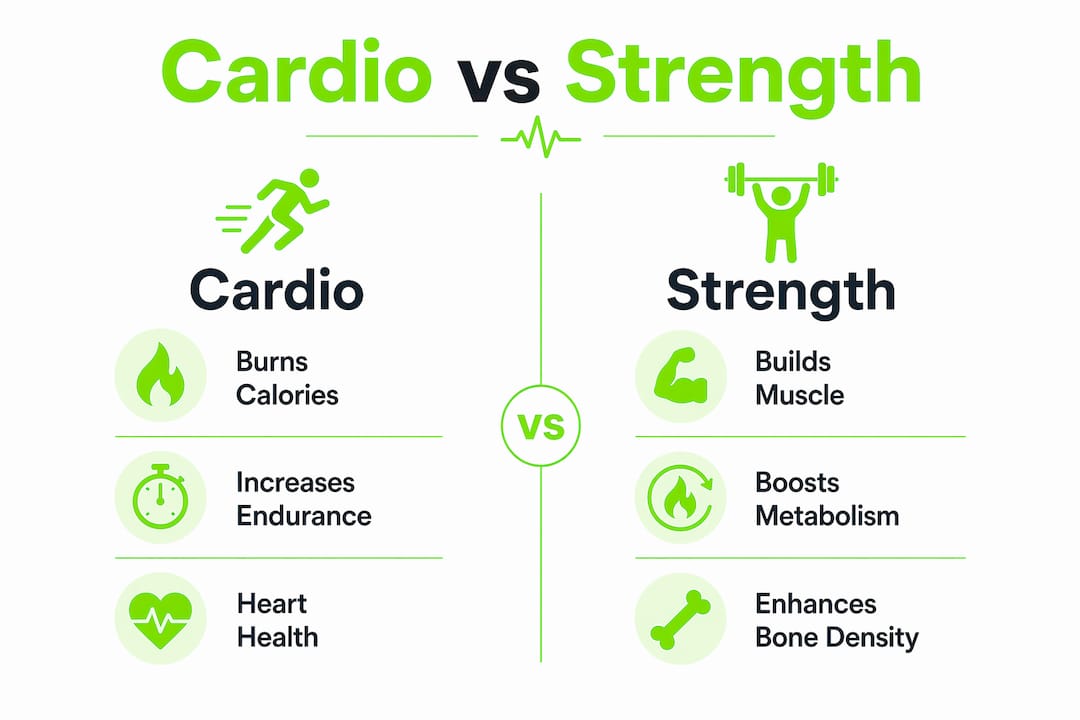
Both exercise types contribute to weight management, but through different mechanisms. Cardio burns calories rapidly during the workout itself. A 45-minute run or cycling session can create a significant caloric deficit in real time, which makes it a popular choice for people focused on fat loss.

Strength training takes a different route to the same destination. Building muscle increases your resting metabolic rate, meaning your body burns more calories at rest, even while you sleep. Strength training protects muscle mass, which is critical for sustaining calorie expenditure over time. This matters especially during weight loss phases, when the body tends to break down muscle alongside fat if resistance work is absent.
Here is how the two approaches compare for weight management:
- Cardio for immediate calorie burn. Aerobic sessions create a direct energy deficit. The higher the intensity and duration, the more calories you burn during the workout.
- Strength training for metabolic rate. Resistance training improves muscle size and function even with modest twice-weekly sessions, raising the number of calories your body burns at rest.
- Combined training for body composition. Pairing both types produces the most favorable changes in body composition. You lose fat while preserving or building lean muscle, which prevents the metabolic slowdown that often accompanies calorie restriction alone.
- Consistency over intensity. Short, regular sessions of both types outperform sporadic high-effort workouts. Your metabolism responds to frequency, not just effort.
Pro Tip: If fat loss is your primary goal, do not abandon strength training in favor of more cardio. Muscle tissue is metabolically active. Losing it while dieting slows your metabolism and makes long-term weight maintenance harder.
The most effective weight management strategy combines both modalities. Cardio creates the caloric deficit; strength training preserves the muscle that keeps your metabolism running at full capacity.
What are the cardiovascular and overall health benefits of combining both?
The health case for combining cardio and strength training goes well beyond aesthetics or weight management. Both aerobic and resistance training reduce cardiovascular disease risk independently, and combined training produces enhanced benefits for metabolic and heart health that neither type achieves alone.
Aerobic exercise improves vascular function by increasing the elasticity of arteries, reducing blood pressure, and improving cholesterol profiles. These changes reduce the mechanical stress on the heart over time. Strength training adds a separate layer of cardiovascular protection. Resistance training improves glucose metabolism, lipid profiles, and reduces systemic inflammation, all independent of aerobic exercise. This means even people who cannot perform high-intensity cardio can still protect their heart through resistance work.
| Health outcome | Cardio training | Strength training | Combined approach |
|---|---|---|---|
| Cardiovascular disease risk | Significant reduction | Moderate reduction | Greatest reduction |
| Resting metabolic rate | Minimal increase | Meaningful increase | Highest increase |
| Muscle mass and strength | Minimal effect | Strong improvement | Strong improvement |
| Blood glucose regulation | Moderate improvement | Strong improvement | Strongest improvement |
| Bone density | Moderate improvement | Strong improvement | Strong improvement |
“Integrating cardio and strength training is increasingly recognized as the optimal approach for longevity and chronic disease prevention.” — Frontiers in Cardiovascular Medicine, 2026
The data makes the case plainly. No single exercise type covers all the health bases. Running protects your heart but does little for your bones. Lifting protects your bones and metabolism but does not train your cardiovascular system the same way a 30-minute run does. The strength training basics that reduce mortality risk work best when paired with regular aerobic activity.
How to design a balanced weekly fitness routine
Designing a weekly routine that includes both cardio and strength training does not require hours in the gym. The structure matters more than the volume, especially when you are starting out.
Current U.S. guidelines from the NIDDK set the baseline at 150 minutes of moderate aerobic activity and two strength sessions per week. Australian 24-hour movement guidelines go slightly further, specifying vigorous aerobic activity three days per week alongside strength training at least twice weekly. Both frameworks agree on one point: frequency and consistency matter more than any single workout.
The 2026 ACSM update reinforces this directly. Training major muscle groups twice per week produces consistent strength gains without requiring complex programming or training to failure. Adherence to a simple, regular program outperforms an elaborate plan you abandon after three weeks.
Practical tips for building your weekly routine:
- Schedule strength sessions on Monday and Thursday, then fill remaining days with cardio at moderate intensity.
- Use cluster workout scheduling by adding a 10 to 15-minute cardio bout before or after each strength session. This meets your weekly aerobic targets without requiring separate gym visits.
- Prioritize compound movements in strength sessions: squats, deadlifts, rows, and presses cover all major muscle groups efficiently.
- On cardio days, vary intensity. Two steady-state sessions and one HIIT session per week covers both aerobic base building and cardiovascular conditioning.
- Home-based resistance training with bands or bodyweight is fully effective. You do not need a gym to meet the guidelines.
Pro Tip: If time is your biggest barrier, cluster your cardio and strength into three 45-minute sessions per week rather than five separate workouts. You will meet both guidelines and reduce the scheduling friction that causes most people to quit.
For beginners, Dietium’s strength training for beginners resource provides a structured starting point that removes the guesswork from your first few months of resistance work.
Key takeaways
Combining cardio and strength training produces better health outcomes than either modality alone, and current 2026 guidelines from the NIDDK and ACSM confirm this as the standard recommendation for all adults.
| Point | Details |
|---|---|
| Both types are necessary | Cardio builds cardiovascular endurance; strength training builds muscle and raises metabolic rate. |
| Combined training wins for health | Aerobic and resistance exercise together reduce cardiovascular disease risk more than either alone. |
| Strength training protects metabolism | Building muscle preserves calorie-burning capacity, which is critical for long-term weight management. |
| Consistency beats complexity | Training major muscle groups twice weekly with a simple program outperforms elaborate plans you cannot maintain. |
| Time barriers are solvable | Clustering short cardio bouts around strength sessions meets weekly guidelines in three sessions per week. |
Why I think the cardio vs. weights debate misses the point entirely
I have spent years reviewing fitness research and working with people who are genuinely trying to improve their health, not just their appearance. The single most common mistake I see is treating cardio and strength training as competing options. Someone decides they want to lose weight, so they run every day and skip the weights. Someone else wants to build muscle, so they lift five days a week and never raise their heart rate. Both approaches leave significant health benefits on the table.
The research from Frontiers in Cardiovascular Medicine published in 2026 makes something clear that most fitness content glosses over: acute exercise comparisons are almost meaningless. What matters is what happens to your body over months and years of consistent training. Cardio remodels your heart. Strength training remodels your muscles, bones, and metabolic system. You cannot get both adaptations from one type of exercise.
The other thing I have noticed is that people dramatically overestimate how much time this requires. Two strength sessions and 150 minutes of moderate cardio per week is not a demanding schedule. That is roughly four hours total, spread across seven days. The barrier is almost never time. It is the absence of a clear, simple structure that makes both feel manageable.
My honest recommendation: stop asking whether you should do cardio or weights. Start asking how to fit both into a schedule you can actually keep. A home workout routine that combines both is more effective than a gym program that only covers one. The best program is the one you show up for consistently, week after week.
— Srasti
Fuel your training with the right nutrition plan
Exercise without proper nutrition is like running a car on the wrong fuel. Your cardio sessions and strength workouts both place specific demands on your body, and what you eat directly determines how well you recover, how much muscle you build, and how effectively you burn fat. Dietium’s personalized diet planning tools align your meal plan with your specific fitness goals, whether you are focused on fat loss, muscle gain, or general health. The Recipians app builds custom meal plans around your calorie needs, macros, and training schedule, so your nutrition works with your workouts rather than against them. Track your progress, adjust your intake, and use Dietium’s fitness calculators to stay on target as your body changes.
FAQ
Should I do cardio or weights to lose weight?
Both are effective, but for different reasons. Cardio burns calories during the session, while strength training builds muscle that raises your resting metabolic rate. Combining both produces the best long-term fat loss results.
How many days per week should I do strength training?
Current ACSM and NIDDK guidelines recommend training all major muscle groups at least twice per week. Research confirms that twice-weekly sessions produce consistent strength and muscle gains without requiring more complex programming.
Can I do cardio and strength training on the same day?
Yes. Clustering a 10 to 15-minute cardio bout before or after a strength session is an effective way to meet weekly aerobic targets without adding extra gym days. This approach is supported by current exercise guidelines.
What counts as cardio exercise?
Cardio workout types include running, cycling, swimming, rowing, jump rope, HIIT, and aerobic classes like Zumba. Any sustained activity that elevates your heart rate and increases breathing rate for an extended period qualifies as aerobic exercise.
Does strength training benefit heart health?
Yes. Resistance training improves glucose metabolism, reduces inflammation, and improves lipid profiles, all of which directly reduce cardiovascular disease risk. These benefits are independent of aerobic exercise, meaning strength training protects your heart even without running or cycling.


