 Skip to content

TL;DR:
- Meal frequency does not impact fat loss or metabolic rate when calorie and macro intake are matched, with meal timing and composition being more influential. Circadian rhythms cause higher thermic effects in the morning, making earlier eating more metabolically efficient, especially for fat loss. Focusing on total protein, calorie targets, and aligning meals with your internal clock offers greater benefits than simply increasing meal frequency.
Meal frequency and metabolism are directly linked in popular fitness culture, but controlled research tells a different story. When total calorie intake is matched, eating three meals a day produces the same fat loss as eating six. The thermic effect of food (TEF), which is the energy your body uses to digest and process nutrients, depends on what and how much you eat, not how often you split it up. What recent 2026 research from the Metabolism journal and JAMA Network Open does reveal is that when you eat relative to your body’s internal clock matters far more than how many times you eat.
What does the science say about meal frequency and metabolic rate?
Controlled trials comparing 3 vs. 6 meals per day with identical calorie and macronutrient totals show no meaningful difference in metabolic rate or fat loss. This finding directly contradicts the widespread belief that spreading food across more meals “stokes the metabolic fire.” The myth persists partly because TEF is real and measurable, but its magnitude is tied entirely to total intake and composition, not meal count.
Here is what the evidence actually shows about TEF and eating frequency:
- TEF accounts for roughly 10% of total daily energy expenditure in most adults.
- Protein intake explains ~6% of TEF variance, with each additional gram of protein increasing TEF by approximately 0.12 kcal. This means your macronutrient choices move the needle on metabolism far more than your meal count does.
- Splitting 2,000 calories into three meals generates the same total TEF as splitting it into six. The body processes the same total load either way.
- Frequency effects on metabolism wash out completely under matched calorie conditions, confirming that energy balance is the dominant driver of fat loss.
The practical implication is clear: chasing a higher meal count to boost metabolism is an inefficient use of effort. Prioritizing total protein intake and overall calorie control delivers far greater metabolic returns.
Pro Tip: If fat loss is your goal, track your total daily protein and calorie intake before adjusting how many meals you eat. Getting those numbers right matters far more than your meal schedule.
How does circadian rhythm influence metabolism and meal timing?
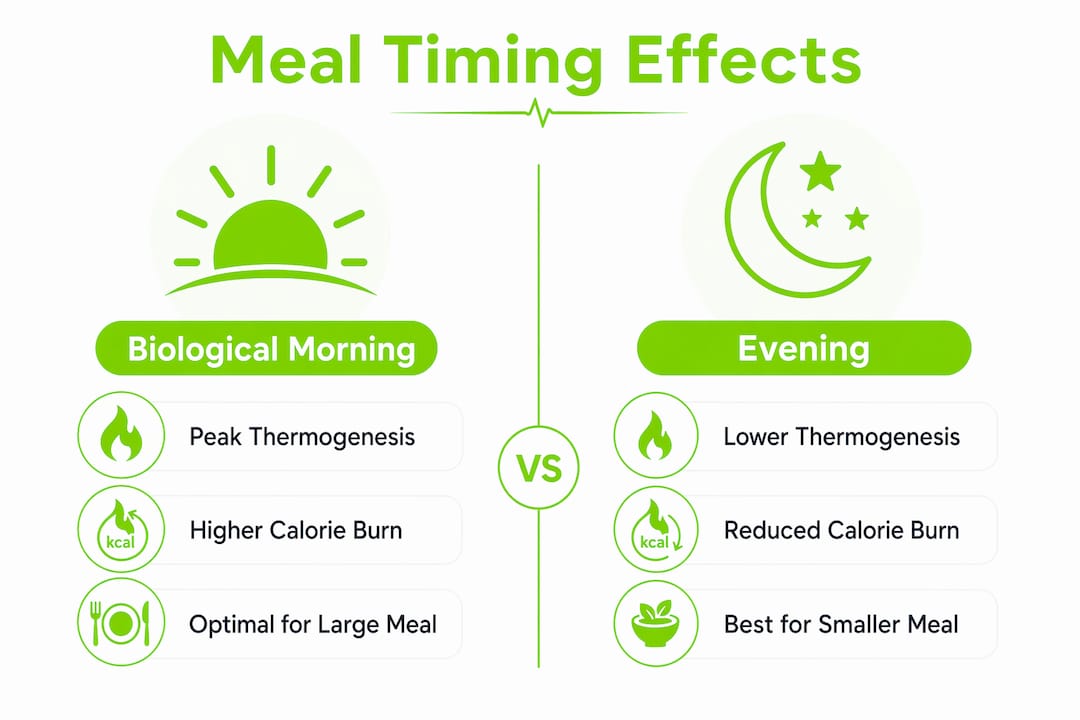
The most underreported finding in nutrition science right now is that your body’s internal clock directly controls how efficiently it burns calories from food. A 2026 constant-routine study published in Metabolism: Clinical and Experimental found that diet-induced thermogenesis peaks in the morning and troughs in the evening, with a 44% peak-to-trough difference of approximately 10 kcal per four-hour window. This rhythm operates independently of sleep, physical activity, or behavioral cues. It is driven by the endogenous circadian clock itself.

What this means practically: a 600-calorie breakfast burns more calories during digestion than an identical 600-calorie dinner. The food is the same. The metabolic response is not.
| Meal timing | Thermogenic efficiency | Implication |
|---|---|---|
| Biological morning (6–10 AM) | Peak TEF | Higher calorie burn from digestion |
| Midday (12–2 PM) | Moderate TEF | Solid window for larger meals |
| Evening (6–10 PM) | Trough TEF | Lower calorie burn; greater storage risk |
| Late night (after 10 PM) | Lowest TEF | Least metabolically efficient window |
Research on time-restricted eating across 25 studies confirms that consolidating food intake into earlier daily windows produces clinically meaningful weight loss of 3 to 5% and measurable cardiometabolic improvements. The mechanism is not calorie restriction alone. Aligning intake with circadian thermogenesis peaks amplifies the metabolic benefit. For fitness enthusiasts who train in the evening, this creates a real trade-off worth understanding.
Pro Tip: Shift your largest meal to the morning or early afternoon when possible. Even a partial shift toward earlier eating can improve your body’s thermogenic response without changing what or how much you eat.
How does meal spacing affect appetite and hunger management?
Meal frequency influences appetite regulation through a mechanism most people have never heard of: postprandial glucose dynamics. A 2026 JAMA Network Open cohort study tracking 7,650 meals in 895 adults found that the size of the glucose dip after a meal directly predicts how hungry you feel and how soon you eat again. Larger glucose drops after eating trigger stronger hunger signals and shorter intervals before the next meal.
This matters because it reframes the entire meal frequency debate. Eating more frequently does not speed up your metabolism. But it may help certain individuals manage hunger by preventing the sharp glucose drops that trigger overeating. The effect is highly individual. People with more variable glucose responses benefit more from structured meal spacing than those with stable postprandial patterns.
| Meal frequency | Hunger impact | Best suited for |
|---|---|---|
| 2 meals/day | Higher hunger risk between meals | People with stable glucose and strong satiety signals |
| 3 meals/day | Moderate, manageable hunger | Most adults; supports dietary adherence |
| 4 to 5 meals/day | Lower hunger peaks | Those with variable glucose or high training volume |
| 6+ meals/day | Minimal hunger fluctuation | Competitive athletes with high calorie needs |
Practical strategies for using meal timing to manage hunger include:
- Eat protein and fiber at every meal to slow glucose absorption and reduce post-meal dips.
- Track how hungry you feel two to three hours after each meal. If hunger spikes consistently, your meal composition likely needs adjustment before your meal count does.
- Use blood sugar balance tools to identify your personal glucose response patterns before committing to a fixed meal schedule.
- Avoid treating hunger as a fixed biological constant. Meal composition, sleep quality, and stress all shift your hunger baseline independently of how often you eat.
What role does meal frequency play for fitness goals beyond metabolism?
For people training consistently, meal frequency carries real benefits that have nothing to do with fat-loss thermodynamics. The primary benefit is protein distribution. Spreading protein across meals triggers multiple muscle protein synthesis cycles throughout the day, which supports muscle retention and growth more effectively than consuming the same total protein in one or two sittings. This is one area where eating frequency genuinely moves the needle for body composition.
The best time to eat protein for muscle synthesis is within a few hours of training, but distributing 20 to 40 grams across three to five meals throughout the day keeps muscle protein synthesis elevated more consistently than front-loading or back-loading intake.
Beyond protein timing, here is how meal frequency interacts with fitness performance:
- Energy availability: Eating every three to four hours maintains blood glucose at levels that support sustained training intensity, particularly for athletes doing two-a-day sessions.
- Recovery nutrition: A post-workout meal within two hours of training accelerates glycogen replenishment and reduces muscle breakdown, regardless of total daily meal count.
- Adherence and sustainability: Fewer, larger meals work better for some athletes who find constant meal prep disruptive. The best meal schedule for metabolism and performance is the one you can maintain consistently.
- Calorie targets: High-volume athletes often struggle to hit calorie needs in three meals. More frequent eating becomes a practical tool for meeting energy demands, not a metabolic strategy.
For practical meal planning for fitness goals, the structure of your eating schedule should follow your training demands and protein targets, not a generic rule about how many meals are optimal.
How to find the right meal frequency for your metabolism and weight goals
The right eating frequency is the one that helps you hit your calorie and protein targets while keeping hunger manageable and your schedule intact. There is no universal optimal meal timing that applies to every body. Here is a practical framework for finding yours:
- Set your calorie and protein targets first. Total intake determines fat loss or muscle gain. Meal count is secondary. Use a calorie calculator to establish your baseline before adjusting your meal schedule.
- Align your largest meal with your morning circadian window. The evidence for circadian meal timing00165-4/abstract) is strong enough to act on. Eating more earlier in the day improves thermogenic efficiency without requiring any change in total intake.
- Use hunger as a feedback signal. If you feel ravenous between meals, add a meal or increase protein and fiber content. If you feel forced to eat, reduce meal frequency. Your hunger patterns are data.
- Test time-restricted eating if fat loss is the goal. Consolidating intake into an eight to ten hour window aligned with daylight hours combines circadian benefits with natural calorie moderation. The evidence-based meal plans approach at Dietium incorporates this principle directly.
- Prioritize sustainability over precision. A meal schedule you follow 90% of the time outperforms a theoretically perfect schedule you abandon after two weeks.
Pro Tip: Start by eating your first meal within an hour of waking and your last meal at least two to three hours before sleep. This single adjustment aligns your intake with circadian thermogenesis peaks without requiring a complete dietary overhaul.
Key takeaways
Meal frequency does not drive fat loss or metabolic rate. Total calorie intake, protein content, and meal timing relative to your circadian clock are the variables that actually matter.
| Point | Details |
|---|---|
| Frequency alone changes nothing | Controlled trials show no fat loss difference between 3 and 6 meals when calories are matched. |
| Circadian timing outperforms frequency | Diet-induced thermogenesis peaks in the morning, making early eating metabolically more efficient. |
| Protein content drives TEF | Each gram of protein increases TEF by ~0.12 kcal, making macros more impactful than meal count. |
| Glucose dips predict hunger | Postprandial glucose drops trigger earlier eating, so meal composition shapes appetite more than frequency. |
| Fitness goals justify structured frequency | Distributing protein across meals supports muscle synthesis cycles, a real benefit for active individuals. |
Why I think the meal frequency debate misses the real question
The obsession with how many meals to eat is a distraction from the variables that actually determine outcomes. After reviewing the 2026 research on circadian thermogenesis, what strikes me is how consistently the science points away from meal count and toward meal timing and composition. The 44% difference in thermogenic efficiency between morning and evening eating is not a marginal finding. It is a substantial metabolic lever that most people have never been told about.
What I find equally important is the sustainability angle. The individuals who succeed long-term at managing weight are not the ones who found the perfect meal frequency. They are the ones who built an eating pattern they can maintain without constant effort. Three meals, four meals, or time-restricted eating all work when total intake is controlled and protein is adequate. The structure that fits your life is the structure that produces results.
The circadian timing insight does deserve more attention in practical nutrition advice. Shifting your calorie distribution earlier in the day is one of the few evidence-based adjustments that improves metabolic efficiency without requiring you to eat less. That is worth prioritizing over any debate about meal count. Dietium’s approach to personalized meal timing reflects exactly this principle.
— Srasti
Build a meal plan that works with your metabolism
Generic meal frequency advice ignores the variables that actually drive your results: your calorie targets, protein distribution, circadian patterns, and lifestyle constraints. Dietium’s personalized diet plans are built around these factors specifically. The Recipians app generates custom meal schedules that align with your metabolic needs, training schedule, and hunger patterns, not a one-size-fits-all eating frequency rule. Whether your goal is fat loss, muscle gain, or better energy throughout the day, Dietium gives you a data-driven structure that adapts to how your body actually works. Explore tailored meal plan options and start eating in a way that supports your specific goals.
FAQ
Does eating more often speed up your metabolism?
No. Controlled trials show that eating frequency does not increase metabolic rate when total calorie intake is matched. The thermic effect of food depends on total intake and macronutrient composition, not how many meals you eat.
What is the best time to eat for metabolism?
The biological morning is the most metabolically efficient window for eating. A 2026 study found a 44% thermogenic difference00165-4/abstract) between morning and evening meals, meaning earlier eating burns more calories during digestion.
How does meal frequency affect weight loss?
Meal frequency affects weight loss primarily through appetite and adherence, not metabolism. Research shows that postprandial glucose dips predict hunger and eating frequency, so the right meal schedule is the one that keeps your hunger manageable and your calorie targets on track.
Is time-restricted eating better than eating multiple small meals?
For fat loss, time-restricted eating produces 3 to 5% weight loss and cardiometabolic improvements across 25 reviewed studies. It works by aligning intake with circadian rhythms, not by changing how many meals you eat within that window.
How many meals a day should I eat to build muscle?
Distributing protein across three to five meals per day supports more muscle protein synthesis cycles than eating the same total protein in fewer sittings. The total daily protein target matters most, but spreading it out amplifies the muscle-building signal.


