 Skip to content

TL;DR:
- Most beginners skip strength training because it feels complicated due to unfamiliar equipment and terminology.
- Simple, consistent routines focusing on major muscle groups twice weekly deliver meaningful health and strength benefits without needing expensive gyms or trainers.
Most people who skip strength training for beginners cite the same reason: it feels complicated. The equipment is unfamiliar, the terminology is confusing, and the fear of doing something wrong keeps them from starting at all. Here is the truth. Simple, consistent programs deliver meaningful strength and health gains, and the 2026 ACSM update of 137 systematic reviews confirms it. You do not need a complex routine, a personal trainer, or an expensive gym membership. You need the right framework and the confidence to begin.
Table of Contents
- Key takeaways
- What strength training for beginners actually means
- Designing your beginner strength training routine
- Common mistakes beginners make and how to avoid them
- Starting at home or at the gym: what you actually need
- A 4-week beginner strength training progression plan
- My honest take on getting started with strength training
- Fuel your strength gains with personalized nutrition from Dietium
- FAQ
Key takeaways
| Point | Details |
|---|---|
| Simplicity beats complexity | Consistent training targeting major muscle groups twice weekly outperforms elaborate programs for beginners. |
| Bodyweight first, weights second | Master movement patterns and form before adding resistance to reduce injury risk. |
| Progressive overload drives growth | Add reps, sets, or load gradually each week to keep your body adapting and improving. |
| Rest is part of the plan | At least one full rest day between sessions protects recovery and prevents stalled progress. |
| Nutrition complements training | Adequate protein intake supports muscle repair and amplifies the results of your workouts. |
What strength training for beginners actually means
Strength training is any form of exercise where your muscles work against resistance. That resistance can come from free weights, resistance bands, machines, or your own bodyweight. The goal is to make your muscles adapt to progressively greater demands, which builds strength, increases muscle mass, and improves how your body functions day to day.
The benefits go well beyond looking stronger. Strength training improves physical fitness, protects against injury, and supports mental health, particularly for beginners building new healthy habits. Research also links regular resistance training to improved bone density, a faster resting metabolism, and better blood sugar regulation.
Here is what beginners often get wrong about their goals. Many assume strength training is only for people who want to bulk up. In reality, the most common goals for new lifters are:
- Building functional strength for daily tasks like lifting groceries or climbing stairs
- Improving muscle tone without dramatic size increases
- Boosting metabolism to support healthy body composition
- Reducing injury risk by strengthening muscles and connective tissue
- Improving mood and energy through the well-documented mental health benefits of resistance exercise
The ACSM 2026 guidelines synthesized data from over 30,000 participants and confirmed one overarching finding: the biggest gains come from moving from no training to any training. You do not need to optimize. You need to start.
Designing your beginner strength training routine
The structure of a solid beginner workout plan is simpler than most fitness content suggests. Three principles shape everything: frequency, exercise selection, and progression.
Frequency: Train two to three full-body sessions per week with at least one rest day between each session. This gives your muscles enough stimulus to adapt and enough time to recover. Beginners benefit from training all major muscle groups twice weekly with two to three sets per exercise, and even a single set provides measurable gains when you are starting out.
Exercise selection: Prioritize compound movements. These are exercises that work multiple muscle groups at once, making your workouts more time-efficient and more effective for building total-body strength. Core compound movements for a beginner fitness routine include:
- Squats (targets quads, glutes, hamstrings, and core)
- Push-ups or dumbbell chest press (targets chest, shoulders, and triceps)
- Bent-over rows or resistance band rows (targets back and biceps)
- Hip hinges or deadlifts (targets glutes, hamstrings, and lower back)
- Overhead press (targets shoulders and upper back)
- Plank variations (targets core and stability muscles)
Progression: This is where most beginners either stall or overreach. Progressive overload simply means making your workouts slightly harder over time so your body keeps adapting. Multiple progression methods work well: adding reps, adding sets, reducing rest between sets, increasing the weight you lift, or slowing down the tempo of each rep.
Start by mastering each movement with bodyweight only. Building on a bodyweight base helps beginners learn proper form and protect against injury before any external load is introduced. Once you can perform each exercise cleanly for three sets of 12 to 15 reps, you are ready to add resistance.
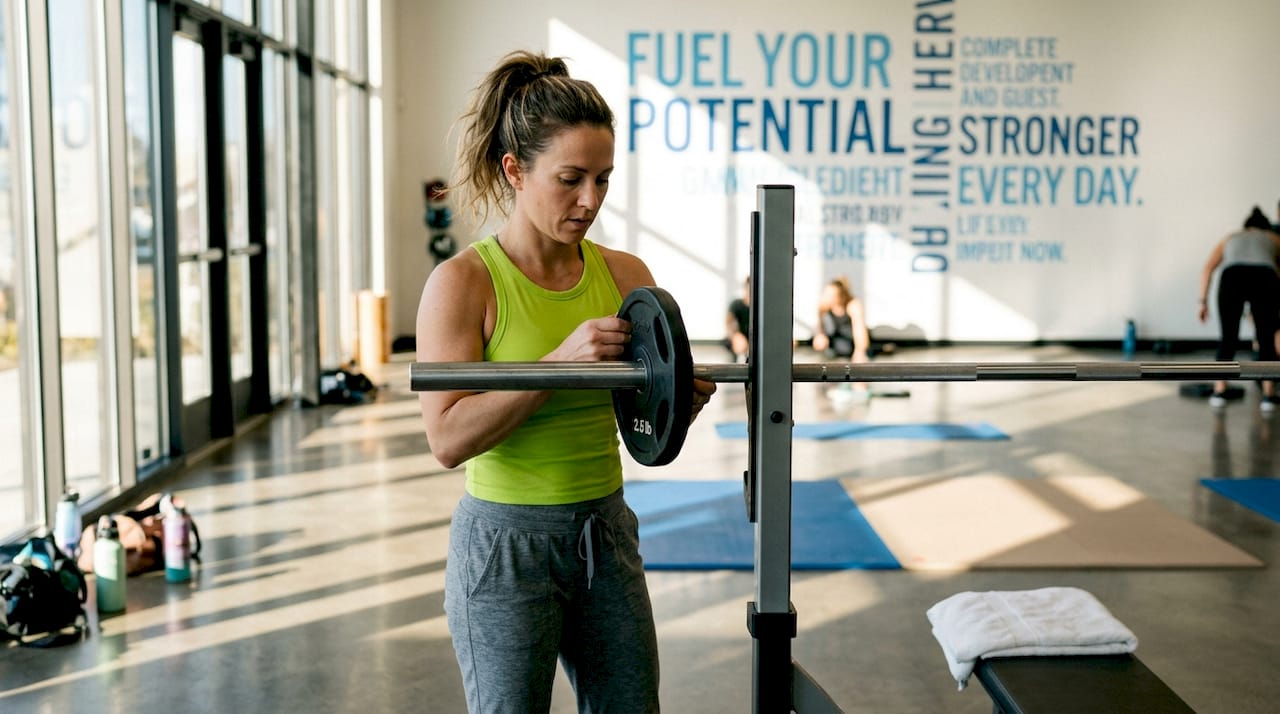
Pro Tip: Track your reps and weights in a simple notebook or app after every session. When you can complete all planned reps with good form, increase the difficulty slightly next session. This one habit separates beginners who progress from those who plateau.
Common mistakes beginners make and how to avoid them
Starting strength training with enthusiasm is great. Starting without awareness of common pitfalls leads to injury, frustration, and quitting. Here are the ones that derail beginners most often:
- Lifting too heavy too soon. Ego lifting, or choosing weights that compromise your form, is the fastest path to injury. Pick a weight where the last two reps of a set are challenging but technically clean.
- Skipping the warm-up. Five to ten minutes of light cardio and dynamic stretching primes your joints and muscles. Cold muscles tear more easily and perform worse.
- Ignoring rest days. Rest days are non-negotiable for beginners. Muscles grow during recovery, not during the workout itself. At least one full day between sessions prevents overuse injuries and progression stalls.
- Treating workouts as optional. Consistency is the single biggest driver of results. Schedule your sessions like appointments and protect that time.
- Judging progress only by appearance. Strength gains happen before visible muscle changes. Track reps, sets, and weights to measure real progress.
Nutrition matters too. Protein is the building block of muscle repair, and most beginners undereat it. A practical starting point is 0.7 to 1 gram of protein per pound of body weight per day. Prioritize whole food sources like chicken, eggs, Greek yogurt, legumes, and fish. Learn more about how post-workout nutrition affects recovery and results.
Pro Tip: Treat your first two weeks as a skill acquisition phase, not a fitness phase. Focus entirely on learning the movement patterns correctly. Speed and intensity come later, and so do the results.
Starting at home or at the gym: what you actually need
One of the biggest misconceptions about weight lifting for beginners is that you need a fully equipped gym to get started. You do not. Here is how to set up for success no matter where you train:
- No equipment: Bodyweight squats, push-ups, lunges, glute bridges, and plank holds cover every major muscle group. This is where everyone should begin.
- Resistance bands: Inexpensive and versatile, bands allow you to add resistance to rows, presses, and hip work without requiring a full dumbbell set.
- Light dumbbells: A pair of adjustable dumbbells or a set ranging from 5 to 25 pounds covers the full scope of a beginner program for most people.
For more on what to stock at home, Dietium’s guide to home workout essentials covers the basics without overspending.
Here is a quick reference for rest periods and their purpose:
| Rest period | Best for | Effect on training |
|---|---|---|
| 30 to 60 seconds | Muscular endurance | Keeps heart rate elevated, builds stamina |
| 60 to 90 seconds | General strength and muscle | Balances recovery with training density |
| 2 to 3 minutes | Max strength (heavier loads) | Allows full recovery for next heavy set |
For beginners, 60 to 90 seconds between sets is the sweet spot. It gives you enough recovery to maintain good form while keeping the session efficient. Log every workout, even just with a notes app on your phone. Seeing your numbers improve week over week is one of the most motivating things you can experience as a new lifter.
A 4-week beginner strength training progression plan
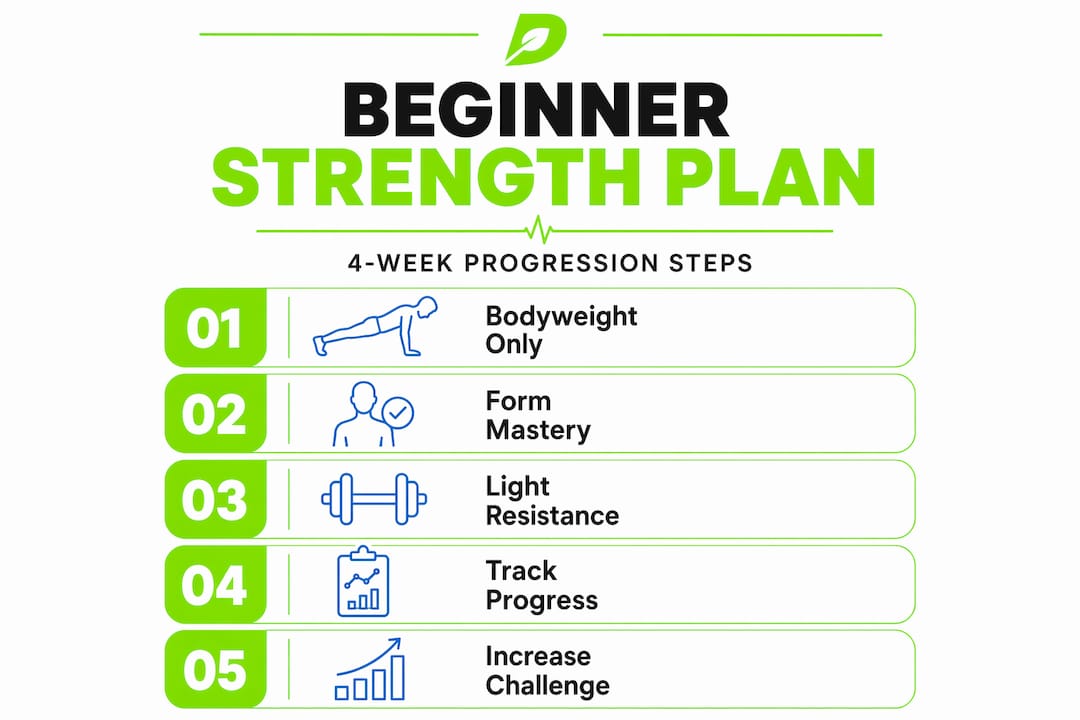
This plan applies the core principles above in a concrete, easy-to-follow structure. A practical approach for new lifters uses bodyweight in weeks one and two to build movement patterns, then introduces light dumbbells or resistance bands in weeks three and four.
| Week | Equipment | Sets x Reps per exercise | Focus |
|---|---|---|---|
| Week 1 | Bodyweight only | 2 x 10 | Learn movement patterns and control |
| Week 2 | Bodyweight only | 3 x 10 | Add one set, refine form |
| Week 3 | Light dumbbells or bands | 3 x 10 to 12 | Introduce external resistance |
| Week 4 | Light dumbbells or bands | 3 x 12 to 15 | Increase reps or slightly increase load |
Each session follows the same format across all four weeks:
- Warm up for five to ten minutes with light movement and dynamic stretches.
- Perform all six compound exercises listed in the routine design section.
- Rest 60 to 90 seconds between sets.
- Cool down with five minutes of static stretching targeting the muscles you worked.
- Log your reps and any notes on how the session felt.
Beginners who avoid frequent exercise changes adapt faster and build strength more reliably. Stick to the same exercises for the full four weeks. Your job is to execute them better and with more resistance each week, not to find new movements to master. After week four, reassess. If three sets of 15 reps feels manageable for most exercises, increase the weight by 5 to 10 percent and restart the rep progression.
My honest take on getting started with strength training
I have worked with a lot of beginners, and the pattern I see most often is this: people spend weeks researching the perfect program instead of starting an imperfect one. The best resistance training program is the one you will actually stick with, and the ACSM 2026 research backs this up directly.
In my experience, beginners who focus on habit consistency over program perfection progress faster and stay in the gym longer. They do not miss sessions trying to find something more optimal. They show up, do the work, and improve incrementally.
The most counter-intuitive thing I have learned is that simple workouts build muscle just as effectively as complex ones for beginners. High exercise variation and volume offer no meaningful advantage at this stage. If anything, complexity introduces confusion and increases the chance of injury or burnout.
My advice is simple. Pick the six compound movements above. Show up two to three times a week. Add a little more difficulty every week. That is not a shortcut. That is the actual path.
— Srasti
Fuel your strength gains with personalized nutrition from Dietium
Strength training creates the stimulus for muscle growth, but nutrition delivers the raw materials that make it happen. If your diet is not aligned with your training, you will work hard and recover slowly. Dietium’s tools help you close that gap.
Start by exploring how to personalize your diet around your specific fitness goals, whether that is building strength, improving body composition, or simply eating in a way that supports your new training routine. Dietium’s AI-powered meal planning through the Recipians app creates custom nutrition plans that account for your calorie needs, protein targets, and food preferences. You can also use Dietium’s fitness and body metric calculators to track your health progress alongside your workout logs, keeping both sides of your health journey in one place.
FAQ
How many days a week should beginners strength train?
Two to three full-body sessions per week is the standard starting point for beginners. Training all major muscle groups at this frequency with adequate rest days in between produces consistent strength gains without overloading recovery.
Do beginners need weights to start strength training?
No. Bodyweight exercises like squats, push-ups, and glute bridges are enough to build a solid strength foundation. Adding resistance bands or light dumbbells becomes appropriate once you can perform bodyweight movements with clean form for three sets of 12 or more reps.
How long before beginners see results from strength training?
Most beginners notice strength improvements within two to four weeks of consistent training, though visible muscle changes typically take six to twelve weeks. Early gains are largely neurological, meaning your brain gets better at recruiting muscle fibers before the muscles themselves visibly grow.
What is progressive overload and why does it matter for beginners?
Progressive overload means gradually increasing the challenge of your workouts over time. For beginners, this can mean adding reps, an extra set, or slightly more weight each week. Without it, your body adapts to the current workload and stops improving.
Is it normal to feel sore after starting strength training?
Yes. Delayed onset muscle soreness, or DOMS, is common in the first one to two weeks of a new program. It signals that your muscles are adapting. Mild soreness is fine to train through. Sharp or joint-related pain is not, and you should rest or seek guidance if that occurs.


