 Skip to content

TL;DR:
- Group fitness enhances physical health, mental well-being, and social connections through instructor-led, community-based exercise. Participants experience delayed cardiovascular disease, improved strength, and reduced depression symptoms, which boost adherence and motivation. Building trust and social bonds with supportive instructors encourages long-term commitment and consistent attendance.
Group fitness is defined as structured physical exercise performed in a social setting, led by an instructor, where shared effort and community drive results that solo workouts rarely match. The benefits of group fitness extend well beyond burning calories. Participants gain measurable improvements in cardiovascular health, mental well-being, and social connection simultaneously. Research from 2026 confirms these advantages with data from tens of thousands of participants. Whether you attend spin classes, yoga sessions, or circuit training, the group format changes how your body and mind respond to exercise.
What are the core benefits of group fitness?

Group fitness delivers three distinct advantages at once: physical health gains, mental health improvements, and stronger social bonds. Most solo workouts address only the physical side. Group exercise, by contrast, activates psychological and social mechanisms that make you work harder, feel better, and keep coming back.
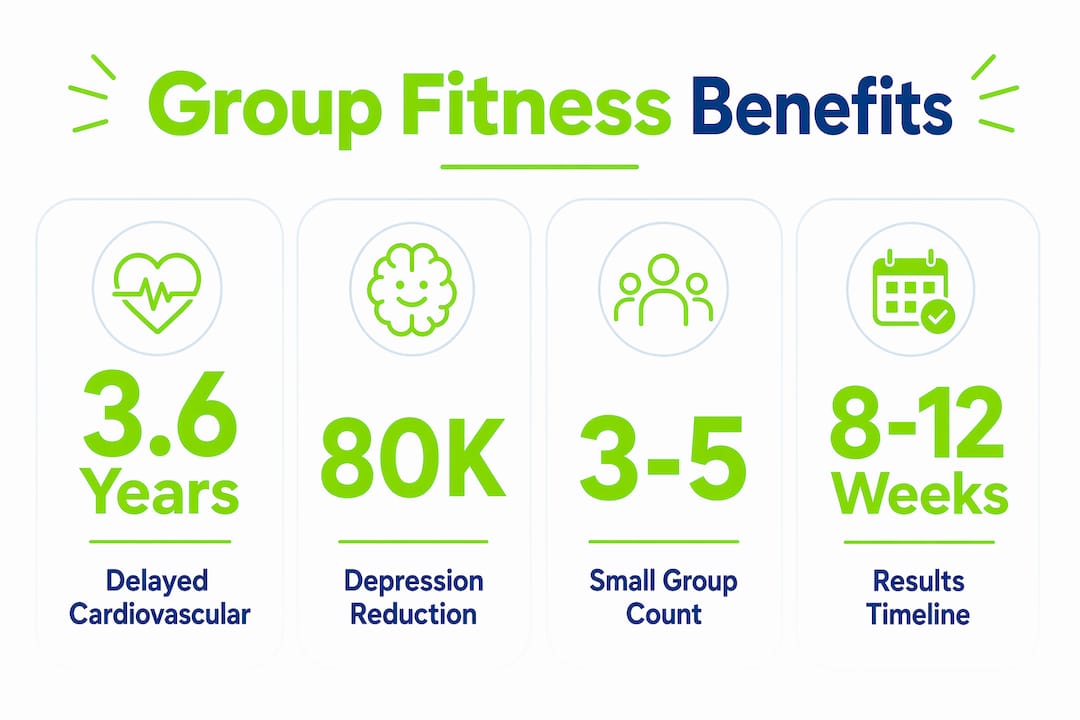
Consistent participation in group fitness can delay cardiovascular disease onset by an average of 3.6 years. That figure comes from long-term study data and represents one of the most compelling arguments for choosing group over solo exercise. A systematic review of over 14,000 participants also found that group-based interventions improve functional outcomes like balance, coordination, and muscle strength more than individual exercise programs.
The term “group exercise” is the standard clinical and research term. “Group fitness” is the widely used consumer label for the same concept. Both refer to instructor-led, socially structured physical activity. This article uses both terms interchangeably, as researchers and fitness professionals do.
How does group fitness improve physical health?
Group exercise produces stronger physical outcomes than solo training across multiple health markers. The cardiovascular benefit alone justifies the switch for most people. A 3.6-year delay in cardiovascular disease onset is not a marginal gain. It represents years of healthy, active life added to your timeline.
Functional fitness also improves significantly in group settings. The meta-analysis of 14,000+ participants showed gains in balance, coordination, and muscle strength that outpaced individual training programs. These improvements matter especially for adults over 40, where fall prevention and mobility become critical health priorities. Dietium’s resource on functional fitness workouts explains how these movements translate into everyday strength and stability.
Attendance is another physical health driver that group settings uniquely support. Participants in one 30-week study maintained nearly 99% workout attendance due to group motivation and social accountability. Showing up consistently is the single biggest predictor of physical results, and group formats make consistency far easier to sustain.
| Physical health metric | Group fitness outcome |
|---|---|
| Cardiovascular disease onset | Delayed by an average of 3.6 years |
| Balance and coordination | Significantly improved vs. solo training |
| Muscle strength | Greater gains in group vs. individual programs |
| Workout attendance | Nearly 99% over 30 weeks in structured programs |
| Functional mobility | Improved across age groups in group interventions |
Pro Tip: Track your resting heart rate and workout consistency over 8–12 weeks after joining a group class. Measurable cardiovascular changes typically appear within that window, giving you concrete evidence of progress.
What mental health benefits does group fitness provide?
Group exercise reduces depression symptoms more effectively than solo workouts. A meta-analysis of nearly 80,000 participants confirmed that group-based exercise produces greater reductions in depression than individual training. That scale of evidence is hard to dismiss. The mental health case for group fitness is as strong as the physical one.
A 12-week group workout program significantly improved stress levels and physical, mental, and emotional quality of life compared to solo exercise. Participants reported feeling better across all three dimensions, not just physically. This matters because most people start exercising for physical reasons but quit when motivation drops. Group settings address the emotional and psychological factors that determine whether you stick with it.
The psychological mechanisms behind these benefits are specific and well-documented:
- Co-regulation: Exercising alongside others calms the nervous system. Group fitness acts as co-regulation of the nervous system, lowering anxiety more effectively than solitary exercise.
- Increased agency: Choosing to show up for a class, week after week, builds a sense of control over your health. That sense of agency directly reduces anxiety and depressive symptoms.
- Interruption of anxious thoughts: Physical exertion in a social environment breaks the cycle of rumination. You cannot spiral into worry when you are focused on keeping pace with a group.
- Shared rhythm: Synchronous movement with others promotes nervous system regulation and social bonding simultaneously.
- Emotional quality of life: Group participants report higher satisfaction with their daily emotional experience, not just their workout performance.
Pro Tip: Choose classes with instructors who actively acknowledge participants by name and create an inclusive atmosphere. That specific social dynamic amplifies the mental health benefits significantly.
How does group fitness build social connection and motivation?
Social connection is not a side effect of group fitness. It is a core mechanism that drives physical results. Research published in Frontiers in Sports and Active Living confirms that social capital, including trust and reciprocity, is critical for motivation and long-term commitment in group fitness settings. When you trust the people around you and feel a sense of mutual support, you are far more likely to return.
The concept of “groupness” explains why group workouts feel different from solo sessions. Research by Les Mills Head of Research Bryce Hastings shows that humans experience higher enjoyment, exertion, and satisfaction when deeply connected in group workouts. That connection is not just emotional. It translates into working harder and enjoying the process more. Shared synchronous movement also promotes social bonding and cooperative behavior, which are key to psychological well-being.
Building strong social bonds in a fitness group does not happen automatically. These strategies accelerate the process:
- Arrive early and stay briefly after class. The five minutes before and after a session are when real social connections form. Use that time to introduce yourself and learn names.
- Choose a consistent class time. Seeing the same people repeatedly builds familiarity, which is the foundation of trust and reciprocity.
- Acknowledge effort in others. A simple nod or word of encouragement during a tough set creates the reciprocity that social capital research identifies as a key motivator.
- Participate in group challenges or events. Many fitness communities run monthly challenges. Shared goals accelerate bonding faster than shared routines alone.
- Engage with the instructor. Instructors who know your name and goals create a sense of belonging that keeps you coming back even on low-motivation days.
What practical tips help you get the most from group fitness classes?
Choosing the right class format matters as much as showing up. Small-group training with 3–5 participants optimizes motivation, safety, form correction, and reduces dropout risk. Larger classes offer energy and variety, but smaller formats give you more instructor attention and a tighter sense of community. Both have a place depending on your goals and experience level.
Regular attendance triggers an identity shift that changes how you relate to exercise. Consistent class attendance converts exercise from a task you complete into a part of who you are. That shift is the difference between someone who exercises and someone who is an exerciser. Once exercise becomes part of your identity, adherence stops being a willpower problem.
Practical steps to maximize your results:
- Prioritize inclusive environments. Classes where instructors modify movements for different fitness levels reduce intimidation and keep you engaged longer.
- Use hybrid or online group formats. When travel or schedule disrupts attendance, online group classes preserve the social accountability that drives results.
- Track your progress outside the class. Monitoring metrics like resting heart rate, strength gains, and energy levels gives you objective feedback that reinforces motivation. Dietium’s guide on fitness tracking benefits explains how to read that data effectively.
- Evaluate your instructor. The best instructors build trust, learn participant names, and create psychological safety. That role is not cosmetic. It directly determines whether the group develops the social capital that drives long-term adherence.
Pro Tip: If you miss a week, contact someone from your class before the next session. That single act of social reconnection dramatically reduces the chance of dropping out entirely.
Key takeaways
Group fitness produces physical, mental, and social benefits simultaneously, making it more effective than solo exercise for long-term health and adherence.
| Point | Details |
|---|---|
| Cardiovascular protection | Group fitness delays cardiovascular disease onset by an average of 3.6 years. |
| Mental health gains | A meta-analysis of nearly 80,000 participants shows greater depression reduction vs. solo exercise. |
| Social capital drives adherence | Trust and reciprocity in group settings are the primary predictors of long-term commitment. |
| Identity shift sustains motivation | Regular attendance converts exercise from a task into a core part of personal identity. |
| Small groups optimize results | Groups of 3–5 participants balance individual attention with group accountability most effectively. |
Why group fitness changed how I think about exercise
I used to believe that discipline was the deciding factor in fitness success. Show up, do the work, repeat. What I missed for years was that discipline is not a fixed resource. It depletes. And when it runs out, solo exercisers quit. Group exercisers do not, at least not at the same rate.
The research on co-regulation shifted my thinking completely. The idea that exercising alongside others literally calms your nervous system, not just your mood, explains something I had observed but never fully understood. People in group classes look different from solo gym-goers. They seem more at ease, more energized at the end of a session. That is not personality. That is biology responding to social context.
What I find most underappreciated is the role of the instructor in building genuine community. A technically skilled instructor who does not learn names or acknowledge individual progress creates a class, not a group. The distinction matters enormously. Classes produce attendance. Groups produce identity shifts, and identity shifts produce the kind of long-term adherence that actually changes health outcomes. If you are evaluating group fitness options, spend less time comparing workout formats and more time assessing whether the instructor builds real relationships with participants.
— Srasti
How Dietium supports your group fitness results
Group exercise builds the foundation. What you eat and how you track your progress determine how far that foundation takes you. Dietium’s personalized diet planning tools align your nutrition with the specific demands of your training schedule, whether you attend three classes a week or six. The platform calculates your calorie needs, macros, and meal timing based on your actual activity levels, not generic estimates. Pair that with Dietium’s fitness progress tracking tools to measure the gains your group workouts are producing. When your nutrition and tracking work together with your exercise routine, results compound faster and motivation stays high.
FAQ
What are the main benefits of group fitness?
Group fitness improves cardiovascular health, reduces depression symptoms, and builds social connection simultaneously. Research confirms it outperforms solo exercise across physical, mental, and emotional health measures.
How does group exercise reduce depression?
A meta-analysis of nearly 80,000 participants found that group exercise produces greater reductions in depression symptoms than individual training. The social environment and co-regulation of the nervous system are the primary mechanisms.
Is small-group training better than large fitness classes?
Small-group training with 3–5 participants optimizes safety, form correction, and motivation while reducing dropout risk. Larger classes offer energy and variety but provide less individual attention.
How quickly do group fitness benefits appear?
Cardiovascular and mental health improvements typically become measurable within 8–12 weeks of consistent attendance. Attendance rates near 99% over 30 weeks have been recorded in structured group programs.
Why do people stick with group fitness longer than solo workouts?
Social capital, including trust and reciprocity built within the group, drives long-term commitment. Regular attendance also triggers an identity shift where exercise becomes part of personal identity rather than an obligation.


