 Skip to content

TL;DR:
- Effective digital meal planning tools are built around behavior change principles, not just recipe delivery. Continuous logging, personalized feedback, and real-time adjustments drive sustained habits and clinically meaningful results. Accuracy in ingredient mapping and tailoring plans to individual health needs are essential for real effectiveness.
Most people download a meal planning app, browse a few recipes, and wonder why nothing actually changes. The frustration is real and common. What separates apps that drive genuine results from glorified digital cookbooks comes down to one key factor: whether the tool is built around behavior change or simply recipe delivery. Recent clinical research confirms that structured digital interventions can produce clinically meaningful improvements in diet quality and body weight. This guide breaks down exactly what makes digital meal planning effective, how nutrition accuracy shapes outcomes, and what features actually matter.
Table of Contents
- What makes digital meal plans different from traditional approaches?
- How digital meal plans drive real behavior change and results
- The science behind nutrition accuracy: Why ingredient mapping matters
- Personalization, usability, and limitations: What users need to know
- The real-world truth about digital meal plans: What most guides don’t tell you
- Ready to build your own smarter meal plan?
- Frequently asked questions
Key Takeaways
| Point | Details |
|---|---|
| Digital plans work best when personalized | Apps with structured feedback and tracking features can support real behavioral change and health improvements. |
| Accuracy depends on technology and data | Ingredient recognition and reputable food databases are crucial for trustworthy nutrition tracking in meal planning apps. |
| Usability affects long-term success | Tools with high usability and integration make it easier to stick to your dietary goals consistently. |
| Custom solutions are needed for health conditions | Standard meal plans may not be safe for every medical need, so clinical guidance remains important for certain populations. |
| Consistency beats novelty | Sticking with a tool and using it regularly is more important than having the flashiest new features. |
What makes digital meal plans different from traditional approaches?
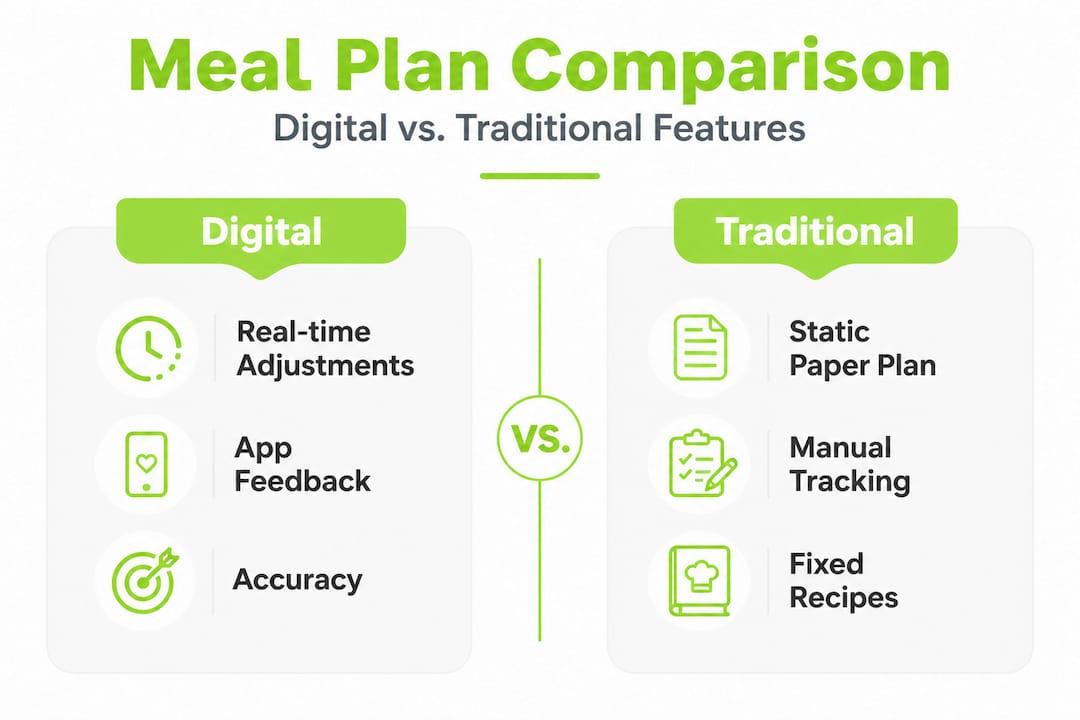
With the new landscape of meal planning shifting digital, it’s vital to see what makes these tools unique. A printed meal plan is static. It cannot react to what you ate for lunch, how your weight changed last week, or whether you skipped breakfast three days in a row. Digital tools can.
The core advantage of digital meal planning is dynamic adjustment. When you log a meal, a well-designed app processes that data and updates your remaining calorie budget, macro targets, and even tomorrow’s recommendations. Paper plans cannot do that. This continuous feedback loop is what separates tools that work from those that collect digital dust.
Here is a direct comparison of what each approach actually offers:
| Feature | Digital meal plan | Traditional (paper/static) |
|---|---|---|
| Real-time calorie tracking | Yes | No |
| Personalized feedback | Yes | No |
| Automatic macro adjustment | Yes | No |
| Behavior change features | Yes (if well-designed) | Rarely |
| Recipe variety and filtering | Extensive | Limited |
| Professional database integration | Yes | Rarely |
| Portability and convenience | Very high | Moderate |
| Cost | Varies (free to subscription) | Low |
The behavioral science behind digital tools matters just as much as the features list. Apps designed with structured feedback, reminders, and goal setting engage users in ways that static resources simply cannot. The ability to personalize your diet based on logged data creates a feedback loop that reinforces healthy decisions daily.
Key differences worth noting:
- Continuous logging keeps users accountable beyond a single meal or day
- Personalized feedback adapts to individual progress, not a generic template
- Behavioral prompts (reminders, streak tracking) build consistent habits
- Integration with wearables connects activity data to nutritional needs
Evidence now backs this up in clinical settings. A randomized controlled trial involving 164 participants found that digital app interventions designed as structured behavior-change programs produced nearly 7 kg of average weight loss over six months. That is a clinically significant result. Template-only apps that simply display recipes did not produce the same outcomes. The distinction between a true digital coaching tool and a recipe browser is the difference that counts. Learning about sustaining healthy eating through structured digital frameworks is what keeps behavior change durable.
How digital meal plans drive real behavior change and results
Now that we see the difference, let’s clarify why these tools can actually transform habits and deliver results. Behavior change is not accidental. It follows predictable patterns rooted in psychology, and the best digital meal plans are engineered around those patterns.

A 2025 systematic review and meta-analysis covering app-based behavioral interventions found small-to-moderate improvements in dietary quality across studies. Fruit and vegetable intake improved meaningfully in multiple cohorts. Specific content types, such as message-based prompts, showed notable effects on reducing meat consumption. The effect sizes vary, but the direction of the evidence is clear: design matters enormously.
Here is a summary of outcomes reported across major studies:
| Outcome measured | Result |
|---|---|
| Average weight loss (structured app, 6 months) | ~7 kg |
| Fruit and vegetable intake | Small-to-moderate improvement |
| Meat reduction (message-based apps) | Moderate effect |
| Dietary quality index improvement | Significant in structured interventions |
| Adherence to logging (12-week studies) | Higher when usability scores are strong |
The behavioral mechanisms that produce these results follow a clear progression:
- Goal setting establishes a clear nutritional target tied to a health outcome (weight loss, muscle gain, cholesterol reduction)
- Daily logging creates awareness of actual food intake versus perceived intake
- Feedback delivery compares logged data against goals in real time
- Self-regulation allows users to course-correct before the day or week is lost
- Progress tracking reinforces positive behavior through visible data trends
- Social features or reminders sustain motivation during plateaus
Understanding why meal planning matters at this behavioral level is what separates people who get results from those who give up after week two. The process is iterative, not linear.
“App-based behavioral interventions show small-to-moderate improvements in dietary quality measures such as fruit/vegetable intake, with effects varying by content type. Message-based content for meat reduction shows particularly notable effects.” — 2025 systematic review and meta-analysis, International Journal of Behavioral Nutrition and Physical Activity
App design beyond recipe delivery is what creates this impact. Features like nutrition coaching messages, real-time macros dashboards, and nutrition awareness tools embedded in daily workflows change behavior because they show up in the user’s environment consistently.
Pro Tip: Consistent use matters more than finding the “perfect” app. An app you log into daily with average features will outperform a sophisticated app you open once a week. Commit to one tool for at least 30 days before evaluating whether it is working.
The science behind nutrition accuracy: Why ingredient mapping matters
Powerful results only follow when the underlying science is solid. Here is what accuracy really involves in digital meal tracking.
When you log a homemade chicken stir-fry, a nutrition app cannot simply look up “chicken stir-fry” and return accurate data. It needs to break that dish into its individual components: chicken breast, sesame oil, soy sauce, bok choy, garlic, and so on. Each component must then be matched to a verified food composition database entry. This process is called ingredient mapping, and it is one of the most technically demanding parts of building a reliable nutrition tracker.
A 2025 study evaluating large language model performance in nutrition analysis found that models like Llama-3 and GPT-4o can decompose compound dishes into basic ingredients with measurable accuracy. Performance is typically quantified using F1-scores (a statistical measure of precision and recall, where 1.0 is perfect). Results showed meaningful variation by food category and dish complexity, confirming that AI-powered tools are promising but not infallible.
Errors in this process cascade quickly. If the app mistakes a tablespoon of olive oil for a teaspoon, your fat and calorie totals shift. Multiply that across three meals and a snack, and your daily nutrition data could be meaningfully off. That directly affects whether your targets are realistic or achievable. Using nutritional analysis methods that are grounded in reputable food composition databases is essential for accuracy.
Key challenges in nutrition logging and ingredient mapping include:
- Portion estimation errors: Visual estimation of serving size is notoriously imprecise; weight-based logging is significantly more accurate
- Mixed dish recognition: Complex recipes with layered ingredients are harder for AI and users to decompose correctly
- Database mismatches: Regional food variants, brand-specific products, and restaurant meals often lack complete database entries
- User input errors: Misremembering what was eaten, skipping minor ingredients (cooking oils, condiments), and inconsistent terminology create data gaps
- Preparation method impact: Boiling versus frying, raw versus cooked weights all change the nutritional profile significantly
Pro Tip: When evaluating a meal planning app, check whether it uses a verified food database (such as USDA FoodData Central) and whether it allows manual portion input by weight rather than vague descriptors like “medium bowl.” Apps with those features are built for accuracy, not just convenience. Dynamic calorie calculation tools that adjust for these variables give you data you can actually act on.
Personalization, usability, and limitations: What users need to know
To make digital meal planning work for you, it’s critical to understand both possibilities and the must-know practical limits. Features and science only matter if the tool fits your actual life, health status, and goals.
Usability is not just about aesthetics. A 12-week mixed methods randomized pilot study of the PortfolioDiet.app found that acceptability benchmarks, including scores on the System Usability Scale (a standardized tool for measuring ease of use), directly influenced whether users could translate a nutrition therapy protocol into actual dietary changes. Apps that scored poorly on usability saw lower adherence and fewer days of active logging per month.
“Usability and acceptability are not secondary concerns. In app-based nutrition therapy, adherence and logging behavior directly determine whether the tool produces real dietary change.” — 12-week PortfolioDiet.app pilot study, PMC
Signs that a digital meal plan is a good fit for your needs:
- It allows you to enter medical history, dietary restrictions, and health goals during setup
- Calorie and macro targets are calculated based on your personal metrics (height, weight, activity level, age), not a generic default
- The app includes options to adjust plans for food allergies, intolerances, or cultural preferences
- It has a usability rating or strong user reviews that indicate consistent, easy daily use
- The meal plan structure aligns with your cooking habits (quick meals, batch cooking, restaurant-friendly options)
- It integrates with fitness tracking so your activity data updates your nutritional needs automatically
Medical context adds another critical layer. A kidney disease meal planning guide makes clear that standard nutrition recommendations can be unsafe for individuals with compromised organ function. Potassium, phosphorus, and sodium limits that are appropriate for a healthy adult may need to be dramatically different for someone managing chronic kidney disease or type 2 diabetes alongside it. This is not a niche concern: millions of people managing chronic conditions also want to improve their diets, and a one-size-fits-all digital plan is genuinely risky without clinical oversight.
Personalized meal plans for every health goal must account for these variables. Digital tools that allow for clinically specific constraint settings and integrate with registered dietitian consultations are the gold standard for anyone managing a complex health profile.
The real-world truth about digital meal plans: What most guides don’t tell you
With the realities of limitations and personal context in mind, let’s cut through the marketing for a hard-won perspective.
Most of the conversation around digital meal planning apps focuses on features. Which AI is smarter? Which database is bigger? Which interface is cleanest? That is the wrong conversation. The real differentiator is not the app’s intelligence. It is yours.
People consistently overestimate how much the tool matters and underestimate how much their engagement matters. An app that sends you smart, personalized recommendations does nothing if you ignore the notifications and log your meals retrospectively three days later. The behavioral loop only closes when you are actually in it, consistently, in real time.
Here is what actually drives results: small, daily data inputs over weeks and months. Not dramatic weekly resets. Not switching to a new app every time you plateau. The users who see meaningful, lasting changes are the ones who log imperfectly but consistently, who review their weekly summaries, who adjust one thing at a time, and who stick with the same tool long enough to accumulate useful data.
Many guides also gloss over the fact that meal plans for busy people need to be realistic above all else. A beautiful seven-day plan featuring recipes that take 90 minutes to prepare is not a tool. It is a fantasy. The best digital plans account for prep time, cooking skill, grocery budget, and weekly schedule. If the plan does not fit your week, you will not follow it, regardless of how nutritionally optimized it is.
Pro Tip: Test two or three apps in the first two weeks to find one that fits your daily habits. Then commit to that single app for at least four weeks without switching. The pattern of your logged data over 30 days is far more valuable than any single feature comparison.
Ready to build your own smarter meal plan?
For those who want to put these insights into practice, here is your next step. At Dietium.com, personalized digital meal planning is built around the same evidence-based principles covered in this guide: structured goal setting, accurate macro tracking, behavior-oriented feedback, and medical safety considerations. The platform connects you to AI-powered tools, fitness and nutrition calculators, and the Recipians app, which generates custom meal plans and recipe suggestions aligned with your specific goals.
Whether you are starting from scratch or refining an existing approach, you can get a personalized meal plan that is grounded in your metrics, not a template. Explore the science behind meal plan personalization benefits and see how data-driven customization changes what is possible. Real results start with the right system behind them.
Frequently asked questions
Can digital meal plans help with weight loss?
Yes. Structured digital meal plan apps designed for behavior change can support clinically meaningful weight loss. A randomized controlled trial (n=164) in Germany found nearly 7 kg of average weight loss over six months when the app was built around behavioral intervention rather than recipe browsing.
Are digital meal plans safe for people with medical conditions?
Digital meal plans should always be used with professional guidance for chronic disease, since standard nutrition recommendations can be unsafe for some conditions. A kidney disease meal planning guide specifically notes that nutrient limits must be tailored to organ function and current lab values.
How accurate are digital meal plans for tracking nutrients?
Accuracy depends on food database quality, ingredient recognition, and the app’s ability to decompose mixed dishes correctly. A 2025 LLM evaluation study confirmed that even advanced AI models show measurable variation in compound ingredient decomposition, making database integrity and manual review options essential.
What features should I look for in a good digital meal planning app?
Prioritize goal tracking, personalized feedback, easy daily logging, strong usability scores, and customization for dietary restrictions or medical conditions. Research on PortfolioDiet.app confirmed that apps scoring well on the System Usability Scale produce significantly better adherence and real dietary change outcomes.
Recommended
- Master meal planning for fitness goals: boost results – Dietium
- Personalize your diet for real, goal-driven results – Dietium
- Personalized Meal Plans for Every Health Goal – Dietium
- Why meal planning matters for health and nutrition success – Dietium
- Implement science-driven supplementation for better health – SUPERIOR Formulas


