 Skip to content

TL;DR:
- AI calorie trackers vary widely in accuracy, from ±1.2% to over 37%.
- Dynamic calorie calculation adjusts targets in real time using activity, weight, and dietary data.
- Manual review and cross-checking remain essential for precise nutrition, especially for clinical needs.
AI calorie trackers promise to simplify your nutrition logging, but the gap between marketing claims and real-world accuracy is significant. Apps like CalAI advertise 90% accuracy, yet peer-reviewed research places mean absolute percentage error (MAPE) anywhere from 1% to 37% for energy alone, and even higher for macros. That range matters enormously when you’re optimizing for specific body composition goals. This article breaks down what dynamic calorie calculation actually is, how AI-driven and manual logging methods compare, and what practical steps you can take right now to track calories with far greater precision.
Table of Contents
- What is dynamic calorie calculation?
- Evaluating AI-driven calorie tracking accuracy
- Core factors for accurate dynamic calorie calculation
- Best practices to optimize your calorie tracking with dynamic tools
- Why most calorie calculators miss the mark—and how we’ve learned to bridge the gap
- Take the next step with personalized nutrition planning
- Frequently asked questions
Key Takeaways
| Point | Details |
|---|---|
| AI calorie tracking limits | AI tools offer convenience but error rates vary widely and can systematically underestimate calories. |
| Dynamic calculation advantages | Dynamic models improve accuracy with real-time adjustments based on activity and behavior. |
| Manual review importance | For health-critical goals, manual cross-checking is essential despite AI’s progress. |
| Best practices for precision | Use hybrid strategies—dynamic calculation combined with periodic manual review—for optimal results. |
What is dynamic calorie calculation?
Dynamic calorie calculation is an adaptive approach to estimating your daily energy needs. Unlike static models that assign a fixed calorie target based on a one-time assessment of your age, height, weight, and activity level, dynamic systems continuously update your targets as your body and behavior change.
The core principle is simple: your calorie needs today are not the same as they were three months ago. Weight loss, muscle gain, changes in sleep patterns, and shifts in physical activity all alter how many calories your body burns. A dynamic calculator tracks these variables in real time and recalibrates your targets accordingly.
Key features of dynamic calorie calculation:
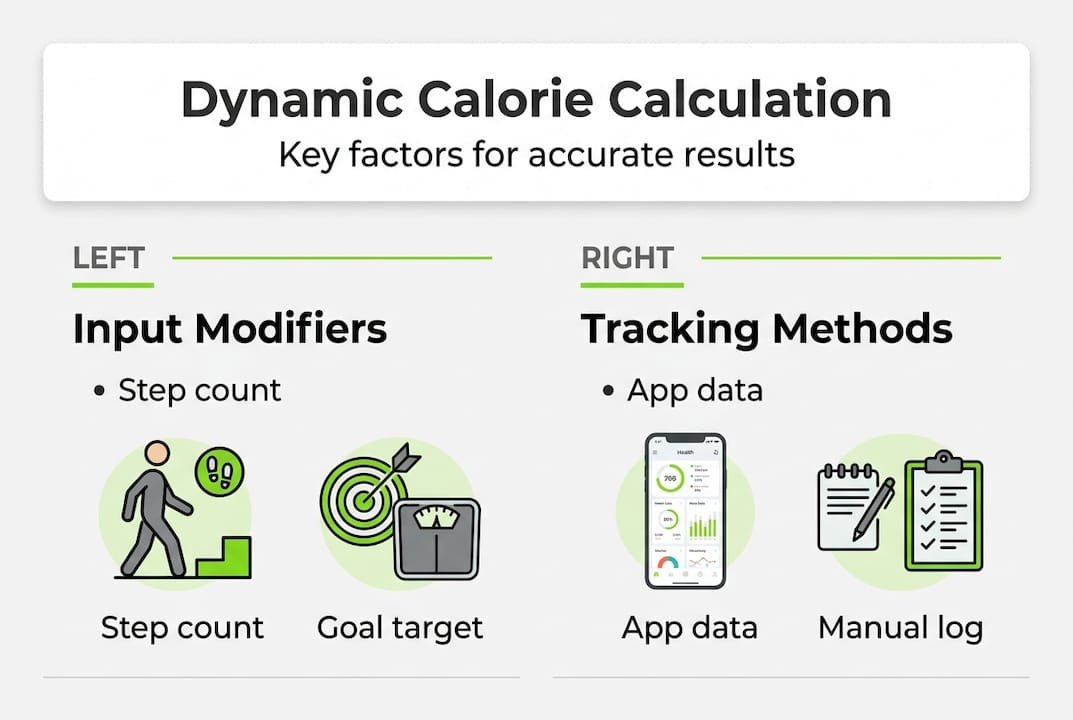
- Real-time adjustments: Targets update based on logged activity, step counts, and weight entries
- Adaptive algorithms: The system learns from your historical data to refine predictions over time
- Personalized targets: Calorie and macro goals shift to reflect your current physiology, not a snapshot from months ago
- Multi-input integration: Pulls data from wearables, food logs, and manual entries for a broader picture
Compare this to a fixed-calorie approach, where you calculate a number once and stick to it indefinitely. That static method ignores the biological reality that your metabolism responds to weight changes, training load, and even stress.
Here is a clear side-by-side of the two approaches:
| Feature | Static calculation | Dynamic calculation |
|---|---|---|
| Target updates | Never or rarely | Continuously |
| Activity integration | Manual input only | Automated via wearables |
| Weight change response | None | Recalibrates targets |
| Accuracy over time | Degrades | Improves |
| Best for | Short-term estimates | Long-term optimization |
Practical calorie intake calculation methods have improved significantly as apps began incorporating step-count and goal modifiers. Research benchmarking digital tools found that MacroFactor’s prediction error dropped by 6% to 20% when these modifiers were applied, compared to static baseline estimates. That is not a marginal improvement. Over weeks and months, it translates into more accurate macro splits, better body composition results, and fewer frustrating plateaus. Understanding AI meal planning facts helps set realistic expectations for what these tools can and cannot do.
Evaluating AI-driven calorie tracking accuracy
Not all AI calorie trackers perform equally, and the variance between tools is wide enough to meaningfully affect your results. The current landscape includes photo-based food scanners, large language model integrations, and hybrid manual-plus-AI systems, each with different accuracy profiles.
Photo-based AI scanners analyze an image of your meal and estimate calories and macros automatically. The best-performing tools in recent systematic reviews achieved impressive results. In a 2026 systematic review, PlateLens recorded a MAPE of just ±1.2% for calorie estimation. ChatGPT and Claude, however, showed weight estimation errors averaging around 36%. Gemini performed worst, with errors ranging from 64% to 110%.
Accuracy breakdown by method:
- PlateLens: ±1.2% MAPE (best in class for photo scanning)
- ChatGPT / Claude: ~36% weight MAPE (significant variability for complex meals)
- Gemini: 64% to 110% MAPE (not suitable for precision calorie tracking)
- Manual logging: ±12% to 31% MAPE (with systematic underestimation for large portions)
| Tool | Method | Calorie error range | Notes |
|---|---|---|---|
| PlateLens | Photo AI | ±1.2% | Best performing photo scanner |
| ChatGPT/Claude | LLM estimation | ~36% | Struggles with portion weight |
| Gemini | LLM estimation | 64-110% | High variance, unreliable |
| Manual logging | User entry | 12-31% | Underestimates large portions/sodium |
Manual logging has its own persistent problem. Research confirms that users systematically underestimate large portions and high-sodium foods, with error rates between 12% and 31%. People tend to log what they intend to eat rather than what they actually eat.
“AI photo logging tools are not yet clinical-grade for precision needs. The accuracy gap between top-performing apps and LLM-based estimators is too wide for users with medical or high-performance nutrition requirements.”
For most fitness-focused users, the practical takeaway is to use a calorie calculator comparison to identify which tool best fits your specific goals. Pairing a high-accuracy photo scanner with dynamic adjustment features gives you the best of both approaches. You can also explore fitness calculators for health to layer in additional metrics like TDEE and body fat percentage for a more complete picture.
Core factors for accurate dynamic calorie calculation
Knowing that dynamic tools outperform static models is useful. Understanding why helps you squeeze more accuracy out of any platform you use. Several variables drive the quality of a dynamic calorie calculation, and each one compounds the others.
The variables that matter most:
- Activity level: Daily step counts and structured workout data are the single biggest driver of calorie expenditure variance between individuals
- Weight fluctuations: Tracking weight consistently, ideally daily and at the same time, gives the algorithm enough signal to filter out water retention noise
- Dietary log completeness: Missing even one meal per day introduces systematic error that cascades over weeks
- Sleep quality: Poor sleep elevates cortisol and suppresses satiety hormones, affecting both hunger signals and energy use
- Hydration status: Dehydration can suppress metabolic rate by up to 3%, which is enough to stall a fat loss phase if the algorithm is not accounting for it
Step and goal-based modifiers are particularly powerful. When MacroFactor users applied these modifiers, accuracy improved by 6-8% in the short term and up to 20% over the long term. That long-term gain reflects the algorithm learning your personal metabolic patterns rather than relying on population averages.
Pro Tip: Every four to six weeks, audit your logging method. If you have been relying heavily on barcode scanning, try photo logging for a week to identify any systematic gaps. Cross-referencing methods catches biases that build up invisibly over time.
Reviewing outcomes from eHealth app personalization studies shows that users who engaged with tailored feedback prompts logged more consistently and achieved 15% better calorie target adherence than passive users. Consistency is what makes dynamic tools work. Use the health calculators for wellness suite to set a baseline before you begin, and revisit interpreting fitness data guides regularly to understand what your numbers are telling you.

Best practices to optimize your calorie tracking with dynamic tools
Accuracy in calorie tracking is not just about picking the right app. It is about building habits that align with how dynamic algorithms actually work.
Actionable strategies to maximize precision:
- Choose apps with built-in dynamic adjustment: Look for platforms that automatically update your calorie target based on logged weight trends and connected activity data, not just a fixed TDEE formula
- Validate AI estimates monthly: Once per month, cross-check your AI-logged totals against a manual calculation for a full day. If the gap exceeds 10%, review your portion entries
- Log everything, including cooking oils and sauces: These are the most commonly missed entries and can add 200 to 400 calories per day without registering
- Use a food scale for high-calorie-density items: Nuts, cheese, and oils are notoriously difficult to estimate by volume; weight-based logging cuts error significantly
- Sync your wearable daily: A single missed sync day can distort weekly activity averages enough to push your target in the wrong direction
Pro Tip: Systematically audit your sodium and volume estimates for large portions every two weeks. Research shows photo logging accuracy varies from ±1% at best to over 30% at worst, and large, mixed-ingredient meals are where most errors cluster. Cross-checking these entries manually is the single most effective way to tighten your tracking.
For users with clinical or performance nutrition goals, no AI photo tool is a substitute for verified input. These tools reduce friction, but they are not yet reliable enough to stand alone for precision needs. Pairing them with body fat calculators review data and regularly updated macro targets from healthy recipe app comparisons creates a more robust system.
Why most calorie calculators miss the mark—and how we’ve learned to bridge the gap
Most calorie tracking apps are built to be easy to use, not to be accurate. That is a deliberate design choice, and it is also the source of the biggest accuracy gaps. When an algorithm is optimized for user retention rather than metabolic precision, complex meals and large portions are where errors concentrate.
The best AI photo tools still achieve accuracy between ±1% and ±6% under controlled conditions. Real-world performance drops considerably for mixed dishes, restaurant meals, and anything without a clear visual boundary. The honest answer is that no single tool is good enough on its own.
What actually works is treating calorie tracking as a system, not a single app. Manual review, periodic cross-checks, and dynamic target recalibration layered together outperform any individual tool. The bias introduced by app convenience features, like quick-add buttons and restaurant database estimates, accumulates slowly and invisibly.
For users serious about their nutrition outcomes, the approach we recommend at Dietium combines the convenience of AI photo logging with the discipline of monthly manual audits and the precision of AI meal planning platforms that update targets dynamically. Friction is the enemy of consistent logging, but unchecked convenience is the enemy of accuracy. Balancing both is what separates effective tracking from guesswork.
Take the next step with personalized nutrition planning
If you are ready to move beyond generic calorie estimates, Dietium’s platform gives you the tools to do it properly. Start with a structured nutritional assessment to establish your actual baseline, then use that data to build personalized meal plans that adapt as your goals evolve. Every plan integrates dynamic calorie targets, macro tracking, and real-time activity data so your nutrition stays aligned with your current physiology. Explore the full suite of essential health calculators to track BMI, body fat, TDEE, and more in one place. Precision nutrition starts with accurate data, and Dietium is built to deliver exactly that.
Frequently asked questions
How accurate are AI photo calorie trackers compared to manual logging?
AI photo trackers range from ±1.2% to over 37% error, depending on the tool, while manual logging averages 12-31% error with consistent underestimation for large portions and high-sodium foods. The best photo scanners outperform manual logging under controlled conditions, but real-world accuracy varies significantly.
What modifiers help improve calorie calculation accuracy?
Activity-based and goal-based modifiers are the most impactful. MacroFactor’s step modifiers improved calorie prediction accuracy by 6-8% short-term and up to 20% over longer periods by personalizing targets to your actual energy expenditure patterns.
Should I trust AI-driven tools for clinical-grade calorie tracking?
AI tools are not yet clinical-grade for precision nutrition needs. Manual review and cross-checking remain essential for any health goal that requires tight calorie or macro control, as accuracy varies widely even among top-performing apps.
How do dynamic calorie calculators adjust for changes in my routine?
Dynamic calculators use real-time inputs including logged weight, activity data, and dietary entries to recalibrate targets continuously. MacroFactor’s adaptive model reduced monthly weight prediction error by 6-20% compared to static baselines, demonstrating how responsive recalibration improves long-term accuracy.


