 Skip to content

TL;DR:
- Reducing added sugar within days improves energy stability, reduces cravings, and enhances mental clarity.
- Long-term benefits include better blood sugar regulation, reduced visceral fat, and decreased risk of metabolic diseases.
Most people know they eat too much sugar. What they don’t know is how fast cutting it out starts to matter. Within days of reducing added sugar, measurable sugar detox benefits begin to appear: more stable energy, fewer cravings, and clearer thinking. This isn’t about going on a restrictive cleanse or eliminating fruit. The process, more accurately called a metabolic reset, targets the added sugars found in sweetened beverages, packaged snacks, and desserts. These are the fast-absorbing sources that drive insulin spikes, reward cycles, and the fatigue most people blame on everything but their diet.
Table of Contents
- Key Takeaways
- How added sugar disrupts your metabolism
- What the science says about short-term sugar reduction
- Managing the first week: challenges and strategies
- Long-term benefits beyond the initial detox
- My take on what sugar detox actually teaches you
- How Dietium helps you get real results
- FAQ
Key Takeaways
| Point | Details |
|---|---|
| Target added sugars, not all sugars | Focus on removing sweetened drinks, desserts, and packaged snacks rather than eliminating natural sugars from fruit. |
| Benefits start within days | Energy stabilizes and cravings ease in the first two weeks as blood glucose and insulin levels stop spiking. |
| The adjustment phase is temporary | Fatigue and cravings in the first week are normal metabolic recalibration, not withdrawal. |
| Taste buds adapt quickly | Sweet taste receptors recalibrate within days, making naturally sweet foods more satisfying. |
| Long-term gains extend beyond weight | Sustained sugar reduction lowers risk factors for diabetes, heart disease, and fatty liver. |
How added sugar disrupts your metabolism
Before understanding what a metabolic reset does for you, it helps to understand what added sugar does against you. There is a meaningful difference between natural sugars found in whole fruit and complex carbohydrates and the added sugars manufacturers put into processed foods. Natural sugars come packaged with fiber and nutrients that slow absorption. Added sugars hit your bloodstream fast.
When you regularly consume added sugars, your body responds by releasing insulin to manage the blood glucose surge. Do this repeatedly throughout the day and a predictable cycle takes hold:
- Blood glucose spikes shortly after consuming sugary foods or drinks
- Insulin surges to bring glucose levels back down
- Energy crashes follow, usually 60 to 90 minutes later
- Cravings return as your brain signals for another quick energy source
- Metabolic stress accumulates over weeks and months of this pattern
The 2025-2030 Dietary Guidelines represent a significant shift in official guidance, moving away from a percentage-based limit toward recommending no added sugars at all as part of a healthy dietary pattern. This reflects growing evidence that even moderate amounts of added sugar, spread across multiple daily meals, contribute to cumulative metabolic stress.
One common misconception is that sugar is physically addictive in the same way substances are. The more accurate picture involves the brain’s reward conditioning system. Repeated sugar intake trains your brain to expect and seek that quick glucose hit, which is why reducing it feels uncomfortable at first but gets noticeably easier after the first week or two.
What the science says about short-term sugar reduction
The term “sugar detox” sounds trendy, but the evidence behind reducing added sugar in the short term is real and specific. Stable energy and fewer cravings come from removing the blood glucose and insulin swings that fast-absorbing added sugars create, particularly from sweetened drinks and desserts.
A notable study involving 41 children who eliminated added sugar for just 10 days showed measurable cardiometabolic improvements including reduced blood pressure, lower body fat, and improved insulin resistance. That’s a meaningful range of results from a short intervention. While children’s metabolisms respond more quickly, the underlying mechanisms apply to adults as well.
Here is a summary of the documented short-term sugar detox results:
| Benefit | Timeframe | Supporting evidence |
|---|---|---|
| Reduced insulin spikes | Days 3–7 | Removal of fast-absorbing sugar sources |
| Improved energy stability | Week 1–2 | Fewer blood glucose fluctuations |
| Reduced blood pressure | 10 days | Cardiometabolic study in children |
| Lower body fat markers | 10 days | Short-term dietary intervention data |
| Taste recalibration | Days 5–10 | Sweet receptor adaptation |
| Reduced cravings | Week 2 | Reward system recalibration |
One of the more surprising sugar detox effects involves your taste system. Sweet taste receptors adapt within days of reducing added sugar, making naturally sweet foods like berries or carrots taste noticeably more satisfying. Foods you once considered bland start to seem flavorful. This is not willpower. It is biology working in your favor.
Pro Tip: Rather than attempting total sugar elimination on day one, start by removing the single biggest source in your diet, usually sweetened beverages. This one change can reduce your daily added sugar load by 40% or more without requiring a complete dietary overhaul.
Managing the first week: challenges and strategies
The first five to seven days of a sugar detox diet plan are the hardest. Most people experience a predictable set of symptoms as their brain and body adjust to the absence of frequent glucose spikes. Knowing what to expect makes a real difference.

According to an AIIMS and Harvard-trained doctor, initial cravings, fatigue, and brain fog are the brain’s reward system recalibrating, not a sign of withdrawal in the clinical sense. Your brain has been conditioned to expect regular sugar input. When that stops, it takes a few days to adjust its signaling.
Here is a practical sequence for managing the first week:
- Remove sweetened beverages first. Sodas, flavored coffees, and energy drinks are the highest-impact sources to cut. Replacing them with water, sparkling water, or unsweetened tea reduces your sugar load immediately.
- Plan meals with protein and healthy fats. Protein and fat slow digestion and maintain blood glucose stability, which directly reduces cravings. Eggs, nuts, Greek yogurt, and avocado are reliable staples.
- Pre-plan snacks. The moment you feel a craving without a prepared alternative, you are likely to grab something sweet. Keep cut vegetables, nuts, or cheese accessible.
- Reduce sweet-tasting cues. Even artificial sweeteners can maintain your brain’s expectation of sweetness. Limiting all sweet tastes, including diet sodas, improves how quickly your reward system recalibrates. Interestingly, replacing sweetened beverages with water alone did not significantly improve glycemic control in a 24-week study involving adults with type 2 diabetes, underscoring that the full dietary pattern matters more than any single swap.
- Get adequate sleep. Sleep deprivation raises ghrelin levels, the hunger hormone, making cravings significantly worse. Seven to eight hours during the adjustment phase is not optional.
- Track how you feel daily. Writing down energy levels, mood, and cravings gives you concrete feedback and makes the improving trend visible in week two.
For deeper strategies on controlling food cravings during this phase, Dietium has a dedicated resource that covers the neuroscience and practical tactics in detail.
Pro Tip: If brain fog feels intense in the first few days, check that you’re eating enough total calories. Under-eating amplifies detox symptoms significantly. A sugar reduction is not a calorie restriction unless that’s also your goal.
Long-term benefits beyond the initial detox
Clearing the first two weeks is where the real gains begin. The sugar detox weight loss results that most people notice early are meaningful, but they represent only one part of what sustained reduced sugar intake does for your health.
The long-term picture looks considerably different from the short-term adjustment phase. Blood sugar regulation improves progressively, insulin sensitivity increases, and visceral fat, the metabolically active fat stored around organs, begins to decrease. Minimizing added sugars is directly tied to improved cardiovascular risk profiles per the American Heart Association’s 2026 guidance on heart-healthy eating.
There are mental health dimensions as well. Many people report reduced anxiety and more consistent mood after several weeks of lower added sugar intake. Brain fog, a constant complaint among people eating high-sugar diets, clears for most people within two weeks. Sleep quality frequently improves because blood glucose is no longer destabilizing during the night.
Here is how short-term and long-term sugar detox outcomes compare:
| Timeframe | What improves | Why it matters |
|---|---|---|
| Days 1–7 | Energy begins stabilizing, taste starts shifting | Glucose and insulin spikes decrease |
| Days 7–14 | Cravings reduce, brain fog clears | Reward system recalibrates |
| Weeks 2–6 | Weight shifts, blood pressure may improve | Metabolic stress is consistently lower |
| Months 2–6 | Insulin sensitivity improves, visceral fat reduces | Cumulative effect of stable blood glucose |
| Long-term | Lower risk of type 2 diabetes, heart disease, and fatty liver | Chronic metabolic stress is eliminated |
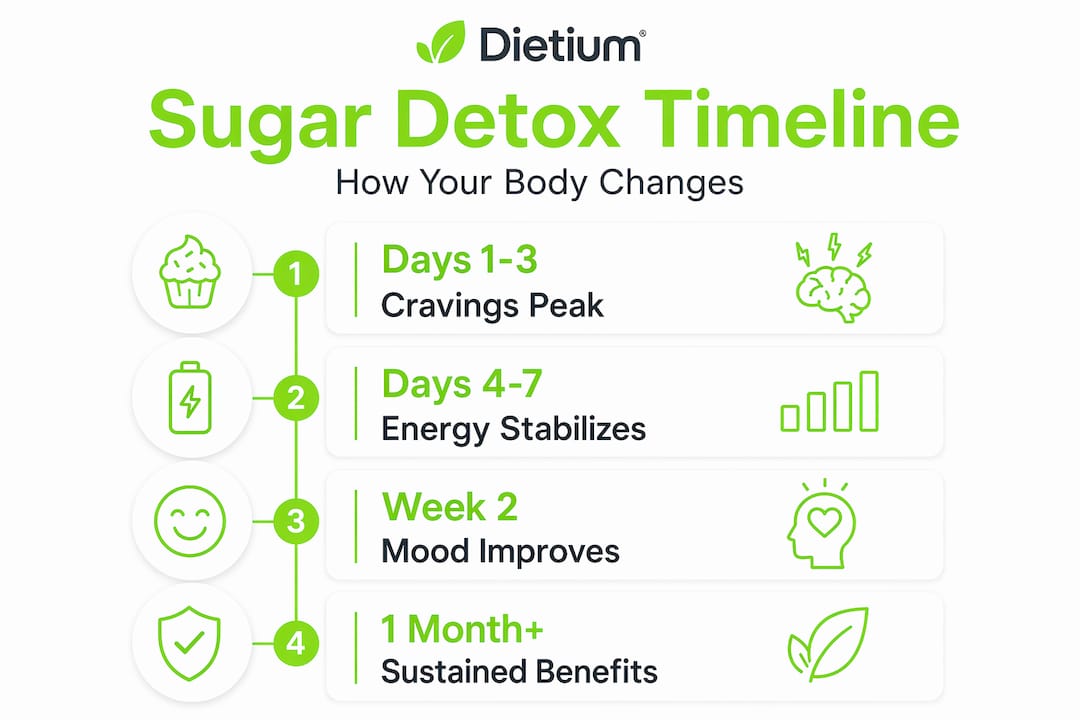
The benefits of sugar detox, sustained over months, also include improved hunger regulation. When blood glucose stops spiking and crashing, the hormonal signals controlling hunger, particularly leptin and ghrelin, begin to function more accurately. You feel genuinely hungry when you need food and genuinely satisfied when you have eaten enough. That recalibration alone changes how you relate to eating.
The key distinction between people who sustain these results and those who revert is the shift in thinking. A sugar detox is a starting point for learning what stable eating feels like. The goal is not to white-knuckle through 30 days and then return to old habits. Discovering how to reduce sugar naturally over the long term is what separates temporary results from lasting change.
For practical meal planning support, a 14-day no sugar food list can give you a structured template to work from without needing to figure everything out on your own.
My take on what sugar detox actually teaches you
I’ve looked at the clinical data on this from multiple angles, and what I find most useful is how a sugar reduction period functions as diagnostic feedback rather than a one-time fix. What I’ve learned from working with this topic is that most people don’t realize how much of their daily fatigue, afternoon slumps, and persistent cravings are tied directly to blood glucose volatility until those things disappear.
The adjustment phase is real, and it’s uncomfortable. But I’ve seen people give up at day four, just before the improvements begin in week two. The cravings and fatigue in those first days aren’t a sign that something is wrong. They are confirmation that your brain’s reward wiring is shifting, and that is exactly what you want.
What I find most overlooked is the taste recalibration. After behavioral and taste system adaptations take hold, previously sweet foods start to taste overwhelmingly sweet. That shift in preference is one of the most powerful tools for long-term success, and it happens without willpower. It happens because of biology.
My practical advice: don’t try to design a perfect sugar detox diet plan from scratch. Use a structured meal framework that already accounts for macronutrient balance and glucose stability. Personalized nutrition planning removes the guesswork from this entirely and makes the first two weeks significantly more manageable.
— Srasti
How Dietium helps you get real results
Knowing the benefits of a sugar detox is one thing. Putting them into practice with a plan that fits your specific eating habits, health goals, and schedule is another. Dietium’s personalized diet plans are built around your individual macros, metabolic needs, and food preferences, removing the common pitfalls that derail most sugar reduction attempts.
If you’re not sure where hidden sugars are entering your diet, Dietium’s nutritional assessment tools help you identify the exact sources and build a custom reduction plan around them. For structured week-by-week support, the personalized meal plans on the platform include options specifically designed for blood sugar stability, making it straightforward to follow through on what the science supports.
FAQ
What are the main sugar detox benefits?
The primary benefits include more stable energy, reduced cravings, improved insulin sensitivity, and lower blood pressure. Most people notice significant changes within the first two weeks of reducing added sugar intake.
How long does it take to see sugar detox results?
Energy stabilizes within the first week for most people, and cravings reduce noticeably by day 10 to 14. Longer-term metabolic improvements like reduced visceral fat and better blood sugar regulation develop over weeks to months.
What are the most common sugar detox challenges?
Fatigue, cravings, brain fog, and irritability in the first five to seven days are the most reported challenges. These reflect normal brain reward system recalibration and typically ease considerably by the start of the second week.
Does a sugar detox mean cutting all sugar?
No. The focus is on added sugars found in processed foods, sweetened drinks, and desserts. Natural sugars in whole fruit and complex carbohydrates are not the same metabolically and do not need to be eliminated.
Can a sugar detox help with weight loss?
Yes. Reducing added sugars lowers caloric intake from nutritionally empty sources, decreases insulin-driven fat storage, and reduces visceral fat over time. Weight loss is one of several measurable outcomes from sustained sugar reduction.


