 Skip to content

TL;DR:
- Whole foods retain their natural state, offering higher nutrient density and better health benefits than processed foods. Consuming more whole foods leads to greater satiety and fewer calories, supporting weight management and heart health. Using the NOVA classification helps identify processing levels, guiding smarter food choices and dietary flexibility.
Whole foods are defined as foods consumed in or close to their natural state, with little to no alteration before eating. Processed foods, by contrast, undergo industrial modification that adds salt, sugar, fat, or synthetic additives to extend shelf life or enhance flavor. The nutritional differences between these two categories are significant, and recent research makes the case for whole foods more compelling than ever. A 2026 University of Bristol study found that people eating a whole foods diet consumed 57% more food by weight yet took in 330 fewer calories daily than those eating ultra-processed foods. That single finding reframes the entire conversation around diet and weight management.
How do whole foods and processed foods differ in nutrition and health?
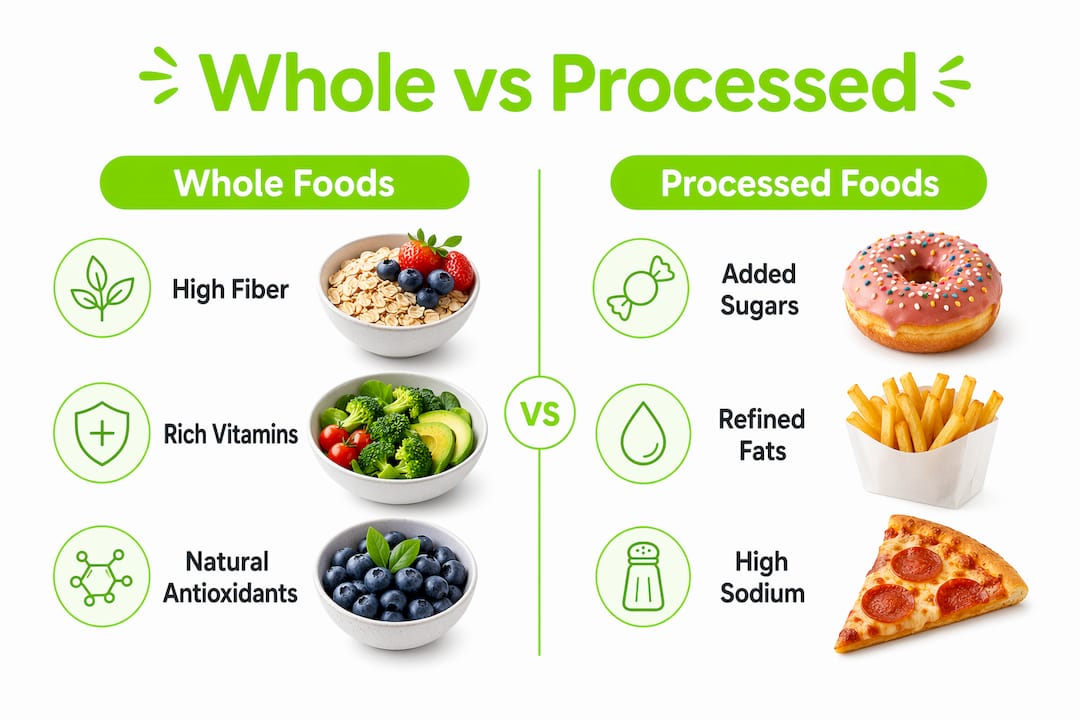
Whole foods deliver higher fiber, vitamins, minerals, antioxidants, and beneficial phytochemicals than most processed alternatives. These nutrients do not work in isolation. They interact through a mechanism called nutrient synergy, where phytochemicals and fiber work together to reduce inflammation and improve absorption in ways that isolated supplements cannot replicate.
Processed foods often replace these compounds with added sugars, sodium, and refined fats. The result is a product that is calorie-dense but nutrient-poor. A study of 120,000 adults linked processed and refined foods to weight gain and increased heart disease risk. Diets built around minimally processed whole grains, vegetables, and lean proteins reduce heart disease risk by about 15%.
The caloric density gap is striking in clinical settings. Volunteers on an ultra-processed diet gained nearly 1kg in two weeks. Those on an unprocessed diet lost nearly 1kg over the same period. The difference was not portion size. It was food structure and caloric density.
Pro Tip: Track your nutrient density rather than just calories. A cup of lentils and a bag of pretzels can have similar calorie counts, but their nutritional profiles are worlds apart.
| Category | Whole Foods | Processed Foods |
|---|---|---|
| Fiber content | High (beans, oats, vegetables) | Often low or removed |
| Added sugar | None | Frequently added |
| Micronutrients | Naturally present | Often lost in processing |
| Satiety effect | Strong, due to food matrix | Weaker, promotes overconsumption |
| Heart disease risk | Lower with regular consumption | Higher with ultra-processed intake |
What are the categories of food processing and how do they affect health?
Not all processing is equal. The NOVA classification system, developed by researchers at the University of São Paulo, organizes foods into four groups based on the extent and purpose of processing. Understanding these categories prevents the kind of all-or-nothing thinking that makes dietary change harder than it needs to be.
The four NOVA categories are:
- Unprocessed or minimally processed foods: Fresh fruits, vegetables, plain meat, eggs, and milk. These foods are either untouched or altered only by drying, freezing, or pasteurizing.
- Processed culinary ingredients: Olive oil, butter, flour, and salt. These are derived from whole foods and used in cooking, not eaten alone.
- Processed foods: Canned tomatoes, cured meats, cheese, and canned beans. These involve added salt, sugar, or preservation methods but retain recognizable ingredients.
- Ultra-processed foods: Packaged snacks, sodas, instant noodles, and flavored cereals. These contain industrial additives, flavor enhancers, and emulsifiers with no whole-food equivalent.
The critical distinction is between the third and fourth categories. Minimally processed foods like canned beans or pasteurized milk provide essential nutrition without meaningful health trade-offs. Pasteurization improves food safety without significant nutrient loss. Freezing vegetables at peak ripeness often preserves more vitamins than fresh produce that has spent days in transit.
The food matrix also matters. Whole almonds provide fewer absorbable calories than ground almonds, even at the same weight. The physical structure of the food limits how much the body extracts. Similarly, the dairy matrix in yogurt and cheese reduces some of the adverse cholesterol effects seen with butter. Processing that breaks down food structure tends to increase caloric availability and reduce satiety.
Pro Tip: When buying packaged foods, check the ingredient list. If you can recognize every item and the list is short, the product is likely closer to the minimally processed end of the spectrum. Use this as a quick filter at the grocery store.
What practical steps help you eat more whole foods without overspending?
Shifting toward a whole foods diet does not require a complete overhaul overnight. Gradual swaps are more sustainable and easier to maintain long-term.
- Start with breakfast. Replace sugary cereals with oats, eggs, or plain Greek yogurt. These are affordable, filling, and require minimal preparation.
- Build meals around vegetables and legumes. Canned beans, lentils, and frozen vegetables are among the most cost-effective whole food options available. They store well and cook quickly.
- Read labels before buying packaged items. Choosing items with fewer ingredients reduces ultra-processed food intake without requiring you to avoid all packaged products.
- Fill your plate with whole foods first. When you start a meal with vegetables, legumes, or whole grains, you naturally eat less of the calorie-dense processed items alongside them.
- Meal prep once or twice a week. Cooking a batch of grains, roasting vegetables, and portioning proteins in advance makes whole food choices the default option on busy days.
Transitioning to a whole foods diet costs approximately $45 more per week than relying on ultra-processed foods. That gap narrows significantly with strategic shopping: buying seasonal produce, using dried or canned legumes, and reducing food waste. The smart shopping tips that work best focus on staples rather than specialty items.
Cooking method also affects nutrient retention. Using cookware that preserves food integrity during high-heat cooking helps you get the most from whole food ingredients without introducing unwanted compounds.

What are the biggest myths about healthy vs unhealthy foods?
The most persistent myth is that all processed foods are harmful and all whole foods are automatically good for you. Neither claim holds up under scrutiny.
Processing has been used for millennia to improve taste and preservation. Fermentation, drying, and salting are ancient techniques that produce nutritious foods like kimchi, dried fish, and aged cheese. The problem is not processing itself. It is the modern category of ultra-processed foods, which are specifically engineered to bypass satiety cues and encourage overconsumption. That engineering is what drives excess calorie intake and obesity risk.
Fortification adds another layer of nuance. Some processed foods are enriched with iron, B vitamins, or vitamin D, making them genuinely useful for people with dietary gaps. The issue is that fortification adds isolated nutrients back into a product that has already lost its food matrix. As nutrition researchers note, nutrient synergy in whole foods cannot be fully replicated by adding individual vitamins to a stripped-down product.
“The ‘whole vs processed’ binary is misleading. Nutrient density and ingredient quality are more meaningful dietary indicators than processing status alone.”
This perspective, supported by researchers at the University of Arizona, reflects a growing consensus in nutrition science: the goal is to eat foods that are rich in nutrients, regardless of whether they passed through a factory.
The practical takeaway is to prioritize nutrient-rich foods and limit ultra-processed items, without treating every packaged product as the enemy. A can of sardines in olive oil is processed. It is also one of the most nutrient-dense foods available.
Key Takeaways
Whole foods consistently outperform ultra-processed foods in caloric efficiency, nutrient density, and long-term health outcomes, but the quality of any food depends on its ingredients and structure, not its processing status alone.
| Point | Details |
|---|---|
| Caloric efficiency | Whole food eaters consumed 330 fewer calories daily despite eating 57% more food by weight. |
| Nutrient synergy | Phytochemicals, fiber, and micronutrients in whole foods work together in ways supplements cannot replicate. |
| NOVA classification | Use the four-tier NOVA system to assess processing level rather than relying on broad “healthy vs unhealthy” labels. |
| Cost management | The $45 weekly cost gap between whole and ultra-processed diets shrinks with legumes, frozen vegetables, and seasonal produce. |
| Label reading | Short ingredient lists with recognizable items signal minimally processed foods worth including in your diet. |
Why I stopped treating “processed” as a dirty word
I spent years defaulting to the simplest rule: if it came in a package, it was suspect. That approach felt disciplined, but it was not accurate. It also made eating unnecessarily stressful.
What shifted my thinking was paying attention to food structure rather than food labels. A can of whole tomatoes and a bag of flavored corn chips are both processed. They have almost nothing else in common nutritionally. The tomatoes retain their fiber, lycopene, and food matrix. The chips are engineered for palatability and provide almost no satiety signal. Treating them as equivalent because both came from a factory is a category error.
The evidence on avoiding ultra-processed foods is strong and worth acting on. But the goal is not to eat zero processed foods. The goal is to build a diet where whole and minimally processed foods make up the majority of what you eat, leaving room for flexibility without guilt. Rigid rules tend to collapse under real-life conditions. A framework built on nutrient density and ingredient quality holds up much better over time.
The readers I see make the most lasting dietary changes are not the ones who eliminate entire food categories. They are the ones who learn to read a label, stock their kitchen with a few reliable whole food staples, and stop treating every dietary slip as a failure.
— Srasti
How Dietium supports smarter food choices for your goals
Knowing the difference between whole and ultra-processed foods is the first step. Applying that knowledge to your specific calorie needs, health goals, and schedule is where most people get stuck. Dietium’s personalized diet planning tools build meal plans that balance whole food nutrition with realistic daily life. The Recipians app generates recipe suggestions and shopping lists aligned with your macros and preferences, so you are not starting from scratch every week. For readers who want a structured starting point, Dietium’s personalized meal plans cover a range of health goals, from weight management to cardiovascular health, with evidence-based food choices built in.
FAQ
What is the main difference between whole foods and processed foods?
Whole foods are consumed in or close to their natural state, with no added sugars, salts, or industrial additives. Processed foods have been altered from their original form, ranging from minimally processed items like canned beans to ultra-processed products like packaged snacks.
Are all processed foods bad for your health?
No. Minimally processed foods like pasteurized milk, frozen vegetables, and canned legumes retain strong nutritional profiles and pose no significant health risk. The concern centers on ultra-processed foods engineered with additives, excess sugar, and refined fats that promote overconsumption.
Why do whole foods help with weight management?
Whole foods have a physical structure that slows digestion and triggers satiety signals more effectively than ultra-processed foods. A University of Bristol study found that people on a whole foods diet ate 57% more food by weight but consumed 330 fewer calories daily compared to those eating ultra-processed foods.
How does the NOVA classification help with food choices?
The NOVA system groups foods into four tiers based on processing level, from unprocessed whole foods to ultra-processed industrial products. Using NOVA as a reference helps you assess a food’s likely nutritional quality without needing to analyze every nutrient individually.
Can you follow a whole foods diet on a budget?
Yes. Staples like dried lentils, canned beans, oats, frozen vegetables, and seasonal produce are among the most affordable foods available. The cost gap between whole and ultra-processed diets can be managed significantly with planned shopping and batch cooking.


