 Skip to content

TL;DR:
- Setting healthy boundaries involves clearly communicating personal limits to protect emotional, mental, and physical well-being without creating walls.
- Practicing boundary-setting through consistent communication, consequences, and regular review helps maintain respectful relationships as circumstances change.
Setting healthy boundaries is defined as the practice of clearly communicating your personal limits to protect your emotional, mental, and physical well-being while maintaining respectful relationships. Boundaries are not walls that shut people out. They are flexible limits that define where your responsibility ends and another person’s begins. Clinical frameworks treat boundary-setting as an ongoing practice, not a single conversation. When you establish personal limits through clear communication, specific consequences, and consistent follow-through, you protect your energy and keep your relationships healthy. The importance of setting boundaries shows up in every area of life, from friendships to family dynamics to romantic partnerships.
What are healthy boundaries versus unhealthy ones?
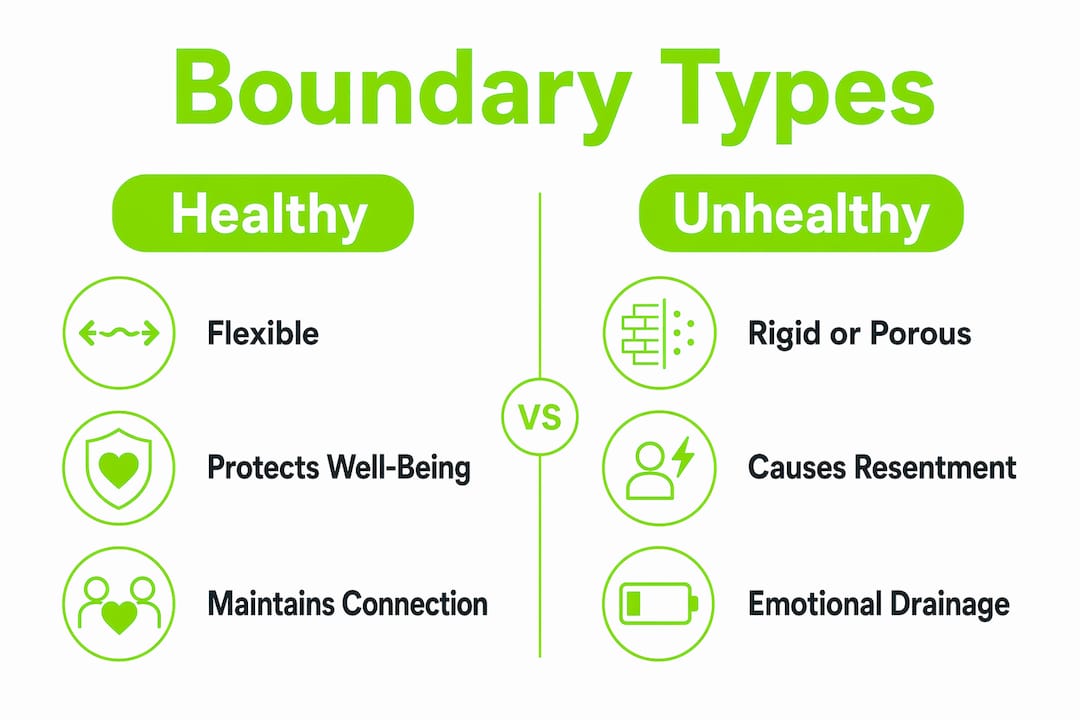
Healthy boundaries are flexible limits that protect your well-being without cutting off connection. Unhealthy boundaries fall into two extremes. They are either too rigid, blocking genuine intimacy, or too porous, leaving you vulnerable to being taken advantage of. Understanding the difference is the first step toward building relationships that actually work.
A healthy boundary tells others what you will do if a limit is crossed. It does not demand that the other person change. That distinction matters. You control your own actions, not theirs. This framing removes the power struggle from the conversation.
Here is how healthy and unhealthy boundaries compare in practice:
- Healthy boundary: “I need an hour of quiet time after work before I can engage in conversation.”
- Porous boundary: Agreeing to every request even when you are exhausted, then feeling resentful afterward.
- Rigid boundary: Refusing all emotional conversations with a partner to avoid vulnerability.
- Healthy boundary: “I am not comfortable discussing my salary with coworkers.”
- Porous boundary: Sharing personal information you later regret because you felt pressured.
Porous boundaries often feel like generosity in the moment. Over time, they produce resentment and emotional depletion that damages relationships far more than a clear limit ever would. Rigid boundaries, on the other hand, prevent the kind of closeness that makes relationships worth having. The goal is the middle ground: clear, kind, and consistent.
How to set healthy boundaries effectively in personal relationships
Setting limits effectively requires a repeatable process, not a single difficult conversation. Clinical frameworks break this process into five steps that build on each other.
Identify your needs. Start by reflecting on where you feel drained, resentful, or uncomfortable. A reflective exercise focused on your core values helps clarify which limits matter most. Ask yourself: “What situation keeps draining me, and what would need to change for me to feel respected?”
Communicate using “I” statements. Assertive communication with “I” statements is 2–3 times more effective at reducing defensiveness than “you” statements. “I feel overwhelmed when plans change last minute” lands very differently than “You always change plans on me.” The first invites dialogue. The second triggers defense.
Define your consequences in advance. A boundary without a consequence is a request. Decide before the conversation what you will do if your limit is crossed. “If this continues, I will leave the conversation” is a consequence. It is specific, calm, and within your control.
Follow through consistently. Unenforced boundaries teach others that your limits are negotiable. The first time you state a consequence and do not act on it, the boundary loses credibility. Consistency is what makes limits real.
Adjust as relationships evolve. Boundaries are not permanent rules. They shift as circumstances and relationships change. Schedule regular check-ins with yourself to assess whether your current limits still serve you.
Pro Tip: Start with a low-stakes boundary in a supportive relationship. Practicing with someone who is likely to respond well builds the confidence you need for harder conversations later.
People new to boundary-setting report feeling anxious almost immediately. That anxiety is normal and does not mean you are doing something wrong. Practicing on supportive individuals first improves outcomes significantly and makes the process feel less threatening over time.

What challenges come up when you start setting boundaries?
Guilt is the most common emotional response when you begin defining your limits. Many people interpret guilt as a sign they have done something wrong. They have not. Guilt in this context usually signals that you are breaking a pattern, not that you have caused harm.
Here are the most common challenges and how to handle them:
- Guilt and fear of rejection. These feelings are normal at the start. Remind yourself that lack of boundaries causes resentment and emotional burnout, which damages relationships far more than a clear limit does.
- Others pushing back. When someone resists your boundary, it often means the old dynamic benefited them. Their discomfort is not evidence that your limit is wrong.
- Over-explaining your reasons. Adding lengthy justifications actually weakens your position. It opens the door to argument. A simple, calm phrase like “That does not work for me” is more effective than a detailed explanation.
- Confusing boundaries with punishment. Boundaries are about self-care, not control. You are not trying to change the other person. You are deciding what you will accept in your own life.
- Inconsistency under pressure. When someone pushes back hard, the temptation is to cave. Calmly repeating your limit without escalating keeps you firm without creating conflict.
Pro Tip: When someone challenges your boundary, you do not owe them a debate. Repeat your limit once, calmly. “I understand you see it differently. This is still my limit.” Then stop talking.
Boundaries for self-care are not selfish. They make your generosity sustainable. When you give from a place of choice rather than exhaustion, the quality of what you offer improves. Caregivers who lack clear limits are at particular risk for burnout symptoms that erode both their health and their relationships.
How do you maintain and adjust boundaries over time?
Boundaries require regular review. A limit that made sense two years ago may no longer fit your current relationship or circumstances. Treating boundary conversations as ongoing dialogues rather than one-time declarations keeps relationships flexible and respectful.
The table below outlines a practical framework for reviewing and adjusting your limits over time.
| Stage | Action | Goal |
|---|---|---|
| Monthly check-in | Ask yourself: “Am I feeling resentful or drained in any relationship?” | Identify limits that need reinforcing or updating |
| After a breach | State the consequence calmly and follow through | Maintain credibility and consistency |
| Relationship repair | Actively reconnect after enforcing a limit | Reassure the other person of continued connection |
| Boundary update | Communicate the change directly and clearly | Prevent confusion and maintain mutual respect |
| Values review | Revisit your core values every six months | Confirm your limits still align with what matters most |
Repairing the relationship after a boundary breach is as important as enforcing the limit itself. Actively reconnecting after enforcement reassures the other person that the relationship still matters to you. This step prevents the distance that often follows a difficult conversation.
The 75/25 Somatic Boundary technique, developed in clinical practice, directs most of your attention to your own physical signals during an interaction. This body-awareness approach helps you detect when a limit is being crossed before the situation escalates. Pairing this kind of reflective practice with regular boundary reviews builds the self-awareness that makes long-term boundary maintenance feel natural rather than forced.
Boundaries in communication also evolve with context. A limit you hold with a close friend may differ from one you hold with a colleague or family member. Recognizing that different relationships call for different limits is not inconsistency. It is maturity.
Key Takeaways
Setting healthy boundaries requires clear communication, pre-determined consequences, and consistent follow-through to protect your well-being and sustain respectful relationships over time.
| Point | Details |
|---|---|
| Boundaries are flexible, not fixed | Healthy limits protect connection; they are not walls that block intimacy. |
| Use “I” statements to communicate | Assertive “I” statements reduce defensiveness and open productive dialogue. |
| Consequences make limits real | A boundary without a consequence is just a request; follow through every time. |
| Guilt is normal, not a warning sign | Feeling guilty when setting limits usually signals a pattern change, not harm caused. |
| Review boundaries regularly | Treat limits as ongoing conversations that adapt as relationships and needs evolve. |
Why boundaries changed how I think about self-care
The conventional advice on boundaries focuses almost entirely on how to say no. That framing misses the deeper point. The real skill is not refusal. It is clarity about what you actually value.
I have seen people set technically correct boundaries and still feel miserable. They followed the scripts, used the “I” statements, and stated their consequences. But they had not done the prior work of identifying what they genuinely needed. The boundary was a performance, not a reflection of their values. It collapsed under the first real test.
What actually works is starting from the inside out. Before you say anything to anyone else, get specific about what drains you and why. A healthy relationship with food or with exercise follows the same logic: the external structure only holds when it is grounded in something real about your life and priorities.
The other thing most articles skip is the repair step. Enforcing a limit can feel like a rupture. People worry the relationship will not survive it. In my experience, relationships that cannot survive a clearly stated, kindly delivered limit were already fragile. The ones that matter almost always come back stronger. The key is making the repair intentional, not leaving the other person wondering where they stand after you have enforced a consequence.
Boundaries are not the end of generosity. They are what makes generosity last. When you give from a full place rather than a depleted one, the people around you feel the difference. That is the outcome worth working toward.
— Srasti
Boundaries and balanced well-being go hand in hand
Emotional self-care and physical health reinforce each other more directly than most people realize. When you reduce chronic stress through clear personal limits, your body responds. Sleep improves, cortisol drops, and you have more energy for the habits that support your health goals.
Dietium’s personalized diet plans are built around the same principle: sustainable results come from plans that fit your real life, not generic templates. If you are working on setting emotional limits and building healthier daily habits at the same time, Dietium gives you the tools to track your nutrition, set realistic goals, and build routines that hold. Explore how setting health goals that align with your values can support every area of your well-being, including the emotional ones.
FAQ
What is a healthy boundary in a relationship?
A healthy boundary is a personal limit that communicates what you will do if a line is crossed, without demanding the other person change. It protects your well-being while keeping the relationship respectful and intact.
How do you start setting boundaries if you never have before?
Start with a low-stakes limit in a supportive relationship to build confidence. Use a clear “I” statement, state one specific consequence, and follow through if the limit is crossed.
Why do I feel guilty when I set boundaries?
Guilt when setting limits usually signals you are breaking an old pattern, not that you have caused harm. Lack of boundaries causes far more long-term damage through resentment and emotional exhaustion than a clearly stated limit does.
How often should you revisit your personal boundaries?
A monthly self-check and a values review every six months are practical starting points. Boundaries should be treated as ongoing conversations that adapt as relationships and personal needs evolve.
What is the difference between a boundary and an ultimatum?
A boundary states what you will do if a limit is crossed. An ultimatum demands that the other person change their behavior or face a consequence. Boundaries are about your own actions; ultimatums are about controlling someone else’s.


