 Skip to content

TL;DR:
- Mindful eating involves deliberate, non-judgmental attention to hunger, fullness, and emotional triggers to break automatic habits.
- It targets the brain’s reward system, reducing craving-driven eating by up to 40% and improving emotional and binge eating behaviors.
- Practicing gradually, with self-compassion and awareness, fosters sustainable behavioral changes and healthier relationships with food.
Mindful eating is defined as the practice of paying deliberate, non-judgmental attention to your eating experience, including hunger signals, fullness cues, taste, and emotional triggers, to break automatic eating habits and build a healthier relationship with food. The term draws from Buddhist mindfulness traditions and has been formalized in clinical settings by researchers like Dr. Jud Brewer, whose work at Brown University maps how mindful eating targets the brain’s reward learning system rather than willpower alone. This is not a diet. It is a psychological skill that changes how your brain processes food cues, and the clinical evidence behind it is more specific than most people realize.
What is mindful eating and how does it work in the brain?
Mindful eating works by disrupting the brain’s habit loop, a cycle of trigger, behavior, and reward that drives most automatic eating. When you feel anxious, bored, or stressed, the brain fires a craving signal. You eat. The brain registers relief. That loop strengthens with every repetition, making emotional eating feel involuntary over time.
Dr. Jud Brewer’s research shows that mindful eating targets brain habit loops rather than simply slowing down eating speed. The key mechanism is updating the reward value of a behavior. When you pause and observe the urge to eat without immediately acting on it, you give your brain new information: the craving is not an emergency. Over time, the automatic pull weakens.
The results of this mechanism are measurable. Research from Mason et al. found that mindful eating reduces craving-related eating by 40% and emotional eating triggered by negative emotions by 36%. Those are not marginal improvements. They reflect a genuine rewiring of how the brain responds to food-related stress.
A few core practices make this rewiring possible:
- Observe the urge before acting. Notice the impulse to eat without judging it or immediately satisfying it. This is the central skill, not slow chewing.
- Engage your senses fully. Focus on the color, texture, smell, and taste of food during each bite. This keeps attention anchored in the present moment.
- Eat without screens or distractions. Distracted eating disconnects you from satiety signals and accelerates the habit loop.
- Check in with your body, not the clock. Ask whether physical hunger or an emotional trigger is driving the urge to eat.
Pro Tip: Put your utensils down between bites and take one full breath. This is not about slowing down. It is about creating a gap between the urge and the action, which is exactly where mindful awareness lives.
“The deeper practice involves observing the urge to eat without immediately acting, not merely eating slowly or putting utensils down.” — Dr. Jud Brewer
What does clinical research say about mindful eating’s effects?
The clinical evidence on mindful eating is specific and worth understanding clearly. A meta-analysis of 19 studies covering 1,160 participants found that mindfulness-based interventions produce moderate weight loss of approximately 6.8 lbs, with a Hedge’s g of 0.42 for weight and a stronger effect of 0.70 for eating behavior improvements like reducing binge eating. The behavioral gains consistently outperform the weight outcomes. This tells you where mindful eating is most powerful: not as a rapid weight loss tool, but as a method for changing how you relate to food.
A 2024 randomized controlled trial with 61 overweight adults showed significant improvements in emotional eating and cognitive restraint after a 16-week mindful eating intervention delivered across eight biweekly sessions. Participants did not follow a calorie-restricted diet. The behavioral changes came from awareness practice alone.
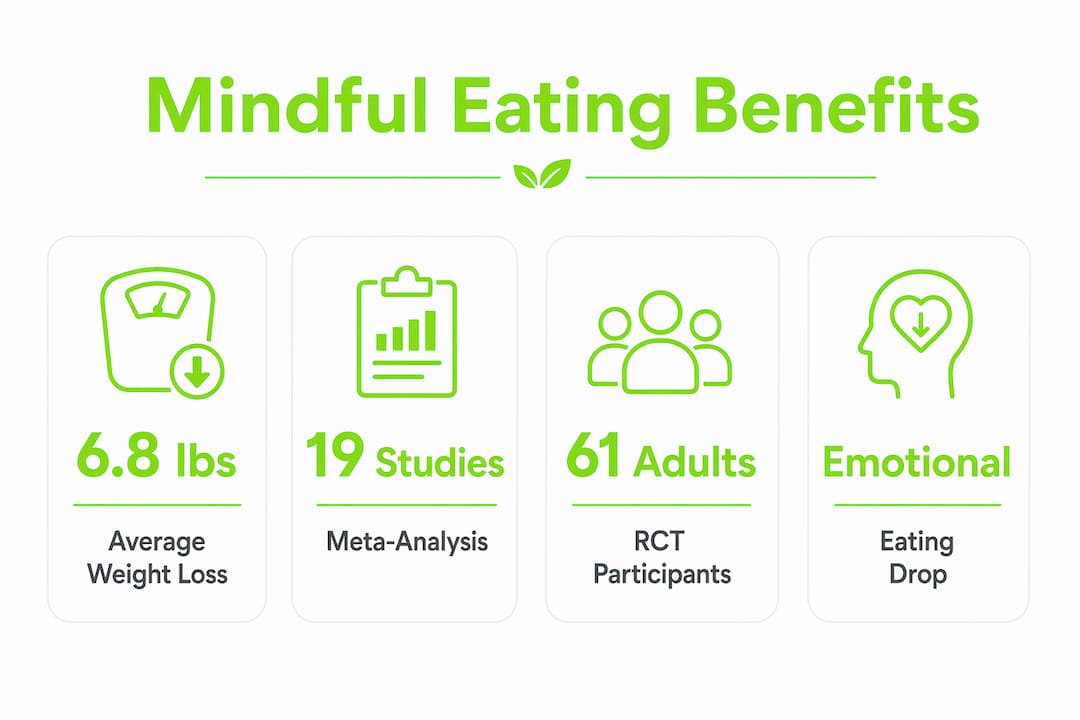
Systematic reviews also confirm that mindful eating stabilizes cognitive restraint and reduces uncontrolled eating more effectively than conventional diet programs when used in overweight populations. The table below summarizes key outcomes across major studies:
| Outcome | Finding |
|---|---|
| Weight loss | Approximately 6.8 lbs average across 19 studies |
| Binge eating reduction | Large effect size (Hedge’s g = 0.70) |
| Emotional eating | 36% reduction in negative-emotion-triggered eating |
| Craving-driven eating | 40% reduction in craving-related eating episodes |
| Cognitive restraint | Significant improvement in 16-week RCT with 61 adults |
Mindful eating for weight management works best when layered with personalized dietary guidance rather than used in isolation. The psychological gains are real and durable. The weight effects are moderate and depend on what else you pair with the practice.
How is mindful eating different from intuitive eating?
Mindful eating and intuitive eating are related but not interchangeable. Mindful eating is a moment-focused awareness skill centered on present-moment attention to hunger, fullness, taste, and emotional state during meals. Intuitive eating, developed by dietitians Evelyn Tribole and Elyse Resch, is a broader anti-diet philosophy built on 10 principles that include body trust, rejecting diet culture, and honoring nutrition without moral judgment.
Think of mindful eating as one skill within the larger intuitive eating framework. You can practice mindful eating without adopting the full intuitive eating philosophy. Both reject calorie counting and food restriction as primary tools. Both treat hunger and fullness as trustworthy signals rather than problems to suppress.
| Feature | Mindful eating | Intuitive eating |
|---|---|---|
| Scope | Moment-to-moment awareness practice | Broad anti-diet lifestyle philosophy |
| Core focus | Attention to sensations and urges during eating | Body trust, food freedom, and self-compassion |
| Calorie counting | Not required | Actively discouraged |
| Weight loss goal | Possible secondary benefit | Not a stated objective |
| Origin | Buddhist mindfulness traditions | Clinical dietetics (Tribole and Resch, 1995) |
If you want to start intuitive eating as a long-term lifestyle shift, mindful eating techniques give you a practical entry point. Mastering the skill of noticing hunger before you act on it is foundational to both approaches.
How to practice mindful eating effectively every day
The most common mistake people make is attempting mindful eating at every meal from day one. That approach leads to burnout within two weeks. Starting gradually, with one meal or snack per day, builds the habit without overwhelming your attention.
Here is a practical framework for building the skill:
- Choose one meal per day to practice. Breakfast works well because it is often eaten alone and without time pressure. Commit to full attention for that one meal only.
- Do a pre-meal check-in. Before eating, rate your hunger on a scale of 1 to 10. Ask whether you are physically hungry or responding to stress, boredom, or habit.
- Remove all screens from the table. Phones, laptops, and televisions compete directly with your ability to notice satiety signals. Distraction is the primary driver of overeating in most adults.
- Eat, then pause at the halfway point. Stop midway through the meal and re-rate your hunger. This single habit prevents the overshoot that comes from eating on autopilot.
- Do a post-meal check-in. Note how you feel physically and emotionally. No judgment. The goal is data, not performance.
Hunger and fullness signals take about 20 minutes to register in the brain after eating begins. This is why the mid-meal pause matters. You are giving your body time to send the signal before you have already eaten past it.
Rushed eating is the most common barrier. If you have 10 minutes for lunch, you cannot practice full mindful eating in that window. Instead, use those moments for a brief pre-meal check-in and one or two conscious bites. Partial practice still builds the neural pathway. Consistency over perfection is the operating principle here.

Pro Tip: Dietitians at the VA recommend assessing hunger and fullness without labeling your choices as right or wrong. Self-kindness is not optional in this practice. It is the mechanism that keeps you returning to it.
For more structured exercises that build these habits over time, Dietium’s guide on mindful eating exercises walks through specific techniques proven to reduce food-related guilt and strengthen body awareness.
Key takeaways
Mindful eating is a brain-based skill that reduces emotional and craving-driven eating by disrupting automatic habit loops, with clinical evidence showing stronger behavioral benefits than weight loss outcomes alone.
| Point | Details |
|---|---|
| Core definition | Mindful eating is deliberate, non-judgmental awareness of hunger, fullness, and eating urges. |
| Brain mechanism | It disrupts reward-based habit loops, reducing craving-driven eating by 40% in research. |
| Clinical evidence | Meta-analyses show moderate weight loss but large effects on binge and emotional eating. |
| Vs. intuitive eating | Mindful eating is a moment-focused skill; intuitive eating is a broader anti-diet philosophy. |
| Best practice | Start with one meal per day and use pre, mid, and post-meal check-ins to build the habit. |
Why mindful eating is not about losing weight faster
I have seen a lot of people come to mindful eating with a weight loss goal and leave with something more durable: a calmer relationship with food. That shift matters more than the number on the scale, and I think the research backs this up clearly.
The behavioral effect sizes in the clinical literature are nearly double the weight effect sizes. That is not a footnote. It tells you what this practice actually does well. It reduces the guilt spiral after eating something you did not plan to eat. It lowers the frequency of eating past fullness. It makes food feel less like a source of anxiety and more like a neutral, manageable part of daily life.
What I find most underappreciated is the role of self-compassion in making the practice stick. Dietitians consistently emphasize non-judgment as a core feature of mindful eating, not a soft add-on. When you observe a craving without immediately acting on it and without criticizing yourself for having it, you are practicing the skill correctly. Guilt and restriction tend to strengthen the very habit loops you are trying to break.
Realistic expectations also matter. Mindful eating is not a replacement for a well-structured nutrition plan. It works best as a complement to personalized dietary guidance, not as a standalone intervention for significant weight loss. If you pair it with a meal plan that accounts for your actual calorie needs and food preferences, the behavioral gains from mindful eating translate into more consistent, sustainable outcomes.
The practice is gradual by design. Give it six to eight weeks before evaluating results. The changes you are looking for are behavioral, not immediate.
— Srasti
Build on mindful eating with a plan that fits your goals
Mindful eating changes how you respond to food. A personalized meal plan determines what you eat in a way that aligns with your specific health goals, whether that is weight management, better energy, or improved metabolic markers. Dietium combines both approaches through its Recipians app, which generates custom meal plans and recipe suggestions based on your body metrics and dietary preferences. When you pair the awareness skills from mindful eating with goal-driven nutrition, you remove two of the biggest barriers to lasting change: reactive eating and generic dietary advice. Explore Dietium’s personalized plans to put structure behind the awareness you are building.
FAQ
What is the mindful eating definition in simple terms?
Mindful eating is the practice of paying deliberate, non-judgmental attention to your hunger, fullness, and emotional state while eating. The goal is to break automatic eating habits and build a healthier relationship with food.
Does mindful eating actually help with weight loss?
Research shows mindful eating produces moderate weight loss of approximately 6.8 lbs on average, but its strongest effects are on reducing binge eating and emotional eating. It works best for weight management when combined with a structured nutrition plan.
How long does it take to see results from mindful eating?
Most clinical interventions run 8 to 16 weeks before measurable behavioral changes appear. Starting with one mindful meal per day and building gradually produces more durable results than attempting full mindfulness at every meal immediately.
What is the difference between mindful eating and intuitive eating?
Mindful eating is a moment-focused awareness skill centered on hunger and fullness signals during meals. Intuitive eating is a broader anti-diet philosophy developed by Evelyn Tribole and Elyse Resch that includes body trust, rejecting diet culture, and honoring nutrition without moral judgment.
Can mindful eating reduce emotional eating?
Yes. Research from Mason et al. found that mindful eating reduces emotional eating triggered by negative emotions by 36% by disrupting the brain’s reward-based habit loops that drive automatic eating responses.


