 Skip to content

Changing your nutrition plan can feel like a new beginning, but progress might slow as weeks pass. This slowdown is often due to metabolic adaptation, a process where your body adjusts energy expenditure when faced with calorie restriction or shifting food choices. Learning how these cellular changes affect weight loss explains plateaus and variable results from identical diets. This guide equips you with clear insight and actionable strategies to help your metabolism work for your fitness goals.
Table of Contents
- Defining Metabolic Adaptation In Nutrition Science
- Causes And Types Of Metabolic Adaptation
- How Metabolic Adaptation Affects Weight Loss
- Recognizing And Addressing Weight Loss Plateaus
- Practical Strategies To Minimize Metabolic Adaptation
Key Takeaways
| Point | Details |
|---|---|
| Metabolic Adaptation Definition | Metabolic adaptation is the body’s response to changes in diet, affecting metabolic rate and efficiency. Understanding it is crucial for addressing weight loss plateaus. |
| Types of Adaptation | There are several types of metabolic adaptation, including energy deficit, environmental, nutrient-specific, and circadian adaptations, each triggered by distinct factors. |
| Weight Loss Implications | Metabolic adaptation significantly impacts weight loss, leading to slower progress than expected due to changes in energy expenditure. |
| Strategies to Minimize Adaptation | Implementing higher protein diets, diet breaks, exercise variation, and prioritizing sleep can help mitigate the effects of metabolic adaptation. |
Defining Metabolic Adaptation in Nutrition Science
Metabolic adaptation is your body’s ability to adjust its metabolic rate and efficiency in response to changing nutritional conditions. When you alter your diet significantly—whether by reducing calories, changing macronutrient ratios, or shifting food timing—your body doesn’t simply accept these changes passively. Instead, it recalibrates at the cellular level.
This biological response happens through complex mechanisms that extend beyond simple calorie math. Understanding metabolic adaptation is critical because it explains why weight loss plateaus occur and why two people eating identical diets can experience vastly different results.
The Cellular Foundation of Adaptation
Metabolic adaptation involves more than just shifting hormones. Research reveals that cellular and organelle structural remodeling occurs within your liver mitochondria and endoplasmic reticulum to cope with nutritional changes. These tiny powerhouses essentially restructure themselves to handle new energy demands and nutrient availability.
When you consume fewer calories, your mitochondria don’t just work harder—they physically adapt their membrane composition and enzyme expression patterns. This molecular basis of adaptation explains why metabolic changes feel slow and stubborn rather than immediate.
Your body’s metabolic shifts happen at the mitochondrial level, making quick fixes impossible—real adaptation takes weeks or months.
How Nutritional Changes Trigger Adaptation
Three primary factors trigger metabolic adaptation:
- Calorie restriction: Reducing intake below maintenance signals your body to conserve energy
- Macronutrient shifts: Changing protein, carbohydrate, or fat ratios alters hormonal signaling
- Meal timing changes: Altering eating windows affects circadian metabolic patterns
Your body perceives these changes as potential threats to energy availability. In response, it downregulates metabolic rate, increases hunger hormones, and becomes more efficient at extracting energy from food. This adaptation served our ancestors during food scarcity but complicates modern weight loss.
Understanding how your body calculates calorie needs becomes essential when planning sustainable nutrition changes. Knowing your baseline helps you make intentional adjustments rather than extreme cuts that trigger aggressive adaptation.
The Difference Between Temporary and Persistent Adaptation
Not all metabolic changes are permanent. Acute adaptation occurs within days as your body adjusts hormone levels and enzyme activity. Chronic adaptation develops over weeks to months through actual cellular restructuring.
This distinction matters because it explains why your metabolism doesn’t crash immediately when you cut calories. The first week of dieting feels manageable. By week 6, however, the structural changes in your mitochondria kick in, making further progress harder.
People with obesity often show defects in this adaptive process, affecting their overall metabolic function. This means some individuals face genuinely greater challenges in weight loss, not simply due to willpower but due to how their cellular machinery responds to nutritional stress.
Why This Matters for Your Results
Metabolic adaptation directly impacts how your body responds to diet changes. If you don’t account for it, you’ll make three mistakes:
- Cut calories too aggressively, triggering stronger adaptive responses
- Expect linear progress, then abandon efforts when plateaus occur
- Assume your metabolism is permanently damaged when it’s temporarily adapted
Recognizing adaptation as a normal, protective response helps you work with your body rather than against it. Progressive calorie adjustments and strategic nutrient timing work better than aggressive restriction because they minimize the strength of adaptive responses.
Pro tip: Small, consistent calorie adjustments every 4-6 weeks prevent your body from shifting into strong adaptation mode, keeping your metabolism responsive to continued progress.
Causes and Types of Metabolic Adaptation
Metabolic adaptation doesn’t happen randomly. Your body triggers specific adaptive responses based on environmental pressures and physiological demands. Understanding what causes these shifts helps you predict how your metabolism will respond to dietary changes.
Genetic and epigenetic mechanisms drive metabolic adaptation, meaning your genes and how they’re expressed control whether your body adapts quickly or slowly. Some people are genetically predisposed to efficient metabolic shifts, while others face more sluggish adaptations. This explains why identical diets produce different results across individuals.
What Triggers Metabolic Adaptation
Your body adapts when it perceives a challenge to energy balance. Three primary triggers activate metabolic adjustment:
- Energy deficit: Reducing calorie intake signals conservation mode
- Environmental stress: Extreme temperatures, altitude, or season changes prompt adaptation
- Nutritional composition shifts: Changing protein, carbs, or fat ratios alters hormone signaling
Your nervous system and hormone systems continuously monitor these conditions. When they detect sustained changes, they initiate metabolic remodeling at the cellular level. This isn’t a quick switch—it’s a cascade of biochemical adjustments.
Metabolic adaptation is your body’s protective mechanism, not a metabolic flaw or weakness.
Types of Metabolic Adaptation
Metabolic adaptation falls into distinct categories based on the challenge your body faces.
Energy Deficit Adaptation occurs when you consume fewer calories than you burn. Your body downregulates thyroid hormone production, reduces spontaneous movement, and increases hunger signals. This type develops gradually over weeks.
Environmental Adaptation happens in response to extreme conditions. Exposure to cold triggers increased metabolic rate to generate heat. High altitude prompts changes in oxygen utilization and red blood cell production. These adaptations develop over days to weeks depending on severity.
Nutrient-Specific Adaptation involves adjusting metabolism based on macronutrient availability. When you restrict carbohydrates, your body shifts toward fat oxidation and ketone production. When you increase protein intake, your body requires more energy for digestion and muscle protein synthesis.
Circadian Adaptation relates to meal timing changes. Your body’s metabolic rate fluctuates throughout the day based on eating patterns. Shifting when you eat triggers hormonal adjustments that affect energy expenditure and nutrient partitioning.
Here is a summary of how the four main types of metabolic adaptation differ:
| Adaptation Type | Triggering Factor | Distinctive Response | Time Frame |
|---|---|---|---|
| Energy Deficit | Calorie reduction | Lowers thyroid and increases hunger | Weeks |
| Environmental | Cold, altitude, extreme climate | Alters energy use or oxygen uptake | Days to weeks |
| Nutrient-Specific | Major macronutrient shift | Changes fuel source for metabolism | Days to weeks |
| Circadian | Meal timing disruptions | Shifts hormone-driven energy use | Days |
How Adaptation Type Affects Your Results
Different adaptation types respond differently to intervention strategies. Energy deficit adaptation responds well to calorie cycling and strategic refeeds. Environmental adaptation often improves with gradual exposure rather than shock protocols.
Knowing how your metabolism works helps you identify which type of adaptation you’re experiencing. Someone experiencing pure calorie deficit adaptation needs different strategies than someone adapting to extreme nutrient restriction.
Your body can simultaneously experience multiple adaptation types. During a strict diet in winter at high altitude, you might trigger energy deficit, environmental, and nutrient-specific adaptation simultaneously. This compounded effect explains why some dieting scenarios feel harder than others.
Pro tip: Identify your primary adaptation trigger—calorie deficit, nutrient restriction, or environmental stress—then address it specifically rather than fighting all three at once.
How Metabolic Adaptation Affects Weight Loss
Metabolic adaptation directly impacts how much weight you lose and how quickly you lose it. This isn’t just about feeling hungry or tired—it’s a measurable physiological shift that changes your body’s energy expenditure.
When metabolic adaptation occurs, your resting metabolic rate decreases, meaning you burn fewer calories at rest than predicted. Two people following identical diets can experience vastly different weight loss results because of how much their metabolism adapts.

The Weight Loss Slowdown Effect
Metabolic adaptation creates a frustrating reality: you lose less weight than calorie math predicts. If your deficit should produce 2 pounds of loss weekly, metabolic adaptation might reduce that to 1.2 pounds.
Research shows that metabolic adaptation accounts for greater-than-expected declines in energy expenditure during weight loss. Your body isn’t just eating less—it’s working harder to conserve energy by reducing the calories it burns.
This creates a compounding problem. As adaptation deepens, progress slows progressively. Week 4 feels manageable, but week 12 feels impossible despite unchanged diet adherence.
People with stronger metabolic adaptation lose significantly less weight despite perfect dietary compliance, making progress feel disproportionately difficult.
How Adaptation Determines Your Rate of Progress
Metabolic adaptation influences three critical factors:
- Speed of initial weight loss: Stronger adaptation slows the rate of loss from day one
- Plateau timing: Those with severe adaptation hit plateaus within 4-6 weeks instead of 8-12 weeks
- Time to reach goals: A goal that should take 16 weeks might take 24 weeks with significant adaptation
Someone with minimal metabolic adaptation might lose weight steadily for months. Someone with robust adaptation hits a wall quickly and watches progress stall despite consistent effort.
The adaptation doesn’t stop after weight loss either. Weight loss plateau strategies become necessary because adaptation persists even after you stabilize your weight.
Individual Variation in Adaptation Response
Not everyone adapts equally. Genetic factors, age, initial body composition, and diet type all influence adaptation severity. A 35-year-old with significant muscle mass might adapt minimally, while a 28-year-old with less muscle mass adapts aggressively.
This explains why one person’s successful diet fails for another person. Their metabolic adaptation response is fundamentally different. Some people are metabolic adapters—their bodies shift quickly into conservation mode. Others are non-adapters who maintain relatively stable energy expenditure.
Your body composition also matters. People with higher fat mass often show stronger adaptation than lean individuals. This means heavier individuals typically face steeper metabolic resistance during weight loss.
Strategic Responses to Metabolic Adaptation
Understanding adaptation lets you work around it rather than fight it. Three strategies minimize its impact:
- Vary calorie intake: Cycling between deficit and maintenance prevents habituation
- Add activity strategically: Increasing non-exercise movement offsets reduced energy expenditure
- Adjust macronutrients: Increasing protein reduces metabolic downregulation
These approaches don’t prevent adaptation, but they slow its progression and reduce its severity. Small adjustments every 3-4 weeks often work better than aggressive restriction that triggers rapid adaptation.
Pro tip: Track your actual weight loss rate weekly and adjust calories down by 100-150 only when progress stalls for 3 consecutive weeks, preventing your body from over-adapting to static intake levels.
Recognizing and Addressing Weight Loss Plateaus
Weight loss plateaus feel like your body has quit cooperating. You’re doing everything right, but the scale refuses to budge. This frustrating standstill typically signals that metabolic adaptation has reached a point where your current approach no longer creates sufficient energy deficit.
Plateaus aren’t failures—they’re normal physiological responses. Weight loss stalls due to metabolic adaptation, hormonal shifts, and behavioral fatigue, creating a complex situation requiring multiple intervention strategies simultaneously.
Identifying a True Plateau
Not every week without scale movement means you’ve plateaued. Normal weight fluctuates daily based on water retention, sodium intake, and menstrual cycle. A true plateau persists for 3-4 consecutive weeks despite consistent effort.
Look for these signs that indicate genuine plateau rather than normal variance:
- No scale movement: Zero progress for 21+ days
- No progress photos change: Your appearance remains static
- No performance improvements: You’re not getting stronger or more endurance-capable
- Consistent dietary adherence: You’re truly following your plan
If you’re losing inches but not weight, you’re experiencing body recomposition—not a plateau. This means you’re simultaneously gaining muscle while losing fat, a positive outcome even when the scale stalls.
True plateaus occur when adaptation matches your deficit, leaving no net energy loss—the remedy requires changing the variables, not trying harder at current ones.
Why Plateaus Develop
Three primary mechanisms create plateaus:
- Metabolic adaptation: Your body downregulates energy expenditure, shrinking your deficit
- Behavioral drift: Portion sizes slowly increase or exercise intensity decreases unconsciously
- Hormonal adaptation: Sustained dieting triggers changes in hunger, fullness, and satiety hormones
Most people experience all three simultaneously. Identifying which dominates your situation determines your intervention strategy. Someone with pure metabolic adaptation needs different solutions than someone experiencing behavioral drift or hormonal resistance.
Strategic Plateau-Breaking Approaches
Research-backed strategies for overcoming plateaus include combining aerobic exercise with resistance training while making nutritional adjustments. No single fix works universally—plateaus require layered approaches.
Effective strategies include:
- Calorie cycling: Alternate low-deficit days with maintenance-level days
- Exercise variation: Shift intensity, duration, or modality weekly
- Macro adjustments: Increase protein or reduce carbohydrates temporarily
- Intermittent fasting: Create larger deficits on specific days
- Diet breaks: Eat at maintenance for 1-2 weeks to reset hormonal signals
When addressing weight loss plateau solutions, start with smallest changes. Reduce calories by 100-150 before jumping to major diet overhauls. Add 10-15 minutes of activity before completely changing your routine.
If plateaus persist beyond 6 weeks despite intervention attempts, consider hormonal testing. Thyroid dysfunction or cortisol dysregulation can create stubborn plateaus that require medical attention rather than dietary tweaks.
Pro tip: Implement one change weekly rather than overhauling everything simultaneously—if plateaus break within 2 weeks, you’ve identified your limiting factor; if not, add another intervention while keeping the first.
Practical Strategies to Minimize Metabolic Adaptation
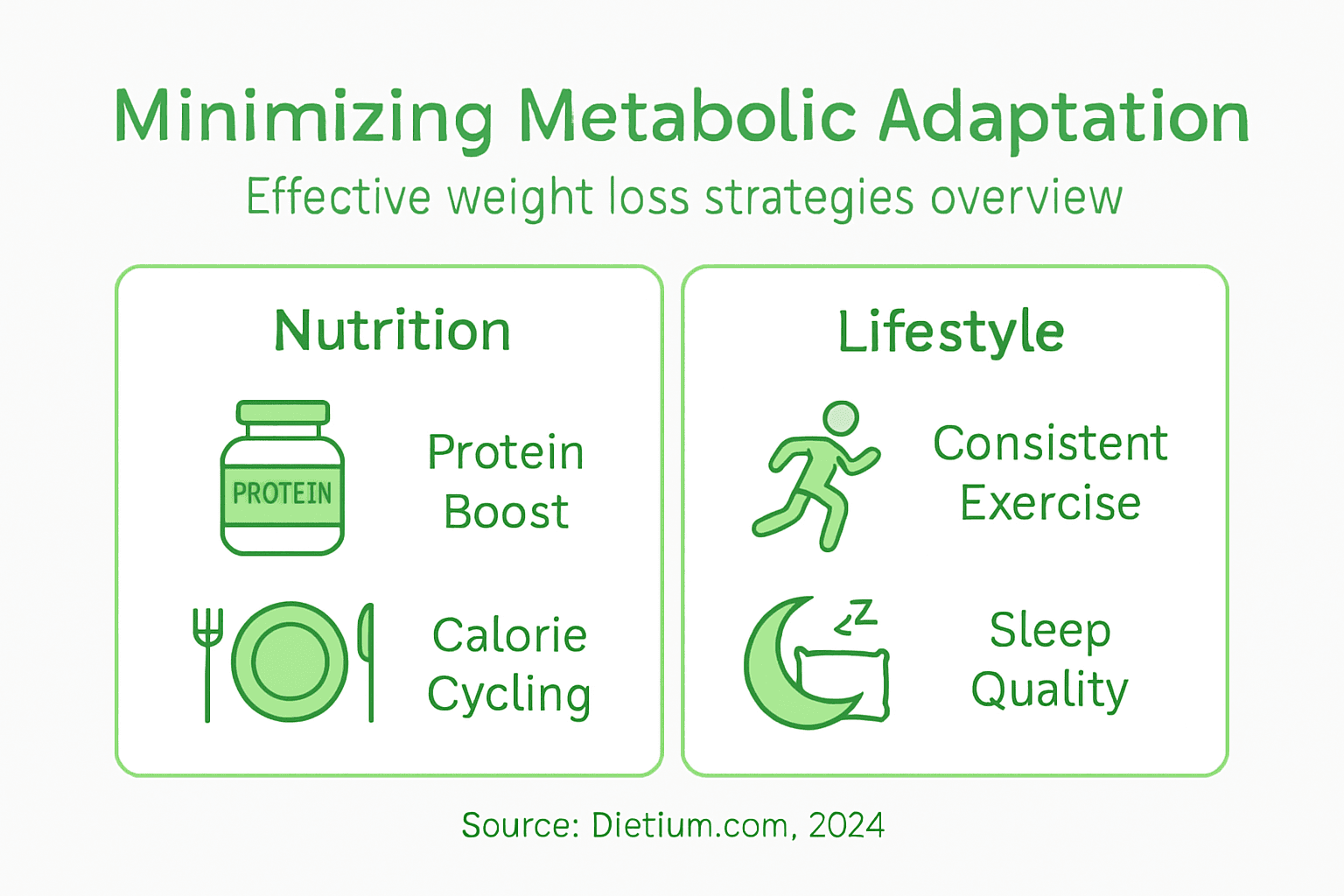
Metabolic adaptation is inevitable, but you can significantly reduce its severity and speed. The key is working against adaptation’s mechanisms rather than accepting it as unchangeable. Strategic interventions at multiple levels create compounding effects that keep your metabolism responsive.
Your approach should combine nutrition, exercise, recovery, and behavioral strategies simultaneously. Increasing protein intake, incorporating high-fiber foods, and implementing controlled diet refeeds all support adaptation management. No single strategy works alone—combination approaches deliver superior results.
Strategic Protein Optimization
Protein is your primary defense against metabolic adaptation. Higher protein intake preserves muscle mass during dieting, maintains metabolic rate, and increases diet-induced thermogenesis (calories burned digesting food).
Target 0.8-1.0 grams per pound of body weight daily. This higher intake signals your body to preserve lean tissue rather than sacrifice it for energy conservation. When your body maintains muscle, it maintains metabolic rate, counteracting adaptation.
Protein also increases satiety, reducing unconscious calorie creep. You’ll naturally eat less because you feel fuller longer. This behavioral benefit amplifies the physiological metabolic advantage.
Protein intake is your most controllable variable for fighting metabolic adaptation—maximize it before adjusting other factors.
Controlled Diet Breaks and Refeeds
Continuous calorie restriction triggers progressive adaptation. Periodically eating at maintenance or slight surplus signals your body that the energy threat has passed, allowing metabolic rate to recover partially.
Implement strategic approaches:
- Refeed days: Eat maintenance calories weekly, using carbohydrates to replenish depleted glycogen
- Diet breaks: Take 1-2 weeks at maintenance every 6-8 weeks of dieting
- Calorie cycling: Alternate low-deficit days with maintenance days weekly
These breaks don’t erase progress—they reset hormonal signals and preserve metabolic responsiveness. Research shows that diet breaks and refeed days effectively manage metabolic adaptation while maintaining overall weight loss trajectories.
Exercise as Metabolic Resistance
Exercise directly counteracts metabolic downregulation. Resistance training preserves muscle mass during calorie restriction, while cardio increases energy expenditure independent of baseline metabolism.
Combine both modalities:
- Resistance training: 3-4 sessions weekly to maintain muscle and metabolic rate
- Cardio variation: Mix steady-state with interval training weekly
- NEAT optimization: Increase non-exercise activity like walking and daily movement
Increasing physical activity and maintaining training intensity directly support continued weight loss by offsetting metabolic slowdown.
Recovery and Sleep Prioritization
Adaptation accelerates when recovery is insufficient. Sleep deprivation increases hunger hormones and decreases satiety signals, compounding metabolic challenges. Aim for 7-9 hours nightly to preserve hormonal balance.
Quality sleep allows your nervous system to recover from sustained dietary stress. Poor sleep increases cortisol, promoting metabolic downregulation. This makes recovery as important as diet and exercise for adaptation management.
Moderate Deficit Strategy
Aggressive calorie restriction triggers stronger adaptation. A moderate deficit of 300-500 calories daily produces steady progress while minimizing aggressive metabolic shifts. Smaller deficits feel more sustainable and trigger gentler adaptation responses.
When addressing sustainable weight loss approaches, moderate deficits consistently outperform aggressive ones long-term. You lose less per week initially but face fewer plateaus and maintain better adherence.
Pro tip: Implement calorie cycling starting day one—eat 300 calories below maintenance 5 days weekly and maintenance calories 2 days weekly—this prevents your body from fully adapting while creating a 1,500 weekly deficit.
The following table compares interventions for minimizing metabolic adaptation:
| Strategy | Main Benefit | Application Frequency |
|---|---|---|
| Higher protein diet | Preserves muscle and satiety | Daily |
| Diet breaks/refeeds | Resets hormones, boosts rate | Every 6–8 weeks |
| Exercise variety | Prevents metabolic slowdown | 3-5 times weekly |
| Sleep optimization | Maintains hormone balance | Nightly |
Take Control of Metabolic Adaptation for Lasting Weight Loss
Metabolic adaptation can feel like an invisible barrier blocking your weight loss progress. This natural protective response slows metabolism, increases hunger, and makes plateaus frustratingly common despite your hard work. By understanding concepts like energy deficit adaptation and strategic calorie cycling, you can intelligently outmaneuver these challenges rather than get stuck guessing what to do next.
At Dietium.com, we specialize in turning complex metabolic science into actionable tools designed specifically for you. Our AI-powered Recipians app offers personalized meal plans and fitness routines tailored to your unique metabolism and goals. With features such as precise calorie tracking, protein optimization guidance, and smart meal timing suggestions, you can effectively minimize metabolic adaptation and keep progress steady.
Ready to break through your weight loss plateau with confidence and ease Use Personalized Nutrition and Fitness Plans to get custom strategies that work with your body Explore how Calorie Intake Calculators help you avoid aggressive deficits fueling adaptation and learn more about Sustainable Weight Loss Techniques that promote lasting results. Start your journey today at Dietium.com and take the next step toward a healthier, more responsive metabolism.
Frequently Asked Questions
What is metabolic adaptation?
Metabolic adaptation is your body’s ability to adjust its metabolic rate and efficiency in response to changes in diet or nutritional conditions, such as calorie restriction, macronutrient shifts, or meal timing changes.
How does metabolic adaptation affect weight loss?
Metabolic adaptation can slow down weight loss progress by reducing your resting metabolic rate, meaning you burn fewer calories than expected on a diet. This can lead to plateaus where weight loss becomes much harder despite adherence to the diet.
What are the main triggers for metabolic adaptation?
The primary triggers for metabolic adaptation include calorie deficits through reduced food intake, environmental stresses such as extreme temperatures, and shifts in macronutrient composition in your diet.
How can I minimize the effects of metabolic adaptation during my weight loss journey?
To minimize metabolic adaptation, you can vary your calorie intake, increase protein consumption, incorporate regular exercise (both resistance and cardio), implement diet breaks or refeeds, and prioritize adequate sleep for hormonal balance.


