 Skip to content

TL;DR:
- Relying solely on weight and BMI masks true progress because they cannot distinguish fat from muscle or account for fat distribution. Accurate body composition tracking and clear tissue-based goals enable more effective assessments and sustainable improvements. Consistent, scheduled reviews using reliable measurement methods are essential for long-term success in body shape transformation.
You step on the scale and the number hasn’t moved in three weeks. Frustrating — especially when your clothes fit differently and your lifts are up. The scale isn’t lying, but it isn’t telling the whole story either. BMI does not capture changes in fat mass versus fat-free mass, and differences in fat depot location affect health in ways a single number simply cannot reflect. Reaching your body shape goals requires smarter assessment, sharper targets, and tools that track what actually matters. This guide delivers exactly that.
Table of Contents
- Why traditional weight and BMI tracking isn’t enough
- How to define actionable body shape goals
- Setting nutrition and training targets for your body shape goal
- Tracking progress: Best methods and tech for results you can trust
- Why body shape assessment works only if you adapt your approach
- Next steps: Personalize your strategy with Dietium
- Frequently asked questions
Key Takeaways
| Point | Details |
|---|---|
| BMI and weight are limited | Tracking only scale or BMI often hides true body changes and can undermine your result. |
| Set tissue-based goals | Defining goals as fat loss, muscle gain, or recomposition leads to actionable nutrition and training plans. |
| Track with reliable methods | Use consistent body composition or measurement tools to gauge trends instead of guessing. |
| Adjust strategically | Review your progress on a fixed schedule and change only one variable at a time for best results. |
| Consistency beats novelty | Long-term success relies on sticking to simple, evidence-backed assessments and tools. |
Why traditional weight and BMI tracking isn’t enough
Most people start a fitness plan by setting a target weight. It feels logical. You pick a number, step on the scale each morning, and judge success or failure by whether that number drops. The problem? Weight is a blunt instrument for measuring body shape change.
Here’s what actually happens when you train and eat well: fat decreases, muscle increases, and the scale can stay exactly the same. That’s body recomposition in action. The scale registers zero change, yet your body composition has shifted significantly. This is why relying on weight alone can make real progress completely invisible.
BMI compounds the problem. Body Mass Index uses height and weight to estimate health status, but BMI does not differentiate between fat and lean mass or fat locations, leading to inaccurate assessments of progress. A lean athlete and a sedentary individual with high visceral fat can share the same BMI. That tells you nothing about who is healthier or how either person’s body shape is actually changing.
Fat distribution matters enormously. Visceral fat (the fat stored deep around your organs) carries a very different health risk profile than subcutaneous fat (the fat just under your skin). Two people at the same weight and BMI can have entirely different visceral fat levels. One may have elevated cardiometabolic risk; the other may not. The scale cannot distinguish between them.
Understanding body composition measurement methods gives you a far clearer picture of your actual progress.
Comparison: Traditional vs. composition-based tracking
| Metric | What it measures | What it misses |
|---|---|---|
| Scale weight | Total mass | Fat vs. muscle breakdown |
| BMI | Weight-to-height ratio | Fat distribution, muscle mass |
| Body fat percentage | Fat vs. lean mass ratio | Visceral vs. subcutaneous split |
| DEXA scan | Full tissue breakdown | Cost, accessibility |
| Waist-to-hip ratio | Fat distribution | Absolute fat mass |
“A meaningful body shape assessment must go beyond weight. Tracking fat mass, lean mass, and fat distribution provides the data your goals actually require.”
Key limitations of weight and BMI tracking:
- Weight fluctuates 2 to 5 pounds daily due to water, food, and glycogen stores.
- BMI misclassifies a significant portion of individuals who are metabolically healthy or unhealthy.
- Neither metric detects changes in fat-free mass (muscle, bone, water).
- Neither accounts for age-related muscle loss, which can hide fat accumulation entirely.
Shifting to tracking body composition resolves these gaps and gives you data that actually drives better decisions.
How to define actionable body shape goals
Vague goals produce vague results. “I want to look better” or “I want to lose weight” are not actionable. Effective body shape goals describe what tissue you want to change, by how much, and within what timeframe.
The most actionable assessment loop is to: (1) define the goal in tissue terms, (2) pick reliable measurement anchors, and (3) review and adjust on a fixed schedule. This three-step framework removes guesswork and creates clear feedback at every stage.
Step 1: Classify your goal by tissue type
There are three distinct body shape goals:
- Fat loss: Reduce fat mass while preserving lean tissue. Requires a calorie deficit and sufficient protein.
- Muscle gain (hypertrophy): Increase lean mass with minimal fat gain. Requires a calorie surplus and progressive resistance training.
- Body recomposition: Lose fat and gain muscle simultaneously. Best suited for beginners or those returning after a break. Learn more about body recomposition explained to determine if this path fits your current status.
Step 2: Choose reliable measurement anchors
Your measurement method should match your goal and be repeatable. Here’s a practical comparison:
| Method | Best for | Accuracy | Cost |
|---|---|---|---|
| DEXA scan | Detailed composition analysis | Very high | High |
| BIA (bioelectrical impedance) | Trend tracking | Moderate | Low to moderate |
| Skinfold calipers | Fat percentage estimation | Moderate | Low |
| Tape measurements | Circumference tracking | Good for trends | Free |
| Progress photos | Visual change | Subjective | Free |
No single method is perfect. Use two methods in combination for stronger data. For example, pair waist tape measurements with a BIA device, or skinfold calipers with progress photos.
Step 3: Review trends, not snapshots
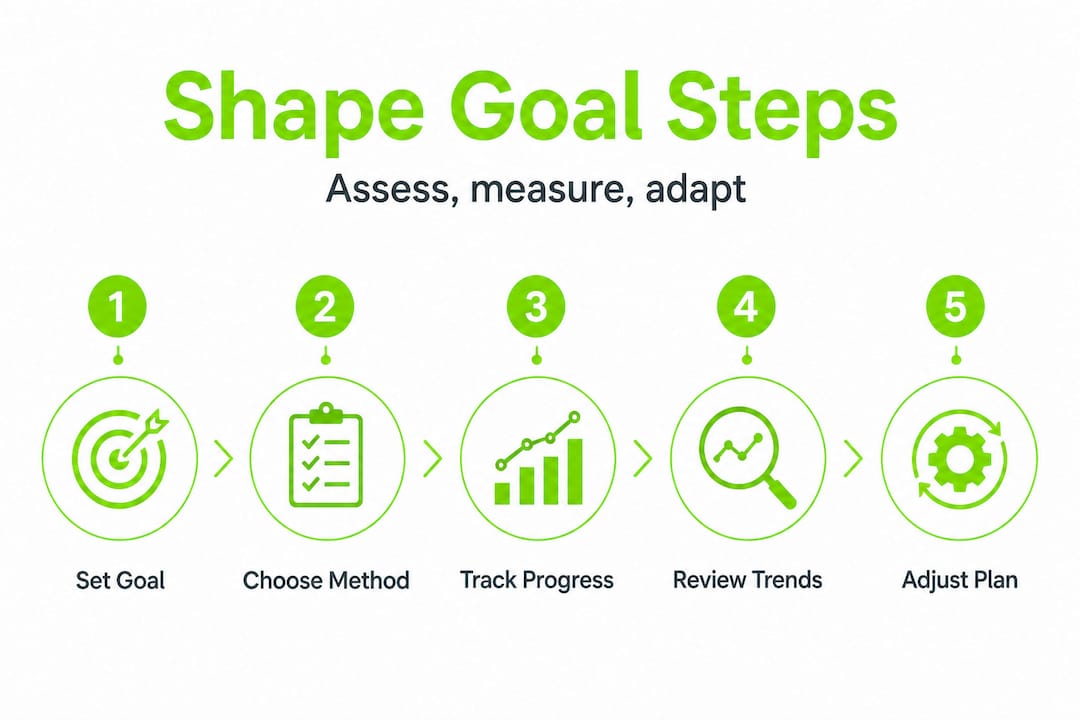
Single data points are meaningless. What you want is a trend over time. Take measurements under the same conditions every time (same time of day, same hydration status, same scale). Review results every two to four weeks, not daily. Learn how tracking body measurements effectively supports consistent progress.
Pro Tip: Adjust only one variable at a time when your metrics stall. If fat loss has slowed, reduce calories slightly or add one training session per week before making any other changes. Changing multiple variables at once makes it impossible to identify what actually worked.
Setting nutrition and training targets for your body shape goal
Once your goal is defined and your measurement system is in place, the next step is translating that goal into specific nutrition and training targets. This is where many people skip ahead too quickly, setting arbitrary calorie or macronutrient targets without first establishing a metabolic baseline.

Calculate your baseline first
Your Basal Metabolic Rate (BMR) is the number of calories your body burns at complete rest. Your Total Daily Energy Expenditure (TDEE) adds your activity level on top of BMR. These two numbers form the foundation of any calorie or macro strategy.
Calorie and macro targets should start from your metabolic baseline (BMR/TDEE) and current body fat percentage; your goal selection then determines your energy-balance range. Skipping this step means your targets are guesses, not calculations.
Use essential health calculators to determine your BMR and TDEE quickly and accurately before setting any nutrition targets.
Energy balance by goal
- Fat loss: Aim for a calorie deficit of 300 to 500 calories below TDEE. Larger deficits increase muscle loss risk. Smaller deficits are more sustainable.
- Muscle gain: Aim for a calorie surplus of 200 to 400 calories above TDEE. Lean bulking (small surplus) minimizes fat accumulation.
- Recomposition: Eat at or very close to TDEE. Prioritize protein to support muscle synthesis while the deficit comes from stored fat.
Macronutrient targets by goal
Macros matter as much as total calories for body shape goals. Here are evidence-backed starting points:
- Protein: 0.7 to 1.0 gram per pound of body weight for all three goals. Higher intake (closer to 1.0 g/lb) supports muscle preservation during fat loss.
- Carbohydrates: Scale based on activity level. Higher training volume needs more carbs for performance and recovery. Reduce carbs slightly on rest days.
- Fats: Keep at minimum 20 percent of total calories to support hormone function, particularly important for testosterone and cortisol regulation.
Key training considerations by goal:
- For fat loss: Combine resistance training (3 to 4 days/week) with moderate cardio to preserve lean mass while burning calories.
- For muscle gain: Focus on progressive overload in resistance training. Cardio is secondary and should not exceed recovery capacity.
- For recomposition: Resistance training 4 to 5 days per week is central. Cardio supports calorie balance but should not impede recovery.
Pro Tip: Track your protein intake first. If you can consistently hit your protein target, calorie and macro totals often fall into place more naturally, and muscle preservation is protected regardless of which goal you’re pursuing.
Tracking progress: Best methods and tech for results you can trust
Setting targets is only half the equation. You need a reliable tracking system to know whether those targets are working. The right tracking approach gives you accountability, surfaces problems early, and keeps you making evidence-based adjustments.
Digital diet monitoring tools help but have real limitations around accuracy, accessibility, and affordability. Evidence shows they are most useful when users track consistently over time rather than sporadically. The benefit is not in the individual data point but in the pattern across weeks and months.
Popular tracking tools and their trade-offs
- MyFitnessPal: Large food database, easy barcode scanning, integrates with most wearables. Database accuracy varies because user-submitted entries can contain errors.
- Lose It!: Clean interface, strong goal-setting features, premium tier adds detailed nutrient breakdowns. Limited free version.
- Fitbit/Apple Watch: Excellent for activity tracking, steps, and heart rate. Calorie burn estimates can be off by 15 to 30 percent depending on individual metabolic variation.
- DEXA scan clinics: The gold standard for body composition data. Not practical for weekly tracking but ideal for quarterly benchmarks.
- Smart scales with BIA: Affordable and convenient for trend tracking. Hydration levels significantly affect daily readings, so consistent timing and conditions are critical.
Learn the full picture of tracking progress for fitness goals to select the combination that fits your routine.
Best practices for accurate tracking
- Weigh yourself at the same time each day, ideally in the morning after using the restroom and before eating.
- Log food immediately after eating, not at the end of the day. Delayed logging increases the chance of inaccurate estimates.
- Take body measurements every two weeks, not daily. Daily data creates noise. Biweekly data shows trends.
- Use progress photos in consistent lighting, same time of day, same pose. Visual comparison over 6 to 8 weeks is often the clearest indicator of change.
- Review your data weekly in aggregate. Look at the weekly average of scale weight rather than individual daily values.
Pro Tip: Create a simple tracking spreadsheet or use a notes app to log your biweekly measurements alongside your weekly average weight. Seeing both numbers side by side gives a far cleaner picture of body composition shifts than any single app can provide.
One stat worth remembering: Studies suggest that individuals who track food intake consistently are significantly more likely to reach and maintain their body composition goals compared to those who do not track at all. Consistency with the tool matters more than which tool you choose.
Why body shape assessment works only if you adapt your approach
Here’s an uncomfortable truth: most people fail at body shape goals not because they picked the wrong diet or the wrong training program. They fail because they keep changing programs too frequently, and they measure success with metrics that don’t reflect what their program is actually doing.
The fitness industry has a novelty problem. New apps, new assessments, and new protocols generate attention and revenue. But the science points in the opposite direction. Review and adjust on a fixed schedule, changing only one variable at a time if markers stall. That’s how real progress is built.
Consistency with a simple, repeatable system produces better results than chasing precision with expensive gadgets you use irregularly. A tape measure used every two weeks under the same conditions beats a DEXA scan taken once a year, followed by nothing for months. The data gap kills the feedback loop.
The other critical point: your assessment approach should evolve with your goal stage, not stay static. Someone in the early stages of fat loss needs different tracking priorities than someone trying to break through a body recomposition plateau after six months. Use body composition tracking as a living system, not a one-time setup.
What actually works long-term is a three-part mindset shift:
- Prioritize trend over snapshot. One bad weigh-in or one inflated body fat reading means nothing. Four weeks of data means something.
- Simplify your metric set. Pick two or three measurements and track them religiously. Tracking 10 metrics inconsistently is worse than tracking 2 metrics perfectly.
- Schedule your reviews. Put a biweekly review on your calendar. Treat it like a standing appointment. That structured feedback loop is what separates people who adapt effectively from those who drift.
The best assessment system is the one you will actually use. Consistently. For months.
Next steps: Personalize your strategy with Dietium
Knowing the right methods is the starting point. Putting them into practice with a system built around your specific body shape goal is where real results happen. Dietium’s platform combines meal plan personalization with advanced tracking tools, giving you calorie targets, macro breakdowns, and meal suggestions calibrated to your current body composition data. The platform also supports accurate nutritional assessment methods to ensure your baseline is correct before targets are set. Whether you are in a fat loss phase, building lean mass, or pursuing recomposition, personalized meal plans align your daily nutrition with your exact goal stage. Take the next step and put science-backed assessment to work for you.
Frequently asked questions
What’s the difference between fat loss and body recomposition goals?
Fat loss focuses on reducing fat mass while preserving lean tissue, while recomposition aims to lose fat and gain muscle simultaneously, each requiring distinct nutrition targets and tracking approaches.
How often should I reassess my body shape progress?
Every two to four weeks is the most effective schedule. Reviewing trends on a fixed schedule and adjusting one variable at a time gives your body enough time to show real change before you modify your approach.
Are digital diet tracking apps accurate for body composition goals?
Digital monitoring tools support progress when used consistently, but accuracy and accessibility can be limiting factors. Treat app data as a trend indicator rather than an exact measurement.
Which measurement is best: body fat analyzers, tape, or the scale?
Body composition assessments like DEXA, BIA, or skinfold calipers offer more meaningful data than scale weight alone. The best method is whichever one you can repeat consistently under the same conditions.


