 Skip to content

Many fitness enthusiasts discover their BMI labels them overweight despite visible abs and low body fat. This common frustration highlights a critical gap in how we measure health. Standard metrics like BMI fail to account for muscle mass, leading active individuals to question their progress. Understanding which health calculators actually work for your body type transforms how you track wellness goals. This guide explores essential tools that provide accurate insights into body composition, cardiovascular health, and personalized nutrition needs, helping you make informed decisions about your fitness journey.
Table of Contents
- Understanding Bmi And Its Limitations For Fitness Enthusiasts
- Using Body Fat Percentage And Other Advanced Metrics For Accurate Health Tracking
- Comparing Essential Health Calculators: Features, Benefits, And Applications
- Applying Health Calculators To Personalize Your Nutrition And Wellness Goals
- Take Your Health To The Next Level With Personalized Nutrition Solutions
- FAQ
Key takeaways
| Point | Details |
|---|---|
| BMI misleads athletes | High muscle mass skews BMI results, often misclassifying fit individuals as overweight or obese. |
| Body fat percentage matters more | Caliper and circumference methods provide reliable data for tracking actual body composition changes. |
| Multiple metrics create clarity | Combining WHtR, strength ratios, and cardiovascular assessments delivers comprehensive health insights. |
| Personalized nutrition requires accurate data | Calculator results inform tailored meal plans and macronutrient targets that align with individual goals. |
| Regular tracking drives progress | Consistent monitoring with appropriate tools helps adjust wellness strategies for optimal results. |
Understanding BMI and its limitations for fitness enthusiasts
Body Mass Index calculates your weight in kilograms divided by height in meters squared. The resulting number places you in categories ranging from underweight (below 18.5) to obese (30 and above). Healthcare providers use BMI as a quick screening tool for population health trends.
The formula treats all weight equally, ignoring whether pounds come from muscle or fat. Athletes and regular gym-goers face significant misclassification because muscle tissue weighs more than fat per unit of volume. A bodybuilder with 8% body fat might score in the obese range purely due to muscle mass.
Consider these real-world examples:
- NFL running backs average BMI scores of 30.5, technically obese despite elite fitness levels
- Olympic sprinters frequently fall into overweight categories while maintaining single-digit body fat percentages
- Powerlifters with exceptional strength metrics receive obesity classifications that ignore their metabolic health
Relying solely on BMI for athletes creates unnecessary anxiety and provides misleading feedback about fitness progress. Someone gaining muscle while losing fat might see their BMI increase, suggesting deteriorating health when the opposite occurs. This disconnect frustrates people doing everything right.
“BMI was designed for population studies in the 1800s, not individual fitness assessment. Using it as your primary health metric is like navigating with a map from two centuries ago.”
The tool becomes particularly problematic when insurance companies or employers use BMI thresholds for health incentives. Muscular individuals face penalties despite superior cardiovascular health, metabolic function, and body composition compared to sedentary peers with normal BMI scores.
Using body fat percentage and other advanced metrics for accurate health tracking
Body fat percentage reveals what portion of your total weight comes from adipose tissue versus lean mass. This metric separates fitness progress from simple weight changes. Two people weighing 180 pounds might have dramatically different body compositions, one at 12% body fat and another at 28%.
Several calculation methods provide reliable results without expensive equipment:
- Navy Method uses neck, waist, and hip circumferences with height to estimate body fat through validated formulas
- Jackson-Pollock protocols measure skinfold thickness at specific body sites using calipers, offering accuracy within 3-4% of laboratory methods
- Circumference-based equations combine multiple body measurements for comprehensive assessment
Optimal body fat ranges vary by gender and goals. Men typically target 10-20% for general fitness, while women aim for 18-28%. Athletes often maintain lower percentages, with male competitors around 6-13% and female athletes between 14-20%. These ranges support hormone production, organ protection, and athletic performance.
Pro Tip: Take measurements at the same time each day, preferably morning before eating, to maintain consistency and track genuine changes rather than daily fluctuations.
Waist-to-height ratio (WHtR) provides another powerful metric by dividing waist circumference by height. Keeping this ratio below 0.5 correlates with reduced cardiovascular disease risk regardless of total body weight. A 70-inch tall person should maintain waist circumference under 35 inches by this standard.

Strength ratios compare your lifting performance across different movements, revealing muscular imbalances and injury risks. Tracking body fat percentage calculation alongside strength metrics creates a complete picture of fitness development. Understanding body fat percentage meaning helps interpret results correctly.
| Metric | Equipment Needed | Accuracy Level | Best For |
|---|---|---|---|
| Navy Method | Measuring tape | ±4% | Quick home assessment |
| Caliper Measurements | Skinfold calipers | ±3% | Regular progress tracking |
| WHtR | Measuring tape | High for CVD risk | Cardiovascular health screening |
| Strength Ratios | Gym access | Varies | Athletic performance monitoring |
Comparing essential health calculators: features, benefits, and applications
Each health calculator serves distinct purposes and works best for specific situations. BMI requires only height and weight, making it accessible but limited. Body fat percentage needs additional measurements but reveals composition changes BMI misses entirely.
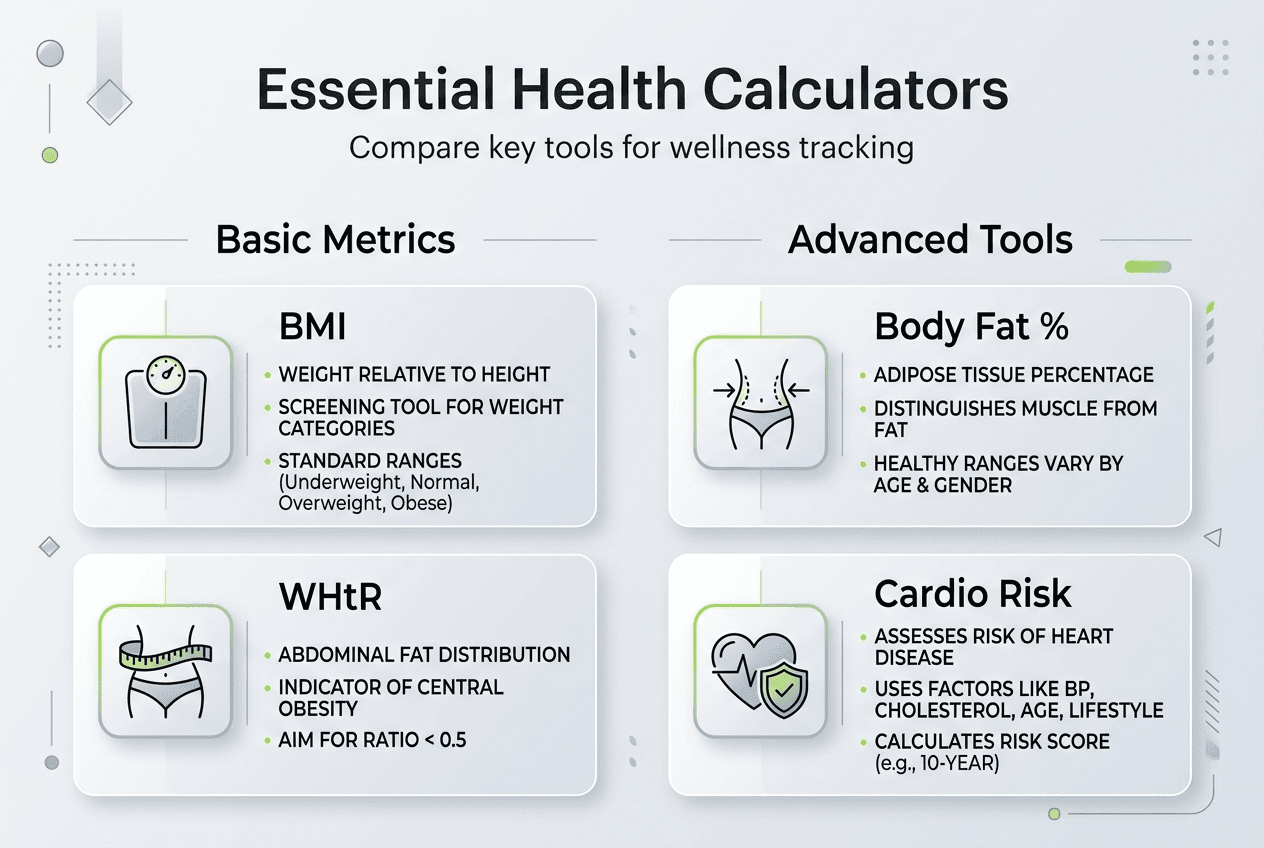
Cardiovascular disease risk calculators like PREVENT incorporate age, blood pressure, cholesterol levels, and lifestyle factors. These tools outperform older models by accounting for more variables and providing tailored risk assessments. Someone with high muscle mass receives appropriate evaluation rather than automatic high-risk classification.
| Calculator Type | Data Required | Primary Benefit | Main Limitation |
|---|---|---|---|
| BMI | Height, weight | Quick population screening | Ignores body composition |
| Body Fat % | Multiple measurements | Reveals actual composition | Requires proper technique |
| WHtR | Waist, height | Predicts CVD risk | Single-factor assessment |
| PREVENT Score | Comprehensive health data | Accurate cardiovascular prediction | Needs clinical measurements |
Different life stages and goals demand specific calculator combinations. Young athletes benefit most from body composition tracking and strength ratios. Middle-aged individuals should add cardiovascular risk assessment. Older adults might prioritize bone density considerations alongside body fat monitoring.
Pro Tip: Use at least three different calculators quarterly to cross-reference results and catch measurement errors or unusual changes that warrant professional consultation.
The body composition tracking guide explains how combining multiple metrics creates redundancy that improves accuracy. When body fat percentage, WHtR, and strength measurements all trend positively, you confirm genuine progress. Conflicting signals suggest measurement issues or the need to adjust your approach.
Understanding how to track progress in health and fitness means selecting tools that match your specific objectives. Endurance athletes emphasize different metrics than bodybuilders. Weight loss journeys require different tracking than muscle gain phases. Matching calculator selection to current goals maximizes their utility.
Applying health calculators to personalize your nutrition and wellness goals
Translating calculator results into actionable nutrition strategies requires understanding what numbers mean for your situation. A 25% body fat reading suggests different approaches depending on whether you weigh 150 or 250 pounds and whether you prioritize fat loss or muscle gain.
Follow these steps to create personalized meal plans based on your metrics:
- Calculate your baseline using multiple tools to establish current body composition and health status
- Set specific, measurable targets for each metric based on realistic timelines and sustainable changes
- Determine calorie and macronutrient needs that support your goals while maintaining metabolic health
- Track weekly measurements to identify trends and distinguish real changes from normal fluctuations
- Adjust nutrition strategies every 4-6 weeks based on progress toward target metrics
- Integrate nutritional assessment methods to refine your approach over time
Continuous monitoring reveals how your body responds to dietary changes. Someone losing weight too quickly might need more calories to preserve muscle mass. Another person seeing body fat percentage drop while weight stays stable celebrates successful recomposition. These insights come only through consistent tracking.
Common interpretation mistakes include:
- Reacting to single measurements rather than weekly averages that smooth daily variations
- Comparing your results to population averages instead of your personal baseline and trajectory
- Ignoring how factors like hydration status, meal timing, and sleep affect body composition readings
- Expecting linear progress when natural plateaus and fluctuations occur in every fitness journey
Pro Tip: Schedule measurements on the same day each week under identical conditions, recording not just numbers but also notes about sleep quality, stress levels, and training intensity to identify patterns.
Learn how to set nutrition goals that align with calculator insights rather than arbitrary targets. Your body fat percentage trajectory matters more than hitting some idealized number. Sustainable progress requires patience and data-driven adjustments.
Professional nutritionists use these same calculators but add expertise in interpreting complex interactions between metrics. They spot concerning patterns like rapid muscle loss during calorie restriction or identify when cardiovascular risk factors deserve medical attention. Combining self-monitoring with periodic professional guidance optimizes results while maintaining safety.
Take your health to the next level with personalized nutrition solutions
Your calculator results provide the foundation, but transforming data into delicious, sustainable meal plans requires expertise and ongoing support. Dietium combines advanced health tracking tools with personalized nutrition guidance that adapts to your changing needs. Our platform integrates the metrics you measure with custom recipes, shopping lists, and meal timing strategies designed for your specific goals. Whether you’re building muscle, optimizing body composition, or improving cardiovascular health, our nutritional assessment methods ensure your plan evolves with your progress. Ready to turn those numbers into real results? Explore our personalized meal plans and discover how professional guidance accelerates your wellness journey. Visit our nutrition goals guide to start building your customized roadmap today.
FAQ
What are essential health calculators and why should I use them?
Essential health calculators measure body metrics like BMI, body fat percentage, waist-to-height ratio, and cardiovascular disease risk to provide objective data about your physical condition. These tools help you make informed decisions about nutrition, exercise, and wellness strategies rather than relying on guesswork or how you feel on any given day. Regular use reveals trends that guide effective adjustments to your health plan.
Why is BMI considered a limited metric for athletes?
Muscle tissue has higher density than fat, causing BMI to misclassify muscular individuals as overweight or obese despite low body fat percentages. Athletes with significant lean mass receive inaccurate health assessments because the formula treats all weight identically. This limitation makes BMI unreliable for anyone who strength trains regularly or maintains above-average muscle mass.
How can I accurately track my body composition at home?
Use skinfold calipers or a measuring tape to collect data for established body fat formulas like the Navy Method or Jackson-Pollock protocols. Take measurements at consistent times under similar conditions to minimize variables like hydration and meal timing. Following proper technique guides ensures results within 3-4% of laboratory methods. Learn how to calculate body fat percentage correctly for reliable tracking.
What is the best way to use health calculators for personalized nutrition?
Calculator metrics inform your calorie targets and macronutrient distribution based on current body composition and specific goals. Track changes over 4-6 week periods to assess whether your nutrition strategy produces desired results, then adjust portions or meal timing accordingly. Combine self-monitoring with guidance from personalized meal plans and nutritional assessment methods to optimize your approach while maintaining sustainable habits.


