 Skip to content

TL;DR:
- Body measurements reveal fat loss and muscle gain despite unchanged scale weight.
- Using a tape measure and consistent technique is key for reliable tracking.
- Tracking trends over weeks provides more actionable insights than daily measurements.
You’ve been consistent with your workouts, dialing in your nutrition, and putting in real effort. Then you step on the scale and see no change. That frustration is real, and it’s one of the most common reasons people give up on their goals. Here’s the thing: the scale measures one number. Your body is doing far more than that number can capture. Fat loss and muscle gain can happen simultaneously, shifting your body composition without moving the scale at all. This guide walks you through how to calculate body measurements accurately, which tools to use, how to interpret your results, and how to avoid the mistakes that make tracking feel pointless.
Table of Contents
- Why calculate body measurements for fitness and nutrition?
- Essential tools and preparation: What you need to get started
- Step-by-step guide: How to calculate your body measurements
- Interpreting your results: Benchmarks and tracking progress
- Common pitfalls and troubleshooting: What to avoid and correct
- A smarter approach: Why consistency matters more than perfect precision
- Take your progress and nutrition to the next level
- Frequently asked questions
Key Takeaways
| Point | Details |
|---|---|
| Circumference beats scale | Body measurements capture changes that scales and BMI miss, driving real fitness progress. |
| Consistency over perfection | Regular, same-technique tracking is far more important than choosing the perfect measurement tool. |
| Preparation is key | Assemble the right tools and set a routine to avoid the most common measurement mistakes. |
| Interpret for trends, not snapshots | Use benchmarks and weekly logs to assess long-term change instead of stressing over each number. |
| Support your goals | Pair measurement tracking with nutrition and training plans for sustained results. |
Why calculate body measurements for fitness and nutrition?
The scale gives you one data point. Body measurements give you a map. When you track circumference at key sites like your waist, hips, chest, arms, and thighs, you capture what the scale completely misses: changes in body shape and composition.
This matters most during body recomposition, the process of losing fat and gaining muscle at the same time. Your weight may stay identical for weeks while your waist shrinks and your arms grow. Circumference tracking is superior to scale weight for detecting recomp progress. Without measurements, you’d assume nothing is working.
BMI has similar blind spots. It uses only height and weight, so a muscular athlete and a sedentary person of the same height and weight receive the same BMI score. That tells you almost nothing useful for fitness planning. Tracking body measurements fills that gap with real, observable data.
Here’s what circumference tracking gives you that the scale cannot:
- Muscle gain detection: Your arms, thighs, and chest grow as you build strength.
- Fat loss confirmation: Waist and hip measurements shrink even when weight holds steady.
- Motivation during plateaus: Visible progress in measurements keeps you moving forward.
- Nutrition feedback: Measurement trends tell you whether your calorie and macro targets are working.
- Injury and posture insight: Asymmetries between sides can flag imbalances worth addressing.
| Metric | Detects fat loss | Detects muscle gain | Affected by hydration |
|---|---|---|---|
| Scale weight | Partially | No | Yes |
| BMI | Partially | No | Yes |
| Circumference measurements | Yes | Yes | Minimally |
| Body fat percentage | Yes | Yes | Depends on method |
“The direction of change in your measurements over weeks tells you far more than any single weigh-in ever could.”
Understanding body fat percentage meaning alongside circumference data gives you the clearest picture of your actual progress. Consistency over precision is what drives reliable trends, not chasing a perfect number on any given day.
Now that you know why the scale often fails to reflect true progress, let’s clarify which measurements matter and how to turn this insight into action.
Essential tools and preparation: What you need to get started
Good news: you don’t need expensive equipment to track body measurements effectively. A simple flexible tape measure is the most accessible and reliable tool available. Cloth or fiberglass tape measures work better than metal ones because they conform to body curves without digging in.
For more detail on fat distribution, body fat calipers measure skinfold thickness at specific sites. They require practice and ideally a second person for consistent placement, but they add a useful layer of data when used correctly. Digital scales with built-in bioelectrical impedance analysis (BIA) can estimate body fat percentage, but they are not essential for circumference tracking.
Here’s what to have ready before your first session:
- Flexible tape measure (cloth or fiberglass, 60 inches or longer)
- Body fat calipers (optional, for skinfold estimates)
- A mirror or assistant for hard-to-reach sites like the back
- Tracking sheet or app to log date, time, and all measurements
- Consistent clothing or measure directly on skin for accuracy
| Tool | Cost | Best for | Limitation |
|---|---|---|---|
| Flexible tape measure | Under $5 | Circumference tracking | Requires consistent technique |
| Body fat calipers | $10-$30 | Skinfold body fat estimates | Skill-dependent accuracy |
| BIA scale | $30-$150 | Quick body fat estimates | Inaccurate post-exercise or when dehydrated |
| DEXA scan | $50-$150 per session | Gold-standard body composition | Cost and access |
Timing matters as much as tools. Measure first thing in the morning, before eating or drinking, and after using the restroom. This controls for the variables that cause the most day-to-day noise. BIA is inaccurate when you’re dehydrated or have exercised recently, and skinfold calipers are less reliable at the extremes of very low or very high body fat.

Use body fat percentage benchmarks to give your numbers context once you have them. You can also use a body shape type calculator to understand how your proportions relate to common fitness and health patterns.
Pro Tip: Set a recurring reminder for your measurement day and keep your tape measure in the same spot. Reducing friction makes consistency far easier to maintain long-term.
Once you’re set up, it’s time to start measuring.
Step-by-step guide: How to calculate your body measurements
Accuracy comes from technique and repetition. Follow these steps every session to get results you can actually compare over time.
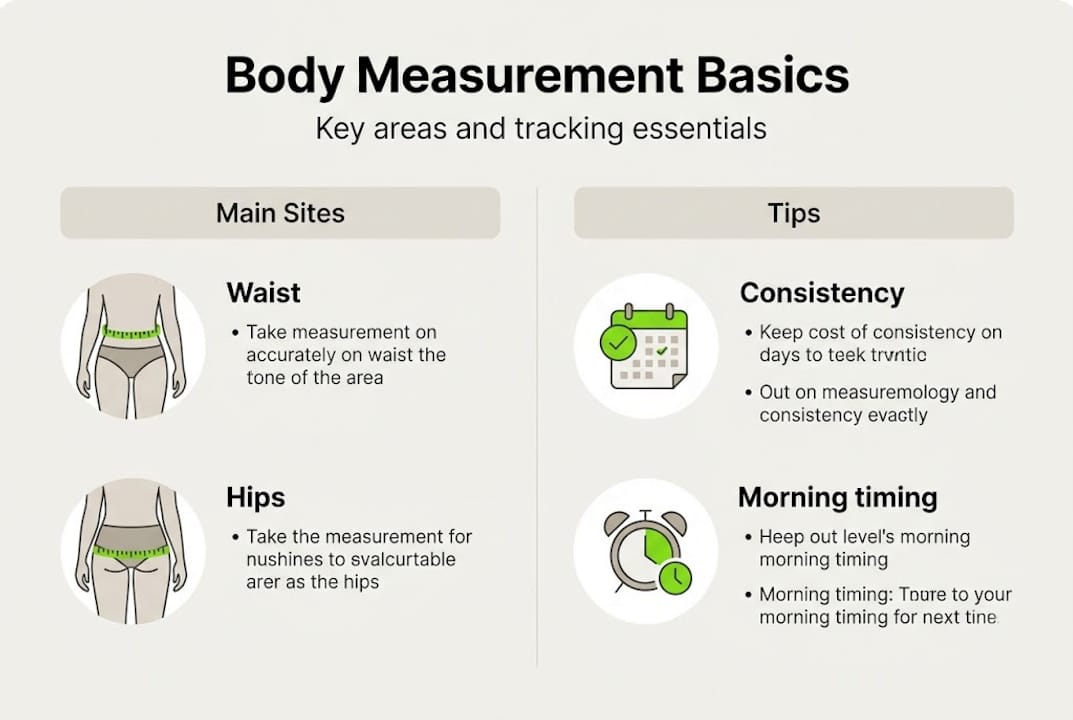
- Choose your measurement sites. Standard sites include waist (narrowest point), hips (widest point), chest (at nipple line), upper arms (flexed or relaxed, both sides), thighs (upper, both sides), and neck (just below the larynx).
- Locate your landmarks. Use a marker or note a visible reference point for each site. Consistent placement is everything.
- Stand in a neutral posture. Feet together, arms relaxed at your sides. Avoid flexing or sucking in.
- Wrap the tape snugly, not tightly. The tape should touch the skin without compressing it. You should be able to slide one finger underneath.
- Read to the nearest 0.1 inch or 0.1 cm. Record immediately. Don’t round up or down.
- Repeat each site twice. Average the two readings. If they differ by more than 0.5 cm, take a third.
- Log everything. Date, time, hydration status, and any notes about the session.
For most people, measuring every one to two weeks is the right frequency. Daily measurements add noise without adding useful information. Biweekly gives enough time for real changes to register while keeping you engaged with your progress.
Here’s a simple tracking log layout:
| Date | Waist (cm) | Hips (cm) | Chest (cm) | R. Arm (cm) | L. Thigh (cm) | Notes |
|---|---|---|---|---|---|---|
| Week 1 | ||||||
| Week 3 | ||||||
| Week 5 |
No measurement method is perfect, but prioritizing consistency over precision is what generates reliable trends. Explore body fat percentage methods if you want to pair circumference data with fat estimates for a fuller picture. You can also track your progress digitally to spot trends faster.
Pro Tip: Take photos from the front, side, and back on the same day as your measurements. Visual changes often show up in photos before they register as significant numerical shifts.
Interpreting your results: Benchmarks and tracking progress
Numbers without context are just numbers. Once you have your measurements, you need reference points to understand what they mean.
For body fat percentage, ACE benchmarks provide widely used ranges. Men: essential fat is 2 to 5%, athletes 6 to 13%, fitness range 14 to 17%, average 18 to 24%, and obese 25% and above. Women: essential fat is 10 to 13%, athletes 14 to 20%, fitness range 21 to 24%, average 25 to 31%, and obese 32% and above. These ranges widen with age.
For waist circumference, health risk increases above 35 inches (88 cm) for women and 40 inches (102 cm) for men, according to major health organizations. These are risk thresholds, not fitness targets, but they provide a useful floor.
How to assess your trends without obsessing over daily data:
- Compare every four to six weeks, not week to week.
- Look for directional movement, not perfection. A 0.5 cm reduction in waist over four weeks is real progress.
- Flag unusual jumps. A sudden 2 cm increase in waist with no diet change may indicate water retention, not fat gain.
- Track multiple sites together. If your waist shrinks but your thighs grow, that’s a strong recomp signal.
- Note non-numerical wins. Clothes fitting differently, improved performance, and better energy all count.
“Progress is a trend, not a single data point. Give your measurements weeks to tell a story before drawing conclusions.”
Use body fat percent charts to compare your numbers against age and gender-specific ranges. Pair that with a body composition tracking system to keep all your data organized and actionable.
Common pitfalls and troubleshooting: What to avoid and correct
Even with good preparation, measurement errors are common. Knowing what to watch for keeps your data reliable.
The most frequent mistakes include:
- Measuring at different times of day. Morning versus evening measurements can differ by 1 to 2 cm at the waist alone due to food, fluid, and digestive volume.
- Poor tape placement. Drifting even half an inch from your landmark skews results. Use the same reference point every session.
- Inconsistent hydration. High sodium intake or intense training the day before can cause water retention that inflates measurements temporarily.
- Measuring during hormonal shifts. For women, measurements taken in the week before menstruation often show temporary increases due to fluid retention. Note this in your log and compare same-phase weeks.
- Changing methods mid-program. Switching from a cloth tape to a BIA device mid-tracking introduces data that can’t be compared directly.
Biological variation is normal and expected. BIA is inaccurate post-exercise or when dehydrated, and the Navy tape method loses accuracy for individuals with extreme muscularity. Experts recommend a hybrid approach: use DEXA scanning for a baseline and periodic rechecks, then rely on home tape measurements for ongoing tracking between sessions.
Pro Tip: If a single measurement session looks wildly off, don’t adjust your plan. Repeat under controlled conditions two days later before making any decisions.
For a deeper look at which methods work best for your body type and goals, review accurate body composition methods to choose the right combination of tools.
A smarter approach: Why consistency matters more than perfect precision
Here’s something most tracking guides won’t tell you: obsessing over measurement precision is one of the fastest ways to quit tracking altogether. We’ve seen it repeatedly. Someone buys a high-end BIA scale, gets a reading that seems off, compares it to a gym’s handheld device, gets a different number, and decides the whole process is unreliable.
Both readings may be imprecise in absolute terms. But if you use the same device, at the same time, under the same conditions every two weeks, the change in that number is highly reliable. That’s what matters.
No method is perfect, but tape measures and the Navy method are free, reliable, and well-suited for ongoing fitness planning. DEXA is the gold standard for accuracy, but it’s costly and impractical for weekly tracking. The best approach combines a DEXA baseline every few months with consistent home measurements in between.
Your body’s direction of change is the signal. The exact starting number is just context. Use essential health calculators to build a complete picture of your metrics and stop letting imperfect precision get in the way of real progress.
Take your progress and nutrition to the next level
Measuring your body is only the first step. Turning those numbers into a smarter nutrition and fitness strategy is where real results happen. Dietium connects your measurement data to personalized tools designed to help you act on what you find. Use the body composition tracking guide to organize your data, explore nutritional assessment methods to align your intake with your goals, and access personalized meal plans built around your specific body metrics and targets. Whether you’re in a fat loss phase, building muscle, or maintaining, Dietium’s tools give you the data-driven support to keep moving forward with confidence.
Frequently asked questions
How often should I take my body measurements for tracking progress?
For most people, measuring every one to two weeks balances accuracy and motivation while minimizing noise from natural daily fluctuations. More frequent measurements rarely add useful information.
Which body areas give the best insight for fitness and nutrition planning?
Key areas include waist, hips, chest, arms, thighs, and neck, as these sites reflect both fat loss and muscle gain trends most clearly across different fitness goals.
Can I use household tape measures for accurate body measurement?
Yes, household tape measures work well as long as you keep your technique consistent and measure under identical conditions each time. Consistency over precision is what makes home tracking reliable.
What should I do if my measurements seem inconsistent week to week?
Look for trends over several weeks rather than reacting to single data points, and review your measurement method for any variations in timing, hydration, or tape placement.
How do body measurements compare with BMI or body fat percentage?
Body measurements track direct changes in shape and size, which is especially valuable when BMI and scale weight are misleading. Circumference tracking is superior to scale-based metrics for detecting recomposition progress where fat is lost and muscle is gained simultaneously.


