 Skip to content

TL;DR:
- A beginner strength training routine involves resistance exercises performed 2–3 times weekly to build muscle and improve health. Focus on four major movement patterns—squat, hinge, push, and pull—with manageable loads and consistent progression to see results within weeks. Training gradually with proper form, tracking progress, and allowing recovery ensures safe, sustainable strength development.
A beginner strength training routine is a structured set of resistance exercises performed 2–3 times per week to build muscle, improve physical function, and support long-term health for those new to working out. Resistance training, the formal term used by the American College of Sports Medicine (ACSM) and the U.S. Physical Activity Guidelines, covers everything from bodyweight squats to dumbbell presses to resistance band rows. Synthesized data from 137 systematic reviews covering more than 30,000 participants confirms that training at least twice weekly produces significant improvements in strength, muscle size, and physical function. That finding matters because it tells you the bar for results is lower than most beginners assume. You do not need six days a week, a gym membership, or heavy barbells to start seeing real change.
What exercises should beginners include in a strength training routine?
The most effective exercise selection for beginners covers four major movement patterns: squat, hinge, push, and pull. These four patterns work every major muscle group in the body. Focusing on them means you never accidentally skip your legs, back, or shoulders while spending all your time on bicep curls.

Guidance aligned with the U.S. Physical Activity Guidelines recommends that resistance training cover all major muscle groups at least two days per week. Compound exercises, which recruit multiple joints and muscle groups at once, are the most efficient way to do that. A single goblet squat trains your quads, glutes, core, and upper back simultaneously. An isolation exercise like a leg extension trains only your quads.
Here are the core exercises organized by movement pattern:
- Squat: Bodyweight squat, goblet squat (dumbbell or kettlebell), leg press machine
- Hinge: Romanian deadlift (dumbbells or barbell), hip thrust, good morning
- Push: Push-up, dumbbell bench press, overhead press, chest press machine
- Pull: Dumbbell row, resistance band row, lat pulldown machine, inverted row
Choose one or two exercises per pattern based on what equipment you have. Home workouts using bodyweight or resistance bands can be as effective as gym training when applied consistently and progressively. That removes the “I don’t have a gym” excuse entirely.
Pro Tip: Pick exercises you can perform with good form on day one. A push-up you do correctly beats a bench press you do dangerously. Master the movement before adding load.
How often and how hard should beginners train to see results?
Training frequency and effort level are the two variables beginners get wrong most often. The answer is simpler than most fitness content suggests.
The ACSM recommends the following structure for beginners:
- Frequency: Train 2–3 full-body sessions per week with at least one rest day between sessions.
- Sets: Perform 2–3 sets per exercise per session.
- Reps: Target 8–12 repetitions per set.
- Load: Choose a weight that makes the last 2–3 reps feel challenging but does not cause form breakdown.
- Effort: Stop each set before failure. You should feel like you could do 1–2 more reps when you rack the weight.
ACSM findings show that training to failure provides no consistent benefit over stopping short of failure for healthy adults starting out. Stopping short of failure also reduces injury risk and keeps recovery manageable between sessions.
A practical way to gauge effort is Rate of Perceived Exertion (RPE), a scale from 1 to 10. Beginners should target RPE 7–8 per set. That means the set feels hard but controlled. An RPE of 10 means you could not do another rep. Staying at RPE 7–8 gives your muscles enough stimulus to adapt without wrecking your recovery.
Harvard Health’s 2026 guidance reinforces that beginners do not need gym equipment or exhausting sets to see gains. Two focused sessions per week with moderate effort produce measurable results. That is the minimum effective dose, and it is enough to start.
How do you safely increase strength over time?
Progressive overload is the principle that drives all strength gains. It means your muscles must face slightly more challenge over time to keep adapting. Without it, your body stops changing after the first few weeks.
The safest method for beginners is double progression. Here is how it works:
- Pick a rep range, such as 8–12 reps.
- Start with a weight where you can complete 8 reps with good form.
- Each session, try to add 1–2 reps until you reach 12.
- Once you consistently hit 12 reps with solid form, increase the weight by the smallest increment available (typically 2.5–5 lbs) and return to 8 reps.
Double progression is an ACSM-aligned strategy that avoids the need for one-rep max (1RM) testing, which is impractical and risky for beginners. Most beginners do not know their 1RM, and testing it early in training increases injury risk without adding useful information.
Pro Tip: Keep a simple training log. Write down the exercise, weight, sets, and reps after every session. You cannot track progress you do not record, and seeing numbers improve week over week is one of the strongest motivators in early training.
Common progression mistakes to avoid:
- Increasing weight every single session before mastering the current load
- Switching exercises every week, which resets the learning curve and makes progress invisible
- Skipping rest days because you feel fine, which leads to accumulated fatigue over weeks
- Chasing soreness as a sign of a good workout; soreness is not a reliable indicator of progress
Keeping exercise selection stable for at least 4–6 weeks lets you accurately judge improvement and refine technique. Changing exercises constantly disrupts both skill development and the ability to measure strength gains.
Strength improvements typically appear within 4–6 weeks of consistent training, with visible muscle changes often emerging around 8–12 weeks. Setting that timeline as your expectation prevents the frustration that causes most beginners to quit.
How to structure your weekly workout plan
A full-body routine performed 2–3 days per week is the most effective structure for beginners. It trains each muscle group more frequently than a split routine, which accelerates skill development and strength gains in the early months.
Sample 2-day per week plan
| Session | Exercise | Sets | Reps |
|---|---|---|---|
| Day 1 | Goblet squat | 3 | 8–12 |
| Day 1 | Push-up or dumbbell press | 3 | 8–12 |
| Day 1 | Dumbbell row | 3 | 8–12 |
| Day 2 | Romanian deadlift | 3 | 8–12 |
| Day 2 | Overhead press | 3 | 8–12 |
| Day 2 | Resistance band pull-apart | 3 | 12–15 |
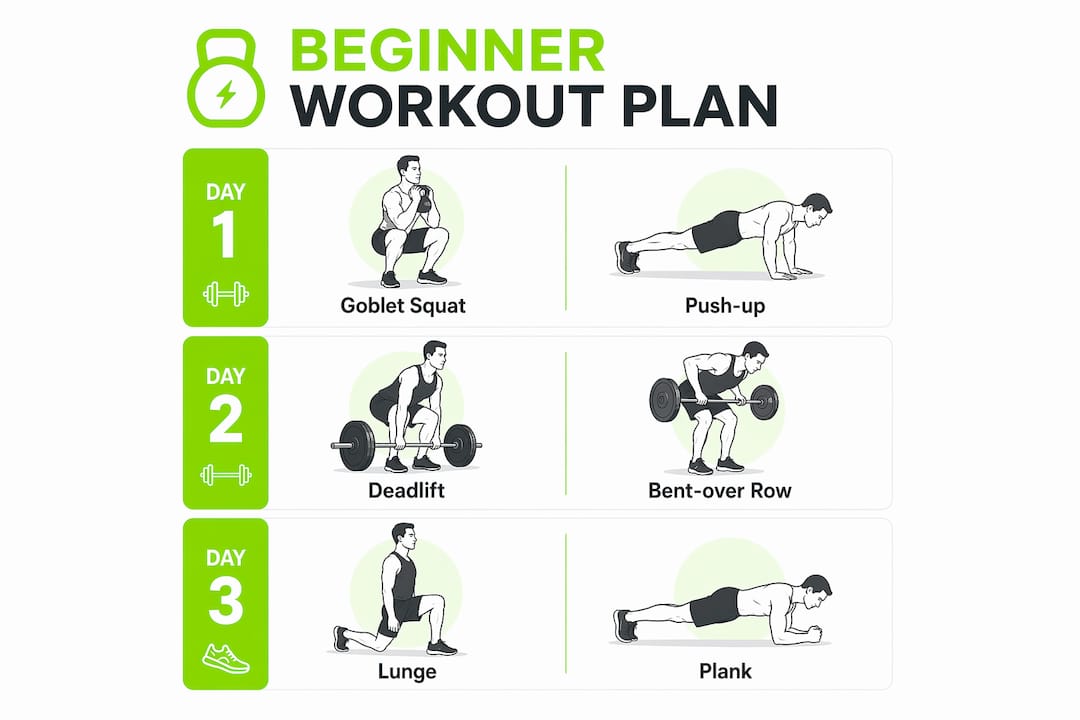
Sample 3-day per week plan
For a 3-day plan, varying session emphasis while maintaining total volume prevents excessive fatigue. For example, Day 1 can prioritize lower body, Day 2 upper body, and Day 3 a balanced full-body session. This approach keeps total weekly volume consistent while reducing the chance of overworking any single muscle group.
Follow these steps to build your first week:
- Choose 4–6 exercises covering squat, hinge, push, and pull patterns.
- Schedule sessions on non-consecutive days (Monday, Wednesday, Friday works well).
- Warm up for 5–10 minutes with light cardio or dynamic movements like leg swings and arm circles.
- Complete your working sets using the RPE 7–8 guideline.
- Cool down with 5 minutes of light stretching targeting the muscles you trained.
If you train at home, beginner-friendly home workouts using resistance bands and bodyweight exercises follow the same structure. A resistance band row replaces a cable row. A bodyweight squat progresses to a banded squat, then to a goblet squat with a loaded backpack. The pattern stays the same; only the tool changes.
Training frequency matters most in the early months because each session teaches your nervous system how to recruit muscle fibers more efficiently. That neural adaptation is why beginners often feel stronger within 2–3 weeks before any visible muscle change occurs.
Pro Tip: Attach your workout to an existing habit. If you always make coffee at 7 a.m., train at 7:15. Habit stacking removes the decision fatigue that kills consistency in the first month.
Common mistakes beginners make in strength training
Most beginners quit or plateau not because the program fails them but because of a handful of avoidable errors. Recognizing these early saves months of frustration.
- Starting too heavy: Using weights that force poor form from rep one. Start lighter than you think you need to.
- Skipping major muscle groups: Doing only push exercises (bench press, push-ups) while ignoring pull movements creates muscle imbalances and increases injury risk over time.
- Ignoring recovery: Muscles grow during rest, not during the workout. Training the same muscle group every day without adequate recovery stalls progress.
- Not tracking workouts: Without a log, you cannot confirm you are applying progressive overload. Guessing your previous weights wastes sessions.
- Expecting instant results: Consistency and adherence to a resistance program matter more than any specific exercise or set-rep scheme for beginners.
“The best beginner workout plan is the one you actually follow. A simple, consistent routine outperforms a complex program done sporadically every time.”
If you experience sharp joint pain (not general muscle fatigue) during any exercise, stop and consult a healthcare professional before continuing. General muscle soreness 24–48 hours after training is normal, especially in the first few weeks. Sharp or joint-specific pain is not.
For those new to strength training, exploring a structured beginner workout with clear progressions removes the guesswork and keeps you on track.
Key takeaways
A consistent beginner strength training routine built on compound movements, 2–3 weekly sessions, and double progression produces measurable strength and muscle gains within 4–12 weeks.
| Point | Details |
|---|---|
| Train 2–3 days per week | Full-body sessions on non-consecutive days maximize muscle frequency and recovery. |
| Use compound movements | Squat, hinge, push, and pull patterns cover all major muscle groups efficiently. |
| Apply double progression | Add reps first, then increase weight to build strength safely without 1RM testing. |
| Stop short of failure | Training at RPE 7–8 per set drives adaptation without excessive fatigue or injury risk. |
| Track every session | A written log confirms progressive overload is happening and keeps motivation high. |
Why simple beats perfect when you’re starting out
I have watched dozens of beginners abandon their routines within six weeks. Almost none of them quit because the program was wrong. They quit because the program was too complicated to sustain.
When I started tracking my own training seriously, the biggest shift came from accepting that boring works. Three days a week, the same six exercises, adding one rep or a small amount of weight every session. No variety for variety’s sake. No chasing soreness. Just showing up and doing the work.
The mental hurdle most beginners face is the belief that more is always better. More exercises, more sets, more days. The ACSM data says otherwise. Two sessions per week with focused effort and steady progression builds real strength. The complexity can come later, once the habit is locked in and the movement patterns are solid.
Patience is not passive. It means trusting the process long enough to see the results that data says are coming. Strength improvements show up in 4–6 weeks. Visible changes follow at 8–12 weeks. Your job in that window is simply to not quit.
Start with what you can do today. Add a little more next week. Repeat.
— Srasti
How Dietium supports your strength training goals
Strength training works best when your nutrition matches your effort. Dietium’s personalized diet plans are built around your specific goals, whether that is building muscle, losing fat, or improving overall health. The Recipians app pairs custom meal plans with fitness routines so your food and training work together, not against each other. Dietium also offers fitness tracking tools that help you monitor progress, measure body metrics, and adjust your plan as you get stronger. If you are serious about building a routine that lasts, Dietium gives you the data and structure to make it happen.
FAQ
How many days a week should beginners strength train?
Beginners should train 2–3 days per week on non-consecutive days. ACSM research confirms this frequency produces significant strength and muscle improvements for healthy adults new to resistance training.
Can beginners build strength at home without gym equipment?
Yes. Bodyweight and resistance band workouts are as effective as gym-based training when applied consistently and progressively. Push-ups, bodyweight squats, and banded rows cover all major movement patterns.
How many sets and reps should a beginner do per exercise?
Start with 2–3 sets of 8–12 reps per exercise. This range builds both strength and muscle size while keeping total session volume manageable for recovery.
How long before beginners see results from strength training?
Strength improvements typically appear within 4–6 weeks of consistent training. Visible muscle changes generally follow around 8–12 weeks, depending on nutrition, sleep, and training consistency.
Should beginners train to muscle failure?
No. ACSM evidence shows training to failure provides no consistent benefit over stopping 1–2 reps short for beginners. Stopping short of failure reduces injury risk and supports better recovery between sessions.


