 Skip to content

TL;DR:
- Micronutrient intake varies individually and requires tracking and benchmarking against personalized standards.
- Regular monitoring, including lab testing when needed, helps prevent deficiencies and excesses impacting health.
- Using structured food tracking and understanding DRIs ensures safe, effective, and tailored micronutrient management.
Eating well every day does not automatically mean your body gets every vitamin and mineral it needs. Many health-conscious people log their meals, choose whole foods, and still unknowingly fall short on iron, magnesium, or vitamin D. Gaps like these accumulate silently, affecting energy, immunity, and long-term wellness before any obvious symptom appears. Optimizing micronutrient intake requires more than food awareness. It takes structured monitoring, reliable benchmarks, and the right tools. This guide covers exactly that: practical methods to track your intake, how to interpret Dietary Reference Intakes (DRIs), when lab testing matters, and how to use that data to protect your wellness.
Table of Contents
- Why micronutrient monitoring matters for wellness
- How to track micronutrient intake: Methods and tools
- Benchmarking intake: Using DRIs and avoiding excess
- Beyond diet tracking: When biomarkers and labs matter
- The overlooked realities of micronutrient monitoring
- Personalized nutrition tools for smarter monitoring
- Frequently asked questions
Key Takeaways
| Point | Details |
|---|---|
| Track with structure | Include supplements and fortified foods for a complete micronutrient profile. |
| Benchmark against DRIs | Use RDA, AI, and UL guidelines to check your intake and avoid risks. |
| Lab tests for clarity | Biomarker testing reveals true micronutrient status when dietary tracking is insufficient. |
| Avoid mega-dosing | Tolerable upper limits are nutrient-specific; overdoing supplements can be harmful. |
| Consistency over perfection | Regular monitoring is more important for wellness than flawless tracking. |
Why micronutrient monitoring matters for wellness
Micronutrients are vitamins and minerals your body needs in relatively small amounts, but their impact on health is large. They regulate metabolism, support immune function, enable DNA synthesis, and protect cells from oxidative damage. Without enough of them, even a calorie-sufficient diet fails to deliver real wellness.
The challenge is that most people have no reliable way of knowing whether their intake is adequate. You may eat leafy greens regularly and still fall short on folate. You may take a daily multivitamin and unknowingly exceed the safe upper limit for certain nutrients. This is exactly why understanding micronutrients for optimal health requires more than general dietary awareness.
Two sides of the same risk: Deficiency and excess
Both too little and too much of any micronutrient create health problems.
- Deficiency can cause fatigue, weakened immunity, poor bone density, impaired cognitive function, and developmental problems in children and pregnant women
- Excess from supplements or fortified foods can produce toxicity symptoms, including nausea, nerve damage (vitamin B6 excess), hypercalcemia (excess vitamin D + calcium), and liver damage (excess preformed vitamin A)
- Common deficiencies globally include iron, zinc, vitamin A, vitamin D, and iodine. The importance of micronutrients for preventing these gaps is well-documented across clinical nutrition research
- Subclinical deficiency, where levels are low but not yet causing visible symptoms, is far more common than full deficiency and just as damaging over time
Micronutrient needs are not one-size-fits-all
Age, sex, pregnancy status, and life stage all shift your requirements significantly. An adult woman aged 19 to 50 needs 18 mg of iron per day, while an adult man of the same age needs only 8 mg. A breastfeeding woman needs more iodine than a woman who is not. These distinctions matter for accurate monitoring.
According to the Dietary Reference Intakes framework, the Recommended Dietary Allowance (RDA) is designed to meet the needs of nearly all (97 to 98%) healthy individuals in a specific life stage and gender group. The Tolerable Upper Intake Level (UL) represents the maximum daily intake unlikely to cause adverse health effects.
Understanding these benchmarks is foundational. The RDA is your daily goal; the UL is the ceiling you should not cross from all combined sources. A micronutrient deficiency overview can help you understand which nutrients carry the highest risk for your profile before you start tracking.
Having seen the importance of balanced intake, let’s explore how to accurately track your micronutrient sources.
How to track micronutrient intake: Methods and tools
Tracking micronutrient intake accurately requires choosing the right method for your goals and consistency level. Each approach has trade-offs between precision and practicality.
Main tracking approaches
| Method | Accuracy | Practicality | Captures supplements/fortified foods |
|---|---|---|---|
| 24-hour dietary recall | Moderate | High | Only if prompted |
| Food frequency questionnaire (FFQ) | Low to moderate | Very high | Often limited |
| Weighed food record | High | Low | Yes, if logged manually |
| App-based logging | Moderate | High | Yes, with manual entry |
As the Total Individual Micronutrient Intake Indicator establishes, dietary assessment methods should capture supplements and fortified foods, not just whole foods, to provide meaningful monitoring data. App-based logging is the most convenient option for everyday use, but it estimates intake from food composition databases that may not perfectly reflect the nutrients in your actual meals.

The key insight: no method is perfect. Weighed food records offer the highest precision but require significant effort. App-based logging suits most wellness-oriented users if done consistently and completely, meaning supplements and fortified cereals are always included.
Understanding the difference between nutritional assessment methods helps you choose the right approach for your specific goals and lifestyle. For most beginners, starting with a structured food logging app is the most accessible path.
Steps for setting up effective micronutrient tracking
- Choose a food logging app with a verified nutrition database (look for USDA-backed data or third-party verified databases)
- Set your personal profile: age, sex, weight, activity level, and any specific health goals or dietary restrictions
- Log every meal, snack, and beverage daily, including portion sizes as accurately as possible
- Add all supplements separately, entering the specific nutrient amounts listed on the label
- Note any fortified foods you consume regularly (fortified cereals, plant-based milks, fortified orange juice)
- Review your weekly micronutrient summary and compare it against your age and sex-specific DRI benchmarks
- Identify consistent gaps or consistent highs and use that data to guide food choices or consult a nutrition professional
Pro Tip: Always log supplements and fortified products separately and completely. These sources contribute significantly to your total intake and are the most common reason why people either underestimate or overestimate their micronutrient consumption. The same applies to tracking food intake: completeness matters more than perfection.
For users who also want to track energy balance alongside micronutrients, tracking calorie intake alongside micronutrient data gives you the most complete nutritional picture.
Now that you understand how to track micronutrient intake, it’s important to know how to evaluate your results against wellness benchmarks.
Benchmarking intake: Using DRIs and avoiding excess
Having tracking data is only useful if you know what to compare it against. Dietary Reference Intakes (DRIs) provide that framework. Developed by the National Academies of Sciences, Engineering, and Medicine, DRIs are the authoritative set of reference values used to assess and plan nutrient intakes for healthy individuals.
The four DRI concepts explained simply
- EAR (Estimated Average Requirement): The intake level meeting the needs of 50% of healthy individuals in a group. Used for population-level assessment, not individual goals
- RDA (Recommended Dietary Allowance): Your daily target. Meets the needs of 97 to 98% of individuals in your life stage and sex group
- AI (Adequate Intake): Used when there is not enough evidence to establish an RDA. Still a useful daily target
- UL (Tolerable Upper Intake Level): The maximum total daily intake from all sources that is unlikely to cause harm. Exceeding this consistently raises the risk of toxicity
As outlined in the Dietary Reference Intake Tables, exact DRI values depend entirely on your age, sex, and life stage, which is why a personalized approach to benchmarking is always more useful than generic intake targets.
Sample DRI reference values for common nutrients (adult ages 19 to 50)
| Nutrient | RDA/AI (Men) | RDA/AI (Women) | UL |
|---|---|---|---|
| Vitamin D | 600 IU (15 mcg) | 600 IU (15 mcg) | 4,000 IU (100 mcg) |
| Iron | 8 mg | 18 mg | 45 mg |
| Calcium | 1,000 mg | 1,000 mg | 2,500 mg |
| Folate | 400 mcg DFE | 400 mcg DFE | 1,000 mcg |
| Zinc | 11 mg | 8 mg | 40 mg |
| Vitamin C | 90 mg | 75 mg | 2,000 mg |
Use these benchmarks by comparing your weekly average intake from your tracking app against the RDA or AI for your specific profile. If your vitamin D intake consistently falls below 600 IU and you have limited sun exposure, that is a meaningful signal. If your zinc intake from supplements plus food approaches 35 mg daily, you are getting close to the UL and should adjust.
Reviewing micronutrient value benchmarks regularly keeps your intake aligned with safe and effective targets rather than guesswork.
Signs of excessive intake to watch for
- Nausea, headache, or dizziness after starting a new supplement (possible excess of fat-soluble vitamins)
- Hair loss or brittle nails (associated with excess selenium)
- Nerve tingling or numbness (linked to excess vitamin B6 over long periods)
- Muscle weakness or excessive thirst (can signal hypercalcemia from too much calcium and vitamin D)
- Digestive discomfort or diarrhea (common with high-dose magnesium or vitamin C)
Pro Tip: Avoid blanket mega-dosing from supplements based on general wellness claims. ULs differ widely by nutrient, and not every nutrient even has an established UL, which means data on safety at very high doses is limited. Review micronutrient deficiency information to understand which nutrients carry the most risk in both directions before adjusting your supplement routine.
Once you’ve benchmarked your intake, some situations require targeted assessment to ensure actual wellness improvements.
Beyond diet tracking: When biomarkers and labs matter
Dietary tracking tells you what you consumed. It does not tell you what your body actually absorbed, stored, or utilized. This distinction is critical for anyone serious about optimizing micronutrient status.
Why food tracking alone has limits
Nutrient absorption varies based on gut health, food preparation methods, nutrient interactions, and individual genetics. Vitamin C enhances non-heme iron absorption. Calcium competes with zinc and magnesium for absorption. Fat-soluble vitamins (A, D, E, K) require dietary fat to be absorbed properly. You could consistently hit your RDA target on paper while still having suboptimal body stores.
As research on measuring micronutrient deficiencies confirms, biomarkers like blood and urine measures can reflect micronutrient status more accurately than dietary data alone, but they are also influenced by inflammation, hydration, and other physiological factors, making interpretation more complex.
This does not mean food tracking is useless. It means tracking is your first layer of monitoring. Lab testing is the second layer, used when risk factors or symptoms make dietary data insufficient.
A tiered monitoring approach recommended by public health frameworks begins with intake tracking and adds targeted biomarker assessment when risk factors, symptoms, or specific health goals indicate a need for greater precision.
Signs and risk factors indicating lab testing may be needed
- Persistent fatigue, brain fog, or weakness that does not resolve with dietary changes
- Diagnosed conditions that affect absorption: celiac disease, Crohn’s disease, bariatric surgery history, or kidney disease
- Strict dietary patterns (vegan, raw food, or highly restricted diets) with limited access to fortified foods
- Pregnancy or breastfeeding, where both deficiency and excess carry higher risks
- Age over 65, when nutrient absorption naturally declines and dietary intake often decreases
- Taking multiple supplements without professional guidance and concerned about interaction or toxicity
- Long-term low sun exposure combined with consistent dietary shortfall in vitamin D food sources
Reviewing micronutrient deficiency details before your lab appointment helps you ask more targeted questions and understand your results in context. Combining this with personalized nutritional assessment tools gives you the clearest picture of your current status.
With both tracking and lab assessment understood, let’s wrap up with practical strategies for integrating monitoring into daily life.
The overlooked realities of micronutrient monitoring
Most monitoring guides focus on tools and benchmarks. Fewer address what actually stops people from benefiting from them.
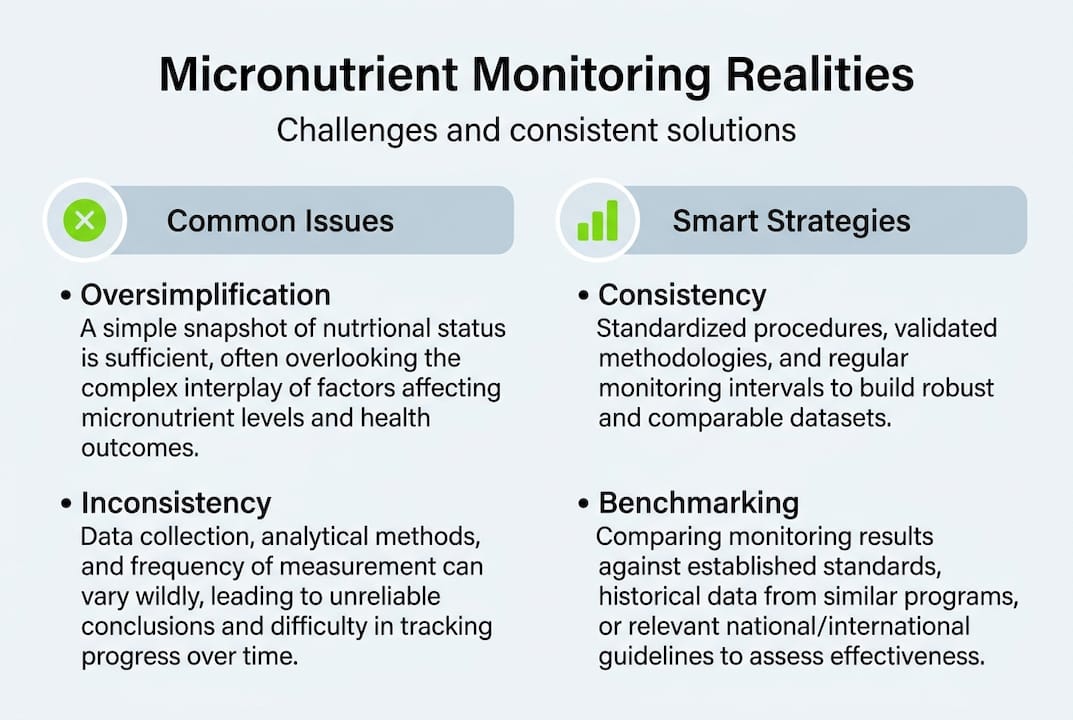
The first problem is oversimplification. Many popular apps report micronutrient totals as if all sources are equal. A milligram of zinc from oysters and a milligram from a supplement tablet are not equivalent in terms of bioavailability. Apps cannot account for this nuance, and most users do not realize the data they see is an estimate, not a precise measurement.
The second problem is inconsistency. Occasional tracking produces misleading snapshots. A single day where you ate fortified cereal, a supplement, and salmon looks very different from a typical Tuesday. Tracking needs to reflect your actual patterns over weeks, not days.
The third reality is that lab testing remains underused among wellness-focused individuals who could genuinely benefit. Many people assume testing is only for the sick. In practice, catching a subclinical vitamin D or iron deficiency early prevents months of suboptimal performance and avoids more significant health interventions later.
A deep dive on micronutrients reinforces this point: the goal is not perfection in every log entry. It is consistent, honest monitoring over time that reveals real patterns and enables real improvements.
Pro Tip: Consistency in logging and benchmarking against DRIs is more valuable than trying to optimize every single micronutrient at once. Pick two or three nutrients most relevant to your goals or risk profile, track them reliably for four to six weeks, then reassess.
Personalized nutrition tools for smarter monitoring
To make micronutrient monitoring easier and more actionable, explore these Dietium resources designed for health-conscious individuals.
Dietium offers a full suite of evidence-based tools built specifically for people who want data-driven control over their nutrition. The personalized nutritional assessment section connects you to structured assessment tools that go beyond calorie counting to examine actual nutrient gaps. The Recipians app generates custom meal plans aligned with your micronutrient targets, factoring in your age, sex, and dietary preferences. Whether you are tracking iron intake as a woman of reproductive age, managing vitamin D status in a low-sun climate, or trying to optimize zinc and magnesium for athletic recovery, Dietium’s integrated platform gives you the tools to track, benchmark, and act.
Frequently asked questions
What is the best way to track micronutrient intake accurately?
Structured dietary recalls or records that include supplements and fortified foods are the most reliable approach, as app-based estimates alone often miss key contributors to total intake.
How do I know if my micronutrient intake is too high or too low?
Compare your average daily intake against age and sex-specific DRI values (RDA for minimums, UL for maximums), and consult a health professional if you notice symptoms of deficiency or excess.
When should I consider lab testing for micronutrient status?
Lab testing is most useful when symptoms persist, absorption-affecting conditions exist, or dietary tracking consistently shows gaps, as biomarker-based assessment provides more direct evidence of your actual body stores.
Do wellness apps provide accurate micronutrient monitoring?
Apps estimate intake from food composition databases but do not measure actual body stores. Because self-reported intake is prone to error, treat app data as useful estimates that inform decisions, not definitive measurements.
Are all micronutrients equally important to monitor?
Each micronutrient plays a unique role, but prioritize those with established DRI benchmarks and higher deficiency risk based on your age, sex, dietary pattern, and specific wellness goals.


