 Skip to content

TL;DR:
- Metabolic flexibility is the body’s ability to efficiently switch between burning fat and carbohydrates based on energy needs and substrate availability. Maintaining this capacity supports energy stability, endurance, and reduces risks of insulin resistance and metabolic diseases, especially through regular exercise and reducing sedentary behavior. Although aging impairs fuel switching, consistent physical activity and lifestyle choices can preserve metabolic adaptability across the lifespan.
Metabolic flexibility is defined as the body’s capacity to switch fuel sources, specifically fat and carbohydrate, in response to changing energy demands and substrate availability. This ability sits at the core of metabolic health, governing everything from how steadily you feel energized throughout the day to how efficiently your body manages weight. When this switching mechanism works well, your metabolism adapts fluidly. When it breaks down, the consequences range from persistent fatigue to insulin resistance and increased cardiometabolic disease risk. Understanding what drives this capacity, and how to protect it, is one of the most practical steps you can take for long-term health.

What is metabolic flexibility, exactly?
Metabolic flexibility is the body’s ability to oxidize fat during fasting or rest and shift to glucose oxidation after eating or during intense exercise. The formal scientific term used in research is “substrate switching,” and it reflects a dynamic, whole-body process rather than a single organ function. Lean, metabolically healthy individuals switch fuels efficiently. People with obesity or type 2 diabetes show blunted switching, meaning their metabolism stays locked in one fuel mode regardless of what the situation demands.
This capacity matters because your body’s energy needs change constantly. During sleep, fat oxidation should dominate. After a carbohydrate-rich meal, glucose should take over. During a sprint, the system should shift again. A flexible metabolism handles these transitions without friction. A rigid one does not, and that rigidity is measurable.
What physiological processes enable metabolic flexibility?
The biology behind fuel switching involves several interconnected systems, with mitochondria at the center. Mitochondria are the organelles responsible for converting both fat and glucose into usable energy (ATP), and their efficiency directly determines how well your body transitions between substrates. Healthy mitochondrial density and function are the single strongest predictor of metabolic flexibility in skeletal muscle.
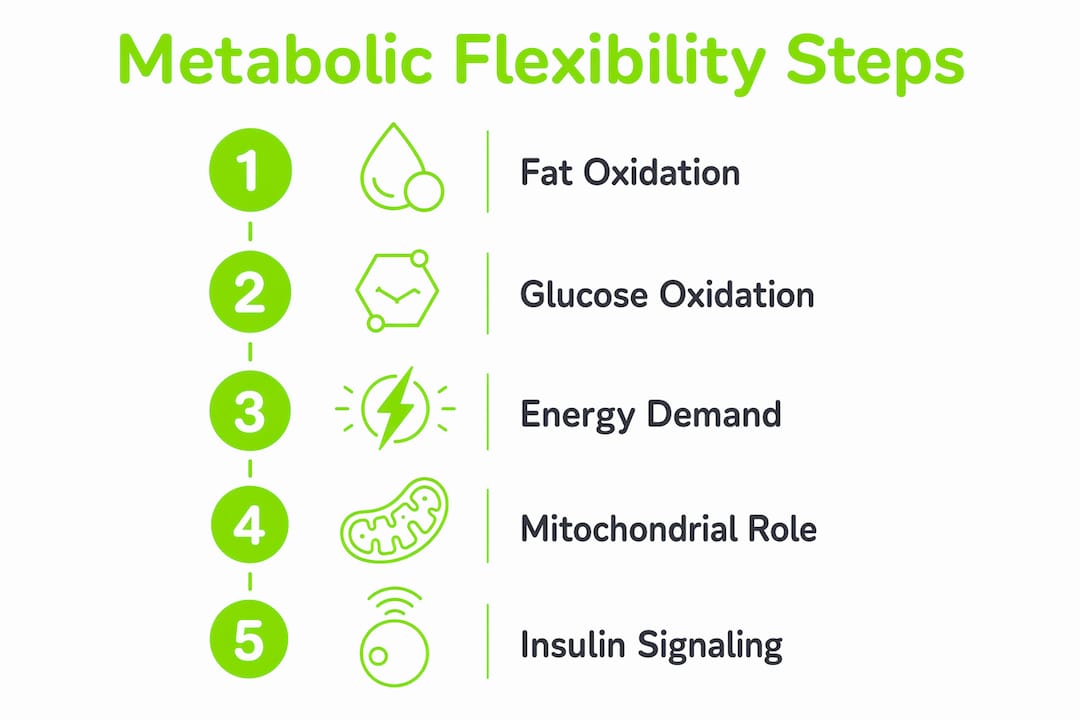
Insulin signaling plays an equally critical role. After eating, insulin rises and signals cells to take up glucose and suppress fat oxidation. In a metabolically flexible person, this signal is sharp and precise. In someone with insulin resistance, the signal is blunted, so glucose uptake is impaired and fat oxidation fails to suppress properly. The result is a metabolic traffic jam where neither fuel is used efficiently.
The process also extends well beyond skeletal muscle. Multi-organ coordination is required for true metabolic flexibility, involving the liver (which regulates glucose output and fatty acid release), adipose tissue (which controls lipid mobilization), the heart (which preferentially burns fat at rest), and even the brain (which adapts its fuel preference during prolonged fasting). No single organ acts alone.
Key physiological drivers of metabolic flexibility include:
- Mitochondrial biogenesis: The creation of new mitochondria, stimulated by exercise and caloric restriction
- Insulin sensitivity: The precision of cellular response to insulin signals
- Hormonal regulation: Glucagon, cortisol, and catecholamines all modulate substrate preference
- Fasting and feeding cycles: Regular transitions between fed and fasted states train the switching mechanism
Pro Tip: Prioritizing sleep quality directly supports mitochondrial repair and insulin sensitivity, two of the most fundamental drivers of fuel switching capacity.
Why does metabolic flexibility matter for weight and health?
Metabolic inflexibility is associated with insulin resistance, obesity, and early cardiometabolic disease risk. This is not a downstream consequence of poor health. It is often an early marker, appearing before clinical diagnoses of type 2 diabetes or metabolic syndrome are made. Detecting reduced substrate switching capacity early gives you a meaningful window to intervene.
The practical benefits of strong metabolic flexibility are direct and measurable:
- Steadier energy levels: No mid-afternoon crashes because your body can access fat stores between meals
- Better endurance: Athletes with high fat oxidation capacity preserve glycogen longer, delaying fatigue
- Efficient fat burning: A flexible metabolism burns stored fat during rest and low-intensity activity
- Lower disease risk: Improved insulin sensitivity reduces the risk of type 2 diabetes and cardiovascular disease
“Metabolic flexibility is essential for smooth fuel transitions that support steady energy levels, endurance, and efficient fat burning. Its loss leads to energy crashes, poor exercise performance, and increased fat storage.” — Obesity Medicine Association
The connection to metabolic health is direct. People with high metabolic flexibility tend to have lower fasting insulin, healthier body composition, and better lipid profiles. These are not independent benefits. They are expressions of the same underlying biological efficiency.
How is metabolic flexibility measured?
The standard research method for assessing metabolic flexibility uses the respiratory exchange ratio (RER), specifically the change in RER (ΔRER) between a fasted baseline state and an insulin-stimulated condition. Higher ΔRER values correlate with better metabolic flexibility and are consistently observed in lean individuals compared to overweight or diabetic groups. This difference in ΔRER is one of the clearest physiological distinctions between metabolically healthy and unhealthy populations.
Exercise-based testing offers a practical alternative. Fatmax protocols, which identify the exercise intensity at which fat oxidation peaks, estimate substrate preference shifts during physical activity. Exercise challenges modify substrate use within mitochondria, making exercise testing an effective tool for assessing fuel switching capacity in real-world conditions.
| Assessment method | What it measures | Key limitation |
|---|---|---|
| Insulin clamp + ΔRER | Whole-body substrate switching under controlled insulin stimulus | Requires clinical setting; invasive |
| Fatmax exercise test | Peak fat oxidation rate and intensity threshold | Protocol variation makes comparisons difficult |
| Indirect calorimetry | Real-time carbohydrate and fat oxidation rates | Equipment-dependent; affected by recent meals |
| Tissue biopsy analysis | Mitochondrial density and function in specific muscle | Invasive; not practical for routine use |
One important caveat: no standardized protocol currently exists for measuring metabolic flexibility, which leads to inconsistent findings across studies. RER measurements depend heavily on insulin infusion rate, timing, and participant state. This means two studies can report conflicting results even when measuring the same population.
Pro Tip: If you want a practical proxy for your own metabolic flexibility, track how you feel two to three hours after a balanced meal. Sustained energy without hunger or brain fog is a reliable sign that your fuel switching is working.
What lifestyle changes can improve metabolic flexibility?
Improving metabolic flexibility does not require extreme dietary protocols. The research points to consistent, moderate lifestyle changes as the most effective approach.
Reduce sedentary time first
Reducing sedentary time by 30 to 60 minutes a day improves metabolic flexibility in sedentary adults, even without formal exercise training. This finding is significant because it means daily movement patterns, not just gym sessions, critically influence your metabolic switching capacity. Standing, walking, and light activity throughout the day keep insulin sensitivity higher and mitochondrial function more active.
Use exercise to build mitochondrial capacity
- Aerobic exercise (zone 2 training): Sustained low-to-moderate intensity cardio, such as brisk walking, cycling, or swimming at a conversational pace, is the most direct stimulus for mitochondrial biogenesis and fat oxidation capacity.
- High-intensity interval training (HIIT): Short bursts of intense effort followed by recovery periods improve insulin sensitivity and glucose disposal, complementing the fat-burning benefits of aerobic work.
- Resistance training: Building muscle mass increases the total metabolic demand on mitochondria and improves glucose uptake independent of insulin.
- Consistency over intensity: Three to five sessions per week of mixed aerobic and resistance work outperforms sporadic high-intensity efforts for long-term metabolic adaptation.
Align nutrition with metabolic switching
Dietary approaches that support fuel switching focus on timing and composition rather than extreme restriction:
- Eat balanced meals with adequate protein, healthy fats, and complex carbohydrates to avoid chronic glucose dependence
- Allow natural fasting windows between meals (12 to 14 hours overnight) to practice fat oxidation
- Avoid constant snacking, which keeps insulin elevated and suppresses fat burning
- Prioritize whole food sources over processed carbohydrates to maintain stable glucose and insulin responses
Multi-organ regulation means that targeting only carbohydrate restriction misses the broader picture. The liver, adipose tissue, and heart all participate in fuel switching, so overall lifestyle quality matters more than any single dietary rule. Explore lifestyle changes for health to see how these factors connect across your daily routine.
How does aging affect metabolic flexibility?
Aging impairs metabolic flexibility by blunting fuel switching, increasing reliance on carbohydrate metabolism, and reducing lipid oxidation capacity. This decline is tied directly to age-related mitochondrial dysfunction, where both the number and efficiency of mitochondria decrease over time. The result is a metabolism that becomes progressively less adaptable, which contributes to the higher rates of metabolic syndrome, type 2 diabetes, and cardiovascular disease seen in older adults.
Key age-related changes in metabolic flexibility include:
- Reduced mitochondrial density in skeletal muscle, limiting fat oxidation capacity
- Dysregulated lipid metabolism, leading to increased fat storage rather than fat burning
- Blunted insulin signaling, reducing the precision of glucose uptake after meals
- Decreased hormonal responsiveness, slowing the transition between fuel states
The encouraging finding from 2026 research is that this decline is not inevitable. Metabolic flexibility fits within what researchers now call “homeodynamics,” the body’s broader capacity to adapt to fluctuating physiological conditions. Lifestyle interventions, particularly regular exercise and reduced sedentary time, can preserve mitochondrial function and maintain fuel switching capacity well into older age. Understanding your metabolic age gives you a clearer picture of where your metabolism currently stands and what strategies are most relevant for your situation.
Key takeaways
Metabolic flexibility is the body’s core fuel-switching capacity, and improving it through exercise, reduced sedentary time, and smart nutrition directly lowers your risk of insulin resistance, obesity, and cardiometabolic disease.
| Point | Details |
|---|---|
| Core definition | Metabolic flexibility is the ability to switch between fat and glucose oxidation based on energy demand. |
| Measurement gap | No standardized protocol exists; ΔRER and Fatmax tests are used but vary across studies. |
| Inflexibility consequences | Reduced fuel switching is an early marker of insulin resistance and metabolic syndrome. |
| Top lifestyle lever | Reducing sedentary time by 30 to 60 minutes daily improves metabolic flexibility without formal exercise. |
| Aging impact | Age-related mitochondrial decline blunts fuel switching, but regular exercise can preserve this capacity. |
Why metabolic flexibility deserves more attention than it gets
Most health conversations focus on calories, macros, or specific diets. Metabolic flexibility rarely enters the discussion, which is a significant oversight. From my perspective, it is one of the most integrative markers of metabolic health available because it reflects mitochondrial function, insulin sensitivity, hormonal regulation, and organ coordination all at once.
What I find most striking in the current research is that you do not need a clinical intervention to move the needle. Simply sitting less each day produces measurable improvements in fuel switching. That is a low-barrier, high-impact target that most people completely ignore while debating whether to go low-carb or low-fat.
The caution I would add is this: metabolic flexibility is not a diet problem with a diet solution. Treating it as purely a carbohydrate issue misses the systemic biology. The liver, heart, and adipose tissue all participate. A person can eat a textbook diet and still have poor metabolic flexibility if they are sedentary, sleep-deprived, or chronically stressed. The whole system needs attention, not just the plate.
Personalized approaches matter here more than general rules. Someone with early insulin resistance needs a different starting point than a fit athlete looking to optimize endurance. Assess your own metabolic state first, then build from there.
— Srasti
Build a nutrition and fitness plan that supports your metabolism
Metabolic flexibility improves when your nutrition and activity patterns work together consistently. Dietium’s personalized diet programs are built around your specific goals, body metrics, and energy needs, so your meal plan actively supports fuel switching rather than working against it. The Recipians app delivers custom meal plans and recipe suggestions aligned with your metabolic targets, while Dietium’s fitness tracking tools help you monitor progress and adjust your approach as your metabolism adapts. Data-driven personalization is the most direct path from understanding metabolic flexibility to actually improving it.
FAQ
What is the metabolic flexibility definition in simple terms?
Metabolic flexibility is your body’s ability to switch between burning fat and burning glucose depending on what fuel is available and what your body needs. A flexible metabolism handles this transition smoothly; an inflexible one stays stuck in one mode.
What are the main signs of metabolic flexibility?
Steady energy between meals, strong endurance during exercise, and the ability to fast without intense hunger or brain fog are reliable signs of good metabolic flexibility. Frequent energy crashes and difficulty losing body fat often indicate reduced fuel switching capacity.
How does exercise improve metabolic flexibility?
Exercise, particularly aerobic training and resistance work, stimulates mitochondrial biogenesis and improves insulin sensitivity, both of which directly enhance the body’s ability to switch between fat and glucose oxidation. Even reducing sedentary time by 30 to 60 minutes daily produces measurable improvements.
Can diet alone restore metabolic flexibility?
Diet contributes, but metabolic flexibility involves multi-organ coordination across the liver, heart, adipose tissue, and skeletal muscle. Targeting only carbohydrate intake misses the broader systemic regulation, so combining dietary changes with regular movement produces significantly better results.
Does aging permanently reduce metabolic flexibility?
Aging impairs fuel switching through mitochondrial decline and reduced insulin signaling, but this is not irreversible. Regular exercise and reduced sedentary behavior can preserve mitochondrial function and maintain metabolic adaptability well into older age.


