 Skip to content

TL;DR:
- Maintaining muscle mass after age 30 requires consistent resistance training, adequate protein intake, and proper lifestyle habits. Proper nutrition, including carbohydrate replenishment, hydration, and nutrient balance, supports muscle preservation during aging and calorie deficits. Prioritizing habits like regular training, sufficient sleep, and hydration over perfection leads to sustainable muscle retention.
Most people don’t notice muscle loss until it shows up as fatigue, a drop in performance, or a body that just doesn’t respond the way it used to. Maintaining muscle mass is not a single-habit problem. It requires a coordinated approach across training, nutrition, and daily lifestyle. The common belief that eating more protein or doing a few sets of curls a few times a week is enough to prevent muscle loss is a significant oversimplification. This article lays out what the evidence actually says and translates it into clear, practical steps you can apply right now.
Table of Contents
- Key takeaways
- Why your muscles are working against you after 30
- Nutrition for muscle preservation: beyond just protein
- Protecting muscle during calorie deficits
- Hydration, recovery, and lifestyle habits that hold it together
- Comparing the most common muscle maintenance approaches
- My take on chasing the “perfect” muscle maintenance plan
- Build a nutrition plan that works for your muscle goals
- FAQ
Key takeaways
| Point | Details |
|---|---|
| Resistance training is non-negotiable | Train all major muscle groups at least twice weekly to slow age-related muscle decline. |
| Protein timing matters as much as totals | Distribute 20–35 g of protein across 3 or more meals, not just one or two large servings. |
| Carbs and hydration protect muscle | Glycogen depletion and dehydration both accelerate muscle protein breakdown. |
| Maintain training intensity when cutting | Reducing effort during a calorie deficit is the fastest way to lose the muscle you worked to build. |
| Consistency beats complexity | The best program is the one you actually follow, week after week. |
Why your muscles are working against you after 30
Men lose 3 to 5% of muscle mass per decade after age 30, and the process accelerates with inactivity. This condition, called sarcopenia, does not announce itself loudly. You might notice it as slower recovery, reduced strength, or a change in body composition before you ever connect it to muscle loss.
The mechanism is straightforward. Muscle tissue requires a consistent stimulus to maintain itself. Without that signal, the body treats muscle as metabolically expensive and begins breaking it down. Aging compounds this by reducing anabolic hormone production and increasing the body’s threshold for triggering muscle protein synthesis.
Resistance training is the most direct way to counter this. Structured training combined with adequate protein can stabilize weight and reverse strength decline in older adults. The training does not need to be elaborate. What it does need is frequency and coverage.
According to 2026 ACSM guidelines, training all major muscle groups at least twice per week is the recommended baseline for maintaining lean muscle. Aiming for roughly 10 sets per muscle group weekly drives hypertrophy, while working at approximately 80% of your one-rep max for 2 to 3 sets builds and preserves strength.
Key training principles to apply:
- Cover all major muscle groups in each weekly training block, including legs, back, chest, shoulders, and arms.
- Prioritize heavier loads with moderate reps. For older adults specifically, 3 sets of 8 reps with heavier weights outperforms high-rep, low-load training for muscle retention.
- Combine free weights and machines. Programs that use both optimize muscle retention while accommodating individual limitations and allowing progressive overload.
- Train consistently, not perfectly. The biggest performance gain comes from moving from no resistance training to any consistent form of it.
Pro Tip: If you are short on time, a full-body resistance session twice a week is more effective for muscle maintenance than splitting workouts into five specialized days that you only complete sporadically.
Nutrition for muscle preservation: beyond just protein
Protein matters. But focusing only on your daily protein total while ignoring how you distribute it, what else you eat, and how much you drink is a common and costly mistake.
Protein intake of approximately 1.2 g/kg/day supports muscle protein synthesis at a level beyond the sedentary baseline. For a 175-pound person, that translates to roughly 95 grams per day. The distribution of that intake across meals matters as much as the total. Muscle protein synthesis responds to per-meal doses of 20 to 35 grams of protein, not to a single large serving. Eating 80 grams at dinner and very little at breakfast does not produce the same results as spreading intake evenly.

Protein source is less critical than most people think. Plant-based protein shows no significant difference versus animal protein for muscle retention when total intake is adequate. If you follow a plant-based diet, total quantity and amino acid variety are the variables to track, not the source itself. You can explore plant versus animal protein in more detail to fine-tune your approach.
Now for the nutrients that rarely get enough credit:
- Carbohydrates replenish muscle glycogen after training. Without sufficient carbs, your body will pull from muscle tissue for fuel, which directly undermines retention goals.
- Hydration is more important than most people realize. Muscle tissue is approximately 76% water, and even mild dehydration accelerates protein breakdown. Staying adequately hydrated is a low-effort, high-return habit.
- Vitamin D, magnesium, iron, and omega-3s each play a role in muscle function, energy production, and inflammation control. Deficiencies in any of these can create silent drag on your muscle maintenance progress.
Pro Tip: Front-load your protein. Aim for at least 25 to 30 grams at breakfast rather than saving most of your protein for dinner. This activates muscle protein synthesis earlier in the day and keeps the signal running consistently.
Protecting muscle during calorie deficits
Cutting calories to lose fat is one of the most common times people lose muscle. The good news is that most of this muscle loss is preventable with the right adjustments.
- Maintain training volume and intensity. This is the single most important rule when you are in a calorie deficit. Reducing effort or progression during restriction is the fastest route to muscle loss. The body only preserves what it regularly uses.
- Spread protein across at least three meals per day. Distributing protein evenly keeps the muscle synthesis signal active throughout the day. Two meals, even if the totals are right, often leave long gaps where catabolism goes unchecked.
- Do not eliminate carbohydrates. Carbs protect muscle by preserving glycogen stores and preventing your body from breaking down muscle for energy. A moderate reduction is fine. A severe cut creates conditions where muscle loss becomes likely.
- Use creatine supplementation strategically. Creatine supports lean mass gains reliably when combined with resistance training. It does not work as a standalone intervention. Think of it as an amplifier for the training you are already doing, not a replacement for effort.
- Track strength, not just the scale. Monitoring strength and performance gives you a far more accurate picture of muscle maintenance during a deficit than watching your body weight. A slight scale increase during a cut can actually reflect retained or gained muscle.
- Watch your cardio volume. Moderate cardio supports overall health. Excessive cardio, especially without adequate calories and protein, creates a caloric environment where muscle breakdown accelerates.
For a deeper look at how to structure your intake during training cycles, evidence-based protein strategies offer practical frameworks you can apply directly.
Hydration, recovery, and lifestyle habits that hold it together
No training or nutrition plan survives consistently poor recovery. Hydration, sleep, and daily movement outside of scheduled workouts are the three variables most people undervalue when planning muscle upkeep.
Start with hydration. Adequate fluid intake reduces muscle protein breakdown and supports the cellular environment that muscle repair depends on. The standard “drink when thirsty” advice underestimates how often training, heat, and daily activity push you into mild dehydration before thirst signals appear. Track your intake or use urine color as a practical proxy. Read more about hydration for performance and how it connects directly to muscle health.
Daily physical activity beyond the gym also contributes to muscle preservation. Walking, recreational sports, and general movement help maintain neuromuscular function and prevent the deconditioning that sets in quickly with sedentary patterns.
Recovery habits that support preventing muscle loss:
- Prioritize sleep duration and quality. Growth hormone release, which drives muscle repair, peaks during deep sleep. Consistent short sleep reduces this response and raises cortisol, which promotes muscle breakdown.
- Avoid overtraining. More sessions are not always better. If performance drops consistently across workouts, recovery is inadequate. Reduce volume before you reduce effort.
- Schedule rest days deliberately. Muscle is built during rest, not during training. Two to three full rest or active recovery days per week is a reasonable target for most training programs.
- Manage stress. Chronic high cortisol accelerates muscle protein breakdown. Stress management is not a soft recommendation. It has a direct, measurable effect on your ability to retain muscle.
Comparing the most common muscle maintenance approaches
Use this table to evaluate where your current habits stand and where the gaps are.
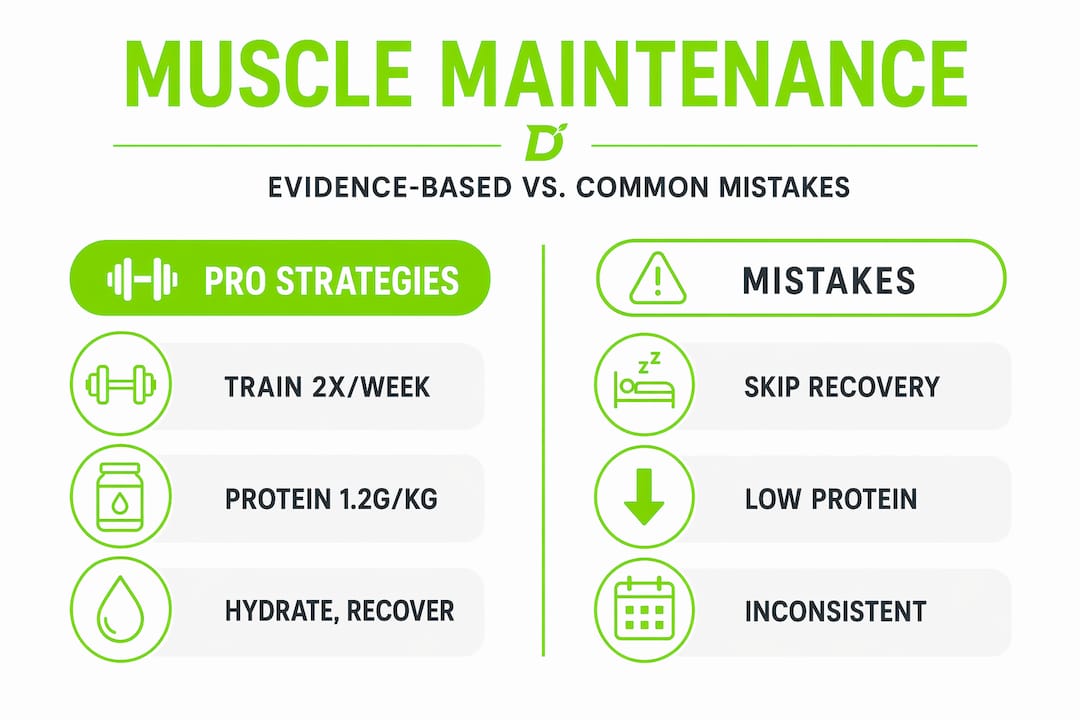
| Approach | What the evidence says | Common mistake |
|---|---|---|
| Resistance training 2x/week | Effective minimum for slowing sarcopenia; 2026 ACSM guidelines recommend covering all major muscle groups | Training only upper body or skipping legs |
| Protein at ~1.2 g/kg/day | Supports synthesis beyond sedentary needs; distribute across 3+ meals | Eating most protein in one meal and assuming totals are enough |
| Carbohydrate intake | Replenishes glycogen and protects muscle from being used as fuel | Cutting carbs severely while already in a calorie deficit |
| Creatine supplementation | Amplifies lean mass gains when paired with training; not effective alone | Taking creatine as a substitute for consistent training |
| Hydration | Directly reduces protein breakdown; muscle is ~76% water | Relying on thirst alone to guide fluid intake |
| Sleep and recovery | Essential for muscle repair and hormone regulation | Prioritizing extra training sessions over adequate rest |
My take on chasing the “perfect” muscle maintenance plan
I’ve watched a lot of people, including myself at certain points, get so focused on optimizing every variable of their muscle maintenance plan that the plan itself becomes unsustainable. They chase exact macros, argue about protein timing windows down to the minute, and try to engineer perfection. And then life interrupts. Travel, work, illness. The plan falls apart, and they feel like they have failed.
What I’ve learned is that the most effective strategy is the one that actually runs in the background of your life without requiring perfect conditions. Missing a meal’s protein target by 10 grams is not the crisis it feels like. Skipping resistance training for two weeks because you are traveling matters far more than any supplement protocol.
In my experience, the people who maintain muscle mass best over the long term are not the ones with the most sophisticated programs. They are the ones who train consistently, eat enough protein across most days, sleep reasonably well, and treat setbacks as pauses rather than resets. I’ve seen more muscle preserved through that approach than through any creatine loading protocol or perfect macro split.
The uncomfortable truth is that discipline over time matters more than optimization in any given week. Small habits compound. Prioritize those over perfection.
— Srasti
Build a nutrition plan that works for your muscle goals
Knowing the principles is one thing. Applying them consistently to your specific body, schedule, and food preferences is another. Dietium’s personalized diet planning helps you translate these evidence-based strategies into a daily plan built around your actual goals. Whether you are managing a calorie deficit, increasing protein across meals, or timing nutrients around training, a tailored approach removes the guesswork. Explore custom meal plans designed to match your fitness targets, dietary preferences, and nutrient timing needs. Dietium’s tools and resources put structured nutrition guidance directly in your hands.
FAQ
How much protein do you need to maintain muscle mass?
Aim for approximately 1.2 g/kg of body weight per day, distributed across three or more meals with 20 to 35 grams per serving. For a 175-pound person, that equals roughly 95 grams daily.
How often should you resistance train to prevent muscle loss?
Train all major muscle groups at least twice per week. The 2026 ACSM guidelines identify this as the effective minimum for slowing sarcopenia and maintaining lean muscle in adults of all ages.
Can you maintain muscle on a calorie deficit?
Yes, but it requires keeping training intensity high and distributing protein evenly across meals. Reducing training effort during a deficit is the primary driver of muscle loss, not the calorie reduction itself.
Does it matter whether protein comes from plants or animals?
No, not significantly. Plant-based protein produces similar muscle retention to animal protein when total daily intake is adequate. Focus on hitting your total and distributing it across meals.
What role does hydration play in muscle maintenance?
Since muscle tissue is approximately 76% water, dehydration directly impairs muscle function and accelerates protein breakdown. Consistent fluid intake is a simple and effective muscle mass retention strategy that most people overlook.


