 Skip to content

TL;DR:
- Mindful eating improves awareness of hunger, fullness, and sensory experiences, reducing overeating through intentional habits. Creating distraction-free environments and starting with simple exercises like mindful bites fosters gradual progress and a healthier relationship with food. Consistent practice, patience, and kindness help develop lasting awareness beyond restrictive dieting or perfection.
Most people finish a meal and barely remember eating it. You were scrolling, watching something, or running through tomorrow’s to-do list, and suddenly the plate was empty. That kind of automatic, distracted eating is one of the most common drivers of overeating and a poor relationship with food. Mindful eating exercises offer a practical way out. They train your attention back to the experience of eating itself, helping you recognize hunger and fullness, enjoy food more, and make choices that actually serve your body. This article walks you through exactly how to start.
Table of Contents
- Key Takeaways
- What mindful eating actually involves
- Setting up your space and mindset
- Practical mindful eating exercises for beginners
- Troubleshooting common challenges
- What progress actually looks like
- My take on what actually makes this stick
- How Dietium can support your next step
- FAQ
Key Takeaways
| Point | Details |
|---|---|
| Mindful eating is not a diet | It builds awareness of your thoughts, feelings, and body signals around food without restricting what you eat. |
| Environment shapes success | Removing phones and screens before meals makes mindfulness easier than relying on willpower alone. |
| Start with one or two bites | Beginning with just the first few bites mindfully is a proven way to build the habit gradually. |
| Pacing meals to 20 minutes helps | Slowing down gives your brain time to register fullness, reducing the likelihood of overeating. |
| Progress takes patience | Self-compassion matters more than perfection when building a consistent mindful eating practice. |
What mindful eating actually involves
Before you can practice it, you need to know what mindful eating is and what it is not. Health Canada describes mindful eating as awareness of how, why, what, when, where, and how much you eat. That is a broader scope than most people expect. It is not just eating slowly. It is paying attention to all the conditions and signals surrounding your meals.
The sensory dimension matters a lot here. Noticing the aroma, texture, temperature, and flavor of food is not a luxury. It is a core part of how mindful eating works. When you engage your senses fully, you shift eating from an automatic behavior to an intentional one.
Here is what mindfulness in eating actually targets:
- Hunger and fullness awareness. Learning to distinguish between physical hunger and eating out of boredom, stress, or habit.
- Sensory engagement. Using sight, smell, taste, and texture to stay present during meals.
- Pace and portion recognition. Noticing how fast you eat and identifying when satisfaction actually arrives.
- Non-judgmental observation. Watching your thoughts and feelings about food without labeling them as good or bad.
- Connection to eating context. Recognizing where and why you eat, not just what ends up on your plate.
One misconception worth clearing up: mindful eating is not restrictive dieting. It does not tell you what to eat or create rules around food groups. The benefits of mindful eating come from strengthening your connection to internal body signals, not from following an external plan. That distinction is why many people find it more sustainable than traditional diets.
Setting up your space and mindset
The single biggest obstacle to mindful eating is not lack of motivation. It is a distraction-heavy environment. VA research confirms that removing phones, turning off the TV, and eating at a table rather than on the go significantly supports successful mindful eating practice. The key insight here is that you should make the distraction-free choice the default, not something you fight for mid-meal.
Creating the right conditions before you sit down is half the work. Try these setup habits before each meal:
- Put your phone in another room or face it down out of reach.
- Sit at a table with your food plated, not eaten from containers or bags.
- Take two or three slow breaths before your first bite to shift into a calmer state.
- Check your hunger level on a scale from 1 to 10. Aim to start eating around a 3 or 4, not at a 1 (starving) or a 7 (already fairly full).
- Set an intention. Even something as simple as “I want to actually taste this meal” is enough.
The mindset piece is equally practical. VA registered dietitians emphasize that mindful eating requires kindness and patience, particularly because many people carry complicated feelings around food, body image, and eating behaviors. You will get distracted. You will eat fast sometimes. That is not failure. It is just the practice.
Pro Tip: Set your fork or spoon down between bites. It sounds almost too simple, but this single habit creates a natural pause that helps you check in with your body instead of eating on autopilot.

Practical mindful eating exercises for beginners
This is where the real work happens. These exercises for mindful eating are ordered from simplest to more structured. Start with one. Get comfortable. Then add another.
The mini-bite exercise
The mini-bite practice from the University of Washington’s Whole U program is the most beginner-friendly starting point. Take one small bite of food and give it your full attention for 30 to 60 seconds.
- Look at the food before it goes in your mouth. Notice color, shape, and texture.
- Smell it. Actually pause and inhale.
- Place it on your tongue without chewing. Notice the immediate flavor and texture.
- Chew slowly, 20 to 30 times, noticing how the flavor changes.
- Swallow deliberately and pause before the next bite.
You do not have to do this for an entire meal. Even one bite per meal practiced this way builds your sensory attention over time.
The 20-minute meal exercise
Harvard Health recommends pacing meals to last about 20 minutes. This is not arbitrary. Your brain needs roughly that long to register fullness signals from your stomach. Eating faster than that means you consistently overshoot your actual needs.
To pace yourself: set a timer for 20 minutes and aim to still be eating when it goes off. Most people discover they finish in 8 to 12 minutes by default. The gap is revealing.
The mid-meal pause
At roughly the halfway point of your meal, put your utensils down and take 30 seconds to check in. Ask yourself two questions: Am I still hungry? Am I eating because the food is in front of me? This pause interrupts the automatic momentum of eating and reconnects you to your actual hunger level.
The mindful eating meditation sequence
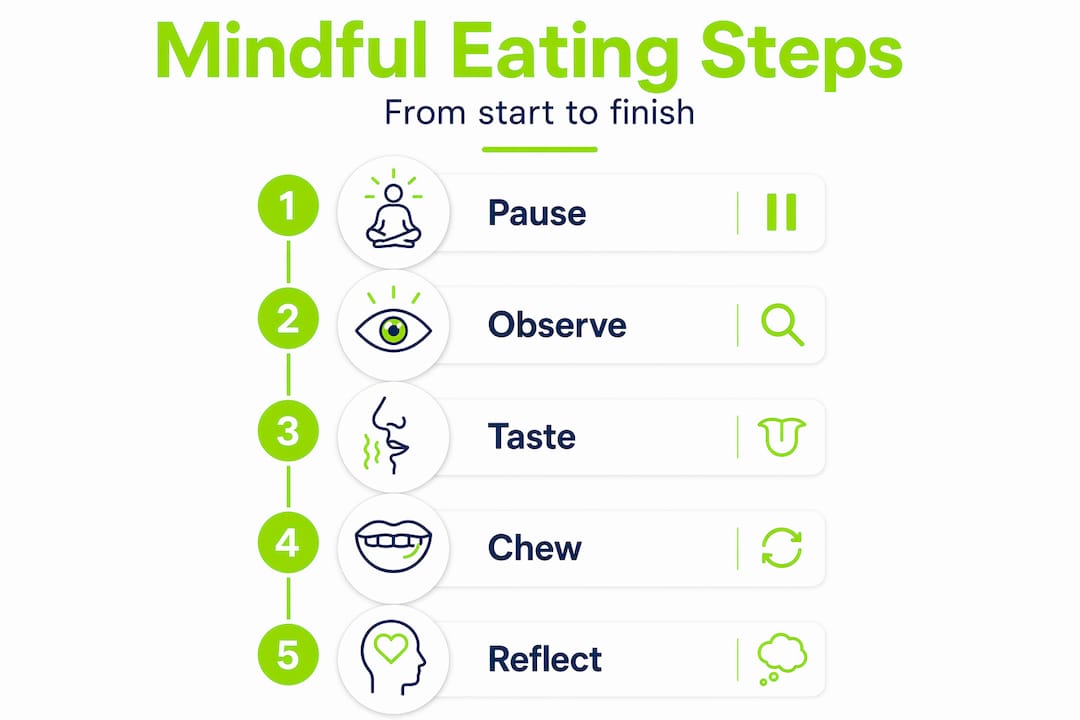
For a more structured practice, this stepwise approach works well:
- Sit quietly before your first bite and take three deep breaths.
- Observe your food. Notice colors, steam, smell, arrangement.
- Take your first bite and chew it 20 to 30 times before swallowing.
- After swallowing, pause for five seconds. Notice any lingering flavors.
- Continue through the meal at this pace, checking in with fullness every five bites.
- After your last bite, sit for one to two minutes without moving on to the next task.
Here is a quick reference for how these exercises compare:
| Exercise | Time needed | Best for | Difficulty |
|---|---|---|---|
| Mini-bite practice | 1 to 2 minutes | Sensory awareness | Beginner |
| 20-minute meal pacing | Full meal | Slowing down | Beginner |
| Mid-meal pause | 30 seconds | Hunger check | Beginner |
| Mindful eating meditation | Full meal | Deep presence | Intermediate |
Pro Tip: If you are new to how to practice mindful eating, do not try to overhaul every meal at once. Pick one meal per day and apply just one exercise. Consistency with one practice beats inconsistency with four.
Troubleshooting common challenges
Even with the best intentions, mindful eating gets hard. Here is what to do when it does.
You keep getting distracted. This is normal. The solution is environmental, not motivational. Making distraction-free eating your default setup is more effective than trying to resist distractions once you are already mid-meal. Phone in another room. No background TV. These are setup decisions, not willpower decisions.
You eat emotionally or out of habit. Psychology Today identifies “food noise” as a real psychological phenomenon where intrusive urges push you to eat beyond hunger. Mindfulness creates space between the impulse and the behavior. That space is where you can make a different choice. You will not eliminate emotional eating overnight, but you can start noticing it without acting on it every time.
You feel impatient or bored. Slow eating feels strange at first, especially if you are used to eating quickly. Start small. Harvard Health advises beginning with just the first few bites of each meal mindfully, then eating the rest normally. That partial approach is a proven way to build the habit without burnout.
“Progress in mindful eating is not measured by perfect meals. It is measured by more moments of awareness than you had last week.”
You can also build mindfulness skills outside of mealtimes. Brief breathing exercises, body scans, or even mindful walks train the same attention muscle you use when eating. The stronger that muscle gets, the easier it becomes to apply it at the table. For more practical strategies on reducing overeating through smarter habits, Dietium’s resource on avoiding overeating naturally covers complementary approaches worth reading alongside this one.
What progress actually looks like
Setting realistic expectations matters. You are not going to finish one mindful meal and suddenly have a transformed relationship with food. Progress is subtle and cumulative.
Signs you are moving in the right direction:
- You notice when you are full before you feel stuffed.
- Meals take longer than they used to.
- You catch yourself eating on autopilot and pause.
- Food tastes more interesting because you are actually paying attention to it.
- Emotional or stress-driven eating episodes become easier to recognize, even if you still act on them sometimes.
A 2026 Springer Nature meta-analysis found that mindfulness-based interventions led to significant reductions in calorie intake and emotional eating, including in younger populations. That finding reinforces what practitioners have observed for years: this works, but it works gradually. Comparing your week three to your week one, not your week one to someone who has practiced for years, keeps the evaluation honest.
If you want a structured way to track your eating patterns alongside your mindfulness practice, Dietium’s intuitive eating guide is a useful companion resource.
My take on what actually makes this stick
I have observed a lot of people try mindful eating and abandon it within two weeks. In my experience, the ones who stick with it share one trait: they stop trying to be perfect about it.
The biggest misconception I see is that mindful eating requires complete, distraction-free, meditative meals every time. That standard is unrealistic for most people living normal lives. What actually works is committing to awareness for just a portion of each meal. The first three bites. A 30-second pause in the middle. That is enough to start rewiring automatic patterns.
What I find genuinely underappreciated is how much mindful eating reshapes your relationship with food beyond weight or calories. People start noticing which foods actually satisfy them. They stop eating things they do not enjoy out of habit. Those shifts are quiet but they compound. And they come from paying attention, not from following rules.
The emotional hurdles are real too. Food is tied to memories, stress, social connection, and comfort. Mindfulness does not erase that. It just gives you enough awareness to make a choice instead of reacting automatically. That is a meaningful shift, and it starts with something as simple as putting your fork down between bites.
— Srasti
How Dietium can support your next step
Building awareness at the table is powerful. Pairing it with a nutrition plan built around your actual goals makes the results more measurable. Dietium’s personalized diet planning service gives you a structure that complements mindful eating by removing guesswork about what to eat, so your attention at mealtimes can go toward how you eat.
For those looking to take it further, Dietium’s personalized meal plans are built around individual health goals, dietary preferences, and lifestyle needs. The Recipians app integrates meal suggestions, fitness tracking, and chef consultations in one place. Mindful eating exercises teach you to listen to your body. A well-designed meal plan gives your body something worth listening to. Explore Dietium’s tools to see how nutritional assessment methods can sharpen the picture even further.
FAQ
What are the easiest mindful eating exercises for beginners?
The mini-bite exercise is the simplest starting point. Take one bite, observe its appearance and smell, chew 20 to 30 times, and pause before the next bite. Even one mindful bite per meal builds meaningful awareness over time.
How long does it take to see the benefits of mindful eating?
Most people notice small changes within two to three weeks of consistent practice, such as eating more slowly or recognizing fullness sooner. Significant shifts in emotional eating patterns typically take longer, often several months of regular practice.
Does mindful eating help with weight loss?
Mindful eating is not a weight loss diet, but research shows it reduces overeating and emotional eating, which can support healthier body weight over time. The primary goal is improving your relationship with food and hunger signals, not tracking calories.
How do you practice mindful eating when you are busy?
Start with just the first two or three bites of each meal eaten mindfully, then continue normally. Even 60 seconds of focused attention before meals and a mid-meal pause can build the habit without requiring a full ritual every time.
Can mindful eating reduce emotional eating?
Yes. Psychology Today research shows that mindfulness interrupts compulsive eating by creating a pause between the urge and the behavior. Over time, that pause gives you more choice about how you respond to emotional food cues.


