 Skip to content

TL;DR:
- Basal metabolic rate (BMR) is the minimum calories your body needs at rest to maintain vital functions. It accounts for most of your daily calorie expenditure and is crucial for effective weight management. Tracking and understanding your BMR helps you set accurate calorie targets and avoid metabolic adaptation during dieting.
Basal metabolic rate (BMR) is defined as the minimum number of calories your body needs to sustain essential life functions, such as breathing, circulation, and cell repair, while at complete rest. BMR accounts for 50% to 80% of your total daily calorie expenditure, making it the single largest component of your energy budget. Understanding basal metabolic rate is the foundation of any serious weight management or fitness plan. Get this number wrong, and every calorie target you set is built on a flawed assumption. Get it right, and you have a reliable baseline to build from.
What is basal metabolic rate and how is it measured?
BMR is measured under strict clinical conditions: complete physical rest, a fasted state of at least 12 hours, and a thermoneutral environment. These conditions are difficult to replicate outside a lab. For that reason, resting metabolic rate (RMR) is used as a practical alternative. RMR is slightly higher than true BMR because it does not require the same rigid conditions, but it is accurate enough for everyday health planning.
The gold standard for measuring either value is indirect calorimetry, a method that calculates calorie burn by analyzing the oxygen you inhale and the carbon dioxide you exhale. This test is available in clinical and sports performance settings. For most people, formula-based calculators offer a practical and accessible alternative.
The two most widely used formulas are:
- Harris-Benedict equation: Developed in 1919 and revised in 1984, it estimates BMR using weight, height, age, and sex.
- Mifflin-St Jeor equation: Published in 1990, it is considered more accurate for most adults and is the preferred formula in clinical nutrition practice today.
- Katch-McArdle formula: Uses lean body mass instead of total weight, making it useful for people who know their body fat percentage.
Pro Tip: For everyday planning, use the Mifflin-St Jeor equation as your starting point. It performs better than Harris-Benedict across a wider range of body types and ages.
The key limitation of any formula is that it estimates a population average. Individual variation in organ size, hormonal status, and body composition means your actual BMR can differ from the formula result. Treat the number as a starting point, not a fixed truth.
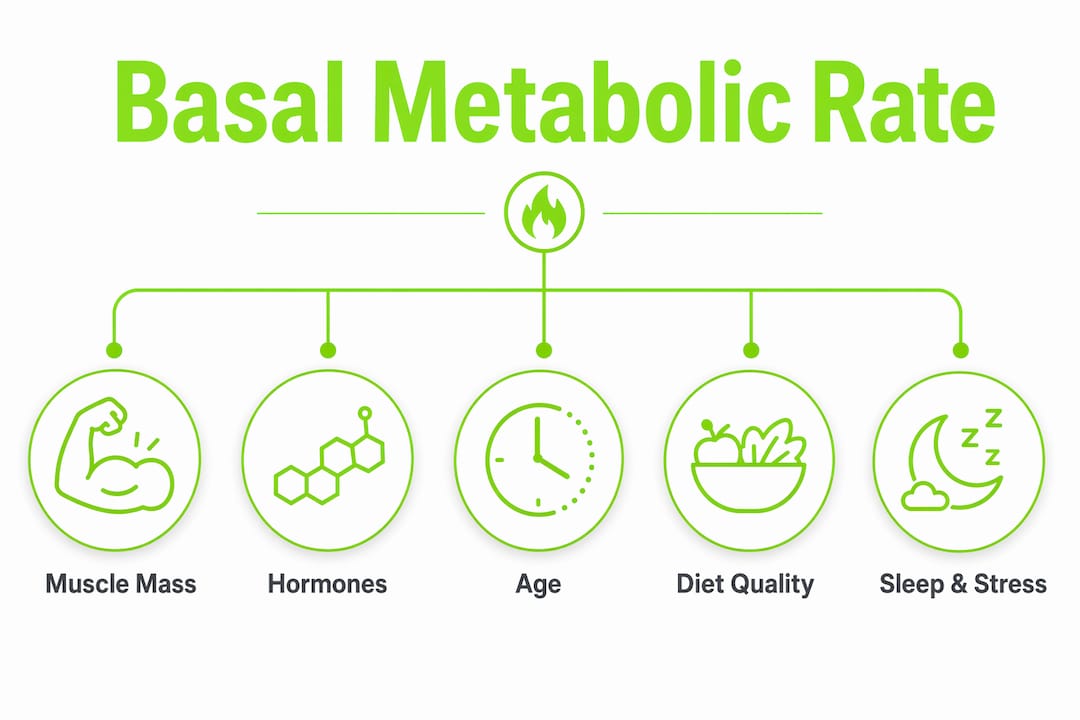
Which factors affect your basal metabolic rate?
Lean muscle mass is the most powerful driver of BMR. Muscle tissue is more metabolically active than fat tissue, meaning it burns more calories at rest per pound. Two people with identical body weight can have significantly different BMRs if their body composition differs. This is why body composition tracking matters far more than the number on the scale.

Age is the second major factor. BMR declines approximately 1–2% per decade after age 20, driven by age-related muscle loss and hormonal changes. That decline is real, but it is not inevitable if you actively maintain muscle mass through resistance training.
The factors affecting metabolic rate break down into four main categories:
- Body composition: Higher lean mass raises BMR. Higher fat mass does not contribute meaningfully to resting calorie burn.
- Sex: Men typically have higher BMRs than women of the same weight and age because they carry more muscle mass on average.
- Genetics: Metabolic rate has a strong hereditary component. Some people are simply born with faster or slower metabolisms.
- Medical conditions: Hyperthyroidism increases BMR, while hypothyroidism decreases it. Both conditions affect weight status and energy levels significantly.
Diet composition also plays a measurable role through the thermic effect of food (TEF). Protein raises metabolic rate by 20–30% after eating, compared to 5–10% for carbohydrates and 0–5% for fats. That difference adds up over the course of a day and a week.
| Factor | Effect on BMR | Modifiable? |
|---|---|---|
| Lean muscle mass | Higher mass = higher BMR | Yes, via resistance training |
| Age | Declines 1–2% per decade | Partially, by preserving muscle |
| Sex | Men average higher BMR | No |
| Thyroid function | Hyper raises, hypo lowers | With medical treatment |
| Diet composition | Protein boosts TEF most | Yes, via food choices |
Sleep and stress also matter indirectly. Poor sleep and chronic stress affect appetite hormones and energy regulation, which can undermine your ability to maintain a healthy body composition over time.
How does understanding basal metabolic rate support weight management?
BMR knowledge gives you a calorie floor. Eating below your BMR for extended periods sends a starvation signal to your body. Severe caloric restriction causes the body to slow its BMR as a survival mechanism, which is called metabolic adaptation. This makes further weight loss progressively harder and is one of the main reasons crash diets fail long term. You can read more about this process in Dietium’s breakdown of metabolic adaptation and its effects on weight loss results.
Here is how to apply BMR knowledge practically for weight management and fitness:
- Calculate your BMR first. Use the Mifflin-St Jeor equation or a validated calculator to get your baseline. This number tells you the minimum calories your body needs to function.
- Multiply by an activity factor to get TDEE. Total daily energy expenditure (TDEE) accounts for movement, exercise, and the thermic effect of food on top of BMR. Eating at a modest deficit below TDEE produces sustainable weight loss.
- Prioritize protein. Protein supports metabolism through both the thermic effect of food and by preserving muscle mass during a calorie deficit. Aim for adequate protein at every meal. For a deeper look at how macros interact with calorie targets, Dietium’s article on macros vs. calories is worth reading.
- Add resistance training. Building and preserving muscle mass through resistance training is the most reliable way to keep your BMR from dropping as you age or diet.
- Avoid extreme restriction. A deficit of 500 calories per day below TDEE is a widely used starting point. Going far below that accelerates muscle loss and triggers metabolic adaptation.
Pro Tip: If your weight loss stalls after several weeks at the same deficit, recalculate your BMR and TDEE. Your body composition has likely changed, and your calorie targets need to be updated accordingly.
The relationship between BMR and exercise is often misunderstood. Exercise itself burns calories, but its bigger contribution to metabolic health is the muscle it builds and preserves. Cardio burns calories during the session. Resistance training raises the calorie cost of simply existing.
How can you estimate and track your BMR effectively?
Estimating your BMR starts with choosing the right formula. The Mifflin-St Jeor equation is the standard choice for most adults. The Katch-McArdle formula is more accurate if you know your lean body mass, which you can measure using a DEXA scan, bioelectrical impedance, or skinfold calipers. Dietium’s guide to estimating BMR naturally walks through each method step by step.
Once you have your BMR, convert it to TDEE by applying an activity multiplier:
- Sedentary (little or no exercise): BMR × 1.2
- Lightly active (1–3 days of exercise per week): BMR × 1.375
- Moderately active (3–5 days per week): BMR × 1.55
- Very active (6–7 days per week): BMR × 1.725
Tracking changes in BMR over time requires tracking body composition, not just weight. The scale does not distinguish between muscle loss and fat loss. A DEXA scan every three to six months gives you the clearest picture of whether your lean mass is holding steady. For a practical framework on body composition tracking, Dietium’s complete guide to body composition covers the key methods and metrics.
Recalculate your BMR every time your weight changes by more than 10 pounds, your activity level shifts significantly, or you enter a new decade of life. These are the moments when your calorie targets drift furthest from reality. The BMR vs. TDEE relationship is worth understanding in detail before you set any long-term calorie goal.
Key Takeaways
BMR is the calorie floor your body requires at rest, and every effective weight or fitness plan must be built on an accurate estimate of this number.
| Point | Details |
|---|---|
| BMR is your calorie baseline | It accounts for 50–80% of daily calorie use and sets the floor for any diet plan. |
| Muscle mass drives BMR | Higher lean mass means more calories burned at rest; resistance training protects it. |
| Age lowers BMR gradually | BMR drops 1–2% per decade, but preserving muscle slows this decline meaningfully. |
| Extreme restriction backfires | Severe calorie cuts trigger metabolic adaptation, slowing BMR and stalling weight loss. |
| Protein earns its place | Protein raises post-meal metabolic rate by 20–30%, more than any other macronutrient. |
Why I think most people are solving the wrong metabolic problem
After spending years working through nutrition data and health research, the pattern I keep seeing is the same: people obsess over speeding up their metabolism when the real problem is that they do not know their baseline. They cut calories without knowing their BMR, add supplements marketed as “metabolism boosters,” and wonder why nothing sticks.
Metabolism is largely genetic and not easily changed in any dramatic way. That is not a pessimistic statement. It is a liberating one. It means you stop chasing the wrong target and start working with what you actually have.
The two levers that genuinely move the needle are muscle mass and diet quality. Build more muscle, and your BMR rises. Eat more protein, and your thermic effect of food goes up. Neither of these requires a supplement, a detox, or a metabolic reset program. They require consistency over months, not days.
The other mistake I see constantly is treating BMR as a fixed number. It changes with age, body composition, and health status. Recalculating it regularly is not obsessive. It is just accurate planning. A calorie target you set two years ago at a different weight and activity level is almost certainly wrong today.
Focus on lean mass. Eat enough protein. Avoid the extremes. That is the metabolic strategy that actually holds up over time.
— Srasti
How Dietium helps you put your BMR to work
Knowing your BMR is only useful if you act on it. Dietium’s platform connects your metabolic baseline to a personalized diet plan built around your specific calorie needs, body composition goals, and food preferences. The Recipians app generates meal plans that align with your TDEE, not a generic calorie average. Dietium also offers personalized meal plans for a range of health goals, from fat loss to muscle building, each grounded in the same evidence-based nutrition principles covered in this article. If you want your calorie targets to reflect your actual metabolism, Dietium gives you the tools to get there.
FAQ
What is basal metabolic rate in simple terms?
BMR is the number of calories your body burns at complete rest to keep you alive. It covers breathing, circulation, cell repair, and organ function.
How do I calculate my BMR?
Use the Mifflin-St Jeor equation: for men, BMR = (10 × weight in kg) + (6.25 × height in cm) − (5 × age) + 5; for women, subtract 161 instead of adding 5. Online calculators apply this formula automatically.
Does BMR change with age?
Yes. BMR declines approximately 1–2% per decade after age 20, primarily due to muscle loss and hormonal shifts. Resistance training slows this decline by preserving lean mass.
Can I increase my metabolic rate?
You can raise it modestly by building muscle through resistance training and increasing protein intake to boost the thermic effect of food. Dramatic increases are not realistic given the genetic component of metabolism.
Why does severe dieting slow weight loss?
Severe caloric restriction triggers metabolic adaptation, causing the body to lower its BMR as a survival response. This makes it harder to lose weight and easier to regain it once normal eating resumes.


