 Skip to content

Sorting through nutrition advice can get confusing fast, especially when you are trying to decide if you should count calories, focus on macros, or both. For anyone serious about healthy weight management, knowing the critical difference between total calorie intake and the roles of protein, carbohydrates, and fats is the real game-changer. This guide breaks down the science of calories and macronutrients, using simple explanations and real-life examples, so you can make informed choices about your food and fitness.
Table of Contents
- Macros Vs Calories Defined Clearly
- Types Of Macros And Their Calorie Impact
- How Tracking Approaches Affect Results
- Practical Benefits, Challenges, And Mistakes
- Choosing The Right Method For Your Goals
Key Takeaways
| Point | Details |
|---|---|
| Understanding Differences | Calories measure total energy intake, while macros focus on the quality and types of nutrients consumed. |
| Nutrient Impact | Each macronutrient (protein, carbohydrates, fats) influences the body differently despite providing calories. |
| Tracking Approaches | Start with calorie tracking to establish a baseline, then introduce macro tracking for better nutrition optimization. |
| Goal Alignment | Choose calorie tracking for weight loss simplicity, and macro tracking for muscle building or performance-focused objectives. |
Macros vs Calories Defined Clearly
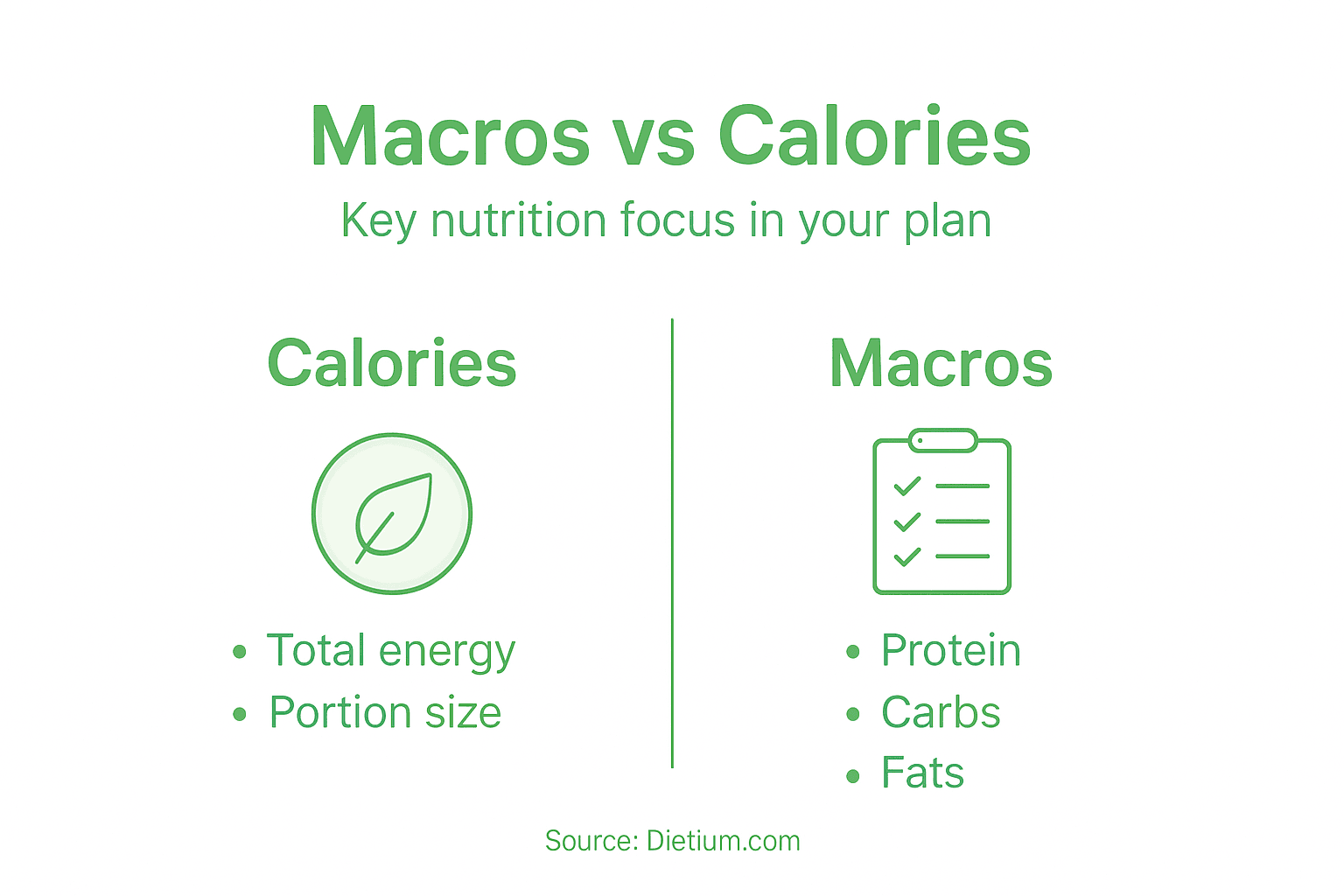
Think of your body like a car engine. Calories are the fuel that powers everything, while macros are the fuel quality that determines how efficiently it runs. Understanding the difference between these two concepts is essential for making informed nutrition decisions.
Calories represent the total energy your body obtains from food. Calories quantify the energy from carbohydrates, fats, proteins, and alcohol in each serving of food you consume. Every food you eat contains calories, and your body uses this energy for everything from breathing to exercising.
Here’s what calories actually measure:
- Total energy content regardless of source (protein, carbs, fats, alcohol)
- How much fuel your body gets from a serving
- The basis for energy balance calculations
- A universal measurement across all foods
Macronutrients, or macros, are the three main nutrient categories your body needs in large quantities. These include protein, carbohydrates, and fats. Each macro serves different functions and provides a specific number of calories per gram.
The three core macronutrients work like this:
- Protein: 4 calories per gram; builds and repairs muscle, tissue, and hormones
- Carbohydrates: 4 calories per gram; provides quick energy and supports brain function
- Fats: 9 calories per gram; stores long-term energy and supports hormone production
Macronutrients in diet include carbohydrates, proteins, fats, fiber, and water, each playing crucial roles in your overall health. The same calorie totals from different macros produce completely different outcomes in your body.
Consider this example: 200 calories from chicken breast versus 200 calories from olive oil create vastly different metabolic responses. The chicken provides protein for muscle building, while the olive oil provides fats for hormone balance. Your body processes them differently.
Calories tell you how much energy you’re consuming; macros tell you what type of energy and how your body will use it.
This distinction matters when you’re tracking nutrition through tools like how to calculate macros for your personal health goals. Many people focus exclusively on calories and miss the bigger picture of nutritional quality.
The relationship between these concepts is straightforward: all macros contain calories, but not all calories are created equal. A 2000-calorie diet of processed foods produces different health outcomes than a 2000-calorie diet of whole foods, even though the energy totals match.
Here is a quick comparison of calories and macros to clarify their roles in nutrition:
| Aspect | Calories | Macros (Macronutrients) |
|---|---|---|
| Definition | Overall energy from all food sources | Main nutrient groups: protein, carbs, fat |
| Main Focus | Energy intake for bodily processes | Nutrient quality and physiological roles |
| Measurement Unit | Kilocalories (kcal) | Grams (g), each with a calorie value |
| Use in Diet Tracking | Controls total energy balance | Optimizes food choices for specific goals |
Pro tip: Start by tracking calories to understand your baseline energy intake, then layer in macro tracking to optimize how your body uses that energy for your specific goals.
Types of Macros and Their Calorie Impact
Each macronutrient acts differently in your body, even though they all contribute calories. Understanding these differences helps you make smarter nutrition choices beyond just hitting a calorie target.
Protein: The Muscle Builder
Protein provides 4 calories per gram and serves as the building block for muscle, bone, skin, and enzymes. Your body breaks down protein into amino acids, which repair tissues damaged during workouts and daily activity.
Protein has unique advantages:
- Highest thermic effect (burns 20-30% of calories during digestion)
- Increases satiety and reduces hunger hormones
- Preserves muscle mass during weight loss
- Supports immune function and hormone production
A 200-calorie protein source keeps you fuller longer than 200 calories of simple carbs. This is why higher protein diets often lead to better results even at the same calorie level.
Carbohydrates: Your Energy Source
Carbohydrates provide 4 calories per gram and are your body’s preferred fuel source. However, carb quality matters tremendously. Carbohydrates vary in quality and impact health differently based on whether they’re whole grains, refined sugars, or fibers.
Not all carbs affect your body the same way:
- Whole grain carbs: Slower digestion, sustained energy, fiber benefits
- Refined carbs: Quick energy spike, rapid blood sugar drop, hunger returns faster
- Fiber: 4 calories per gram but doesn’t spike blood sugar like simple sugars
Total carbohydrate on nutrition labels includes dietary fiber, sugars, and sugar alcohols, each affecting calorie content differently. Fiber actually reduces the calories your body absorbs because it aids digestion without being fully metabolized.
Fats: The Long-Term Energy
Fats provide 9 calories per gram, making them the most calorie-dense macro. Despite higher calories, fats are essential for hormone production, nutrient absorption, and brain function.
Fats serve multiple critical roles:
- Support absorption of fat-soluble vitamins (A, D, E, K)
- Provide sustained energy between meals
- Reduce inflammation when sourced from healthy options
- Stabilize blood sugar alongside protein and carbs
Each macro impacts your body differently, so 2000 calories from balanced macros produces different results than 2000 calories from a single source.
Why this matters: Understanding why count macros for personalized nutrition benefits helps you optimize beyond simple calorie counting. You could hit your calorie goal while neglecting muscle-building protein or energy-supporting carbs.
The calorie density difference between macros is significant. Fat at 9 calories per gram means smaller portions of oil-based foods versus larger portions of protein or carbs. This affects how much food volume you get and your satiety levels throughout the day.

Pro tip: Track your macros for one week using your typical eating pattern, then adjust protein upward by 25-30% while reducing carbs slightly—most people notice improved hunger control without changing total calories.
How Tracking Approaches Affect Results
Your tracking method directly influences your success. Two people eating identical foods achieve different outcomes based on what they measure and how consistently they monitor it.
Calorie Tracking: The Baseline Approach
Calorie tracking creates awareness of total energy intake. Most people underestimate calories by 20-40% without tracking, making this method valuable for establishing a realistic baseline.
Calorie tracking works best for:
- Initial weight loss when total intake exceeds expenditure
- Creating accountability through daily logging
- Understanding portion sizes in your favorite foods
- Identifying hidden calories in condiments and oils
However, calorie tracking alone ignores nutritional quality. You could hit 2000 calories eating pizza or eating chicken with vegetables. Your body responds differently to each option despite identical calorie counts.
Macro Tracking: The Optimization Layer
Macro tracking adds precision by monitoring protein, carbohydrates, and fats separately. This approach addresses the “calories don’t tell the whole story” problem by ensuring you consume the right nutrients for your goals.
Macro tracking delivers better results when:
- Building muscle (higher protein intake matters)
- Managing energy levels throughout the day
- Reducing cravings and improving satiety
- Optimizing body composition rather than just weight
Using Nutrition Facts labels helps track intake and monitor serving sizes accurately. Understanding how to read these labels transforms you from guessing to knowing exactly what you consume.
The Precision Factor
Tracking dietary intake using databases like USDA FoodData Central provides error-corrected nutrient estimates that improve accuracy beyond rough approximations. Most successful people use apps or databases rather than guessing based on memory.
Precision matters because:
- Small daily errors compound into massive weekly gaps
- Apps automatically calculate macros from food entries
- Food scales eliminate portion size estimation
- Consistent logging reveals eating patterns and triggers
The best tracking approach is the one you’ll actually maintain consistently.
Many people obsess over perfect macro ratios while skipping workouts or sleeping poorly. Consistency beats perfection. How to track macros for effective nutrition goals involves finding a sustainable system you’ll use daily rather than a perfect system you abandon in two weeks.
The data shows that tracking itself drives results regardless of method. People who log food intake lose significantly more weight than non-trackers, even with identical calorie targets. The act of measuring creates awareness that changes behavior.
Pro tip: Start with calorie tracking for two weeks to establish your baseline, then add macro targets for the following month—this gradual approach prevents overwhelm while building sustainable habits.
Practical Benefits, Challenges, and Mistakes
Tracking nutrition delivers real benefits, but it comes with genuine challenges that trip up most people. Knowing what goes wrong helps you avoid costly mistakes.
Real Benefits That Stick
Awareness is the first major benefit. You cannot change what you don’t measure. Better awareness of caloric and nutrient intake aids weight and health management significantly more than guessing based on habits.
Other practical benefits include:
- Identifying where hidden calories hide in your diet
- Making informed food swaps that work for your goals
- Breaking the “I eat healthy but don’t lose weight” cycle
- Building awareness that sticks even without tracking forever
People often report that tracking changes their relationship with food. They stop viewing eating as automatic and start making conscious choices.
Common Tracking Challenges
Portion estimation causes the biggest accuracy problems. Most people significantly underestimate portions without measuring tools. Understanding food portions helps avoid overeating and miscalculations that derail your progress.
Real challenges you’ll face:
- Restaurant meals lack accurate nutrition data
- Home-cooked recipes require estimation since ingredients vary
- Packaged foods often list misleading serving sizes
- Tracking becomes tedious and unsustainable for some people
Many people abandon tracking because it feels too complicated, not because it doesn’t work. The system itself becomes the obstacle rather than the solution.
Critical Mistakes to Avoid
Serving size confusion wrecks most people’s efforts. Misunderstanding serving sizes and ignoring servings per package leads to major miscalculations. A package marked “2 servings” that you eat in one sitting means you consumed double the labeled calories.
Common mistakes include:
- Assuming “low fat” or “reduced calorie” means actually low calorie
- Eyeballing portions instead of using a scale
- Forgetting to log cooking oils and condiments
- Switching between tracking methods every few weeks
Consistency matters more than perfection. Track imperfectly for months and see results, or track perfectly for two weeks and quit.
Common dieting mistakes that hinder progress often stem from unrealistic expectations about tracking difficulty. People expect to maintain 100% accuracy immediately, get discouraged by minor errors, and abandon the system entirely.
The key mistake is treating tracking as permanent rather than temporary. Use it as a learning tool for 30-90 days, then apply what you learned without obsessive logging.
Pro tip: Use a food scale for two weeks to calibrate your eye on portion sizes, then switch to visual estimation—you’ll maintain accuracy without the extra effort once you internalize realistic portions.
Choosing the Right Method for Your Goals
Not everyone needs the same approach. Your specific goals determine whether calories, macros, or both matter most. Matching your tracking method to your objective dramatically improves your chances of success.
Goals Shape Your Strategy
Weight loss typically responds well to calorie tracking. If your primary goal is dropping pounds, total energy intake matters most. However, adding macro tracking prevents muscle loss during the weight loss process.
Choose calorie tracking if:
- Weight loss is your main objective
- You’re new to nutrition tracking
- You want simplicity over complexity
- You struggle with detailed logging
Choose macro tracking if:
- You want to preserve or build muscle
- You’re managing energy levels for performance
- You’ve already lost weight and now want body composition changes
- You have specific health conditions requiring nutrient balance
Dietary tracking method selection depends on individual goals, age, sex, weight, and activity level. One size definitely does not fit all in nutrition.
Matching Methods to Common Goals
Performance athletes benefit most from macro tracking. They need adequate carbs for energy, protein for recovery, and fats for hormone balance. Calorie counting alone ignores these performance-critical details.
Muscle builders require higher protein intake. Hitting a calorie target with inadequate protein wastes time and effort. They must track macros to ensure sufficient protein throughout the day.
Disease management often requires strategic macronutrient selection. Strategies like reducing calorie intake through nutrient-dense foods or balancing macronutrients align with specific health objectives. Diabetes management, heart health, and other conditions benefit from macro awareness beyond simple calorie counts.
This table provides a summary of which tracking approach aligns best with different personal goals:
| Goal Type | Recommended Focus | Key Tracking Benefit |
|---|---|---|
| Weight loss | Calorie tracking | Simplifies energy deficit management |
| Muscle building | Macro tracking | Ensures optimal protein intake |
| Performance athlete | Macro tracking | Balances nutrients for energy & recovery |
| Disease management | Macro awareness | Supports tailored nutrient balance |
Start with tracking calories, then layer in macros once you understand your baseline needs and eating patterns.
The Implementation Timeline
Month 1-2: Track calories only to establish your baseline. Identify your current eating patterns without overthinking macro ratios.
Month 3+: Add macro targets once calories feel automatic. You’ll now optimize nutrient distribution based on actual data rather than guessing.
Many people fail by doing too much too fast. How to set nutrition goals for healthy lifestyle success involves progressively building complexity rather than adopting everything simultaneously.
Your tracking method should feel sustainable long-term. Overly complex systems collapse after weeks. Simple systems you maintain for months beat perfect systems you quit in days.
Pro tip: Identify your primary goal first (weight loss, muscle gain, performance), then choose calorie tracking for simplicity or macro tracking for precision—don’t attempt both until you’ve mastered one approach.
Master Your Nutrition by Understanding Macros and Calories
Struggling to choose between counting calories or tracking macros as explained in the article? You are not alone. Many face the challenge of balancing total energy intake with nutrient quality to truly achieve health and fitness goals. Whether your focus is weight loss, muscle building, or optimizing energy, the key pain points are knowing exactly what your body needs and how to apply that knowledge without feeling overwhelmed.
Dietium.com offers a powerful solution tailored to help you overcome this confusion. With our advanced AI-driven tools and the innovative Recipians app, you can seamlessly track calories and macros together, build personalized meal plans, and monitor your progress with precision. Experience guided recommendations that simplify portion control, nutrient balance, and overall energy management so you can take control of your journey today. Explore the benefits of combining education and technology by visiting Dietium’s Recipians platform and find out how easy it is to start empowering your nutrition choices right now.
Frequently Asked Questions
What is the difference between macros and calories?
Macros refer to the three main nutrient categories—proteins, carbohydrates, and fats—each serving different functions in the body, while calories quantify the total energy derived from these nutrients.
Why are macronutrients important for my diet?
Macronutrients provide essential energy and support bodily functions such as muscle repair, quick energy production, and hormone balance, making them crucial for optimizing health and achieving specific fitness goals.
How can I track my macros effectively?
To track macros effectively, start by determining your daily needs based on your personal goals, then use tools like food scales, apps, or nutrition databases to monitor protein, carbohydrate, and fat intake separately.
Should I focus on calories or macros for weight loss?
For weight loss, it’s recommended to start with calorie tracking to establish an energy baseline, then incorporate macro tracking to ensure you’re consuming quality nutrients that support muscle retention and satiety.


