 Skip to content

TL;DR:
- Simple healthy lunches for weight loss focus on protein, fiber, and minimal prep time to support satiety and consistency. Using frameworks like MyPlate and ingredient swaps, such as lettuce wraps, helps reduce calories without sacrificing enjoyment. Pre-preparing components and choosing no-cook options streamline the process and enhance adherence for busy individuals.
Simple healthy lunch ideas for weight loss are meals built around protein, fiber, and minimal prep time. They keep you full, support calorie control, and fit into a busy schedule without requiring a culinary degree. The most effective approach combines lean proteins like tuna or chicken with fiber-rich vegetables, using strategies like MyPlate portioning and calorie-conscious swaps such as lettuce wraps. Sources like EatingWell and the USDA MyPlate framework confirm that consistency and convenience matter more than complexity when it comes to sustainable weight loss at lunch.
1. Quick high-protein lunches ready in 10 minutes or less
The fastest path to a weight-loss-friendly lunch is a high-protein meal you can assemble in under 10 minutes. EatingWell’s 10-minute recipes demonstrate that speed and nutrition are not mutually exclusive. Three standout options prove this point consistently.
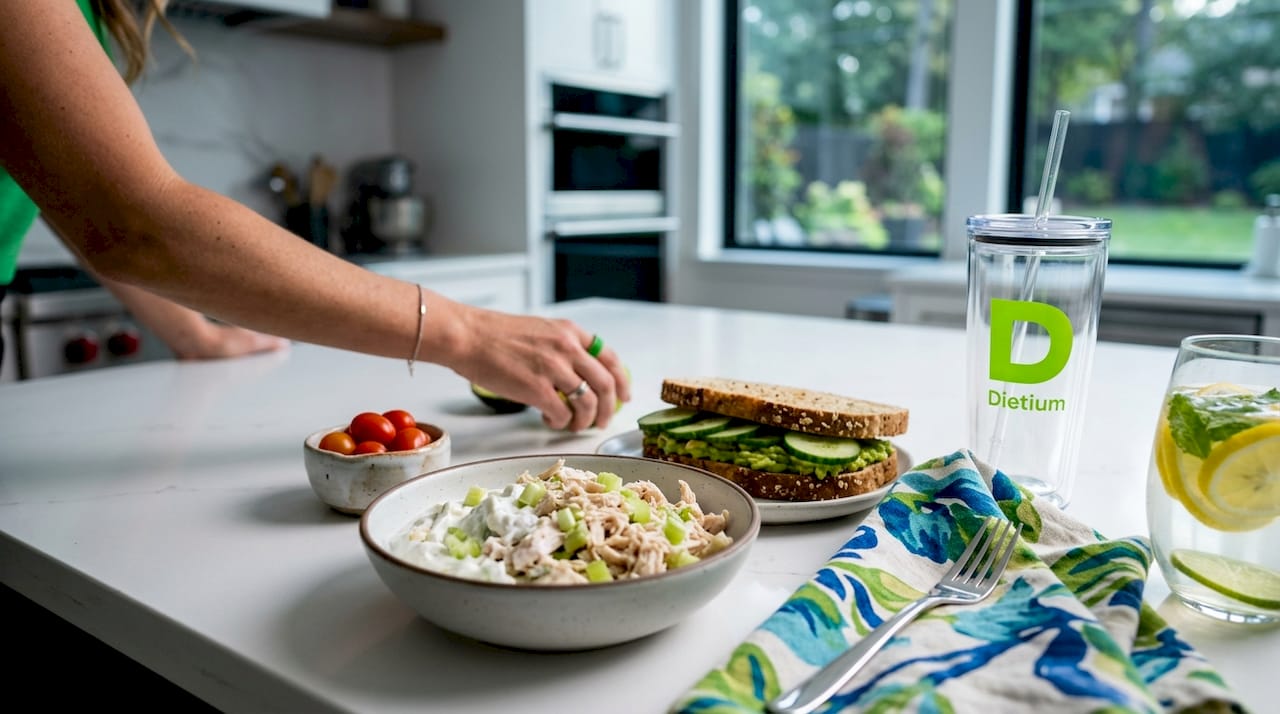
3-Ingredient Chicken Salad combines rotisserie chicken, Greek yogurt, and celery. Greek yogurt replaces mayo, cutting saturated fat while adding protein. The result is a filling, creamy salad that takes five minutes to mix and works in a wrap, on lettuce, or with whole-grain crackers.
Cucumber-Avocado Sandwich layers sliced cucumber and mashed avocado on whole-grain bread. Avocado delivers healthy monounsaturated fats that slow digestion and extend satiety. This option requires zero cooking and delivers fiber and micronutrients in one compact meal.
Dill Tuna Lettuce Wrap swaps bread for romaine lettuce leaves, reducing carbohydrate load while keeping the meal format familiar. This recipe delivers over 30 grams of protein in just over 400 calories, making it one of the most efficient weight-loss lunches available.
Key features at a glance:
- 3-Ingredient Chicken Salad: 5 minutes prep, high protein, no cooking required
- Cucumber-Avocado Sandwich: 5 minutes prep, fiber-rich, heart-healthy fats
- Dill Tuna Lettuce Wrap: 15 minutes prep, 30+ grams protein, under 500 calories
Pro Tip: Prep a batch of shredded rotisserie chicken on Sunday and store it in an airtight container. You can build the 3-Ingredient Chicken Salad in under two minutes on any weekday.
2. How to build a balanced lunch plate using MyPlate
The USDA MyPlate framework defines a balanced meal as one where half the plate holds fruits and vegetables, one quarter holds lean protein, and one quarter holds whole grains. This structure supports weight loss without requiring calorie counting, which makes it one of the most sustainable approaches for busy people.
Translating MyPlate to a real lunch means filling half your bowl with leafy greens, roasted vegetables, or sliced fruit before adding anything else. That visual commitment to volume eating naturally reduces the space available for calorie-dense foods. The remaining half splits between a protein source like grilled chicken, canned tuna, or baked tofu, and a grain like brown rice, quinoa, or a whole-grain wrap.
Fiber-rich additions amplify the satiety effect. Chickpeas, black beans, shredded cabbage, and sliced bell peppers all add bulk and slow digestion. MyPlate portioning supports weight loss without strict calorie tracking, which improves long-term adherence compared to rigid diet plans.
| MyPlate section | What to put there | Weight-loss benefit |
|---|---|---|
| Half the plate | Leafy greens, cucumber, tomato, roasted vegetables | High fiber, low calorie density |
| One quarter | Grilled chicken, tuna, tofu, legumes | Protein promotes satiety |
| One quarter | Brown rice, quinoa, whole-grain wrap | Sustained energy, fiber |
| Extras | Lemon juice, herbs, olive oil (small amount) | Flavor without excess calories |
3. Ingredient swaps that cut calories without cutting satisfaction
Calorie reduction does not require eating less food. It requires swapping high-calorie components for lower-calorie alternatives that preserve the meal’s structure and flavor. Swapping bread for lettuce wraps mechanically reduces calorie intake without compromising meal enjoyment. A standard flour tortilla adds roughly 150 calories. Two large romaine leaves add fewer than 10.
This swap works across multiple meal formats. Tuna salad, chicken salad, and even falafel all translate well into lettuce cups. The crunch of the lettuce adds texture that many people find more satisfying than soft bread. For those who need more structure, a low-calorie whole-grain wrap or a thin rice cake base are solid middle-ground options.
Other high-impact swaps worth building into your weekly rotation:
- Replace mayo with plain Greek yogurt in any creamy salad dressing or spread
- Use frozen edamame instead of croutons for protein and crunch in salads
- Swap white rice for cauliflower rice to cut carbohydrates while maintaining volume
- Choose sparkling water with lemon over juice or soda to eliminate liquid calories at lunch
Pro Tip: Keep a bag of pre-washed romaine hearts in your refrigerator at all times. They last up to a week and serve as an instant wrap, salad base, or side, cutting your lunch prep time by several minutes every day.
Meal prep amplifies these swaps. Pre-portioning and using ready-to-eat components like pre-washed salad mixes and baked tofu reduce time, improve adherence, and combine convenience with strong nutrition. Batch-cooking a grain like quinoa or brown rice on Sunday gives you a ready base for four or five lunches without any additional daily effort.
4. No-cook plant-based lunches that are dense in nutrients
No-cook lunches are the most time-efficient category of easy healthy lunches for weight loss. They require no stove, no oven, and no reheating. The best ones still deliver substantial protein and fiber, which is the combination that controls hunger most effectively.
The No-Cook Sprouts Salad with lemon dressing is a standout example. Mixed sprouts with cucumber, tomato, and lemon juice create a protein-rich, fiber-packed meal with zero cooking required. Sprouts are nutritionally dense because the germination process increases bioavailable vitamins and enzymes. Adding pumpkin seeds or sunflower seeds introduces healthy fats and additional protein without adding more than two minutes of prep.
The Chopped Salad with Sriracha Tofu and Peanut Dressing takes a slightly different approach. It delivers 27 grams of protein and 8 grams of fiber using pre-chopped greens, frozen edamame, and baked tofu. The anti-inflammatory profile of this salad comes from the combination of tofu, edamame, and dark leafy greens. That level of protein and fiber in a single meal is clinically meaningful for appetite control.
Here is a direct comparison of these two no-cook options:
| Feature | Sprouts Salad | Sriracha Tofu Chopped Salad |
|---|---|---|
| Prep time | Under 5 minutes | 10 minutes |
| Protein | Moderate (sprouts + seeds) | 27 grams |
| Fiber | High | 8 grams |
| Cooking required | None | None (uses pre-baked tofu) |
| Best for | Ultra-fast days | Higher protein needs |
Both meals are customizable. Add hemp seeds, sliced avocado, or a soft-boiled egg to either dish to increase protein and healthy fat content. For quick healthy lunch ideas that require no heat, these two options cover most nutritional bases.
5. Meal prep strategies that make consistency automatic
Consistency is the single biggest predictor of weight loss success at lunch. A default balanced lunch template assembled in under 10 minutes and remixable daily reduces decision fatigue and supports sustained adherence. Decision fatigue is real. When you are tired and hungry at noon, the path of least resistance wins. Meal prep removes that friction.
The most practical system is the “component method.” Rather than prepping full meals, you prep individual components and combine them fresh each day. Cook a large batch of quinoa or brown rice. Roast a sheet pan of mixed vegetables. Hard-boil six eggs. Wash and dry a full head of lettuce or a bag of mixed greens. Store each component separately in the refrigerator.
Each day, you assemble a different combination in under five minutes. Monday is a grain bowl with roasted vegetables and a hard-boiled egg. Tuesday is a lettuce wrap with tuna and avocado. Wednesday is a chopped salad with edamame and peanut dressing. The ingredients rotate, but the prep work is already done. This approach also works well alongside smart snack planning to keep total daily calories on track.
Protein and fiber-rich meals using convenient ingredients like pre-washed greens and frozen edamame optimize satiety and adherence for busy individuals. Frozen edamame is particularly useful because it thaws in minutes under warm water and adds 17 grams of protein per cup with no prep beyond thawing.
6. How to use the 16 five-minute lunch options for busy weekdays
EatingWell’s 16 healthy lunches that can be made in five minutes represent the upper tier of convenience for weight-loss eating. These meals are designed for weekdays when time is genuinely scarce. The common thread across all of them is reliance on pre-cooked, canned, or frozen proteins combined with fresh vegetables and a simple dressing or seasoning.
Canned tuna, canned salmon, canned chickpeas, and rotisserie chicken are the four proteins that appear most frequently in fast weight-loss lunches. Each one requires zero cooking, stores well, and delivers 20 to 30 grams of protein per serving. Pairing any of these with a pre-washed salad mix, a handful of cherry tomatoes, and a drizzle of olive oil and lemon juice produces a complete, calorie-controlled lunch in under five minutes.
The key insight from this category is that fast does not mean low-quality. A five-minute canned salmon salad over arugula with capers and lemon delivers more protein, fiber, and micronutrients than most restaurant lunches. It also costs a fraction of the price and contains none of the hidden sodium or added sugars common in takeout. For a broader set of quick and healthy lunch recipes, Dietium covers additional options suited to tight schedules.
Key takeaways
The most effective simple healthy lunch for weight loss combines at least 20 grams of protein, high-fiber vegetables, and a prep time under 15 minutes to support satiety and daily consistency.
| Point | Details |
|---|---|
| Protein and fiber drive satiety | Target 20+ grams of protein and 7+ grams of fiber per lunch to control hunger effectively. |
| MyPlate portioning simplifies decisions | Fill half your plate with vegetables before adding protein and grains to control calories without counting. |
| Lettuce wraps cut calories fast | Swapping bread or tortillas for lettuce reduces lunch calories by 100 to 150 without reducing fullness. |
| Component meal prep saves time | Prepping grains, proteins, and greens separately on Sunday enables five-minute assembly all week. |
| No-cook options are fully viable | Sprouts salad and Sriracha tofu chopped salad deliver strong nutrition with zero cooking required. |
Why simplicity beats strategy every time
After working through hundreds of meal plans and nutrition frameworks, the pattern that stands out most clearly is this: the people who lose weight and keep it off at lunch are not the ones with the most sophisticated plans. They are the ones with the most boring, repeatable ones.
The 3-Ingredient Chicken Salad is not exciting. The Dill Tuna Lettuce Wrap is not glamorous. But both deliver over 30 grams of protein in under 15 minutes, and that is what actually moves the needle. Complexity is the enemy of consistency. When a lunch requires 12 ingredients, a blender, and 40 minutes, it gets skipped the moment life gets busy.
What I have found genuinely useful is treating lunch like a system rather than a decision. Pick three or four meals you enjoy, rotate them weekly, and stop treating variety as a virtue. Your palate adapts faster than you think, and your waistline responds to consistency far more than to novelty. The MyPlate framework works not because it is scientifically perfect, but because it is simple enough to execute when you are tired, rushed, and hungry at noon.
One more thing worth saying directly: flavor matters. A healthy lunch you do not enjoy eating is a lunch you will eventually stop making. Sriracha peanut dressing, lemon and herb seasoning, and a good quality olive oil are not indulgences. They are the tools that make a sustainable eating pattern possible. Build flavor in from the start, and you will not need willpower to stay consistent.
— Srasti
Build lunches that match your specific goals
The recipes and strategies in this article work well as a starting point. But weight loss is personal. Your calorie needs, protein targets, and food preferences are different from everyone else’s, and a generic lunch plan only gets you so far. Dietium’s personalized meal plans are built around your individual goals, dietary preferences, and schedule, so every lunch recommendation is one you can actually follow. The Recipians app takes this further by generating custom recipe suggestions and tracking your nutritional intake in real time. If you want lunches that are calibrated to your body and your goals, personalize your diet with Dietium’s tools today.
FAQ
What makes a lunch good for weight loss?
A weight-loss-friendly lunch combines at least 20 grams of protein with high-fiber vegetables to promote satiety and control total calorie intake. Meals that follow the USDA MyPlate framework, with half the plate as vegetables, consistently support this goal.
How much protein should a weight-loss lunch contain?
Aim for 20 to 30 grams of protein per lunch. The Dill Tuna Lettuce Wrap delivers over 30 grams of protein at just over 400 calories, making it a strong benchmark for high-protein weight-loss lunches.
Can I lose weight eating the same lunch every day?
Yes. Repeating the same high-protein, high-fiber lunch reduces decision fatigue and improves dietary adherence, both of which are directly linked to sustained weight loss. Variety is less important than consistency when the meal is nutritionally complete.
What are the fastest no-cook lunch options for weight loss?
The No-Cook Sprouts Salad with lemon dressing and the Chopped Salad with Sriracha Tofu and Peanut Dressing are both ready in under 10 minutes with zero cooking. The Sriracha tofu salad delivers 27 grams of protein and 8 grams of fiber per serving.
Does meal prepping actually help with weight loss?
Meal prepping reduces the time and mental effort required to eat well on busy days. Pre-portioning and using ready-to-eat components like pre-washed greens and baked tofu improve adherence and reduce the likelihood of defaulting to high-calorie convenience food.


