 Skip to content

Not all carbohydrates affect your body the same way. Two foods can have identical calorie counts and similar carb totals, yet one sends your blood sugar soaring while the other barely moves the needle. Glycemic load is the metric that explains this difference. It accounts for both the quality of carbs in a food and the actual amount you eat per serving. Once you understand glycemic load, you stop guessing and start making food choices backed by real data. This guide covers what glycemic load means, how to calculate it, and how to use it for weight management and smarter daily eating.
Table of Contents
- What is glycemic load and why is it important?
- How is glycemic load calculated?
- Glycemic load vs. glycemic index: Understanding the difference
- How glycemic load impacts weight management and health
- Examples of low glycemic load foods to include in your diet
- Take your nutrition a step further with Dietium
- Frequently asked questions
Key Takeaways
| Point | Details |
|---|---|
| Glycemic load basics | Glycemic load measures the blood sugar impact of both the quality and quantity of carbs. |
| Why it matters | Understanding glycemic load helps you make smarter food choices for weight management and energy. |
| Easy calculation | You can estimate glycemic load using a simple formula for better daily planning. |
| Practical food swaps | Choosing more low-glycemic-load foods supports stable blood sugar and steady energy. |
What is glycemic load and why is it important?
Glycemic load, often abbreviated as GL, is a number that tells you how much a specific serving of food will raise your blood sugar. It builds on the concept of the glycemic index basics, which ranks foods by how quickly their carbs convert to glucose. The key difference is that GL also factors in how many carbohydrates are actually in a typical serving.
Think of it this way: the glycemic index tells you how fast a car can go. Glycemic load tells you how far it actually travels. A food might have a high speed potential, but if you only drive it a short distance, the total impact is small.
Glycemic load predicts blood sugar impact more accurately than glycemic index alone, making it a far more practical tool for real-world nutrition planning. Here is why GL matters:
- Blood sugar control: GL predicts the actual glucose response your body will have after eating a specific portion.
- Weight management: Foods with lower GL values tend to produce less insulin release, which supports fat metabolism.
- Satiety: Low-GL foods are often digested more slowly, keeping you fuller for longer.
- Meal planning accuracy: GL accounts for portion size, so it reflects how you actually eat, not just how a food performs in a lab.
“Glycemic load helps predict how a food will affect blood sugar more accurately than glycemic index alone.” — Harvard T.H. Chan School of Public Health
For a deeper look at how GI and GL compare, glycemic index vs load explained is a useful reference.
How is glycemic load calculated?
The formula is straightforward. Calculate glycemic load by multiplying the glycemic index of a food by the grams of carbohydrate in one serving, then dividing by 100.

GL = (GI x grams of carbohydrate per serving) / 100
Here is a step-by-step walkthrough using two common foods:
- Apple: GI of 36, with about 15 grams of carbs per medium apple. GL = (36 x 15) / 100 = 5.4 (low)
- White bread (1 slice): GI of 75, with about 14 grams of carbs. GL = (75 x 14) / 100 = 10.5 (medium to high)
Both foods have a similar carb count per serving, but white bread has more than double the glycemic load. That is the power of this calculation.
| Food | GI | Carbs per serving (g) | Glycemic load |
|---|---|---|---|
| Apple | 36 | 15 | 5.4 (low) |
| White bread (1 slice) | 75 | 14 | 10.5 (medium) |
| Brown rice (1 cup cooked) | 50 | 45 | 22.5 (high) |
| Watermelon (1 cup) | 72 | 11 | 7.9 (low) |
| Lentils (1 cup cooked) | 32 | 40 | 12.8 (medium) |
| Cornflakes (1 cup) | 81 | 26 | 21.1 (high) |
GL categories are generally defined as: low = 10 or under, medium = 11 to 19, and high = 20 or above. Notice that watermelon has a high GI of 72 but a low GL because a typical serving contains very few carbs. This is a critical insight for smarter eating.
Pro Tip: Always check the serving size on a nutrition label before estimating GL. Doubling your portion doubles the glycemic load, even if the food is labeled “healthy” or “natural.”
For practical guidance on applying this to daily meals, the meal planning for diabetes resource from the CDC offers solid frameworks that work for anyone, not just those managing diabetes.
Glycemic load vs. glycemic index: Understanding the difference
With the calculation in hand, it is important not to confuse glycemic load and glycemic index, as they influence food choices quite differently.
| Feature | Glycemic index (GI) | Glycemic load (GL) |
|---|---|---|
| What it measures | Speed of blood sugar rise | Total blood sugar impact per serving |
| Accounts for portion size | No | Yes |
| Best used for | Comparing food types | Planning actual meals |
| Practical for daily use | Limited | High |
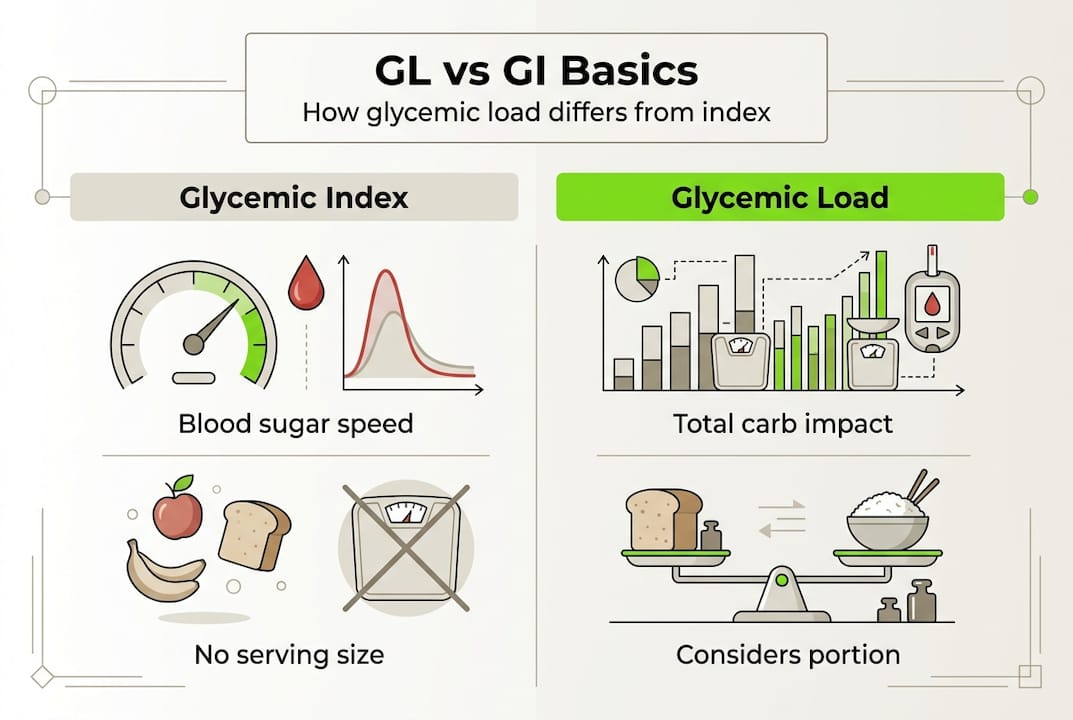
A high GI food can have low GL if its carbohydrate content per serving is low. This is one of the most misunderstood facts in nutrition. Many people avoid watermelon or carrots because of their high GI scores, but both have low GL values in normal serving sizes.
Common misconceptions worth clearing up:
- “High GI means unhealthy”: Not always. Carrots have a GI around 71 but a GL of only 3 per serving.
- “Low GI means you can eat unlimited amounts”: Wrong. Eating large portions of even low-GI foods raises total GL significantly.
- “Fruit is bad for blood sugar”: Most fruits have moderate GI but low GL per serving, making them smart choices.
- “All whole grains are low GL”: Some whole grain products still carry medium to high GL values depending on processing.
For daily meal planning, GL is the more actionable number. GI is useful for understanding a food’s general character, but GL tells you what actually happens when you sit down and eat. The glycemic index explained article covers the foundational concepts if you want to build on this comparison. For a broader framework, the low glycemic diet guide from the American Diabetes Association is a reliable resource.
How glycemic load impacts weight management and health
Applying glycemic load principles can directly improve health and make weight management easier. Low glycemic load diets support weight loss and improved blood sugar regulation, according to research from Harvard T.H. Chan School of Public Health.
Here is how GL works in your favor:
- Reduces insulin spikes: Lower GL meals trigger less insulin release, which means your body stores less fat after eating.
- Stabilizes energy: Steady blood sugar prevents the mid-afternoon energy crash that drives snacking.
- Controls hunger: Slower digestion from low-GL foods keeps appetite in check between meals.
- Supports metabolic health: Consistent low-GL eating is linked to better cholesterol levels and reduced inflammation.
For those managing weight, understanding metabolic adaptation and weight loss alongside GL principles gives you a more complete picture. If you are also tracking body metrics, the connection between BMI and diabetes risk is worth reviewing. For a broader strategy, healthy weight loss strategies outlines evidence-based approaches that pair well with GL-focused eating.
“A low-glycemic diet can help control blood sugar levels and may reduce the risk of type 2 diabetes and heart disease.” — Mayo Clinic
Pro Tip: Combine GL awareness with mindful eating. Slow down at meals, chew thoroughly, and pay attention to hunger cues. This combination amplifies the blood sugar benefits of a low-GL diet because eating speed itself affects glucose response.
For practical meal ideas that support balancing blood sugar, building your plate around low-GL foods is one of the most effective and sustainable strategies available. The low glycemic index diet overview from Mayo Clinic provides additional clinical context.
Examples of low glycemic load foods to include in your diet
Understanding the science is helpful, but making it work for you comes down to daily food choices. Non-starchy vegetables, most fruits, nuts, and legumes typically have a low glycemic load, making them reliable building blocks for any meal plan.
Here are 10 low-GL foods and meals to add to your rotation:
- Lentil soup: Filling, high in fiber, and has a GL around 7 per serving.
- Greek yogurt with berries: Protein-rich with a combined GL under 8.
- Roasted chickpeas: A crunchy snack with a GL of about 8 per half-cup.
- Steamed broccoli with olive oil: Nearly zero GL and packed with micronutrients.
- Apple slices with almond butter: GL around 6, with healthy fats that slow digestion further.
- Quinoa salad: GL of about 13 per cup, lower than white rice and far more nutritious.
- Egg and vegetable omelet: Virtually zero GL with high satiety.
- Mixed nuts: GL under 5 per ounce, ideal for between-meal hunger.
- Whole grain rye bread (1 slice): GL around 8, a smart swap for white bread.
- Baked salmon with asparagus: Zero GL, rich in omega-3s, and deeply satisfying.
Easy swaps make a real difference. Replace white rice with cauliflower rice or quinoa. Swap sugary breakfast cereals for oats or eggs. Choose whole fruit over fruit juice. For more ideas, explore nutritious dinner foods, low carb meal ideas, and healthy snack ideas to build a full day of low-GL eating.
Pro Tip: Batch-cook legumes, grains, and roasted vegetables at the start of the week. Having low-GL ingredients ready to assemble removes the temptation to reach for high-GL convenience foods when you are short on time.
For a complete reference, the glycemic load food table from Harvard lists GL values for hundreds of foods. You can also browse high volume low calorie foods for strategies that pair naturally with a low-GL approach.
Take your nutrition a step further with Dietium
Knowing your glycemic load numbers is a strong start. Putting them into a consistent, personalized eating plan is where real results happen. Dietium’s platform gives you the tools to do exactly that. Start with a nutritional assessment to understand your current dietary patterns, then use personalized meal plans built around your specific health goals, whether that is weight loss, blood sugar control, or sustained energy. The Recipians app also offers a library of healthy recipe ideas designed to make low-GL eating practical and enjoyable every day. You do not need to overhaul your diet overnight. Small, data-driven changes add up fast when you have the right support.
Frequently asked questions
What is considered a low glycemic load?
A GL of 10 or less per serving is generally considered low. Foods in this range have a minimal impact on blood sugar levels.
Can I use glycemic load for weight loss planning?
Yes. Low-GL diets support weight management by reducing blood sugar spikes and the insulin response that promotes fat storage, which also helps control hunger between meals.
Is glycemic load important for people without diabetes?
Absolutely. GL is useful for anyone looking to stabilize energy levels, manage weight, or simply build healthier eating habits, not just those managing a medical condition.
Can fruit have a high glycemic index but still be healthy?
Yes. Many fruits carry a moderate or high GI but deliver a low GL per serving because the actual carb content in a typical portion is small. Watermelon is a classic example.
How do I find the glycemic load of a food?
Use the formula: GL = (GI x grams of carbs) / 100. You can also reference published GL tables from sources like Harvard T.H. Chan School of Public Health for hundreds of common foods.


