 Skip to content

TL;DR:
- A calorie surplus is essential for muscle growth but must be carefully calculated and controlled.
- Clean bulking with nutrient-dense foods produces better muscle-to-fat ratios than dirty bulking.
- Applying a precise, moderate surplus and tracking progress optimizes gains and minimizes fat gain.
Most people assume that eating more automatically means building more muscle. That logic feels intuitive, but it misses a critical detail: your body has a ceiling for how much muscle it can build in a given period, regardless of how many extra calories you consume. Eat beyond that ceiling and you are mostly storing fat. A strategic calorie surplus, one that accounts for your training, metabolism, and macros, is what actually drives quality muscle growth. This guide breaks down what a surplus really is, how to calculate yours, and how to apply it in a way that produces real results without unnecessary fat gain.
Table of Contents
- What is a calorie surplus and why does it matter?
- How to calculate your calorie surplus: step-by-step
- Clean vs. dirty bulking: outcomes, risks, and best practices
- Personalizing your calorie surplus for results: key variables and adjustments
- Why ‘more is better’ is a myth: building muscle is a precision game
- Take your gains further with smart meal planning and tracking tools
- Frequently asked questions
Key Takeaways
| Point | Details |
|---|---|
| Calorie surplus basics | Eating above your total daily energy expenditure is essential for building muscle but must be targeted and controlled. |
| Optimal surplus size | A 250-500 calorie daily surplus typically maximizes lean muscle gains with minimal fat. |
| Personalization matters | Factors like experience, metabolism, and body type mean your ideal surplus may differ from general recommendations. |
| Clean bulking wins | Moderate, nutrient-rich surpluses outperform large, junk-heavy ones for sustained and healthy progress. |
What is a calorie surplus and why does it matter?
A calorie surplus means you are consuming more calories than your body burns each day. That daily burn total is called your total daily energy expenditure (TDEE), which covers everything from breathing and digestion to workouts and walking to your car. When intake exceeds TDEE, your body has extra fuel available. What it does with that fuel depends heavily on your training and food choices.
A calorie surplus occurs when energy intake exceeds total daily energy expenditure, providing extra fuel for muscle growth. Without it, your body has no raw material to build new tissue.
During resistance training, your muscles experience microscopic damage. Repair and growth require both protein and energy. A surplus ensures that energy is available so your body does not cannibalize muscle tissue for fuel. This process is called muscle protein synthesis (MPS), and a surplus supports it directly. Good nutrition for muscle gain keeps MPS elevated consistently.
Here is the catch: surplus calories do not automatically become muscle. The body decides how to partition those extra calories based on several factors:
- Training stimulus: Resistance training signals your body to prioritize muscle repair
- Protein intake: Adequate protein (more on this below) drives MPS rather than fat storage
- Surplus size: A moderate surplus tends to favor lean tissue; a large surplus tends to favor fat
- Hormonal environment: Testosterone, insulin, and cortisol all influence how calories are used
- Sleep and recovery: Poor sleep shifts partitioning toward fat storage
Good post-workout recovery nutrition is especially important here. Consuming protein and carbohydrates within a few hours of training maximizes the window for muscle repair. The surplus does not work in isolation. It works in combination with training, sleep, and smart food choices. Without those elements, extra calories are simply extra calories, and your body will store them efficiently.
How to calculate your calorie surplus: step-by-step
Knowing you need a surplus is one thing. Knowing exactly how large that surplus should be is where most people get stuck. Here is a straightforward process to get your number.
- Calculate your BMR. Your basal metabolic rate (BMR) is the number of calories your body burns at complete rest. Use the Mifflin-St Jeor equation: for men, BMR = (10 x weight in kg) + (6.25 x height in cm) – (5 x age) + 5. For women, subtract 161 instead of adding 5.
- Multiply by your activity factor. Sedentary (desk job, little exercise) = 1.2. Lightly active (1-3 days/week) = 1.375. Moderately active (3-5 days/week) = 1.55. Very active (hard training 6-7 days/week) = 1.725. This gives you your TDEE.
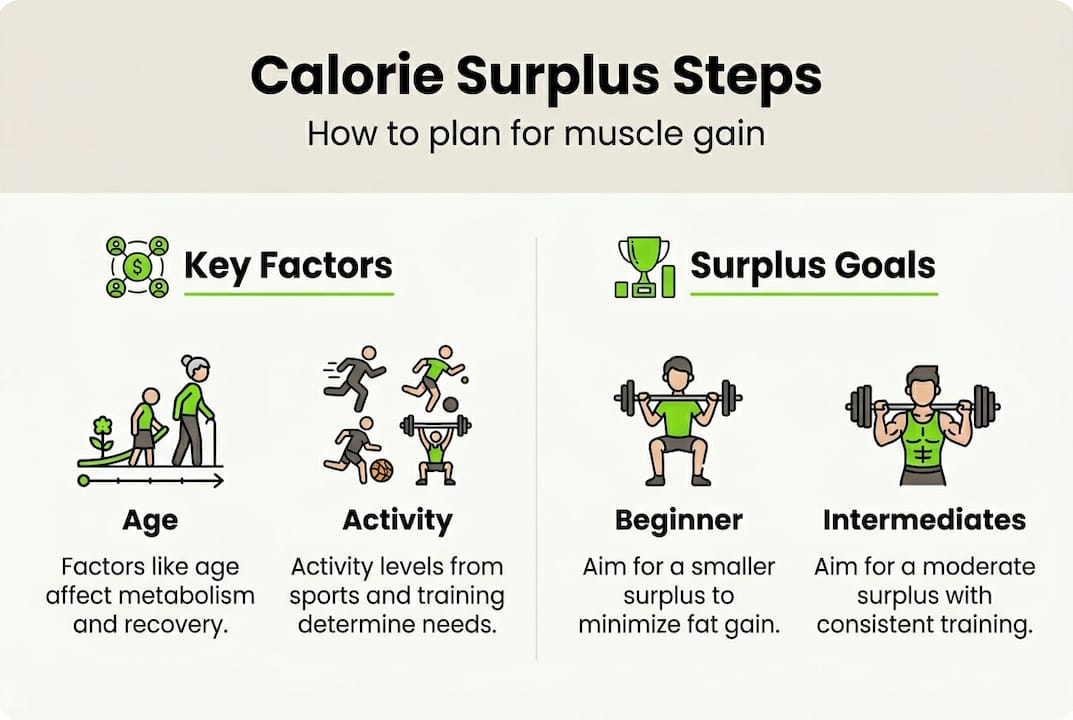
- Add your surplus. Calculate surplus by estimating TDEE then adding 5-20%, which typically equals 100-500 calories per day depending on your experience level.
- Set your macros. Aim for 0.7-1g of protein per pound of bodyweight. Fill remaining calories with carbohydrates (priority) and healthy fats (0.3-0.5g per pound of bodyweight).
Use the table below as a reference for typical surplus targets:
| Experience level | Recommended surplus | Expected weekly gain |
|---|---|---|
| Beginner (under 1 year) | 300-500 kcal/day | 0.5-1 lb |
| Intermediate (1-3 years) | 200-350 kcal/day | 0.25-0.5 lb |
| Advanced (3+ years) | 100-200 kcal/day | 0.1-0.25 lb |
You can calculate calorie intake using Dietium’s tools to get a precise baseline. Your calorie needs by age also shift over time, so revisit your numbers every 8-12 weeks.
Pro Tip: Do not round up aggressively. A 200-calorie surplus is enough to support meaningful muscle growth in most intermediate lifters. Bigger is not better here.
Clean vs. dirty bulking: outcomes, risks, and best practices
Calculating your surplus is one thing, but how you apply it, the clean versus dirty approach, makes a significant difference in your long-term results.

Clean bulking means eating a moderate surplus using nutrient-dense, whole foods. Think lean proteins, complex carbohydrates, healthy fats, and plenty of vegetables. Dirty bulking means hitting your calorie target using whatever is convenient, often processed foods, fast food, and high-sugar items.
Clean bulking yields a better muscle-to-fat ratio, easier cuts, and sustained energy, while dirty bulking results in faster short-term scale movement but significantly more fat and downstream health risks.
| Factor | Clean bulk | Dirty bulk |
|---|---|---|
| Muscle-to-fat ratio | High | Low |
| Energy levels | Stable | Variable |
| Long-term health | Favorable | Risk of metabolic issues |
| Ease of cutting phase | Easier | Harder |
| Food flexibility | Moderate | High |
When is each approach appropriate?
- Clean bulk: Best for most people, especially those who want to minimize fat gain, maintain athletic performance, and avoid a lengthy cutting phase afterward
- Dirty bulk: Occasionally useful for hardgainers (people with very fast metabolisms) who genuinely struggle to hit calorie targets with whole foods alone
- Hybrid approach: Some athletes use a mostly clean diet with planned higher-calorie meals on heavy training days
For practical bulking meal plans that support a clean approach, structure matters. Understanding the difference between a lean vs bulky body goal also shapes which strategy fits your situation. If you have a demanding schedule, nutrition for busy lifestyles can help you stay consistent without defaulting to junk food.
Pro Tip: The best bulk is the one you can maintain for 3-6 months without burning out. Sustainability beats short-term aggression every time.
Personalizing your calorie surplus for results: key variables and adjustments
With your bulk approach chosen, it is time to fine-tune for your unique needs and monitor your real-world progress.
No two people respond identically to the same surplus. Several factors shift your requirements significantly:
- Metabolism and body type: Ectomorphs (naturally lean, fast metabolism) often need larger surpluses to see scale movement. Endomorphs (tend to store fat easily) do better with smaller, tightly controlled surpluses.
- Age: Anabolic hormone levels decline with age, meaning older lifters may need more precise training and nutrition to achieve the same gains as younger individuals.
- Gender: Women generally have lower baseline muscle mass and different hormonal profiles, which affects how efficiently they partition surplus calories.
- NEAT (non-exercise activity thermogenesis): This is all the movement you do outside of formal exercise. When you eat more, some people unconsciously move less, which reduces the effective surplus. This is called adaptive thermogenesis.
Signs your surplus is too large:
- Waist measurements increasing faster than weight on the scale
- Visible fat gain in the mirror within 2-3 weeks
- Feeling sluggish or bloated consistently
- Scale jumping more than 1.5 lb per week as an intermediate or advanced lifter
Signs your surplus is too small:
- No scale movement for 2+ weeks despite consistent training
- Strength stalls or declines
- Persistent fatigue and poor recovery
Deliberate overfeeding research shows that the energy cost of weight gain is approximately 33-43 kJ per gram, and that lean mass accounts for 38-43% of weight gained during overfeeding. That means even under ideal conditions, a meaningful portion of surplus-driven weight is fat. Controlling surplus size is the primary lever for shifting that ratio.
A solid meal plan for weight gain removes the guesswork from daily eating. Stocking up on strategic high-calorie snacks also helps you hit targets without forcing large, uncomfortable meals.
Why ‘more is better’ is a myth: building muscle is a precision game
Here is the reality that most fitness content glosses over: muscle protein synthesis has a ceiling. Your body can only build so much new muscle tissue in a given week, regardless of how many extra calories you throw at it. Research on energy surplus magnitude confirms that surplus beyond the optimal range drives fat gain, not additional muscle growth. The extra calories do not unlock a faster anabolic response. They just get stored.
This matters because the fitness world often rewards visible scale progress. A dirty bulk moves the scale fast. But that number includes water, glycogen, and fat, not just muscle. Chasing scale weight without tracking body composition leads to a longer, harder cutting phase later.
Body recomposition, gaining muscle while losing fat simultaneously, is also possible for certain populations: true beginners, people returning after a long break, and those with higher body fat levels. A surplus is not always mandatory. But for trained individuals, a controlled surplus consistently outperforms maintenance calories for muscle growth.
The lean vs bulky approach debate ultimately comes down to your timeline and goals. For physique athletes and anyone who values sustainable quality gains, clean bulking with a precise surplus is the evidence-backed winner.
Pro Tip: Track body composition using measurements, progress photos, and body fat estimates, not just scale weight. The scale alone tells you very little about what is actually changing.
Take your gains further with smart meal planning and tracking tools
Applying a calorie surplus strategy consistently is where most people hit a wall. Knowing the numbers is one step. Actually hitting them day after day, across different schedules and food environments, is another challenge entirely. Dietium’s personalized meal plans take your specific surplus target and translate it into real meals you can follow. The platform’s fitness calculator tools help you dial in your TDEE, macros, and progress benchmarks with precision. And understanding the science behind why you should track food intake makes the habit stick. Less guesswork, more measurable progress.
Frequently asked questions
How big should my calorie surplus be to gain muscle without excess fat?
A surplus of 250-500 calories per day works well for most people, as 250-500 kcal/day typically yields 0.25-0.5 kg per week while favoring lean tissue over fat. Beginners can sit at the higher end; advanced lifters should aim lower.
Is it possible to build muscle on maintenance calories instead of a surplus?
Body recomposition can occur, particularly in beginners or detrained individuals, but a surplus optimizes muscle gain in trained individuals who have already adapted to resistance training.
What are signs that my calorie surplus is too large?
Rapid fat gain, consistent sluggishness, and a rising waist measurement are the clearest signals. Large surpluses increase fat gain without producing additional muscle benefit beyond the optimal range.
Are there differences in calorie surplus needs for men and women?
Yes. Women and endomorphs generally require smaller surpluses and should monitor adaptive thermogenesis and NEAT closely to avoid overshooting their target.


