 Skip to content

TL;DR:
- Eating earlier in the day enhances metabolic health, weight loss, and insulin sensitivity through circadian alignment.
- Consistent meal timing, especially finishing dinner by 6 to 8 p.m., offers significant metabolic advantages over late eating.
- Personalized, sustainable schedules aligning with biological rhythms optimize health outcomes, regardless of meal frequency.
You already know that what you eat matters. But mounting research shows that when you eat may be just as significant for your metabolic health and weight management. The importance of meal timing, studied formally under the term chrononutrition, goes well beyond habit or preference. Consistent meal timing helps your body build reliable hunger cues and supports metabolic regulation. Ignore it, and even a carefully counted calorie budget may not deliver the results you expect.
Key takeaways
| Point | Details |
|---|---|
| Early eating outperforms late eating | Shifting meals earlier in the day improves weight, insulin, and blood pressure beyond calorie restriction alone. |
| Calorie timing beats meal frequency | How often you eat matters less than when your eating window opens and closes. |
| Circadian alignment drives results | Matching meals to your body’s biological clock reduces metabolic risk regardless of diet quality alone. |
| Personalization sustains adherence | The best meal timing strategy is the one that fits your chronotype and lifestyle long term. |
| Older adults face higher stakes | Delayed meal timing correlates with greater health risks and increased mortality in aging populations. |
How meal timing shapes metabolism and health
Your body does not treat a 7 a.m. breakfast the same as a 10 p.m. dinner, even if the macros are identical. Circadian rhythms govern hormone secretion, insulin sensitivity, and fat oxidation across the 24-hour cycle. Insulin sensitivity peaks in the morning and declines significantly by evening, which means the same meal triggers a much larger glucose spike at night than it would at breakfast.

Time-restricted eating (TRE) is the structured practice of confining all food intake to a defined daily window, typically 6 to 10 hours. Research shows that TRE improves metabolic markers independent of calorie intake, meaning timing itself is an active variable, not just a proxy for eating less.
The timing of that window matters enormously. Early TRE reduced body weight by a mean difference of 1.15 kg and cut fasting insulin by 3.32 μIU/ml compared to late TRE, based on a 2026 systematic review and network meta-analysis with high-certainty evidence. Late eating, by contrast, is consistently linked to poorer glycemic control, elevated triglycerides, and blunted fat oxidation overnight.
The table below shows how early and late TRE compare across key metabolic markers.
| Metabolic marker | Early TRE | Late TRE |
|---|---|---|
| Body weight reduction | Superior (mean 1.15 kg greater loss) | Modest |
| Fasting insulin | Significantly reduced | Minimal change |
| Blood glucose | Improved | Less improved |
| LDL cholesterol | Improved with shorter windows | Variable |
| Blood pressure | Reduced | Less consistent |
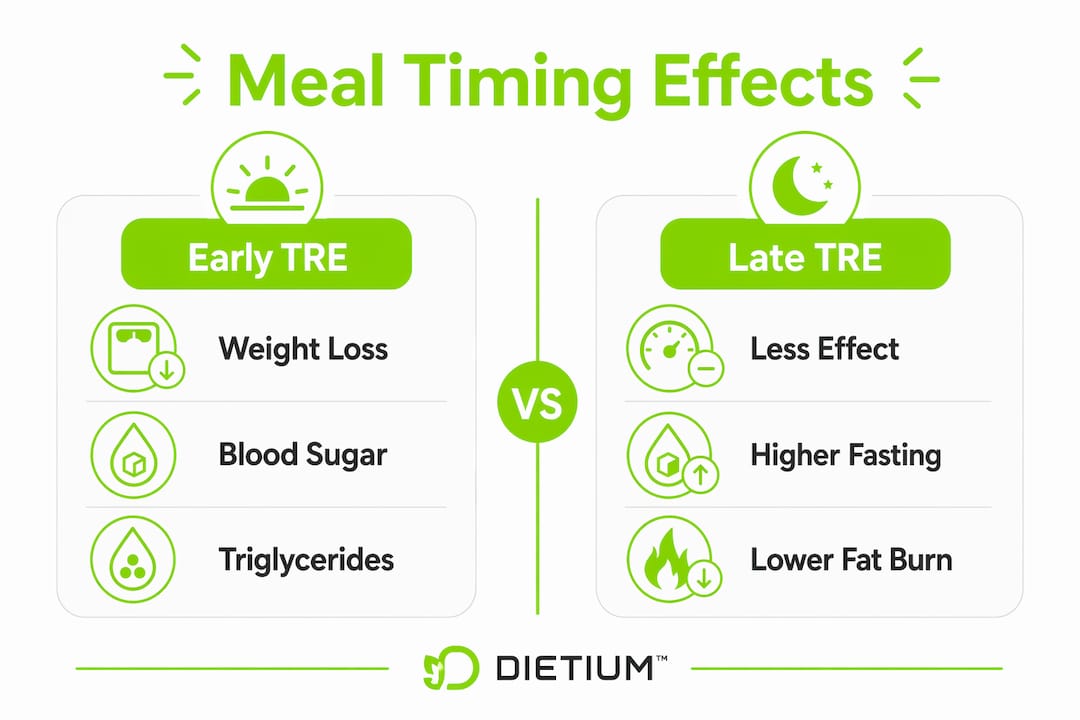
Pro Tip: Shifting your last meal earlier has a greater metabolic impact than simply moving breakfast earlier. Finishing dinner by 6 or 7 p.m. is more effective than eating a 6 a.m. breakfast but still snacking at 10 p.m.
Meal timing for weight loss: what the 2026 data says
The research is getting harder to ignore. Six months of intermittent fasting produced an 8% body weight reduction and a 16% decrease in body fat among overweight adults, along with significant improvements in LDL cholesterol and triglycerides. These results came from structured eating windows, not from dramatic calorie cuts alone.
Early and mid-day eating windows consistently outperform late eating windows for fat loss, glycemic control, and BMI reduction, according to a 2026 BMJ Medicine study. If you are timing meals for weight loss, moving your eating window to the morning or early afternoon is one of the highest-leverage adjustments you can make.
What about meal frequency? The idea that eating six small meals per day stokes your metabolism is largely a myth. Meal frequency does not significantly impact fat loss or metabolic rate when total calories are matched, per findings published in the British Journal of Nutrition. Three meals or six meals produce similar outcomes when the eating window and total intake are the same. What matters is consistency and when the window opens and closes.
Here are the most effective meal timing strategies for weight management, backed by current evidence:
- Open your eating window early. Aim to eat your first meal within 1 to 2 hours of waking to align with peak insulin sensitivity.
- Close your eating window by early evening. A cutoff between 6 and 8 p.m. supports overnight fat oxidation and reduces late-night calorie accumulation.
- Keep your window to 8 to 10 hours. Eating windows under 6 hours show the strongest weight and fat mass reductions, but 8 to 10 hours is more practical and still highly effective.
- Stay consistent day to day. Erratic meal timing disrupts hunger hormones and undermines the metabolic benefits of structured windows.
- Front-load your calories. Eat your largest meal earlier in the day. A large dinner after 8 p.m. is processed less efficiently by your metabolism.
Pro Tip: For deeper context on meal timing and weight loss, Dietium’s dedicated breakdown explains the mechanisms in detail, which is useful if you want to apply these principles to a specific fat loss goal.
Building a practical, sustainable meal schedule
Understanding chrononutrition is one thing. Applying it in a real life with work shifts, family dinners, and social obligations is another. The goal is not rigid adherence to a perfect schedule. The goal is to move your habits closer to what your biology prefers while keeping it sustainable.
Follow these steps to build a meal schedule that works with your circadian biology:
- Set a consistent wake time. Your eating window should follow your wake time by 60 to 90 minutes. If you wake at 7 a.m., aim for a first meal between 8 and 8:30 a.m.
- Schedule your largest meal at midday. Lunch is metabolically your most forgiving meal. Your insulin sensitivity is high, cortisol is at a functional level, and digestion is efficient.
- Set a firm cutoff for your last meal. Choose a time you can realistically hit on most days. Six p.m. is ideal. Eight p.m. is a practical minimum for most schedules.
- Eat at the same times on weekdays and weekends. Social jet lag from shifting meal times on weekends disrupts your circadian rhythm just like time zone changes do.
- Listen to genuine hunger cues. Consistent timing builds predictable hunger signals over time. If you are eating from boredom or stress rather than hunger, your timing structure will not function as intended.
- Adapt for late-shift work. If you work nights, align your eating window to your waking hours rather than the clock. The principle is circadian alignment, not a fixed a.m. time.
For older adults, the stakes are particularly high. Delayed breakfast timing correlates with physical and mental health conditions and increased mortality risk during follow-up periods. Eating earlier and maintaining consistency may hold as much value as any specific dietary change in supporting healthy aging. Additionally, timing protein intake strategically throughout the day becomes increasingly relevant for preserving muscle mass with age.
Special considerations and individual variation
Not everyone responds to the same eating schedule in the same way. Meal timing effectiveness depends heavily on when eating windows occur relative to individual chronotype and whether the schedule is genuinely feasible to maintain.
A few key considerations worth keeping in mind:
- Chronotype matters. Evening chronotypes (people who naturally prefer staying up and sleeping later) face a structural disadvantage because their circadian rhythm is shifted later. Forcing a strict early TRE schedule may be difficult to sustain and counterproductive if it leads to poor sleep or abandonment.
- Calorie quality still counts. Timing improvements do not cancel out poor food choices. Aligning your window is most powerful when paired with whole foods, adequate protein, and appropriate calorie targets.
- Metabolic improvements can occur without weight loss. Research confirms that TRE improves insulin sensitivity and other metabolic markers even when body weight does not change significantly, which means timing benefits extend beyond the scale.
- Flexibility beats perfection. Missing your eating window by an hour on a given day does not erase your progress. Chronic irregularity does. Aim for consistency over seven days, not obsession over any single day.
- Ongoing research continues to refine guidance. The field of chrononutrition is advancing fast, and 2026 studies are clarifying which populations benefit most from which window lengths and times.
My take: timing is the variable most people are skipping
I’ve spent a lot of time looking at what actually separates people who get lasting metabolic results from those who cycle endlessly through diets. The difference is rarely the specific food plan. It’s structure, and timing is the most underused form of structure available.
What I’ve seen work in practice is simpler than most people expect. Stop eating two to three hours before bed, eat a real breakfast within 90 minutes of waking, and keep those two anchors consistent for four to six weeks. You will likely notice changes in energy, hunger patterns, and body composition before you change a single food on your plate.
The theory that only calories matter was never the full picture. The circadian alignment research makes that clear now. What I find most useful to tell people is this: do not try to optimize your eating window and overhaul your diet simultaneously. Start with timing. Once your hunger and energy stabilize, adjusting food quality becomes far easier because your body is actually responding to hunger signals rather than fighting a disrupted metabolic rhythm.
The science is moving toward personalization. The tools to support that are already here. Use them.
— Srasti
Build your optimal meal schedule with Dietium
Knowing when to eat is powerful. Knowing what to eat within that window, personalized to your goals, is where results compound. Dietium’s personalized diet plans are built around your specific metrics, preferences, and schedule, so your eating window works with a meal structure designed for your body. The platform’s Recipians app integrates meal timing principles directly into your custom plan, from breakfast timing to pre-workout nutrition. If you want a data-driven structure that accounts for both timing and nutrition quality, Dietium’s meal plan personalization tools make it practical, not theoretical. Your biology is already optimized for early eating. Your meal plan should be too.
FAQ
What is the importance of meal timing for metabolism?
Meal timing influences insulin sensitivity, hormone release, and fat oxidation across the day. Eating earlier aligns with peak circadian metabolic function, improving blood glucose, weight, and lipid markers beyond what calorie control alone achieves.
Does it matter how many meals you eat per day?
Meal frequency has minimal impact on fat loss or metabolic rate when total calories are matched. Consistency of your eating window and the timing of your first and last meal matter far more than how many meals you fit inside it.
What is the best time to stop eating for weight management?
Research supports finishing your last meal by 6 to 8 p.m. for optimal metabolic outcomes. Earlier cutoffs align with declining insulin sensitivity in the evening and support overnight fat oxidation.
How does meal timing affect older adults differently?
Later breakfast timing in older adults correlates with increased physical and mental health conditions and higher mortality risk. Consistent, earlier meal timing is particularly important for healthy aging and should be a priority for this population.
Can meal timing improve health without changing what I eat?
Yes. Studies show that time-restricted eating improves metabolic markers independently of calorie restriction, meaning that shifting your eating window earlier can produce measurable health benefits even before you change the content of your diet.


