 Skip to content

TL;DR:
- AI meal plans tailor nutrition to individual preferences and health data, improving adherence and outcomes.
- Research shows personalized AI plans lead to greater weight loss, better metabolic health, and reduced food waste.
- Limitations include potential micronutrient gaps; a hybrid approach with dietitian input enhances safety and accuracy.
Most meal plans fail not because people lack willpower, but because the plan itself was never built for them. Generic calorie targets and one-size-fits-all food guides ignore your metabolism, food sensitivities, fitness goals, and daily schedule. Personalized AI nutrition programs outperform general dietary advice in randomized controlled trials, showing measurably greater health improvements. AI-driven meal planning changes that equation by analyzing your unique health profile and generating plans that actually fit your life. This article covers the science, the real-world results, the limitations, and the exact steps to use AI for smarter, more sustainable eating.
Table of Contents
- How AI personalizes meal planning
- The science: Real-world results of AI-guided meal planning
- Common pitfalls and limitations to watch for
- How to use AI for smarter, sustainable meal planning
- The real promise and future of AI meal planning
- Upgrade your meal planning journey with expert support
- Frequently asked questions
Key Takeaways
| Point | Details |
|---|---|
| True personalization matters | AI-driven meal planning tailors strategies to your health needs better than generic advice. |
| Data powers better diets | Modern AI considers your food habits, health markers, and goals for precision guidance. |
| Mind AI’s limits | Most AI tools still need reviewing for micronutrients and may not be perfect for every age group. |
| Get practical with AI | Follow a step-by-step approach and combine AI suggestions with your preferences for lasting results. |
| AI means less waste | Smarter planning with AI dramatically cuts food waste and saves money. |
How AI personalizes meal planning
True personalization goes far beyond asking whether you prefer chicken or tofu. Modern AI meal planning platforms pull together multiple data streams to build a nutritional picture that’s specific to you.
Here’s how the process typically works:
- Data collection: You input your dietary preferences, food allergies, health conditions, fitness goals, and activity level. More advanced platforms also connect to wearable devices to pull real-time data like steps, heart rate, and sleep quality.
- Needs analysis: The AI calculates your macronutrient targets (protein, carbohydrates, and fat), calorie needs, and micronutrient requirements based on your profile.
- Plan generation: The system generates a weekly meal plan with recipes, portion sizes, and a grocery list tailored to your targets.
- Ongoing adaptation: As you log meals and track progress, the AI adjusts future recommendations to reflect what’s working and what isn’t.
What separates advanced platforms from basic apps is the depth of data integration. Precision nutrition tools can incorporate continuous glucose monitors (CGMs) and microbiome data to deliver superior, ongoing recommendations that a generic chatbot simply cannot match. A CGM, for example, shows how your blood sugar responds to specific foods, allowing the AI to flag meals that spike your glucose even if those meals are considered “healthy” by general standards.
You can explore personalized meal plans that align with specific health goals to see how this level of customization translates into practical, day-to-day eating strategies.
“The future of nutrition isn’t about eating less. It’s about eating right for your biology.” This idea drives the shift from population-level dietary guidelines to individual-level AI guidance.
Pro Tip: Choose an AI platform that updates your plan based on logged meals and biometric feedback. Static plans lose effectiveness within weeks as your body adapts and your goals evolve.
The science: Real-world results of AI-guided meal planning
Knowing how AI personalizes plans is useful. Knowing what actually happens to your body when you follow one is more useful.
Research backs the results. RCT participants using AI meal plans showed greater reductions in triglycerides, more weight loss, and improved mood and sleep quality compared to those following generic dietary advice. These aren’t small differences. They reflect what happens when a plan is built around your data instead of a population average.
| Outcome | AI-personalized plan | Standard dietary advice |
|---|---|---|
| Weight loss | Significantly greater | Modest |
| Triglyceride reduction | Clinically meaningful | Minimal |
| Mood improvement | Reported by majority | Inconsistent |
| Sleep quality | Improved | No change |
| Plan adherence | Higher long-term | Drops within weeks |
Beyond clinical trials, practical benefits show up quickly:
- Energy levels stabilize because macros are matched to your activity output.
- Adherence improves because the plan includes foods you actually like.
- Health markers like blood pressure and fasting glucose respond to targeted dietary changes.
- Food waste drops because grocery lists are generated for exactly what you need.
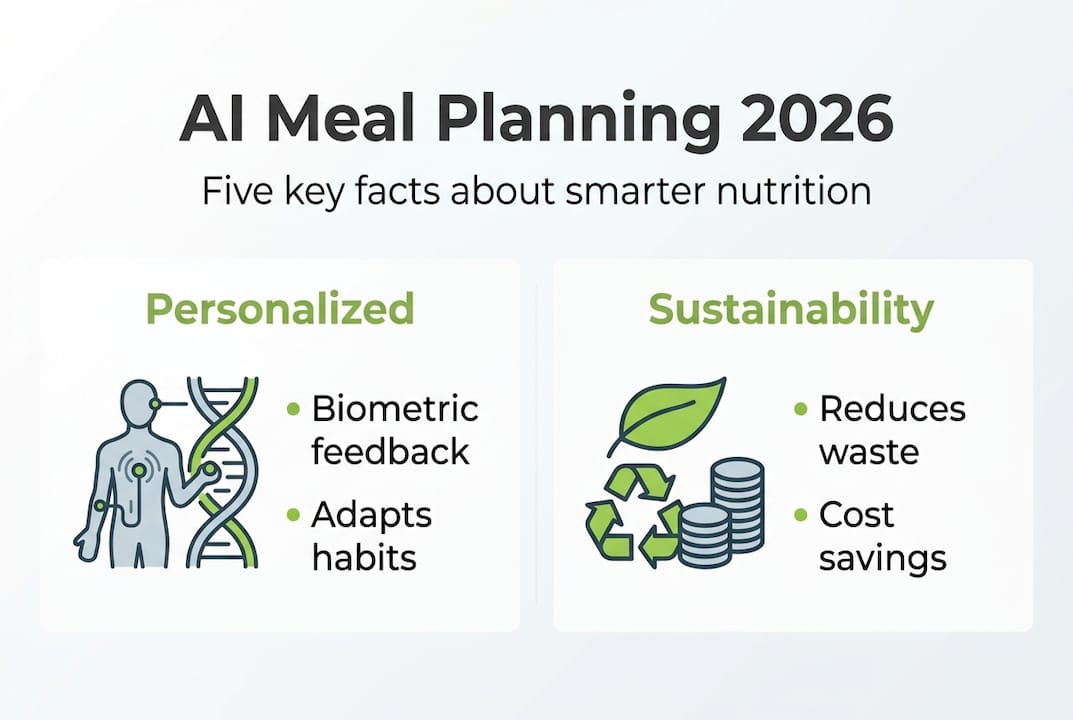
On that last point, the numbers are striking. AI-based nutrition programs reduce food waste by 30 to 60% and can match your daily nutrient targets within 5%. That’s a level of precision that’s nearly impossible to achieve manually.
Understanding evidence-based nutrition helps you evaluate which AI claims are grounded in research and which are marketing. Pairing that knowledge with solid nutritional assessment methods gives you a framework for tracking whether your AI plan is actually delivering results.
Common pitfalls and limitations to watch for
AI meal planning delivers real results, but it is not perfect. Expecting it to be sets you up for frustration.
One of the most documented issues involves nutrient accuracy. AI tools can underestimate calorie needs in adolescents by nearly 700 kcal per day and frequently miss key micronutrients like iron, calcium, and vitamin D. These gaps matter, especially if you have specific health conditions, follow a restrictive diet, or are in a life stage with elevated nutrient demands.
Here’s where most AI tools fall short:
- Underestimating energy needs for active individuals or growing teens
- Missing iron and calcium targets for plant-based eaters
- Failing to account for vitamin D needs in low-sunlight climates
- Ignoring cultural food preferences, making plans impractical to follow
- Lacking memory between sessions in general chatbots, which resets your context each time
| Approach | Strengths | Weaknesses |
|---|---|---|
| AI meal planner | Fast, scalable, data-driven, cost-effective | May miss micronutrients, lacks clinical judgment |
| Registered dietitian | Clinical expertise, personalized counseling, medical context | Time-intensive, costly, limited availability |
| Hybrid approach | Combines AI efficiency with human oversight | Requires access to both tools and professionals |
The hybrid approach wins for most people with specific health goals. Use AI to generate the structure and save time, then review the plan with a nutrition professional for accuracy. You can also cross-check your plan using reliable nutritional assessment accuracy tools to catch gaps before they become problems.
For a side-by-side breakdown of available tools, the AI meal planning tool comparison at Dietium covers the key differences across leading platforms.
Pro Tip: If you have elevated iron needs, follow a vegan diet, or are under 18, always have a registered dietitian review your AI-generated plan before committing to it long-term.
How to use AI for smarter, sustainable meal planning
Knowing the technology’s limitations, you can maximize benefits by following a few proven steps.

The digital personalized nutrition market is projected to surpass $1.5 billion by 2029, driven by smarter tools and outcomes like reduced food waste and higher adherence rates. That growth reflects real demand. More people are finding that AI-powered planning saves time, reduces decision fatigue, and produces measurable results when used correctly.
Here are five steps to get the most out of AI meal planning:
- Choose the right platform. Look for tools that integrate with your fitness tracker, allow biometric input, and update recommendations over time. Avoid static plan generators that don’t adapt.
- Set specific, measurable goals. “Eat healthier” is too vague. Define targets like losing 10 pounds in 12 weeks, reducing sodium intake, or hitting 130g of protein daily.
- Track consistently. Log every meal, even imperfect days. The AI learns from your actual behavior, not your ideal behavior. Honest tracking produces better recommendations.
- Review results every two to four weeks. Check whether your health markers, energy, and weight are moving in the right direction. Adjust your goals in the platform if needed.
- Update your profile regularly. Life changes. A new workout routine, a health diagnosis, or a seasonal shift in food availability should all trigger a profile update.
Avoid these common mistakes when getting started:
- Entering incomplete health data to speed up setup
- Ignoring the grocery list and improvising at the store
- Expecting instant results within the first week
- Treating the AI plan as fixed rather than a starting point
- Skipping the micronutrient review if you have dietary restrictions
Adapting your plan to your cultural food preferences and budget is also critical. Meal planning automation works best when you input realistic constraints, not idealized ones. For practical strategies that complement your AI plan, meal planning tips can help you build habits that stick beyond the algorithm.
The real promise and future of AI meal planning
Most articles focus on whether AI can generate a “perfect” meal plan. That’s the wrong question.
No algorithm produces a perfect diet. What AI does exceptionally well is reduce the friction between knowing what you should eat and actually eating it. It handles the calculation, the variety, the grocery list, and the macro tracking so you don’t have to. That’s where its real value sits.
The people who get the best results from AI meal planning aren’t the ones who follow the plan rigidly. They’re the ones who use it as a starting point, experiment with what works for their body, and adjust based on how they feel. AI gives you a framework. Your lived experience fills in the gaps.
We also think the obsession with algorithmic precision misses something important: consistency beats perfection every time. An 85% adherent plan you can sustain for six months beats a technically perfect plan you abandon in three weeks. Evidence-based nutrition supports this. The goal is a pattern of eating that improves your health over time, not a flawless day of macros.
Let AI do the heavy lifting for structure and ideas. Then personalize the final plan with your own preferences, cultural context, and intuition.
Upgrade your meal planning journey with expert support
Ready to get real, lasting results with AI-powered meal planning? Dietium brings together the tools you need in one place.
Personalized Meal Plans at Dietium are built around your goals, lifestyle, and health markers, not generic population averages. The platform’s Meal Planning Automation saves you time on grocery lists, recipe selection, and macro tracking so you can focus on eating well. Pair that with Dietium’s Nutritional Assessment Methods to verify your plan is hitting the right targets for your specific needs. Whether you’re just starting out or optimizing an existing routine, Dietium gives you evidence-based, practical tools to make AI-powered nutrition work in your real life.
Frequently asked questions
Is AI meal planning accurate for all ages and dietary needs?
AI tools are improving rapidly but still have documented gaps, particularly for adolescents and individuals with elevated micronutrient needs. Research shows AI can underestimate nutrients in adolescents and miss key minerals, so a dietitian review is advisable for these groups.
Can using AI really help me lose weight or improve my health?
Yes, with the right platform and consistent tracking. RCTs confirm better results for AI-personalized plans compared to standard dietary guidance, including greater weight loss and improved blood lipids.
What data does an AI meal planner need?
Most platforms require your dietary preferences, health goals, allergies, and activity level at minimum. More advanced tools benefit from integrating continuous health data like CGM readings or microbiome results for higher precision.
How does AI meal planning reduce food waste?
AI platforms generate grocery lists matched exactly to your weekly meal plan, eliminating over-purchasing. Food waste drops by 30 to 60% with AI-optimized planning compared to unstructured grocery shopping.


