 Skip to content

TL;DR:
- Stress eating occurs when emotional triggers lead to food cravings driven by cortisol.
- Effective solutions target both biological hunger and emotional triggers, not just willpower.
Stress eating, clinically called emotional eating, is defined as consuming food in response to emotional triggers rather than physical hunger. Cortisol, the body’s primary stress hormone, drives cravings for high-fat, high-sugar foods by activating the brain’s reward system. The result is a cycle that feels impossible to break without the right tools. Effective stress eating solutions address both the biological and emotional sides of the problem. Relying on willpower alone fails consistently because chronic stress depletes the mental resources needed for self-regulation. The strategies in this article are grounded in evidence, not guilt.
What are the best stress eating solutions?
Stress eating solutions work best when they target the root cause, not just the behavior. The first step is always the same: figure out whether your body actually needs food or whether your mind is seeking comfort.
How to distinguish biological hunger from emotional hunger
Biological hunger builds gradually over 4–6 hours after your last meal. It produces a general appetite, meaning your body will accept almost any food. Emotional hunger tends to arrive suddenly, targets specific comfort foods, and often persists even after eating a full meal.
A practical test called the “apple test” cuts through the confusion fast. Ask yourself: would I eat an apple or a handful of raw vegetables right now? If the answer is no, hunger is likely emotional, not biological. This single question creates a moment of awareness that interrupts the automatic reach for chips or cookies.
Ignoring biological hunger makes emotional eating worse. When blood sugar drops, impulse control weakens and cravings intensify. Eating at consistent intervals of 4–6 hours stabilizes blood sugar and reduces the urgency behind stress-driven urges. Skipping meals is not a neutral act. It sets the stage for the exact reactive eating you are trying to avoid.
- Biological hunger: Gradual onset, flexible food preferences, stops when full
- Emotional hunger: Sudden onset, craves specific comfort foods, persists past fullness
- Mixed hunger: Physical hunger amplified by stress, requires both food and emotional coping
Pro Tip: Before opening the fridge during a stressful moment, drink a full glass of water and wait five minutes. Dehydration mimics hunger signals and can trigger unnecessary snacking.
How do mindful interruption techniques reduce stress eating?
Food acts as comfort, distraction, or sedation during stress. That function is largely unconscious, which is why awareness-based techniques are so effective. They create a gap between the impulse and the action.
The most evidence-backed method is the “pause and breathe” approach. Taking three slow, deep breaths activates the parasympathetic nervous system, the part of your nervous system responsible for rest and digestion. This 30–60 second buffer is enough to shift from reactive to intentional behavior. It does not require meditation experience or a quiet room. You can do it at your desk, in your car, or standing in front of the refrigerator.
Here is a simple sequence to practice:
- Notice the urge. Acknowledge that you feel the pull toward food without judging it.
- Pause for 30 seconds. Set a phone timer if needed. Do not act on the urge yet.
- Take three deep breaths. Inhale for four counts, hold for four counts, exhale for six counts.
- Name the emotion. Say or write down what you are actually feeling: anxious, bored, frustrated, or overwhelmed.
- Choose consciously. Decide whether to eat, and if so, what and how much.
Journaling pairs well with this sequence. Writing two or three sentences about your emotional state before eating builds emotional trigger awareness over time. Patterns become visible within a week. You may notice that stress eating spikes on Sunday evenings or after certain types of meetings. That data gives you a target.
Pro Tip: Keep a small notebook near your kitchen. A two-sentence entry before stress eating episodes creates a paper trail of your triggers, which is far more useful than trying to recall patterns from memory.
What should you eat during stressful times?
Choosing better foods during stress is not about perfection. It is about nutritional mitigation, which means reducing the damage to stress-driven eating while still meeting the sensory need for comfort.

Ultra-processed snacks deliver a short dopamine spike followed by a blood sugar crash, which worsens anxiety and fatigue. Replacing them with nutrient-dense options satisfies the craving without the crash. Air-popped popcorn provides the crunch of chips with far more fiber. Cucumber slices with hummus deliver the same satisfying texture with added protein and fat to increase fullness. Apple slices with almond butter hit the sweet-and-creamy combination that many stress eaters crave.
| Stress Craving | Better Alternative | Why It Works |
|---|---|---|
| Salty chips | Air-popped popcorn | High fiber, satisfying crunch, low calorie density |
| Sugary candy | Apple slices with almond butter | Natural sugar plus protein and fat for satiety |
| Ice cream | Greek yogurt with berries | Protein-rich, probiotic, satisfies cold and creamy texture |
| Cookies | Oat-based energy balls | Complex carbs, slower blood sugar release |
| Fast food | Pre-portioned nuts and cheese | Portable, protein-dense, no preparation needed |
After a stress-eating episode, the recovery strategy matters as much as the episode itself. Hydration and fiber reset digestive rhythm faster than fasting or restriction. Herbal teas, water-rich vegetables, and whole grains help the gut recover without adding stress. Skipping the next meal as punishment is counterproductive. It primes your body for stronger cravings at the next stressful moment.
- Pair every snack with protein or healthy fat to extend satiety
- Keep pre-portioned snacks visible and processed foods out of easy reach
- Eat slowly and without screens to register fullness signals accurately
How do you build habits that prevent stress eating long term?
Sustainable change requires environment design, not discipline. Willpower is a depleting resource, especially under chronic stress. The goal is to make the healthy choice the easy choice before stress hits.
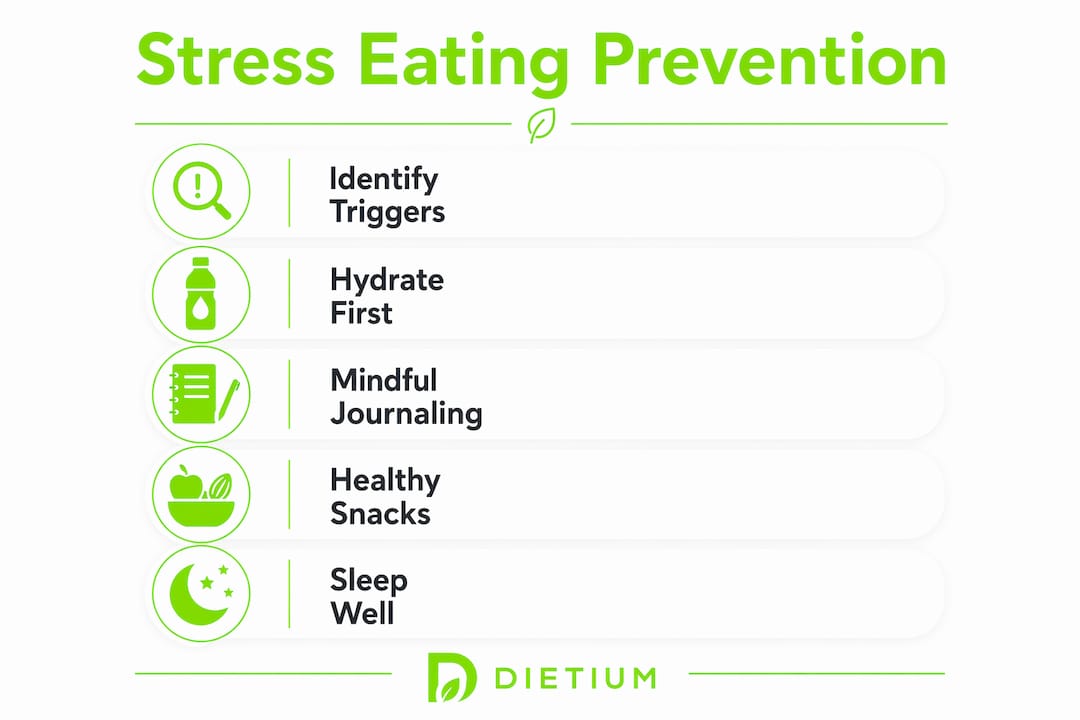
Regular meal timing is the single most effective structural habit. Eating at consistent times prevents the blood sugar dips that amplify stress-eating urges. A blood sugar-stabilizing meal pattern also reduces cortisol spikes, which directly lowers the biological drive to seek comfort food.
Non-food coping tools are equally critical. Physical activity, even a 10-minute walk, reduces cortisol and provides the sensory regulation that stress eaters seek from food. Other effective alternatives include:
- Movement: Walking, stretching, or a short workout shifts the body’s stress response
- Social connection: Calling a friend or family member addresses loneliness-driven eating
- Sensory comfort: Warm showers, massage, or weighted blankets meet the physical comfort need
- Mindfulness practices: Five minutes of guided meditation lowers acute stress faster than most snacks
Sleep deprivation is an underrated stress-eating trigger. Poor sleep raises ghrelin, the hunger hormone, and lowers leptin, the satiety hormone. Prioritizing 7–9 hours of sleep per night reduces next-day cravings significantly. Fatigue and stress compound each other, and food becomes the fastest available energy source when both are present.
Restricting food after a binge worsens the cycle. Self-imposed restriction triggers a physiological stress response, which increases the likelihood of a stronger binge at the next stressful event. The more effective approach is to return to your normal eating pattern at the very next meal, without guilt or compensation.
When should you seek professional help for emotional eating?
Professional support is appropriate when stress eating feels uncontrollable, occurs multiple times per week, or causes significant distress. These signs indicate that the behavior has moved beyond occasional stress response into a pattern that requires structured intervention.
Counseling increases awareness of emotional triggers and builds coping skills that food cannot provide. Cognitive behavioral therapy, in particular, targets the thought patterns that drive emotional eating. A registered dietitian addresses the nutritional side, creating meal structures that reduce biological vulnerability to stress-driven cravings.
- Seek help if: Stress eating happens most days of the week
- Seek help if: You feel shame, guilt, or loss of control after eating episodes
- Seek help if: You use food to cope with trauma, anxiety, or depression
- Seek help if: Physical health markers like weight, blood sugar, or energy are declining
The stigma around seeking help for eating behaviors is real but unfounded. Emotional eating is a learned coping mechanism, not a character flaw. A trained professional provides the integrated behavioral and nutritional approach that self-help strategies alone cannot replicate. Peer support groups and online communities also reduce isolation, which is one of the most common triggers for stress-driven eating.
Key Takeaways
Effective stress eating management requires addressing both biological hunger patterns and emotional triggers, not willpower alone.
| Point | Details |
|---|---|
| Identify hunger type first | Use the apple test to distinguish emotional from biological hunger before eating. |
| Use the pause-and-breathe method | Three deep breaths activate the parasympathetic nervous system and interrupt reactive eating. |
| Choose nutritional mitigation | Replace ultra-processed snacks with fiber, protein, and healthy fat combinations. |
| Design your environment | Consistent meal timing and non-food coping tools reduce stress eating triggers structurally. |
| Get professional support when needed | Counseling and registered dietitians provide integrated help when patterns feel uncontrollable. |
What I’ve learned about stress eating that most articles get wrong
Srasti here. After years of working in health and nutrition content, the most persistent myth I encounter is that stress eating is a willpower problem. It is not. It is a nervous system problem wearing a food costume.
The people I see struggle most are not weak or undisciplined. They are chronically under-nourished, sleep-deprived, and running on cortisol. Their bodies are doing exactly what biology designed them to do under threat: seek fast energy. Blaming yourself for that response is like blaming your eyes for watering in smoke.
What actually works, in my experience, is building the structure before the stress arrives. That means eating on a schedule, keeping satisfying foods accessible, and having two or three non-food coping tools you genuinely enjoy. Not tools you think you should enjoy. Tools you will actually use at 9 PM on a hard Tuesday.
The other thing most articles skip: recovery matters more than prevention. You will have stress-eating episodes. The question is what you do in the 24 hours after. Returning to normal eating without restriction or punishment is the single most protective behavior you can practice. Self-kindness is not soft advice. It is the mechanism that breaks the cycle.
— Srasti
Dietium’s approach to managing stress and eating patterns
Personalized nutrition is one of the most effective structural tools for reducing stress-driven eating. When your meals are timed, portioned, and built around your specific hunger signals and goals, the biological conditions for stress eating become far less frequent. Dietium’s personalized diet plans are built around individual calorie needs, blood sugar balance, and food preferences, giving you a consistent eating framework that holds up under pressure. The platform’s nutritional assessment tools identify gaps in your current diet that may be amplifying stress-related cravings. Consistent, satisfying meals are not a luxury. They are the foundation of any lasting approach to managing emotional eating.
FAQ
What is the fastest way to stop a stress-eating urge?
Take three slow deep breaths before eating anything. This activates the parasympathetic nervous system and creates a 30–60 second pause that interrupts the automatic stress-eating response.
How do I know if my hunger is emotional or physical?
Apply the apple test: if you would not eat a plain piece of fruit or a vegetable right now, your hunger is most likely emotional rather than biological.
Should I skip meals after a stress-eating episode?
No. Restricting food after a binge triggers a physiological stress response that worsens future cravings. Return to your normal meal pattern at the next scheduled meal without compensation.
What foods help reduce stress-eating cravings?
Fiber-rich, protein-paired snacks like air-popped popcorn, Greek yogurt with berries, or apple slices with almond butter satisfy cravings without the blood sugar crash that follows ultra-processed foods.
When does stress eating require professional help?
Seek support from a counselor or registered dietitian when stress eating occurs most days of the week, causes significant distress, or feels completely outside your control.


