 Skip to content

TL;DR:
- Vegans can meet their calcium needs by choosing high-absorption plant foods like kale, bok choy, and calcium-set tofu. Regularly consuming fortified plant milks, tahini, and chia seeds helps fill the daily requirement efficiently. Combining these foods across meals and ensuring adequate vitamin D intake maximizes calcium absorption and bone health.
Vegan calcium sources are defined as plant-based and fortified foods that deliver the mineral calcium without any animal products. The RDA for calcium is 1,000 mg per day for adults aged 19–50 and 1,200 mg per day for women over 51 and men over 70. Calcium supports bone density, muscle contraction, and nerve signaling. Meeting these targets on a plant-based diet is entirely achievable. The key is knowing which foods deliver the most calcium and how well your body actually absorbs it.
What are the top vegan calcium sources by milligram content?
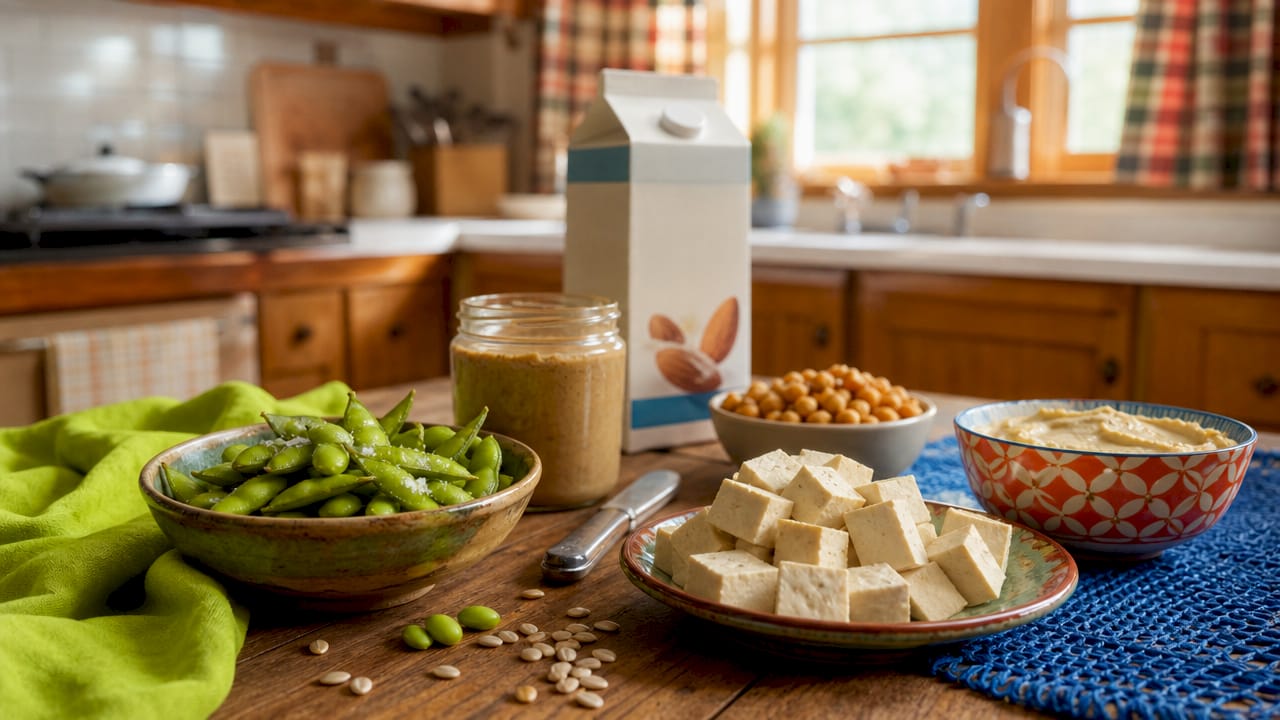
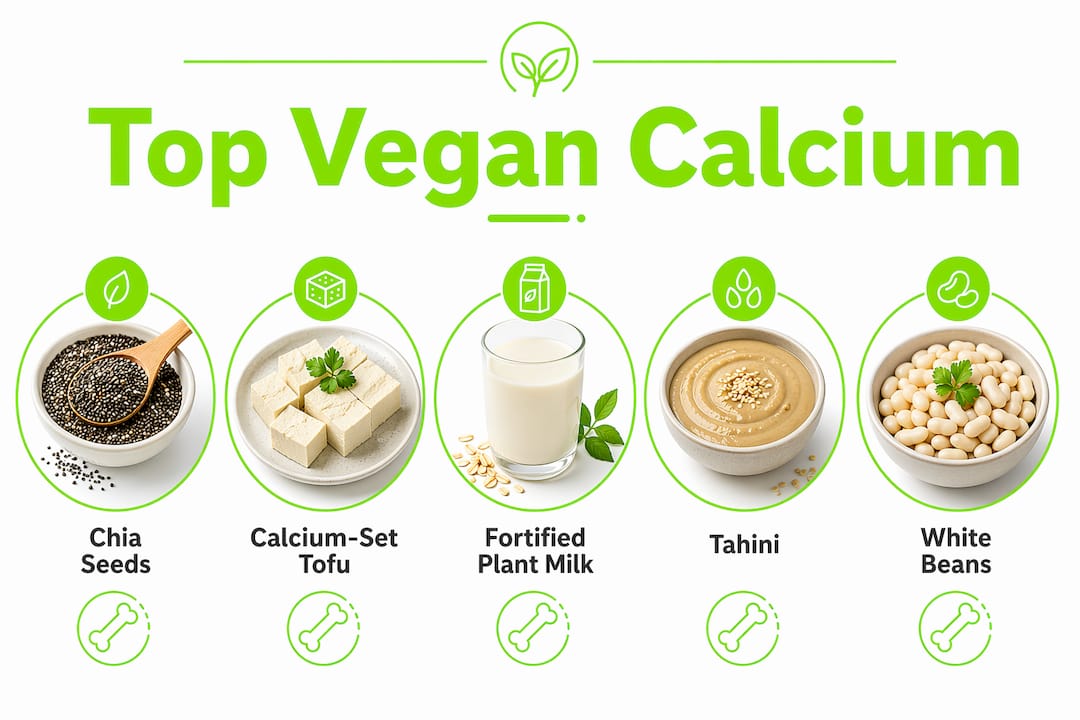
The richest plant-based calcium sources are chia seeds, tahini, calcium-set tofu, fortified plant milks, and white beans. These five foods alone can cover a large portion of your daily target when used consistently across meals.
Chia seeds deliver approximately 631 mg of calcium per 100g, making them one of the most concentrated plant sources available. Two tablespoons added to oatmeal or a smoothie contribute roughly 180 mg. Tahini, the sesame seed paste used in hummus and dressings, provides around 426 mg per 100g. A two-tablespoon serving adds close to 130 mg with almost no effort.
Calcium-set tofu is a standout non-dairy calcium option. Tofu processed with calcium sulfate delivers 250–350 mg of calcium per 100g. The coagulant type matters: only tofu made with calcium sulfate or calcium chloride contributes meaningful calcium. Always check the label. Fortified plant milks, including oat, soy, and almond varieties, typically provide around 300 mg per cup, comparable to cow’s milk. White beans round out the list at approximately 130 mg per 100g, and they work well in soups, stews, and grain bowls.
| Food | Calcium per serving | Serving size |
|---|---|---|
| Chia seeds | ~180 mg | 2 tablespoons (30g) |
| Tahini | ~130 mg | 2 tablespoons (30g) |
| Calcium-set tofu | ~250–350 mg | 100g |
| Fortified plant milk | ~300 mg | 1 cup (240ml) |
| White beans | ~130 mg | 100g (cooked) |
| Kale (cooked) | ~180 mg | 1 cup |
| Bok choy (cooked) | ~160 mg | 1 cup |
Nuts and seeds like almonds and sesame seeds also contribute meaningfully. Almonds provide around 75 mg per ounce. Leafy greens like kale and bok choy are particularly valuable because of their absorption advantage, which the next section covers in detail.
Pro Tip: Blend tahini into salad dressings or stir it into soups. It adds calcium without changing the flavor profile of most dishes.
How does calcium bioavailability vary among vegan foods?
Bioavailability is more critical than total calcium content. A food can be high in calcium on paper but deliver very little to your bones if absorption is blocked by natural compounds called oxalates or phytates.
Spinach is the clearest example of this gap. Spinach absorbs at only about 5% due to its very high oxalate content. That means a cup of cooked spinach with 245 mg of calcium delivers fewer than 15 mg of usable calcium. Swiss chard has a similar problem. Relying on these vegetables as primary calcium sources is a common and costly mistake.
Low-oxalate greens tell a completely different story. Kale and bok choy absorb at 50–60%, outperforming even fortified plant milks, which absorb at around 30%. This means a cup of cooked kale can deliver more usable calcium than a glass of fortified oat milk, even if the oat milk lists a higher total milligram count on the label. Diversifying your greens is not just variety for its own sake. It directly affects how much calcium your body actually uses.
- Low-oxalate, high-absorption greens: kale, bok choy, broccoli, napa cabbage, mustard greens
- High-oxalate, low-absorption greens to limit as calcium sources: spinach, Swiss chard, beet greens
- Fortified foods: absorb at approximately 30%, similar to dairy
- Calcium-set tofu: absorbs at a rate comparable to fortified foods
Vitamin D is the other major factor. Vitamin D enhances calcium absorption at the intestinal level, and without adequate levels, even a calcium-rich diet underperforms. Vegans should get vitamin D through safe sun exposure, fortified foods, or a D3 supplement derived from lichen.
Pro Tip: Pair calcium-rich meals with a vitamin D source. A bowl of calcium-set tofu stir-fry with bok choy eaten after 20 minutes of midday sun exposure is a genuinely effective combination.
How to plan vegan meals to meet your daily calcium target
Spreading calcium intake across three or more meals improves absorption and reduces the risk of falling short by the end of the day. Distributing calcium-dense foods across meals increases overall intake efficiency because the body absorbs calcium more effectively in smaller doses than in one large serving.
A practical daily structure looks like this:
- Breakfast: Oatmeal made with fortified soy milk (300 mg) topped with two tablespoons of chia seeds (180 mg). Total: approximately 480 mg.
- Lunch: A grain bowl with cooked white beans (130 mg), a tahini dressing (130 mg), and a side of cooked bok choy (160 mg). Total: approximately 420 mg.
- Dinner: A stir-fry with calcium-set tofu (300 mg) and broccoli (60 mg). Total: approximately 360 mg.
That structure delivers over 1,200 mg across three meals, meeting the higher RDA target for older adults. Younger adults targeting 1,000 mg have even more flexibility. For balanced vegan meal ideas that incorporate these principles, planning tools make the process faster and more consistent.
Reading nutrition labels correctly is a skill that pays off. Foods showing 20% or more of the Daily Value for calcium per serving are considered strong contributors. The Daily Value for calcium is 1,300 mg, so 20% DV equals 260 mg. For tofu specifically, multiply the listed %DV by 13 to get the milligram amount per serving. A tofu package showing 25% DV delivers 325 mg of calcium per serving.
Pro Tip: When buying fortified plant milk, shake the carton before pouring. Calcium can settle at the bottom, and an unshaken carton may deliver less than the label promises.
What are the most common pitfalls in vegan calcium intake?
The biggest mistake vegans make is treating spinach as a calcium food. Spinach is nutritious in many ways, but its oxalate content blocks calcium absorption so effectively that it contributes almost nothing to your daily total. Eating a spinach salad does not count toward your calcium goal.
A second common error is ignoring fortified foods entirely. Some vegans avoid processed foods on principle, but fortified plant milks and cereals are among the most reliable and consistent calcium sources available. A cup of fortified oat milk at breakfast requires zero preparation and delivers 300 mg. That is a third of the daily target for most adults before 9 a.m.
- Avoid spinach, Swiss chard, and beet greens as primary calcium sources.
- Include at least one fortified food daily, such as plant milk or calcium-fortified cereal.
- Check tofu labels for calcium sulfate or calcium chloride as the coagulant.
- Add tahini to at least two meals per week for a concentrated, easy calcium boost.
- Monitor vitamin D status. Vitamin D deficiency limits calcium absorption significantly, making it a critical nutrient to track alongside calcium.
A third pitfall is inconsistency. Eating a calcium-rich meal one day and forgetting about it the next does not build bone density. The body needs a steady supply. Planning three calcium-containing meals daily, rather than trying to hit the target in one sitting, is the most reliable approach.
Pro Tip: Keep a jar of tahini and a bag of chia seeds on your counter. Visible foods get used. Hidden foods get forgotten.
Key takeaways
Vegans can reliably meet the 1,000–1,200 mg daily calcium RDA by combining high-absorption plant foods, fortified options, and consistent meal distribution across three meals.
| Point | Details |
|---|---|
| Prioritize absorption, not just milligrams | Kale and bok choy absorb at 50–60%, far outperforming spinach at only 5%. |
| Use fortified foods strategically | One cup of fortified plant milk delivers 300 mg with zero preparation. |
| Spread calcium across three meals | Smaller, distributed doses absorb more efficiently than one large calcium serving. |
| Check tofu labels carefully | Only calcium-set tofu (made with calcium sulfate) contributes meaningful calcium. |
| Vitamin D is non-negotiable | Without adequate vitamin D, even a calcium-rich diet underdelivers at the cellular level. |
Why I stopped counting milligrams and started thinking about absorption
When I first went plant-based, I tracked every milligram of calcium obsessively. I ate spinach daily because it showed up on every “calcium-rich vegan foods” list I found. My intake looked great on paper. My bone density screening told a different story.
The shift happened when I understood that bioavailability is the real metric. Swapping spinach for kale and bok choy, adding tahini to almost everything, and making calcium-set tofu a weekly staple changed my results more than any supplement. The foods I was eating before were not bad. They were just poor calcium delivery systems.
The 2026 nutritional guidance reinforces what I learned the hard way: diversification across food categories, not volume within one category, is what produces consistent calcium status. Monitoring micronutrient intake over time, rather than guessing based on a single day’s meals, is the only way to know if your strategy is actually working. I also learned that vitamin D is not optional. Without it, calcium absorption stalls regardless of how well you eat.
— Srasti
Dietium’s tools for building a calcium-complete vegan diet
Knowing which foods to eat is one thing. Building a consistent, calcium-complete meal plan around your schedule, preferences, and health goals is another. Dietium’s personalized diet planning tools are built for exactly this. The Recipians app generates custom meal plans that factor in your daily calcium targets, preferred foods, and nutrient absorption considerations. You get meal suggestions that actually hit your numbers, not just generic vegan recipes. For vegans who want to track mineral intake alongside macros and body metrics, Dietium’s personalized meal plans bring all of that data into one place.
FAQ
What is the best vegan food for calcium?
Calcium-set tofu and fortified plant milks are the most reliable high-calcium vegan foods, each delivering 250–350 mg per serving with absorption rates comparable to dairy.
Can vegans get enough calcium without supplements?
Yes. Vegans who regularly eat calcium-set tofu, fortified plant milks, tahini, chia seeds, and low-oxalate greens like kale can meet the 1,000–1,200 mg daily RDA from food alone.
Why is spinach a poor calcium source for vegans?
Spinach absorbs at only about 5% due to its high oxalate content, meaning most of its calcium never reaches your bones. Low-oxalate greens like kale and bok choy are far more effective.
How does vitamin D affect calcium absorption on a vegan diet?
Vitamin D is required for calcium absorption at the intestinal level. Vegans should get vitamin D through sun exposure, fortified foods, or a lichen-derived D3 supplement to avoid absorption losses.
How do I read a nutrition label for calcium content?
Look for the %DV for calcium on the label. Foods at 20% DV or higher are strong contributors. Multiply the %DV by 13 to calculate the exact milligram amount per serving.


