 Skip to content

TL;DR:
- Knowing your BMR alone is insufficient for reaching your fitness goals because it doesn’t account for daily activity or exercise. TDEE, which includes all activities and digestion, provides a realistic calorie target to support weight loss, maintenance, or muscle gain. Accurate assessment and regular adjustment of both metrics are essential for effective, goal-driven nutrition planning.
Knowing your BMR alone won’t get you to your fitness goals. Plenty of people calculate their Basal Metabolic Rate, plug it into a meal plan, and then wonder why the scale won’t move or why energy levels crash mid-week. The real issue is that BMR and TDEE (Total Daily Energy Expenditure) are two different numbers that serve two different purposes, and mixing them up leads to calorie targets that are either dangerously low or completely off-base. This guide breaks down exactly what each metric means, how to calculate them correctly, which formula fits your profile, and how to turn both numbers into a practical, goal-driven nutrition plan.
Table of Contents
- What is BMR? Understanding your metabolic foundation
- What is TDEE? Going beyond the metabolic baseline
- BMR versus TDEE: Key differences explained
- Choosing the right formula for your needs
- How to apply BMR and TDEE for real-world goals
- Why most people get BMR versus TDEE wrong—and what to do instead
- Personalized tools to perfect your calorie planning
- Frequently asked questions
Key Takeaways
| Point | Details |
|---|---|
| BMR vs TDEE defined | BMR is your basic metabolic minimum, while TDEE includes all energy used daily. |
| Choose equations by profile | Select lean mass or adjusted body weight formulas for athletes and obese individuals for better accuracy. |
| Apply to real goals | Use BMR and TDEE to set realistic calorie targets for weight loss, gain, or maintenance. |
| Measurement over prediction | Track your real-world progress to adjust formulas instead of relying solely on calculators. |
What is BMR? Understanding your metabolic foundation
BMR, or Basal Metabolic Rate, is the number of calories your body burns just to stay alive. No movement, no digestion, no exercise. Just breathing, maintaining organ function, regulating temperature, and keeping your heart beating. Think of it as the minimum energy bill your body pays every single day, no matter what.
Several equations are used to estimate BMR. The two most widely used are the Harris-Benedict equation and the Mifflin-St Jeor equation. Both factor in your weight, height, age, and biological sex. The Mifflin-St Jeor formula is generally considered more reliable for the general population and tends to produce slightly lower, more realistic estimates. The Katch-McArdle formula takes a different approach, using lean body mass instead of total weight, making it more accurate for people with above-average muscle or above-average body fat.
Key factors that influence your BMR include:
- Body weight and size: Larger bodies burn more calories at rest.
- Muscle mass: Muscle tissue is metabolically active and burns more calories than fat, even at rest.
- Age: BMR typically declines as you age, largely due to muscle loss.
- Biological sex: Males generally have higher BMR values due to greater muscle mass on average.
- Hormonal status: Thyroid function and other hormonal factors can significantly raise or lower BMR.
One critical caution: standard BMR equations are not equally accurate for everyone. Research shows that prediction equations overestimate BMR compared to indirect calorimetry measurements, with all four major equations overpredicting by 115 or more kcal in athletes and varying significantly by population.
Pro Tip: If you’re an athlete or have a high percentage of muscle, a lean mass-based formula will give you a far more accurate BMR than a weight-based one. Learn more about estimating BMR to pick the right starting point.
It also helps to understand the relationship between BMI vs BMR, since BMI measures body proportions while BMR measures metabolic output. They are entirely different tools with different purposes.
BMR is your foundation, but it is only step one. It does not account for anything you actually do during the day.
What is TDEE? Going beyond the metabolic baseline
TDEE, or Total Daily Energy Expenditure, is the total number of calories you burn in a full day across every activity. It includes your BMR plus everything else: walking to your car, lifting weights, digesting food, typing at a keyboard, and even fidgeting.

Your TDEE is the number you should actually use when setting a calorie target for weight loss, maintenance, or muscle gain. Using your BMR as a daily calorie target would leave most people severely under-eating.
TDEE is made up of four components:
- BMR (Basal Metabolic Rate): The baseline, typically 60 to 75% of total energy use.
- Exercise Activity Thermogenesis (EAT): Calories burned during intentional exercise, like running, cycling, or strength training.
- Non-Exercise Activity Thermogenesis (NEAT): Calories burned through all movement that isn’t formal exercise, including standing, walking, and daily tasks.
- Thermic Effect of Food (TEF): The energy your body uses to digest and process food, roughly 10% of total calorie intake.
To estimate your TDEE, start with your BMR and multiply it by an activity multiplier:
- Sedentary (little to no exercise): BMR × 1.2
- Lightly active (1 to 3 days per week): BMR × 1.375
- Moderately active (3 to 5 days per week): BMR × 1.55
- Very active (6 to 7 days per week): BMR × 1.725
- Extremely active (physical job plus training): BMR × 1.9
“TDEE is not a fixed number. It changes as your weight, body composition, and physical activity patterns shift over time. Recalculate it every 4 to 6 weeks during active weight loss or muscle gain phases.”
One important note: generic activity multipliers are built for average populations. Research on resting metabolic rate prediction accuracy confirms that athletes need lean mass formulas like Katch-McArdle or Cunningham, individuals with obesity benefit from body weight-specific equations, and indirect calorimetry remains the gold standard but is impractical for everyday use.
Pro Tip: NEAT is one of the most underestimated contributors to daily calorie burn. People who work desk jobs and people with active occupations can differ by 500 to 1,000 calories per day in NEAT alone, even if they do the same gym workout.
For a detailed walkthrough, the TDEE calculation guide covers each step. If you’re ready to go deeper, exploring calculating calorie intake will show you how to connect your TDEE to a specific daily food target.
BMR versus TDEE: Key differences explained
Now that both terms are clearly defined, here is how they compare side by side in practical use.
| Feature | BMR | TDEE |
|---|---|---|
| What it measures | Resting calorie need | Total daily calorie burn |
| Activity included? | No | Yes |
| Best used for | Understanding metabolic baseline | Setting daily calorie targets |
| Relevant for weight loss? | No (too low) | Yes (primary planning tool) |
| Changes with activity? | Indirectly (via muscle) | Directly and frequently |
| Who should pay attention? | Everyone as a reference | Everyone making a diet plan |
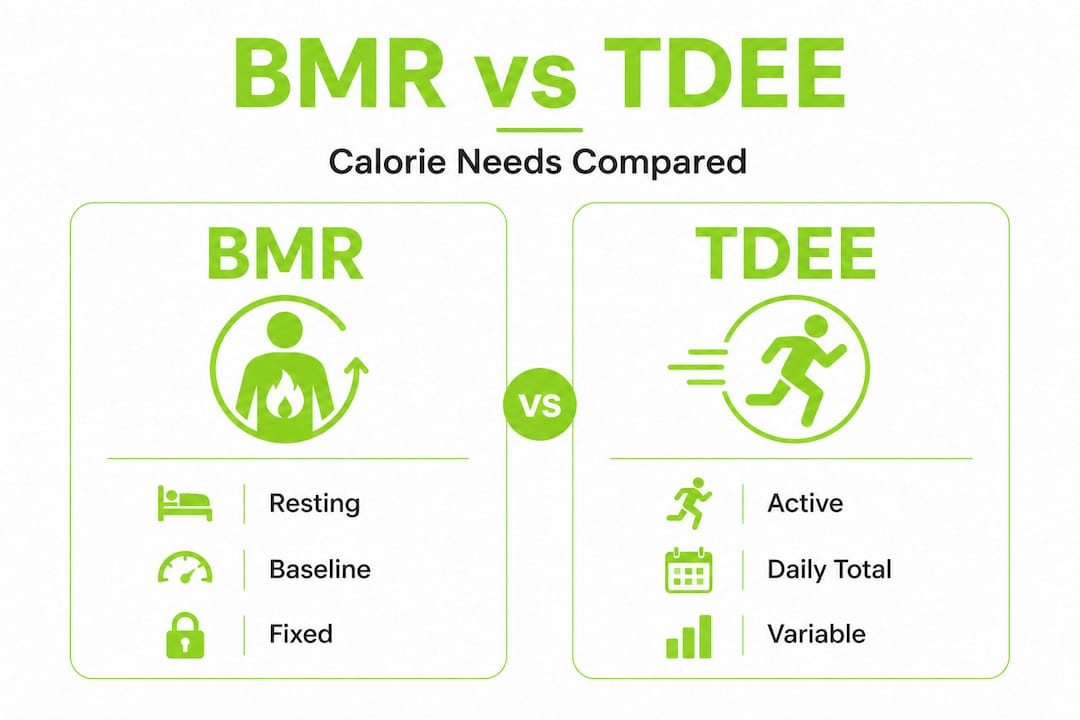
The most damaging mistake in calorie planning is treating BMR as your daily calorie target. People who do this often eat 400 to 700 fewer calories than their body actually needs, which leads to fatigue, muscle loss, and slowed metabolism over time.
A second common error involves how BMR is calculated for individuals with obesity. Some equations like Harris-Benedict that use actual body weight will overestimate BMR in obesity, since excess fat mass doesn’t burn as many calories at rest as lean tissue does. In this scenario, the equation inflates the BMR number, leading to an overstated TDEE and ultimately a calorie target that’s higher than what the body actually needs.
Common mistakes to avoid:
- Using actual weight for BMR in obesity: This overstates metabolic rate. Use an adjusted body weight calculator or ideal body weight equations instead.
- Using BMR as your eating target: Always scale up to TDEE before subtracting for a deficit.
- Applying TDEE without accounting for overestimation: Add a small safety margin and track real results weekly.
- Ignoring body composition changes: As you lose fat or gain muscle, your BMR shifts, and your TDEE should be recalculated.
“Precision starts with understanding what each number actually represents. BMR tells you what the engine needs to idle. TDEE tells you what it needs to run.”
Choosing the right formula for your needs
Selecting the correct equation makes a measurable difference in accuracy. Here’s how the major formulas stack up and when each is most appropriate.
| Formula | Best for | Uses lean mass? |
|---|---|---|
| Mifflin-St Jeor | General population | No |
| Harris-Benedict (revised) | General population, historical use | No |
| Katch-McArdle | Lean athletes, bodybuilders | Yes |
| Cunningham | High-performance athletes | Yes |
Follow these steps to choose and apply the right formula:
- Assess your body composition. If you know your body fat percentage, you can use lean mass-based formulas. If not, a standard formula will work as a starting estimate.
- Identify your category. Are you a recreational exerciser, a competitive athlete, or someone with obesity? Each group has a preferred formula.
- For athletes: Use Katch-McArdle or Cunningham, since these rely on lean body mass and give more accurate results when muscle mass is above average. Evidence supports that athletes need lean mass formulas rather than weight-based equations.
- For obesity: Use ideal or adjusted body weight inputs in place of actual weight to avoid overestimation.
- Apply your TDEE multiplier after selecting the correct BMR equation.
If you’re in the athletic category, understanding BMI for athletes adds context, since standard BMI cutoffs don’t accurately reflect an athlete’s health profile. For step-by-step help on body composition, the guide on calculating lean body mass walks you through the process clearly. Those managing obesity should also explore adjusted body weight formulas to ensure a more accurate baseline.
The gold standard for measuring metabolic rate is indirect calorimetry, which measures actual oxygen consumption and carbon dioxide production to calculate real-time energy use. This method eliminates all guesswork. However, it requires specialized equipment and trained staff, making it impractical for everyday nutrition planning. For most people, a well-chosen prediction equation, combined with consistent tracking, provides a reliable working estimate.
How to apply BMR and TDEE for real-world goals
Having your BMR and TDEE numbers is only useful if you know what to do with them. Here’s how to translate those figures into a daily calorie target that actually serves your goals.
- Calculate your TDEE using the appropriate formula and activity multiplier for your profile.
- Set your goal-specific target:
- Weight loss: Subtract 300 to 500 calories from TDEE per day. This creates a moderate deficit that supports roughly 0.5 to 1 lb of fat loss per week without triggering significant muscle loss.
- Maintenance: Eat at TDEE.
- Muscle gain: Add 200 to 300 calories above TDEE to support muscle synthesis without excess fat gain.
- Track your intake for 2 weeks and compare against actual body weight and performance changes.
- Adjust based on real data. If weight isn’t moving as expected, recalculate and shift your target by 100 to 150 calories in either direction.
- Recalculate every 4 to 6 weeks as body composition shifts.
One practical caution: because BMR prediction equations overestimate actual metabolic rate by 115 or more kcal in athletic populations, the TDEE derived from these equations may also be slightly inflated. Starting with a modest deficit and adjusting based on results protects against this error.
Pro Tip: Don’t change multiple variables at once. Adjust calories or activity, but not both at the same time. This way, you’ll know exactly what’s driving changes in your results.
For a full breakdown of how to structure your daily intake around these numbers, the guide on calculate calorie intake walks through macro distribution, meal timing, and practical examples.
Why most people get BMR versus TDEE wrong—and what to do instead
Most calorie planning mistakes aren’t formula errors. They’re behavioral ones. People trust a calculator result as a permanent truth rather than a working estimate that needs testing and adjustment.
A BMR or TDEE number from an equation is a statistical average applied to your specific inputs. It doesn’t know about your sleep quality, your stress levels, your thyroid function, or how your body specifically responds to a deficit. Two people with identical height, weight, age, and activity levels can have measurably different actual metabolic rates.
The persistent reliance on formulas without feedback loops is what leads to plateaus. The formula becomes the ceiling of understanding instead of the starting point it was always meant to be.
What actually works is tracking your results for two to three weeks, comparing your intake to outcomes, and making small, deliberate adjustments. This turns a generic equation into a personalized estimate. The formula gets you 80% of the way there. Your data gets you the rest. Understanding your lean body mass insights is part of this process, since muscle mass is the single biggest lever you can adjust over time to raise your metabolic floor.
Start with the math. But trust the mirror, the scale trend, and your energy levels more.
Personalized tools to perfect your calorie planning
Understanding BMR and TDEE gives you a strong framework, but applying it consistently and accurately is where many people need support. Dietium offers an integrated set of tools designed to take the guesswork out of your nutrition strategy. Whether you’re building a fat loss plan, optimizing macros for muscle gain, or simply trying to eat in a way that matches your daily activity, the platform’s calculators and meal planning features adapt to your data. Explore options to personalize your diet for goal-driven outcomes, or browse health calculators for wellness to track all your key body metrics in one place. For a structured, customized approach to eating, meal plan personalization connects your calorie targets to real, practical recipes and routines.
Frequently asked questions
What is the main difference between BMR and TDEE?
BMR is your basic daily calorie burn at rest, while TDEE includes all your activity and represents your total daily calorie needs. You should always use TDEE, not BMR, as your daily planning target.
Which is better for weight loss: using BMR or TDEE?
TDEE is the right number for weight loss planning, since it reflects your true calorie use. Using BMR as a target typically means eating too little, which can lead to muscle loss and metabolic slowdown.
How accurate are BMR equations for athletes or obese individuals?
Standard equations often overpredict for both athletes and people with obesity. Research confirms that standard equations overpredict BMR by 115 or more kcal, so using lean mass-based formulas for athletes and adjusted weight inputs for obesity significantly improves accuracy.
Can my TDEE change over time?
Yes. As your weight, muscle mass, and physical activity levels shift, your TDEE changes along with them. Recalculating every 4 to 6 weeks during active dieting or training phases keeps your targets accurate.
What’s the gold standard for measuring calorie needs?
Indirect calorimetry is the most accurate method available, measuring real-time oxygen and carbon dioxide exchange to determine actual energy use. Research confirms it as the gold standard for measurement, though it remains impractical outside clinical or research settings.


