 Skip to content

How to break bad habits starting today
Breaking bad habits works best when you treat them as brain patterns to redirect, not character flaws to overcome. The most effective approach combines three actions: identify the cue triggering the behavior, replace the routine with something that delivers the same reward, and disrupt the environment that makes the old behavior automatic. Here is what that looks like in practice:
- Identify your cues. Note the time, location, people around you, and your emotional state every time the urge hits. Patterns emerge faster than most people expect.
- Replace, don’t just stop. Pair every bad habit with a substitute that satisfies the same underlying need. Quitting cold rarely works because the brain still craves the reward.
- Modify your environment. Move the trigger out of reach. If late-night snacking is the problem, keep chips off the counter entirely.
- Set incremental goals. Aim for small, measurable shifts rather than overnight transformation. Micro-steps build momentum without triggering the frustration that causes relapse.
- Track your progress. A simple journal or habit tracking app keeps patterns visible and accountability real.
- Choose a support person. Pick someone who will encourage without micromanaging. Guilt from a support person accelerates relapse; encouragement sustains change.
- Prepare for discomfort. Early habit change feels uncomfortable by design. That sensation is your brain adapting, not a signal to quit.
Table of Contents
- Why your brain makes bad habits so hard to quit
- How to identify and track the triggers sustaining your bad habits
- Why replacing a bad habit beats trying to eliminate it
- How to handle setbacks and stay motivated when change feels hard
- What research and experts say about making habit change stick
- Key takeaways to successfully break bad habits
Why your brain makes bad habits so hard to quit
The difficulty of breaking bad habits is not a willpower problem. It is a structural one. The basal ganglia, a cluster of structures deep in the brain, acts as an autopilot for learned routines. Once a behavior becomes habitual, the basal ganglia encodes it as an efficient, automatic sequence that runs with minimal conscious input. That efficiency is exactly what makes habits so hard to disrupt.
Dopamine plays a central role here. The brain releases dopamine not just during pleasurable activities but in anticipation of them. Over time, the cue alone triggers a dopamine spike, which is why the urge to check your phone or reach for a snack can feel almost involuntary. Dr. Luana Marques, associate professor of psychology at Harvard Medical School, notes that when people try to break a habit, the brain’s limbic system activates a fight-or-flight response, pushing them back toward the familiar behavior as a form of self-protection.
Self-talk also shapes the process. Negative internal dialogue after a slip, “I have no discipline,” “I always fail at this,” reinforces the neural pathway of the old habit. Reframing those thoughts as data rather than verdicts is a concrete skill, not just positive thinking.
How to identify and track the triggers sustaining your bad habits
Triggers are the starting point of every habit loop, and most people never examine them closely. Tracking yours over several days gives you the data to intervene before the automatic response kicks in.
Step-by-step trigger tracking:
- Record each urge as it happens. Note the time, location, who is nearby, and what you are feeling. Do this for at least five separate instances.
- Look for patterns. After five entries, review the cue patterns to find what consistently precedes the behavior.
- Rate your emotional temperature. On a scale of 1–10, note your stress or anxiety level at the moment of the urge. High emotional temperature often predicts stronger urges.
- Test your hypothesis. Once you suspect a trigger, deliberately change one variable (location, time, or company) and observe whether the urge weakens.
- Use the data to anticipate. If stress at 3:00 PM reliably triggers snacking, plan an alternative activity for that window before it arrives.
| Trigger type | Common example | Intervention |
|---|---|---|
| Time-based | Craving sweets after dinner | Schedule a walk or herbal tea at that time |
| Location-based | Smoking outside the office | Change your break location |
| Emotional | Stress eating after work calls | Practice box breathing before the call ends |
| Social | Drinking more when with certain friends | Plan an activity that does not center on alcohol |
| Sensory | Nail biting when watching TV | Keep a fidget tool nearby during screen time |
Journaling is the most accessible tracking method, but dedicated habit tracking tools can automate pattern recognition and surface trends you might miss manually.

Why replacing a bad habit beats trying to eliminate it
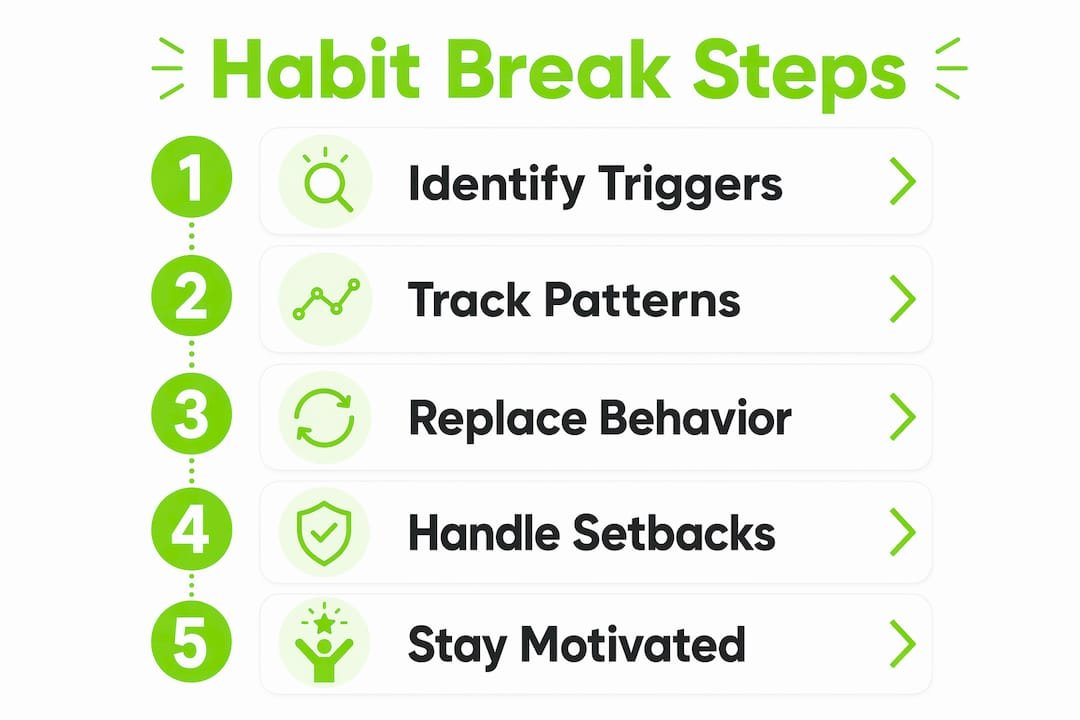
Stopping a behavior cold leaves the brain without a routine to run in that neural slot, and the basal ganglia will push back. Replacement fills that slot with something new. The brain’s craving for the reward does not disappear when you stop the behavior; it redirects. Give it somewhere productive to go.
The key is matching the replacement to the reward type the bad habit was delivering:
- Stress relief: Nail biting, skin picking, and similar habits often soothe anxiety. A fidget toy, slow breathing, or a brief walk can satisfy the same need without the physical cost.
- Sensory stimulation: Cravings for crunchy or sweet foods respond well to healthy food swaps that hit similar sensory notes, like raw almonds instead of chips.
- Social connection: Habits tied to social settings (smoking breaks, after-work drinks) often fill a need for belonging. Replacing the activity while keeping the social context preserves the reward.
- Boredom relief: Mindless scrolling or snacking during downtime responds to any engaging substitute, a short workout, a podcast, or a hobby.
Simplify the replacement behavior as much as possible. The easier it is to perform, the more likely the brain adopts it as the new default. Dr. Collier’s advice applies directly here: “You don’t have to aim for perfect, but just a little bit healthier.”
Pro Tip: Place your replacement behavior where the trigger occurs. If you snack at your desk, put a bowl of cut fruit there instead of removing all food. Friction reduction for the new habit matters as much as friction increase for the old one. Building healthy habits naturally often comes down to making the right choice the easy choice.

How to handle setbacks and stay motivated when change feels hard
Setbacks are not failures. They are a predictable part of how the brain rewires itself. Discomfort during early habit change signals that old neural circuits are being challenged, not that you are doing something wrong. Psychotherapists consistently frame this sensation as evidence of progress, not weakness.
“Everyone has distorted thoughts all the time. It’s what you do with them.” — Dr. Luana Marques, Harvard Medical School
The all-or-nothing mindset is the most common reason people abandon habit change after a single slip. One missed day or one lapse does not reset your progress. The neural pathways you have been building remain. What matters is returning to the new routine quickly, without extended self-criticism.
Practical tools for riding out urges:
- Set a timer for 20 minutes. Urges peak and then fade. Most intense cravings pass within that window if you do not act on them.
- Use sensory distraction. Holding an ice cube or stepping outside to feel the air shifts your brain’s focus from the craving to a competing physical sensation.
- Take a third-person perspective. Ask how you would respond to a friend who slipped once. Apply that same standard to yourself.
- Lean on your support person. The most effective accountability partners encourage without guilt, acting as sideline coaches rather than monitors.
Micro-steps accumulate faster than most people realize. Shifting a behavior by small increments, like moving bedtime back 15 minutes at a time rather than two hours at once, builds consistent wins and avoids the frustration that triggers relapse.
What research and experts say about making habit change stick
The science of habit change points to several specific techniques that outperform general willpower-based approaches.
The basal ganglia’s role in encoding automatic behaviors means that rewiring a habit requires repetition of the new routine in the same context as the old one. Frequency in the original environment is what builds the new neural pathway. James Clear, author of Atomic Habits, frames this as identity-based change: each repetition of the new behavior is a vote for the person you are becoming, not just a task completed.
NIH research on behavior change emphasizes that motivation tied to personal values, being present for family, improving long-term health, sustains effort better than abstract goals. Harvard Health guidance reinforces this: before attempting to change a habit, identify the personal reason behind the goal and return to it during difficult moments.
“You can’t prepare for life. Life is going to throw things at you.” — Dr. Stephanie Collier, McLean Hospital / Harvard Medical School
Specific expert-backed techniques worth applying:
- The 20-minute rule: When an urge hits, set a timer and commit to waiting. Most urges fade before the timer ends.
- Sensory manipulation: Cold water, ice cubes, or a hot shower introduce competing physiological signals that shift the brain away from craving. Cold water immersion can slow heart rate and interrupt the craving cycle.
- Emotional thermometer: Rate your emotional state on a 1–10 scale before acting on an urge. High scores predict impulsive behavior; awareness alone reduces reactivity.
- Environment redesign: Remove cues from your physical space wherever possible. Changing your route to avoid a bakery is more reliable than relying on in-the-moment resistance.
For habits tied to nutrition and physical health, tools like Dietium’s personalized meal planning can structure the replacement behavior, making healthy alternatives the default rather than the exception. Oral health habits follow the same replacement logic; building a natural oral care routine replaces harmful patterns with consistent, low-effort alternatives that the brain can automate over time.
Key takeaways to successfully break bad habits
Sustained habit change requires understanding your brain’s autopilot system, replacing old routines rather than simply stopping them, and building the self-compassion to recover from setbacks without losing momentum.
| Point | Details |
|---|---|
| Identify triggers first | Track at least five urge instances, noting time, place, people, and emotional state to find cue patterns. |
| Replace, don’t just stop | Match the substitute behavior to the same reward type the old habit delivered to satisfy the brain’s craving. |
| Use the 20-minute rule | Most urges fade within 20 minutes; setting a timer and waiting is one of the most effective urge management tools available. |
| Micro-steps prevent relapse | Gradual, incremental behavior shifts build wins and avoid the frustration that causes people to abandon change entirely. |
| Self-compassion sustains progress | Treating setbacks as part of the process, not proof of failure, keeps neural pathway rewiring on track. |


