 Skip to content

Spending long days indoors under artificial lights becomes routine for many European professionals, especially during winter. This makes maintaining strong bones and a resilient immune system much harder than most realize. Vitamin D operates as both a nutrient and hormone, directly supporting bone health, muscle function, and immune defense. Discover why misconceptions about sunlight, diet, and the differences between vitamin D2 and D3 could impact your wellness, and learn smart strategies for keeping your vitamin D levels optimized while balancing a busy lifestyle.
Table of Contents
- Vitamin D Defined And Common Misconceptions
- Essential Roles For Immunity And Bone Health
- Major Dietary Sources And Sunlight Impact
- Risks Of Deficiency And Health Consequences
- Optimal Levels, Testing, And Supplementation
Key Takeaways
| Point | Details |
|---|---|
| Vitamin D Importance | Vitamin D is crucial for bone health, immune function, and muscle performance, requiring both sunlight and dietary sources to maintain adequate levels. |
| Deficiency Risks | Even in sunny regions, factors such as geography, skin tone, and lifestyle can lead to vitamin D deficiency, which often goes unnoticed until serious health issues arise. |
| Testing Recommendation | Regular testing for vitamin D levels is essential, particularly for those at higher risk, allowing for informed dietary and supplementation strategies. |
| Supplementation Guidelines | Aim for 600 to 800 IU daily for prevention, with higher doses necessary for those with identified deficiencies; excessive supplementation can lead to health complications. |
Vitamin D Defined and Common Misconceptions
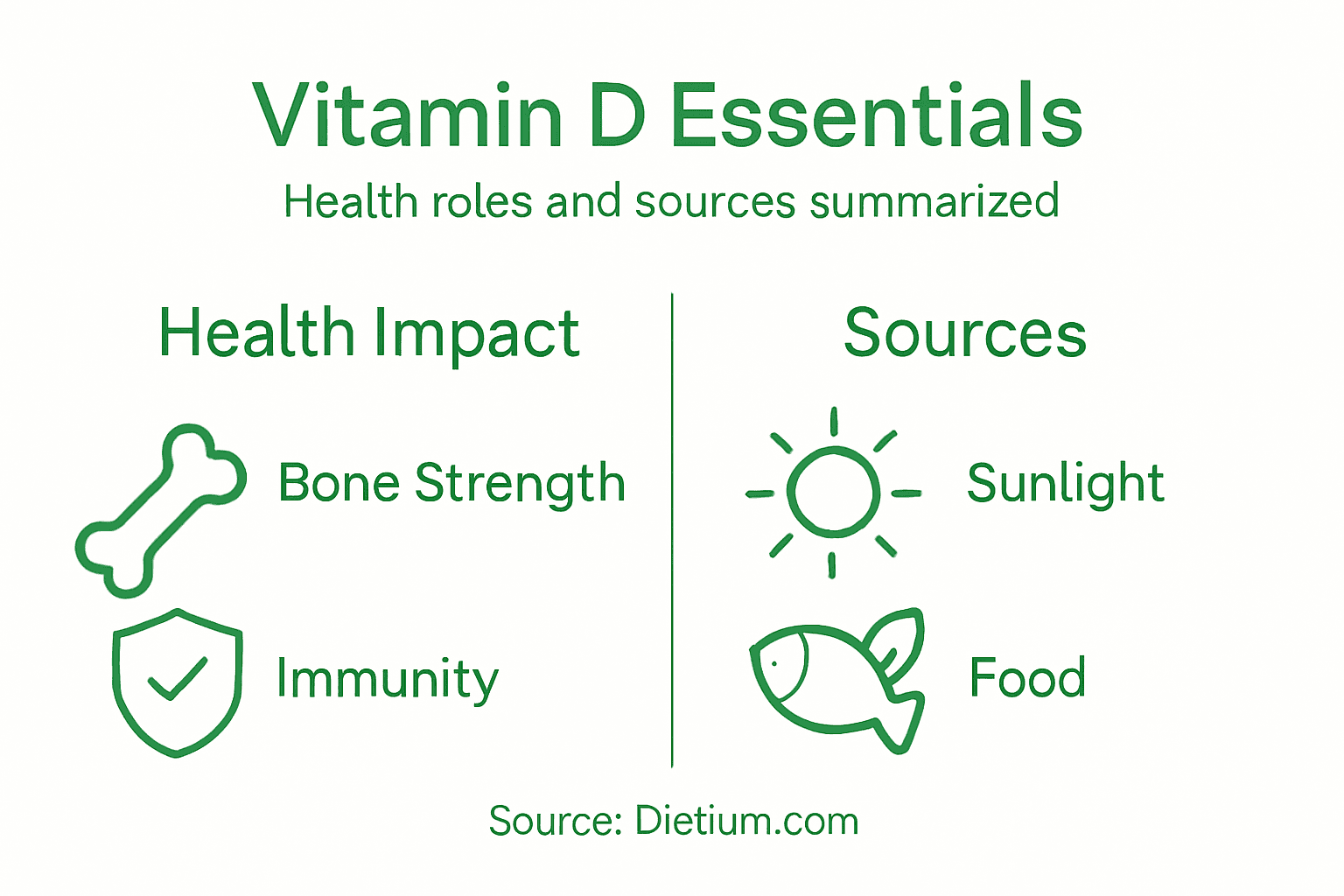
Vitamin D operates as both a nutrient and hormone, making it one of the most multifunctional compounds your body relies on. Unlike most vitamins your body cannot synthesize from food alone, vitamin D requires either sunlight exposure or dietary intake to meet your needs. The primary role you hear about most often involves calcium absorption and bone health, but that’s only part of the story. Vitamin D also regulates muscle function, supports nerve signaling, and strengthens your immune response. For European professionals working indoors during winter months, understanding what vitamin D actually does becomes increasingly critical to maintaining performance and long-term wellness.
The confusion around vitamin D starts with its origins. Your skin produces vitamin D when exposed to UVB rays from sunlight, which is why it earned the nickname “sunshine vitamin.” However, this name creates a dangerous misconception that sunlight exposure alone will always provide sufficient levels. Geographic location, skin tone, age, season, and even the angle of the sun significantly affect how much vitamin D your body synthesizes. Someone living in Scandinavia in December produces dramatically less vitamin D than someone in the Mediterranean during summer. Additionally, the protective measures you likely use daily (sunscreen, protective clothing, time spent indoors) reduce UVB penetration to your skin. The reality is that vitamin D deficiency affects populations worldwide, even in regions with seemingly abundant sunshine. This means relying solely on natural synthesis without monitoring your levels is a gamble with your health.
Another widespread misconception concerns the different forms of vitamin D. You may have heard vitamin D2 (ergocalciferol) and D3 (cholecalciferol) described as completely different substances requiring specific supplementation. This distinction matters less than most people believe. Your body processes both forms similarly, converting them through the same metabolic pathways to produce the active hormone your cells actually use. Whether you obtain D2 from fortified plant-based foods or D3 from animal products or supplements, the end result in your bloodstream functions identically. What matters far more is achieving adequate total vitamin D levels, regardless of source. Natural food sources remain surprisingly limited. Few foods naturally contain meaningful amounts of vitamin D—fatty fish like salmon and mackerel are the exceptions, along with egg yolks and mushrooms exposed to sunlight. Most vitamin D in your diet comes from fortified foods: milk, cereals, orange juice, and yogurt. For health-conscious professionals managing specific fitness and nutrition goals, calculating your daily vitamin requirements reveals whether your current intake matches your actual needs based on age, gender, and activity level.
Pro tip: Request a 25-hydroxyvitamin D blood test during your next health checkup to determine your actual levels (measured in ng/mL), then adjust your sunlight exposure, dietary intake, and supplementation based on results rather than assumptions about your status.
Essential Roles for Immunity and Bone Health
Your bones are not static structures that remain the same throughout your life. They constantly rebuild themselves, breaking down old bone tissue and forming new bone in a process that requires precise coordination of multiple nutrients. Vitamin D stands as the master regulator of this process, working with calcium and phosphorus to mineralize bone matrix and maintain skeletal strength. Without adequate vitamin D, your body cannot absorb calcium efficiently, regardless of how much dairy or fortified foods you consume. This explains why populations with limited sunlight exposure often develop weakened bones despite consuming sufficient calcium. For professionals in your age group entering the years when bone density naturally begins declining, maintaining optimal vitamin D becomes not just beneficial but preventive. Low vitamin D contributes to both osteomalacia in adults and rickets in children, conditions marked by soft bones, muscle weakness, and increased fracture risk. Regular resistance training combined with adequate vitamin D levels creates a powerful synergy for maintaining bone density and preventing age-related degeneration.
The immune system benefits from vitamin D in ways that go far beyond fighting common colds. Vitamin D receptors exist on nearly every immune cell type in your body, allowing this nutrient to modulate inflammatory responses and coordinate immune defense mechanisms. This regulatory role makes vitamin D particularly important for managing autoimmune conditions, where your immune system incorrectly attacks your own tissues. Research demonstrates that vitamin D influences autoimmune disease susceptibility, with particularly strong evidence for conditions like multiple sclerosis. Your immune system also depends on vitamin D for producing antimicrobial peptides that directly kill pathogens and for coordinating the inflammatory cascade needed to fight infections without causing excessive damage to healthy tissue. During winter months when respiratory infections peak in Europe, vitamin D deficiency leaves your immune system less equipped to mount an effective response. The connection between vitamin D status and infection risk explains why supplementation studies show reduced illness rates, particularly in populations with deficiency. Someone with optimal vitamin D levels does not necessarily avoid illness, but their immune system responds more efficiently when exposed to pathogens.
The practical impact of these two roles converges in your everyday life and fitness performance. Strong bones support the heavy resistance training that builds muscle and bone density further, creating a positive feedback loop. An immune system functioning at full capacity means fewer missed training days due to illness and faster recovery between workouts. Additionally, vitamin D supports muscle fiber contraction and neuromuscular coordination, meaning its benefits extend directly to athletic performance and injury prevention. Athletes with inadequate vitamin D show increased injury rates and slower recovery times compared to properly supplemented peers. Supplementation with at least 800 IU daily demonstrates measurable reductions in falls and fractures among older adults, with some research suggesting higher doses produce better outcomes for those with deficiency. The combination of bone strengthening, immune regulation, and direct muscle support makes vitamin D one of the few nutrients worthy of proactive monitoring rather than passive assumption of adequacy.
Pro tip: Combine vitamin D supplementation with resistance training targeting major muscle groups at least twice weekly, as the mechanical stress from strength training amplifies bone mineralization stimulated by adequate vitamin D levels.
Major Dietary Sources and Sunlight Impact
Finding vitamin D through food alone presents a genuine challenge for most people, which explains why nutrition experts consistently point to multiple sources as the realistic solution. The reality is that few foods naturally contain meaningful amounts of vitamin D, creating what nutritionists call the “vitamin D paradox”: your body needs it, but nature provided it in very limited quantities in everyday foods. Fatty fish stand out as the clear winners here. Salmon delivers approximately 450 IU of vitamin D per 100-gram serving, while mackerel and tuna offer comparable amounts. Fish liver oils provide even higher concentrations, though most people find them unpalatable without supplementation. Egg yolks contain small amounts, and mushrooms exposed to sunlight develop vitamin D through the same UVB process your skin uses. However, consuming sufficient quantities of these foods daily to meet your vitamin D needs would create dietary imbalance in other nutrients and calories. This is why fortified foods have become the practical backbone of dietary vitamin D intake across Europe and North America. Milk, plant-based alternatives like oat and almond milk, many breakfast cereals, orange juice, and yogurt are fortified with vitamin D as a public health measure. When you purchase fortified products at your grocery store, you’re benefiting from decades of research showing this approach effectively prevents deficiency at the population level. For professionals managing nutrient-dense food choices as part of a comprehensive nutrition strategy, combining natural sources with fortified foods creates a practical, sustainable approach.
Sunlight remains your body’s primary source of vitamin D production, yet its reliability varies dramatically based on where you live and how you spend your time. Your skin synthesizes vitamin D when exposed to UVB radiation from the sun, but this process depends on multiple factors that many people underestimate. Skin pigmentation significantly affects synthesis rates, with darker skin tones synthesizing roughly 3 to 6 times less vitamin D from identical sunlight exposure compared to lighter skin. This biological difference, while rarely discussed openly, means that recommendations designed for lighter-skinned populations often prove inadequate for people with darker skin tones. Geographic latitude creates another major barrier. Someone in Stockholm receives meaningful UVB radiation from sunlight only during the summer months, while someone in southern Spain can produce vitamin D year-round. The angle of the sun matters tremendously. During winter in northern Europe, the sun sits so low on the horizon that UVB radiation cannot penetrate the atmosphere effectively, effectively stopping vitamin D production entirely for several months. Your daily habits further reduce synthesis. Sunscreen, protective clothing, spending 8 hours daily indoors at an office, and using sunglasses all reduce UVB exposure to your skin. A professional working in an office building from 9 AM to 5 PM, even in sunny locations, receives minimal vitamin D synthesis. Age compounds the problem. Older adults synthesize vitamin D less efficiently from sunlight than younger people. The practical result is that relying on sunlight alone, even in Mediterranean locations, leaves many people with deficient levels, particularly during winter months.

Understanding these limitations transforms how you approach vitamin D adequately. Sunlight exposure remains valuable and should be pursued when feasible, but treating it as your sole source nearly guarantees deficiency during winter and for indoor workers year-round. A realistic strategy acknowledges that you likely cannot obtain sufficient vitamin D from sunlight alone and incorporates dietary sources and supplementation as backup systems. Spend 10 to 30 minutes in midday sun several times weekly without sunscreen when conditions allow, as this supports both vitamin D production and other health benefits. Include fatty fish in your diet at least twice weekly. Choose fortified food options when shopping for staple items. Most critically, test your vitamin D blood levels during winter and adjust supplementation based on actual data rather than geographic assumptions. Someone in Greece may still develop deficiency through sedentary lifestyle choices, while someone in Germany with deliberate supplementation maintains optimal levels. The interaction between these sources is what matters most. You cannot separate sunlight, diet, and supplementation into isolated strategies. Instead, view them as complementary components of a comprehensive approach tailored to your individual circumstances, geographic location, age, and lifestyle patterns.
Here’s a side-by-side comparison of vitamin D sources and their unique benefits:
| Source Type | Example Foods or Methods | Contribution to Vitamin D Status | Key Limitation |
|---|---|---|---|
| Sunlight Exposure | Midday sun (10-30 min/week) | Main source for most individuals | Varies by geography, skin, and season |
| Natural Foods | Salmon, mackerel, egg yolks, mushrooms | Supports intake, especially for diets with fish | Low vitamin D content in most foods |
| Fortified Foods | Milk, orange juice, cereals, yogurt | Helps meet daily requirements | Requires label checking, not all products fortified |
| Supplements | Vitamin D capsules/drops | Effective for deficiency prevention | Risk of over-supplementation |
Pro tip: Schedule your vitamin D blood test for late fall before winter begins, then adjust your supplementation dose if needed by early December to maintain optimal levels throughout the darkest months when sunlight synthesis reaches zero.
Risks of Deficiency and Health Consequences
Vitamin D deficiency creeps up quietly. You might feel nothing for months or even years while your bones gradually weaken and your immune system operates at reduced capacity. This silent progression makes deficiency particularly dangerous because most people never realize they have it until a fracture occurs or blood work reveals the problem. Deficiency directly impairs your body’s ability to absorb calcium and phosphorus, two minerals absolutely essential for bone structure and density. Without adequate vitamin D, calcium passes through your digestive system without being properly absorbed, forcing your body to steal calcium from your bones to maintain blood levels. Over time, this creates brittle bones susceptible to fractures from minor falls or impacts that would not normally cause injury. Osteomalacia in adults and rickets in children represent the severe end of this spectrum, characterized by soft bones, severe muscle weakness, and skeletal deformities. Even before reaching these clinical conditions, subclinical deficiency compromises bone density silently. For professionals in your age group, this matters tremendously. Bone density peaks around age 30, then gradually declines throughout life. Someone with optimal vitamin D maintains bone density better during this inevitable decline, while someone with chronic deficiency accelerates bone loss and fracture risk substantially. A 50-year-old woman with undiagnosed deficiency might fracture a wrist from a simple fall, while her deficiency-free peer experiences nothing but soreness from the identical impact.
Muscle weakness represents another major consequence that affects your daily life and fitness performance more directly than most people realize. Vitamin D receptors exist on muscle cells, and the hormone actively participates in muscle protein synthesis and calcium handling within muscle tissue. Deficiency weakens muscles in measurable ways that show up in strength testing and functional performance. You might notice difficulty climbing stairs, slower walking speed, or reduced ability to rise from a seated position without using your arms. For fitness enthusiasts, deficiency creates frustrating training plateaus where strength gains slow dramatically despite consistent effort. Recovery from workouts extends longer. Muscle soreness lingers. Athletic injuries increase in frequency. The connection between vitamin D and muscle dysfunction explains why athletes with suboptimal levels struggle with performance consistency compared to properly supplemented peers. Beyond musculoskeletal effects, emerging research suggests deficiency may increase susceptibility to infections and possibly contribute to autoimmune disease development, though these connections require more research for definitive understanding. The interaction is complex: deficiency compromises immune regulation, leaving you more vulnerable to respiratory infections, particularly during winter when both deficiency and infection risk peak simultaneously in northern latitudes.
The truly concerning aspect is how common deficiency remains despite increased awareness. Many people never have vitamin D levels checked, meaning deficiency goes entirely undiagnosed. You could be losing bone density and experiencing reduced immune function without any obvious symptoms alerting you to the problem. Certain populations face elevated risk: older adults synthesize less vitamin D from sunlight, people with limited sun exposure due to occupation or lifestyle, individuals with darker skin tones (who naturally synthesize less), and people with malabsorption issues affecting nutrient absorption. If you fall into any of these categories, deficiency is not a theoretical risk but a practical likelihood requiring proactive management. The consequences compound over decades. Someone who maintains borderline deficiency from age 35 to 65 experiences significant cumulative bone loss and increased fracture risk compared to someone with consistent optimal levels. Early detection and consistent management through dietary sources, supplementation, and safe sunlight exposure prevent these long-term consequences effectively. Testing remains the critical first step. Without knowing your actual vitamin D level, you cannot make informed decisions about supplementation needs. The cost of a single blood test is minimal compared to the expense and suffering associated with fractures, chronic pain, and functional decline resulting from untreated deficiency.
This reference table summarizes common risk factors for vitamin D deficiency and their impact levels:
| Risk Factor | Explanation | Impact on Deficiency Risk |
|---|---|---|
| Limited Sun Exposure | Indoor work, winter months | High |
| Darker Skin Tone | Reduced synthesis from UVB | Moderate to High |
| Age Over 50 | Lower skin production efficiency | Moderate |
| Malabsorption Issues | Digestive disorders or surgeries | High |
| Dietary Restriction | Plant-based without fortified foods | Moderate |
Pro tip: Request your vitamin D blood test results in numerical form (measured in ng/mL), then track the number over time rather than just accepting “normal” or “adequate” labels, as this data guides precise supplementation adjustments for your individual needs.
Optimal Levels, Testing, and Supplementation
Determining your optimal vitamin D level requires understanding what the research actually shows versus what popular wellness culture claims. Blood tests measure 25-hydroxyvitamin D, the form your body uses to assess vitamin D status. The interpretation of results depends on which medical organization you consult, as optimal ranges remain somewhat debated in the scientific community. Generally, levels below 20 ng/mL indicate deficiency, 20-29 ng/mL suggest insufficiency, and 30 ng/mL and above are considered adequate for most people. However, current guidelines emphasize that truly optimal levels and the precise intake amounts needed to achieve them remain uncertain. The 2024 Endocrine Society clinical practice guidelines reflect this uncertainty, noting that vitamin D supplementation recommendations for disease prevention vary based on individual risk factors rather than applying uniformly to all adults. This distinction matters. Someone living in northern Europe with limited sunlight exposure, darker skin tone, or age over 50 faces different optimization needs than a younger person in the Mediterranean with regular sunlight exposure. Rather than chasing a single number, think of vitamin D status as existing on a spectrum where your individual circumstances determine where you should aim on that spectrum.
Testing practices have shifted significantly in recent years based on evolving evidence. Routine vitamin D testing is no longer recommended for most healthy adults without specific risk factors. This might seem counterintuitive given the emphasis on vitamin D importance, but it reflects practical reality: testing everyone would be expensive, and most people in developed countries maintain adequate-to-sufficient levels through dietary sources and casual sunlight exposure. Testing becomes valuable when you fit into specific categories. If you have limited sunlight exposure due to geographic location or lifestyle, work indoors full-time, have darker skin tone, are older than 50, have malabsorption issues, follow a strictly plant-based diet without fortified foods, or have medical conditions affecting nutrient absorption, testing provides actionable information. The test itself is straightforward. Your healthcare provider orders a 25-hydroxyvitamin D blood test, results arrive within days, and you receive your level in ng/mL. The cost typically ranges from 30 to 100 euros depending on your location and healthcare system. If testing reveals insufficiency or deficiency, you now have concrete data guiding supplementation decisions rather than guessing.
Supplementation approaches have become more evidence-based and less aggressive than the megadosing trends that circulated years ago. Current guidelines suggest adults aim for 600 to 800 IU daily through fortified foods and supplements combined. This modest amount prevents deficiency for most people when combined with typical sunlight exposure and dietary sources. Higher doses may be appropriate for specific populations. Children benefit from supplementation to prevent rickets, particularly those with limited sunlight exposure. Older adults benefit from higher doses to maintain bone density and reduce fall risk. People with diagnosed deficiency or insufficiency require higher supplementation temporarily to raise levels back to adequate ranges. The distinction between prevention and treatment matters. Preventing deficiency in a generally healthy person requires 800 IU daily. Treating deficiency in someone with levels below 20 ng/mL might require 2000 to 4000 IU daily for several months until levels normalize. Over-supplementation poses risks. Excessive vitamin D accumulates in your body, potentially causing hypercalcemia, kidney problems, and other complications. More is not better. The goal is reaching adequacy, not maximizing levels. This is why testing before aggressive supplementation makes sense. You cannot determine whether you need supplementation or how much without knowing your actual starting level.
Pro tip: If testing reveals insufficiency, increase supplementation to 2000 IU daily for three months, then retest and adjust based on results rather than assuming higher doses indefinitely, as this data-driven approach prevents both deficiency and over-supplementation.
Take Control of Your Vitamin D Health with Personalized Nutrition Solutions
Feeling unsure about your vitamin D status and how it affects your bone strength, immune system, and fitness progress is common. The challenge is balancing sunlight exposure, limited natural food sources, and the right supplementation without guesswork. You want to avoid deficiency risks like weakened bones, muscle fatigue, and compromised immunity while optimizing your health through data-driven insights tailored just for you.
Dietium.com offers a comprehensive approach to conquer these vitamin D challenges. Use the advanced Vitamin Requirement Calculator to understand your personalized daily needs based on your lifestyle and goals. Combine this knowledge with custom meal planning through the Recipians app to seamlessly integrate vitamin D–rich foods and fortified options into your diet. With tools designed to track your nutrient intake and adjust your plan alongside your fitness routines, Dietium empowers you to take control of your vitamin D levels effectively.
Do not wait for symptoms or yearly checkups to dictate your health. Start today by visiting Dietium Recipians and unlock personalized strategies that keep you strong, energized, and protected all year round.
Frequently Asked Questions
What are the main functions of vitamin D in the body?
Vitamin D plays several critical roles, including regulating calcium absorption for bone health, supporting muscle function, aiding in nerve signaling, and enhancing the immune response.
How can I ensure I have adequate vitamin D levels?
To ensure adequate vitamin D levels, consider getting a 25-hydroxyvitamin D blood test to check your current levels. Aim for a combination of sunlight exposure, dietary intake of vitamin D-rich foods, and if necessary, supplementation based on your test results.
What are the risks of vitamin D deficiency?
Vitamin D deficiency can lead to weakened bones, increased fracture risk, muscle weakness, and may compromise immune function, making individuals more susceptible to infections and potentially contributing to autoimmune conditions.
How much vitamin D should I supplement if I have low levels?
If your test results indicate low vitamin D levels, it is generally recommended to increase your supplementation to 2000 IU daily for three months, then retest to adjust your dosage based on the new results.
Recommended
- Daily Vitamin Requirements Calculator for a Man & Women
- Connection Between BMI, DEXA Test & Bone Density – Dietium
- Vitamins vs Minerals: Complete Nutrient Breakdown – Dietium
- Understanding Micronutrients for Athletes: A Complete Guide – Dietium
- Hair Nutrition Food: Boosting Growth and Vitality | MyHair


