 Skip to content

Most American adults have calculated their BMI at least once, yet few realize what those numbers truly reveal. With over 40 percent of American adults now classified as obese, understanding how Body Mass Index works and its common misconceptions has never been more important. This guide unpacks what a healthy BMI really means, explains the surprising gaps in conventional wisdom, and highlights more accurate ways to assess personal health.
Table of Contents
- Healthy BMI Defined And Common Misconceptions
- BMI Calculation Methods And Key Classifications
- How BMI Reflects Health Risks And Benefits
- Limitations Of BMI And Alternative Measures
- Practical Use Of BMI In Personal Wellness
Key Takeaways
| Point | Details |
|---|---|
| BMI is a Quick Screening Tool | BMI helps assess weight categories and associated health risks but does not differentiate between muscle mass and fat mass. |
| Common Misconceptions Exist | A normal BMI does not guarantee good health; other factors like body composition and metabolic markers are crucial. |
| Limitations and Alternatives | BMI has shortcomings, and alternative methods like Body Adiposity Index (BAI) and Body Shape Index (ABSI) provide more nuanced assessments. |
| Holistic Health Evaluation is Important | Combining BMI with other health assessments leads to a better understanding of personal health and wellness strategies. |
Healthy BMI Defined and Common Misconceptions
Body Mass Index (BMI) is a standardized numerical measurement that helps assess potential weight categories and associated health risks. Understanding body composition through BMI provides insights into potential health implications, though it requires nuanced interpretation.
The National Heart, Lung, and Blood Institute defines BMI as a calculation derived by dividing an individual’s weight in kilograms by their height in meters squared. While this measurement offers a quick screening tool, it does not distinguish between muscle mass and fat mass, which can lead to potential misclassifications. Athletes or individuals with high muscle density might receive misleading results that suggest they are overweight when they are actually healthy.
Several common misconceptions surround BMI calculations. Many people mistakenly believe that a “normal” BMI automatically indicates good health. However, BMI vs Body Fat: Complete Guide to Key Differences reveals that this metric fails to account for critical factors such as muscle density, bone structure, fat distribution, and overall body composition. A person with a seemingly ideal BMI might still have underlying metabolic issues or unhealthy fat percentages.
To truly understand personal health, individuals should view BMI as just one of many assessment tools. Comprehensive health evaluations should incorporate multiple metrics, including body fat percentage, muscle mass, metabolic markers, and professional medical consultations. While BMI provides a useful initial screening, it should never be considered a definitive measure of an individual’s overall health and wellness.
BMI Calculation Methods and Key Classifications
Body Mass Index (BMI) is calculated through a straightforward mathematical formula that provides a standardized method of assessing body composition. Use the BMI calculator to determine your weight category by dividing your body weight in kilograms by the square of your height in meters. This simple calculation yields a numerical value that corresponds to specific health risk categories.
The National Heart, Lung, and Blood Institute establishes clear BMI classifications that help individuals understand their potential health risks. These standard categories include:
- Underweight: BMI below 18.5
- Normal weight: BMI between 18.5 and 24.9
- Overweight: BMI between 25.0 and 29.9
- Obesity: BMI of 30.0 and above
However, these classifications are not universal or absolute. The Food and Agriculture Organization emphasizes that BMI interpretations can vary significantly based on multiple factors such as age, sex, muscle mass, and ethnic background. For instance, athletes or individuals with high muscle density might receive misleading results that do not accurately reflect their overall health status. Professional healthcare providers often recommend combining BMI with additional health assessments like body fat percentage, waist circumference, and metabolic markers for a more comprehensive health evaluation.
How BMI Reflects Health Risks and Benefits
Body Mass Index serves as a critical screening tool that helps healthcare professionals identify potential health risks associated with weight. Understanding obesity beyond traditional metrics reveals that BMI provides insights into potential cardiovascular, metabolic, and systemic health challenges that individuals might face.
Research indicates that different BMI ranges correlate with varying health risks. Individuals with BMI categories in the overweight and obesity ranges typically experience higher probabilities of developing chronic conditions such as type 2 diabetes, heart disease, hypertension, and certain cancers. A high BMI can strain cardiovascular systems, increase inflammation markers, and potentially compromise metabolic functioning.

A global group of experts now proposes a more nuanced approach to assessing health risks. Redefining obesity diagnosis involves incorporating additional factors beyond simple height-to-weight ratios, including waist circumference, body composition, and direct health impact measurements. This comprehensive perspective acknowledges that BMI is a starting point, not a definitive health assessment. While BMI provides valuable initial insights, individual variations in muscle mass, bone density, and fat distribution mean that personalized medical evaluation remains crucial for truly understanding one’s health status.
Importantly, maintaining a healthy BMI is not just about avoiding negative health outcomes. Individuals within normal weight ranges often demonstrate better metabolic efficiency, improved energy levels, enhanced immune function, and reduced risk of chronic disease progression. By understanding BMI as a dynamic health indicator, people can make informed lifestyle choices that support long-term wellness and prevent potential health complications.
Limitations of BMI and Alternative Measures
BMI has significant shortcomings that make it an imperfect measure of individual health. Comparing metabolic assessment techniques reveals that this simple height-to-weight ratio fails to capture crucial nuances of body composition, muscle mass, and metabolic health.
Researchers have developed alternative methods to address BMI’s limitations. The Body Adiposity Index (BAI) offers a more sophisticated approach by estimating body fat percentage using hip circumference and height, without requiring direct weight measurement. This method can provide more accurate assessments for certain populations, particularly those with unique body compositions that traditional BMI calculations might misrepresent.
Another innovative approach is the Body Shape Index (ABSI), which incorporates waist circumference, height, and weight to provide a more comprehensive health risk assessment. By accounting for fat distribution, ABSI addresses a critical weakness in traditional BMI calculations. This method recognizes that where body fat is stored can be as important as the total amount of body fat, especially when evaluating risks for cardiovascular disease and metabolic disorders.
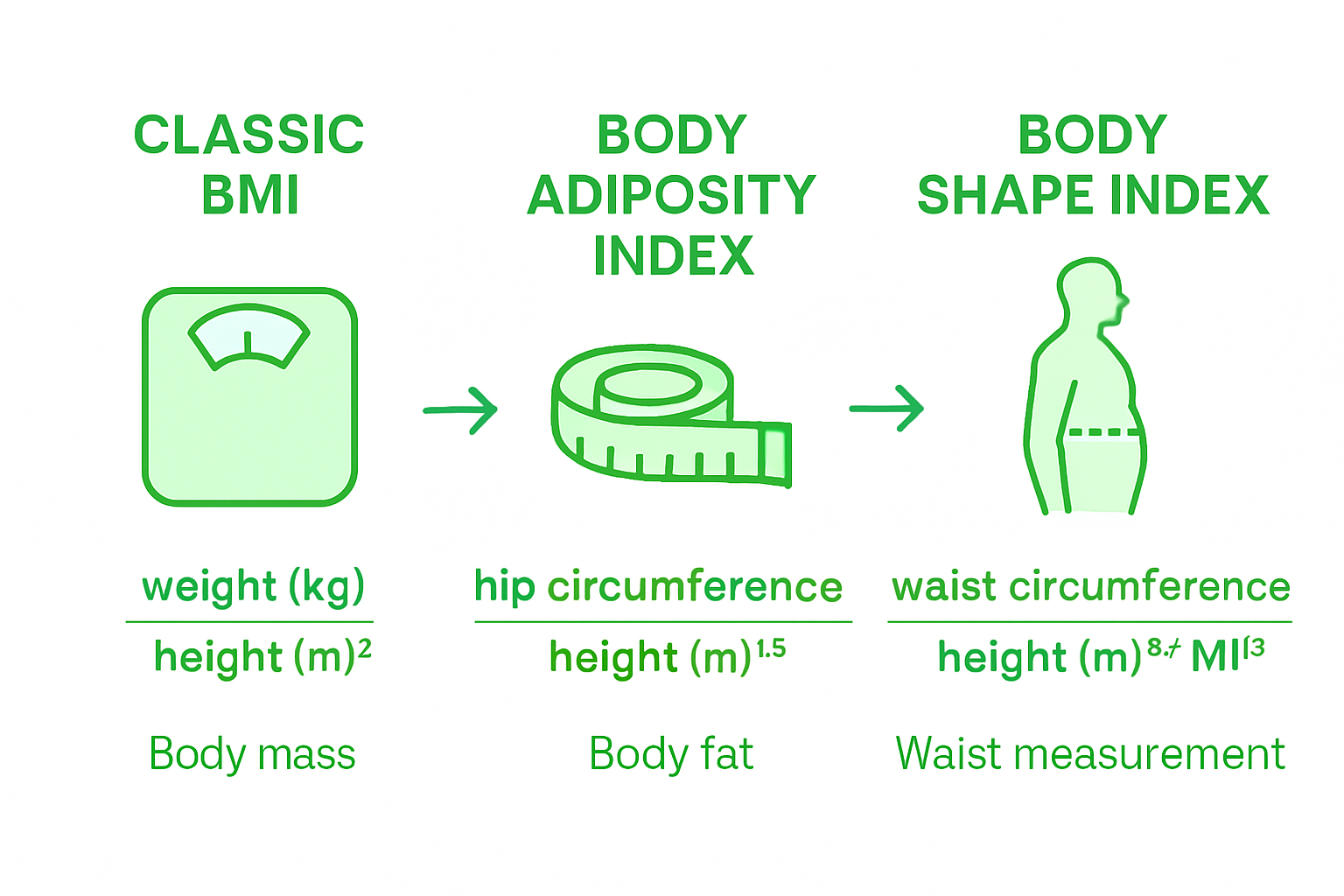
For individuals seeking a more comprehensive understanding of their health, multiple assessment methods provide a more holistic view. Healthcare professionals increasingly recommend combining various measurements such as waist-to-hip ratio, body fat percentage, muscle mass, and metabolic markers. These comprehensive approaches offer a more nuanced and accurate picture of an individual’s overall health status, moving beyond the limitations of a single, simplistic numerical index.
Practical Use of BMI in Personal Wellness
Understanding how to apply BMI effectively requires a nuanced approach to personal health management. Tracking fitness markers for athletes demonstrates that BMI should be viewed as one of many tools in comprehensive wellness strategies, not a definitive health diagnosis.
The National Heart, Lung, and Blood Institute recommends using BMI as an initial screening tool in clinical settings, providing a baseline for identifying potential weight-related health risks. This approach involves integrating BMI measurements with other critical health assessments such as waist circumference, diet analysis, physical activity levels, and overall medical history. Health professionals emphasize that BMI calculations can help individuals:
- Identify potential weight-related health risks
- Establish baseline health metrics
- Track long-term body composition changes
- Trigger more comprehensive health evaluations
Personal wellness strategies require a holistic perspective that goes beyond simple numerical measurements. While BMI offers valuable insights, it should not be the sole indicator of health status. Individuals should consider multiple factors including muscle mass, metabolic efficiency, dietary habits, and physical activity levels. Professional healthcare providers increasingly recommend a comprehensive approach that combines BMI with other diagnostic tools to create personalized wellness plans that address individual health needs and potential risk factors.
For those seeking to optimize their personal wellness, BMI serves as an initial compass, not the final destination. By understanding its limitations and using it as part of a broader health assessment strategy, individuals can make more informed decisions about their nutrition, exercise, and overall lifestyle choices.
Take Control of Your Health with Personalized BMI Insights
Understanding that BMI is just one part of your overall health picture can feel overwhelming. The article explains how factors like muscle mass and fat distribution affect your BMI results and why many traditional measurements can be misleading. If you have struggled with confusing BMI numbers or want to avoid common pitfalls in assessing your weight-related health risks you are not alone. Many seek a clearer, personalized approach that takes into account your unique body composition and lifestyle goals.
Dietium.com offers exactly this kind of tailored solution. With our advanced BMI calculator and the Recipians app you can track your BMI alongside other important metrics like body fat percentage and calorie needs. This ensures you get more than just numbers – you receive actionable insights and customized meal and fitness plans crafted to support your individual wellness journey. Do not wait to transform confusion into confidence by embracing a smarter way to manage your health. Start using Dietium’s tools today and take the first step toward a balanced, informed, and lasting healthy lifestyle.
Frequently Asked Questions
What is a healthy BMI?
A healthy Body Mass Index (BMI) typically ranges from 18.5 to 24.9. It is a screening tool that helps categorize individuals based on their weight relative to their height.
How is BMI calculated?
BMI is calculated by dividing an individual’s weight in kilograms by their height in meters squared. This formula provides a numerical value that corresponds to various health risk categories.
Why is BMI considered a useful health metric?
BMI serves as a quick screening tool to identify potential weight-related health risks, such as cardiovascular disease, type 2 diabetes, and hypertension, helping individuals understand their health status.
What are the limitations of using BMI?
While BMI provides valuable insights, it does not differentiate between muscle mass and fat mass, which can lead to misclassifications. Additionally, it fails to account for factors like age, sex, and body composition, so it’s important to use it alongside other assessments for a comprehensive health evaluation.


